
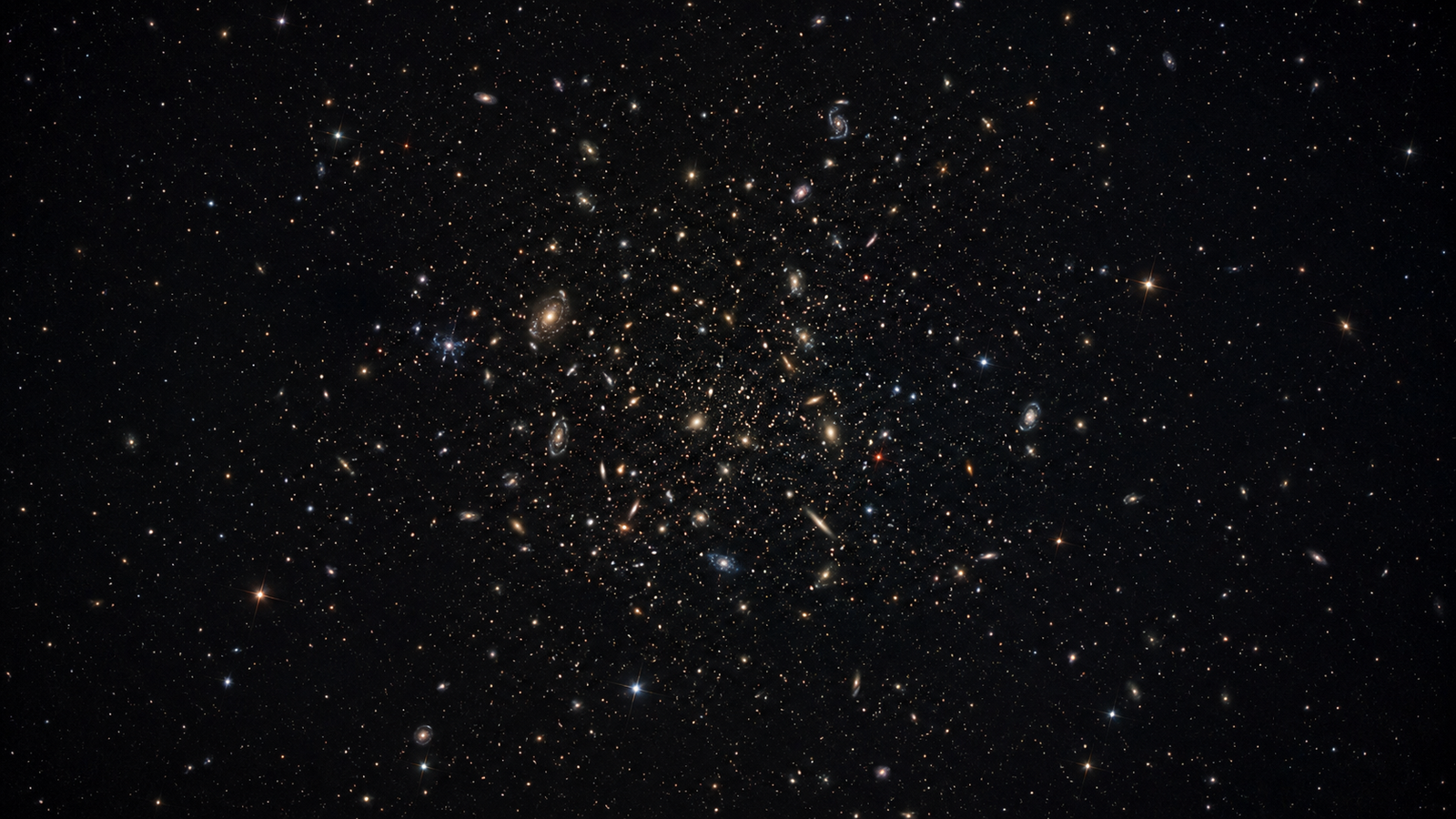
The observable universe is not the whole universe, and it does not end at a physical wall or edge. It is the region from which light and other signals have had time to reach us since the early universe. The boundary we keep hearing about is a limit on what we can see, not a boundary in space, and confusing the two is the source of nearly every misconception about what lies beyond.
What Is Outside the Observable Universe?
So what is outside the observable universe? Almost certainly more universe, just more of the same: galaxies, stars, empty space, following the same physical laws, stretching on for a far greater distance than we will ever be able to see, possibly without end. What is outside the observable universe is not a wall or an edge. It is simply more space that light has not yet had time to reach us from.
What Observable Actually Means
Light travels fast, about 300,000 kilometers per second in vacuum, but it is not instantaneous. The Sun we see now is the Sun as it was eight minutes ago. The Andromeda Galaxy appears to us as it was 2.5 million years in the past. Every distant observation is a look backward in time, because the photons reaching our telescopes tonight set out long ago.
The observable universe is the cumulative result of this delay. Every region of space from which a signal, light, gravitational waves, neutrinos, emitted since the hot early phase of the cosmos has had enough time, traveling at the speed of light, to arrive here and now. Anything inside that volume we can, in principle, detect. Anything outside it we cannot, at least not yet, because its signals are still in transit.
Notice what this definition does not say. It does not say the observable universe is everything that exists, nor that beyond its boundary lies emptiness. There is simply a sphere of visibility centered on whoever is observing, set by the age of the cosmos and the speed of light.
A Horizon Without an Edge
An edge is a feature of space itself, the place where a surface stops, like the rim of a table. A horizon is a feature of observation, the line beyond which our line of sight fails, like the limit of a lighthouse beam on a dark sea. The sea does not end at the edge of the beam. It continues out of view.
The observable universe has a horizon of this second kind. It marks the distance at which light, given the finite age of the cosmos, has not yet had time to reach us. The universe as a whole may or may not possess an edge. Nothing in our observations forces one upon it, and standard models generally assume there is none, either because space extends without bound or because it closes back on itself with no boundary. The limit we encounter is a limit on seeing, not a limit on being.
The limit we encounter is a limit on seeing, not a limit on being.
Why 13.8 Billion Years Gives a 46 Billion Light Year Radius
Here is a puzzle that trips up almost everyone. The universe is about 13.8 billion years old, as measured by NASA’s WMAP and ESA’s Planck missions through study of the cosmic microwave background. If nothing travels faster than light, the most distant thing we could see should be 13.8 billion light years away. So why do cosmologists quote the radius of the observable universe, how big it actually is, as roughly 46 billion light years?
Because space itself has not been sitting still while the light traveled.
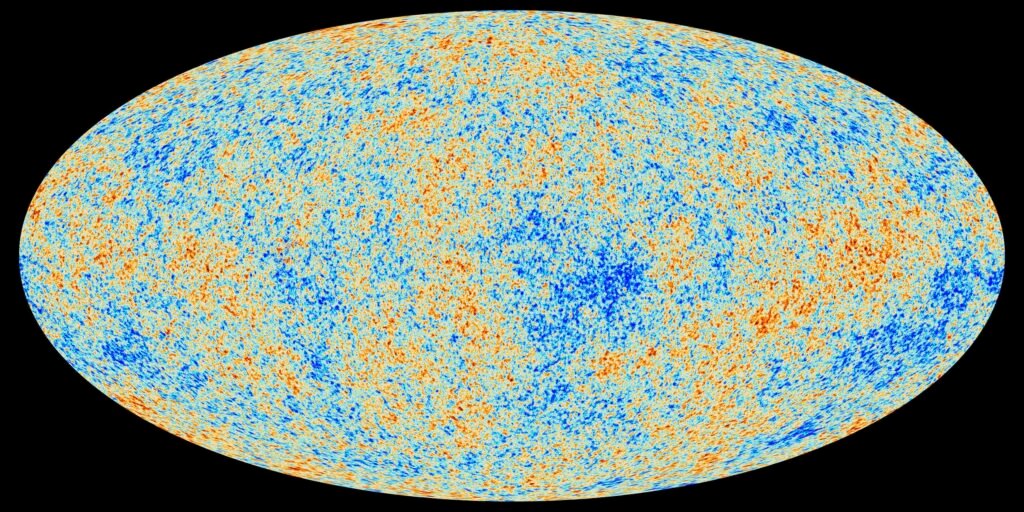
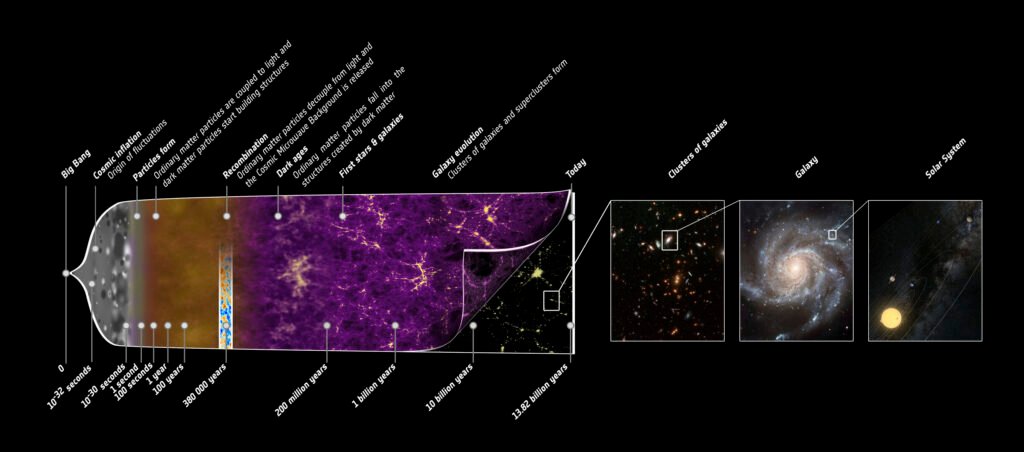
The light from the cosmic microwave background, the oldest signal we can detect, released when the universe became transparent about 380,000 years after the Big Bang, has been traveling toward us for nearly 13.8 billion years. But the region that emitted it has not waited in place. During all those years, the space between us and that region has been stretching, so the point that emitted the photons we detect today is now about 46 billion light years away.
This is comoving distance, measured along a slice of constant cosmic time with the stretching of space factored in. The light has traveled for 13.8 billion years. The place it came from has been carried much farther away by expansion during that journey. NASA’s Imagine the Universe resource gives the diameter of the observable universe as about 94 billion light years, simply twice this radius. Nothing here violates the speed of light limit, because that limit constrains how fast things move through space, not how fast the space between them expands.
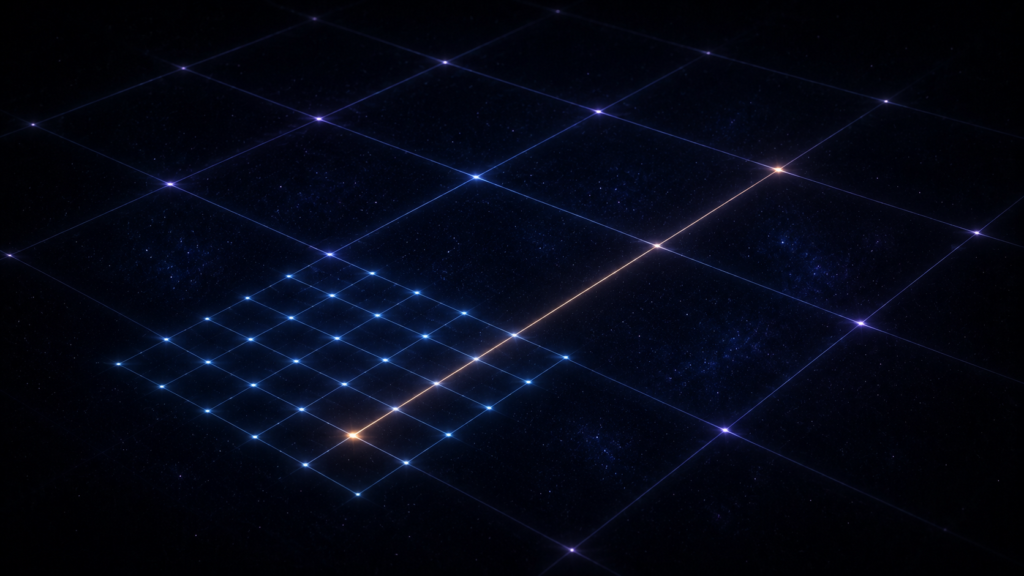
Light crossing an expanding grid. The dots do not slide across the squares. The squares themselves grow larger while the light is still on its way, which is why the light’s starting point ends up much farther off than a simple age times speed calculation would suggest.
Cosmic Expansion, Properly Understood
That last point deserves to be said plainly. The galaxies are not flying apart through empty space the way shrapnel scatters after an explosion. The Big Bang was not an explosion at a point. It was the hot, dense early state of all of space, not a region within space, but the entirety of space itself. Expansion is the stretching of the metric, the geometric fabric in which distances between galaxies at rest with respect to the cosmic flow increase over time. A common teaching image is an inflating balloon with dots on its surface, and it only works with an immediate qualifier: the dots are not sliding across the rubber, the rubber between them is growing. The balloon also suggests a surface floating in a larger room, which is the misconception to avoid, since there is no room the universe is expanding into.
A better picture is a coordinate grid on a rubber sheet, with galaxies at fixed grid points. Over time every square grows larger. The galaxies have not moved across the grid. The grid itself has enlarged, and every pair finds itself farther apart without either having traveled through the sheet. This is why two sufficiently distant galaxies can separate faster than light without either one moving through space faster than light. The rule simply does not apply to the stretching of space itself.
Regions Beyond Our Horizon
If the universe is everywhere the same kind of place on large scales, and the cosmic microwave background gives strong reason to think it is, there is no obvious reason for it to stop existing just where our horizon happens to fall. What lies beyond that limit is presumably much like what lies here, governed by the same physics.
We simply cannot see it. The reason is causal, not physical. Light from those regions has not had time to reach us since the beginning of the cosmos, and in some cases it never will, because expansion is carrying them away faster than new light emitted there can close the gap. The cosmic horizon, then, is not the edge of the universe but the edge of what we can observe. The cosmic microwave background, the most distant thing we can see in light, reaches us from every direction at the same effective distance, forming a luminous shell marking that limit. Beyond it, in all likelihood, lies more universe, not nothing and not a void, simply out of view, the way the far side of a hill is out of view from a valley.
The cosmic horizon is not the edge of the universe. It is the edge of what we can observe.
The Particle Horizon, in Plain Terms
Cosmologists give the boundary of the observable universe a name: the particle horizon.
The particle horizon is the maximum distance from which any signal, traveling at the speed of light since the beginning of the cosmos, could have reached us by now. That is the present day radius of our sphere of visibility, roughly 46 billion light years. Because the universe has a finite age, that horizon sits at a finite distance. Because space has been expanding while the light traveled, the distance is larger than a naive age times speed of light calculation would suggest.
There is a second horizon, pointing the opposite direction in time. The cosmic event horizon is the boundary of what we will ever be able to observe in the future, no matter how long we wait. In an accelerating universe driven by dark energy, some regions currently visible are sending light our way for the last time. Any signal they emit from now on will be carried away by expansion faster than it can travel toward us. This event horizon sits at roughly 16 billion light years, much closer than the particle horizon. It marks a slow closing of the cosmic window, a limit on how much of the future any observer can witness.
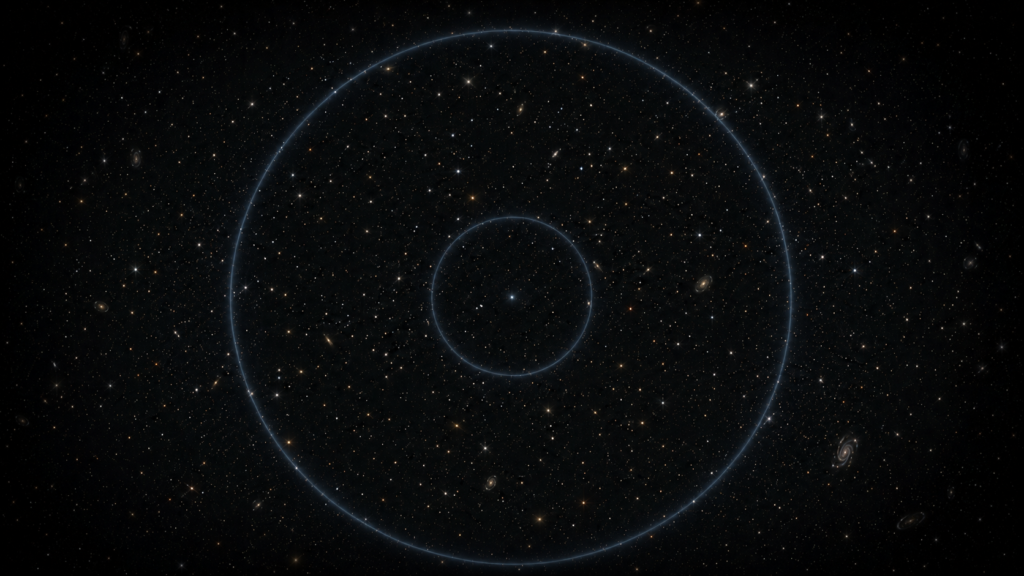
Two horizons around one observer. The inner ring marks how far we will ever manage to see in the future. The outer ring marks how far we can see right now. Past both, the universe most likely keeps going. Only our view runs out.
Is the Universe Infinite?
Cosmology is careful not to answer this too confidently. The honest position is that we do not know whether the universe is finite or infinite. Observations are consistent with both and do not yet distinguish between them. What we can say is that the part of the universe within our horizon appears, to high precision, to be spatially flat. Data from the Planck mission show that the geometry of space deviates from perfect flatness by less than a fraction of a percent. A perfectly flat universe, in the simplest models, extends without bound.
But flatness does not by itself prove infinity. A flat surface can be finite, as the surface of a cylinder demonstrates: no curvature, no edge, yet a finite area. The universe could be spatially flat and still wrap around on itself over a very large scale, so that traveling far enough in one direction returns you to your starting point. Measurements constrain any such wrapping to be larger than the portion we can observe, but they do not rule it out. The Planck results tell us the observable region is flat to remarkable precision. They do not tell us what happens on scales vastly larger than our horizon, where topology could do something unexpected.
Geometry Is Not Topology
This distinction is where popular accounts most often go astray.
Geometry describes the curvature of space at each point, whether the angles of a triangle add up to more than, less than, or exactly 180 degrees. Topology describes the global connectivity of space, whether, if you travel far enough in a straight line, you eventually come back to where you began.
A surface can be flat in geometry and finite in topology. It can also be curved and finite without an edge, like a sphere, where you can walk forever in any direction and never reach a boundary. The same holds in three dimensions: a universe with positive spatial curvature could be finite and edgeless, closing on itself the way a sphere does in two dimensions. What we can rule out, observationally, is a universe with a hard edge, something for which there is no evidence and no natural place in general relativity. We cannot, however, rule out a universe that is finite but unbounded, any more than one that is genuinely infinite.
So when cosmologists say the data favor a flat universe, they mean the local geometry is flat to the precision we can measure, not that the universe is infinite. That further step, from measured flatness to inferred infinity, is one the evidence does not yet support, and a careful scientist will not take it.
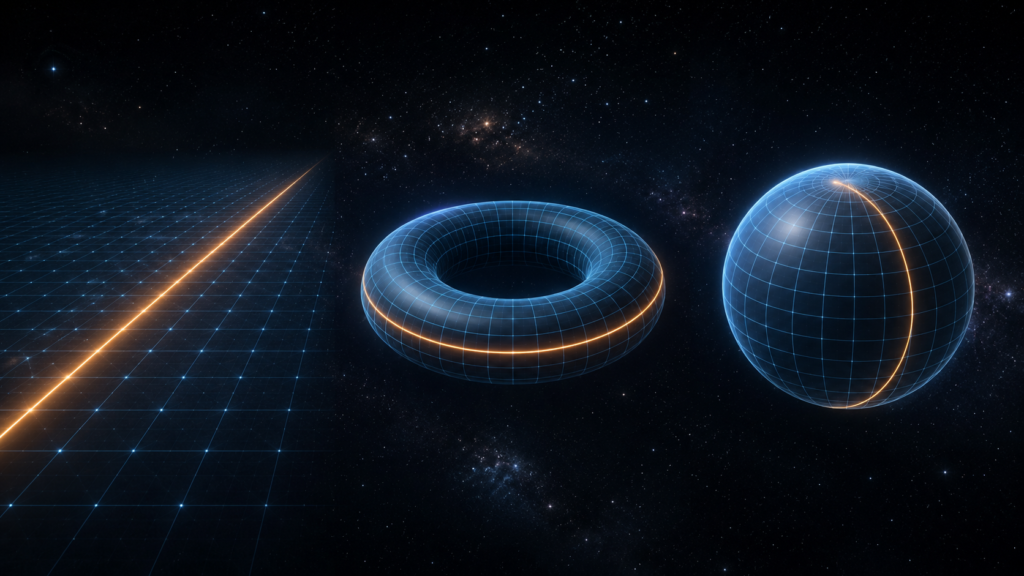
Geometry is not topology. A flat plane can run on forever. A torus is just as flat but finite, since a path around it eventually loops back to where it started. A sphere is curved and finite too, with no edge anywhere to be found.
Possibilities, Labeled as Such
What might lie beyond our horizon? A short list helps organize the honest uncertainty.
The universe could be vastly larger than the part we observe, perhaps many orders of magnitude larger, while remaining finite. In a 2019 discussion of the Planck results, cosmologist Joseph Silk suggested that if the topology of the universe could be measured, it might turn out to be as much as a hundred times the scale of our present horizon: enormous, but not infinite. This is inference, not measured fact.
It could be spatially flat and topologically connected in a repeating pattern, so that finite space folds back on itself across a scale too large for our horizon to reveal. Searches for such topological ghosts, repeating patterns in the cosmic microwave background, have so far found nothing, which limits the size of any repetition but does not eliminate it. It could have positive curvature and be finite and edgeless, a higher dimensional sphere closing on itself, with our measurements of near flatness reflecting curvature so slight over the region we can see. And, simplest of all, it could be exactly flat and genuinely infinite, extending without bound in every direction, with no repetition, no closure, no edge.
All four are consistent with current observations. None has been established over the others. To single out one as the answer would be to claim knowledge the data do not yet provide.
What We Know, What We Infer, and What We Cannot See
A few things about the observable universe are measured directly. The age of the universe, about 13.8 billion years, comes from the cosmic microwave background. The radius of the observable universe, roughly 46 billion light years, follows from that age combined with the measured expansion history. The spatial flatness of the observable region, confirmed to better than one percent, comes from Planck. The accelerating expansion comes from distant supernovae and other probes.
Other things are inferred rather than directly observed. The existence of regions beyond our particle horizon falls into this category. It rests on the cosmological principle, the well tested assumption that the universe is, on large scales, homogeneous and isotropic, so that what we see is representative of what we cannot.
And some things are genuinely unknown: whether the universe is finite or infinite, whether it has nontrivial topology on scales larger than we can observe, and whether it is flat in the strict mathematical sense or merely flat to the precision of our instruments.
Why This Matters
The cosmic microwave background, the expansion history, and the large scale structure of galaxies let cosmologists infer a great deal. But inference is not sight, and some regions may remain permanently beyond observation, carried away by an accelerating expansion that closes the window even as it widens the room. What lies beyond the observable universe is, in the end, a question with a strange answer: probably more of the same cosmos, governed by the same laws, and possibly, in some directions, a structure we will never measure. The boundary is not a wall but the limit of our own line of sight, drawn by the age of the cosmos and the speed of light, and it moves with whoever is doing the looking.
Key Takeaways
- The observable universe is a horizon set by the age of the cosmos and the speed of light, not a physical edge or wall.
- Its radius is about 46 billion light years even though the universe is 13.8 billion years old, because space has been expanding while the light traveled.
- Cosmic expansion stretches the space between galaxies rather than pushing them through pre existing space, which is why distant galaxies can recede faster than light without violating relativity.
- Regions beyond our horizon almost certainly exist and follow the same physics, but current observations cannot confirm what lies there.
- Data from the Planck mission show the observable universe is spatially flat to within a fraction of a percent, but flatness alone does not prove the universe is infinite.
- Whether the universe is finite or infinite, and whether it has unusual topology on scales larger than we can observe, remains genuinely unknown.
References
- NASA, Imagine the Universe, “The Farthest Visible Reaches of Space.”
- NASA, StarChild, “How old is the universe?”
- NASA Science, “Cosmic History.”
- NASA Science, “Discovering a Runaway Universe.”
- ESA Science and Technology, Planck mission, Joseph Silk interview on cosmic topology.
- ESA Science and Technology, Planck Publication Archive, cosmological parameters and spatial flatness.
- NASA Scientific Visualization Studio, “Oldest Light in the Universe.”
- Mukhanov, V., “Physical Foundations of Cosmology,” Caltech Astronomy course reading.
- Pettini, M., “Redshifts and Distances in Cosmology,” Institute of Astronomy, University of Cambridge.
Join the discussion
Comments are moderated and may take a little while to appear.