Ask cosmologists how fast the universe is expanding today and you will get two confident answers that cannot both be right, a disagreement now widely described as a cosmology crisis.
Measure the expansion locally, using stars and supernovae in relatively nearby galaxies, and you get a value close to 73 kilometres per second per megaparsec. Infer it from the infant universe, using the afterglow of the Big Bang, and you get about 67.4. Each camp claims a precision of around one percent. The gap between them is roughly eight percent, and it has refused to close for more than a decade.
This disagreement is called the Hubble tension, and it is the reason so many headlines now ask whether there is a cosmology crisis. The word crisis deserves care. Nobody disputes that the universe is expanding, and no serious researcher claims modern cosmology has collapsed. What the tension does suggest is one of two uncomfortable possibilities: either a subtle error is hiding inside some of the most carefully checked measurements in science, or the standard model of cosmology, the framework that has passed every other test for twenty five years, is missing an ingredient.
The Hubble tension is not a disagreement about whether the universe is expanding, but about precisely how fast it is expanding today.
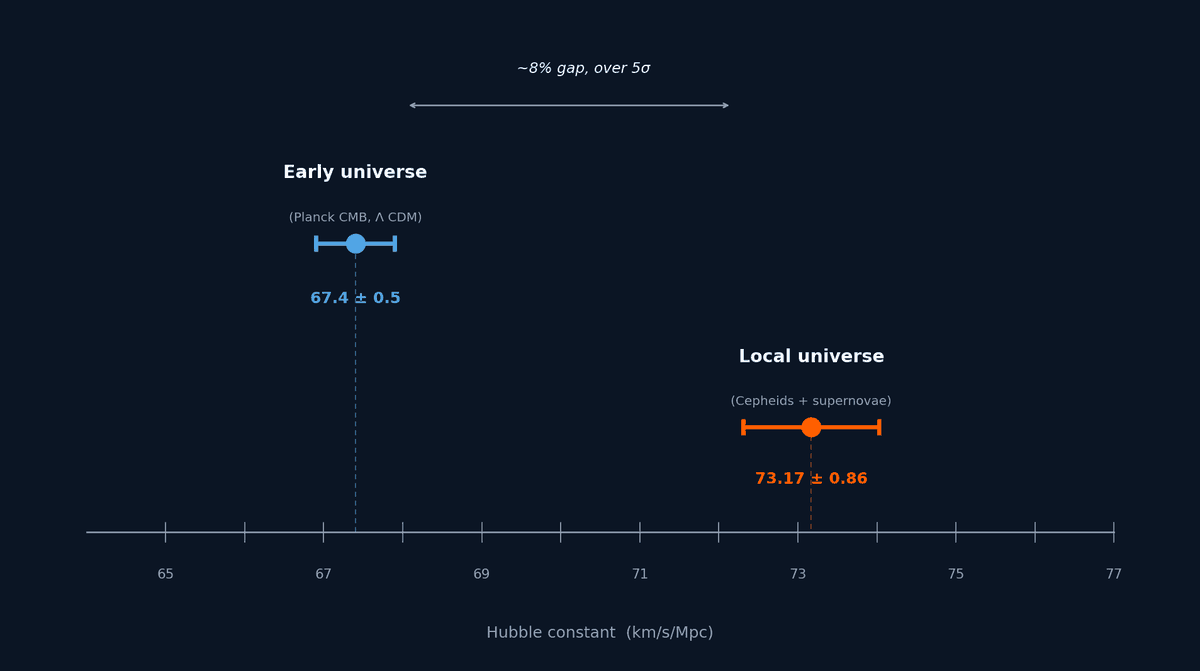
Illustration: Astrinova Editorial
What the Hubble Constant Actually Measures
The Hubble constant, written H0, describes the current expansion rate of the universe. Its awkward looking unit, kilometres per second per megaparsec, is easier to read than it appears. A megaparsec is about 3.26 million light years. A Hubble constant of 70 means that a galaxy 1 megaparsec away recedes from us at 70 kilometres per second, a galaxy 2 megaparsecs away at 140, and so on. Distance and recession speed rise together in a straight line.
One clarification matters before going further. Galaxies are not fragments flying through space away from a central explosion. Cosmic expansion is an increase in the scale of space itself between galaxies that are far enough apart not to be bound together by gravity. The Andromeda galaxy, gravitationally tied to our own, is actually approaching us. Expansion only wins over gravity across truly vast separations.
A second clarification: despite its name, the Hubble constant is not constant through cosmic history. The expansion rate has changed as the universe evolved, first slowing under gravity, then accelerating as dark energy came to dominate. H0 is simply the value of that changing rate today, which is exactly why measuring it at this one moment, from two different eras of cosmic history, makes for such a sharp test of our understanding.
The relationship itself dates to 1929, when Edwin Hubble compared distances to nearby galaxies with the stretching of their light and found that recession speed grows in proportion to distance. That single plot turned an expanding universe from a theoretical possibility in Einstein’s equations into an observed fact. Einstein’s general relativity
Climbing the Local Distance Ladder
Nobody can stretch a tape measure to another galaxy, so astronomers build distances in stages. The method is called the local distance ladder, and each rung calibrates the next.
The first rung uses geometry. For a small number of nearby objects, including the maser galaxy NGC 4258 and Cepheid stars in our own galaxy measured by parallax, distances can be determined almost directly, with minimal assumptions.
The second rung uses Cepheid variable stars, giants that pulse with a rhythm tied to their true brightness. Discovered by Henrietta Leavitt in 1912, this relation means that timing a Cepheid’s pulses reveals its intrinsic luminosity. Comparing that with how bright it appears gives its distance. Cepheids can be seen in galaxies out to tens of megaparsecs.
The third rung uses Type Ia supernovae, exploding white dwarf stars that reach nearly uniform peak brightness. Once Cepheids have calibrated the true luminosity of these explosions in a set of shared host galaxies, supernovae become beacons visible across billions of light years, deep into the smooth cosmic expansion where local gravitational tugs no longer matter.
The SH0ES collaboration, led by Nobel laureate Adam Riess, has spent two decades refining this ladder with the Hubble Space Telescope. Its landmark 2022 measurement gave H0 = 73.04 ± 1.04 km/s/Mpc, and subsequent updates have tightened this to 73.17 ± 0.86. That is a claimed precision near one percent, on a chain of measurements where every rung has been repeatedly stress tested.
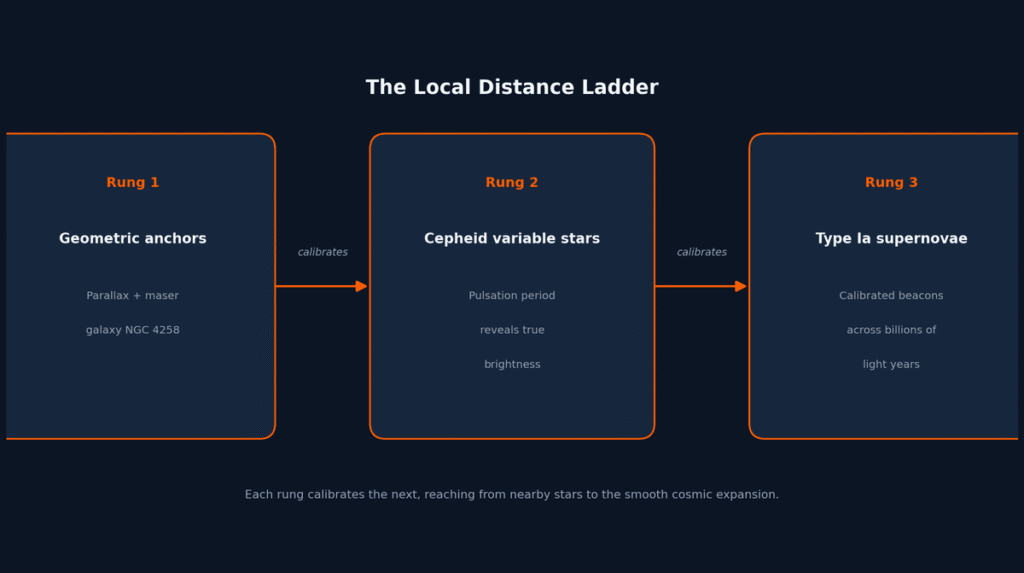
Illustration: Astrinova Editorial
Reading the Expansion Rate From the Early Universe
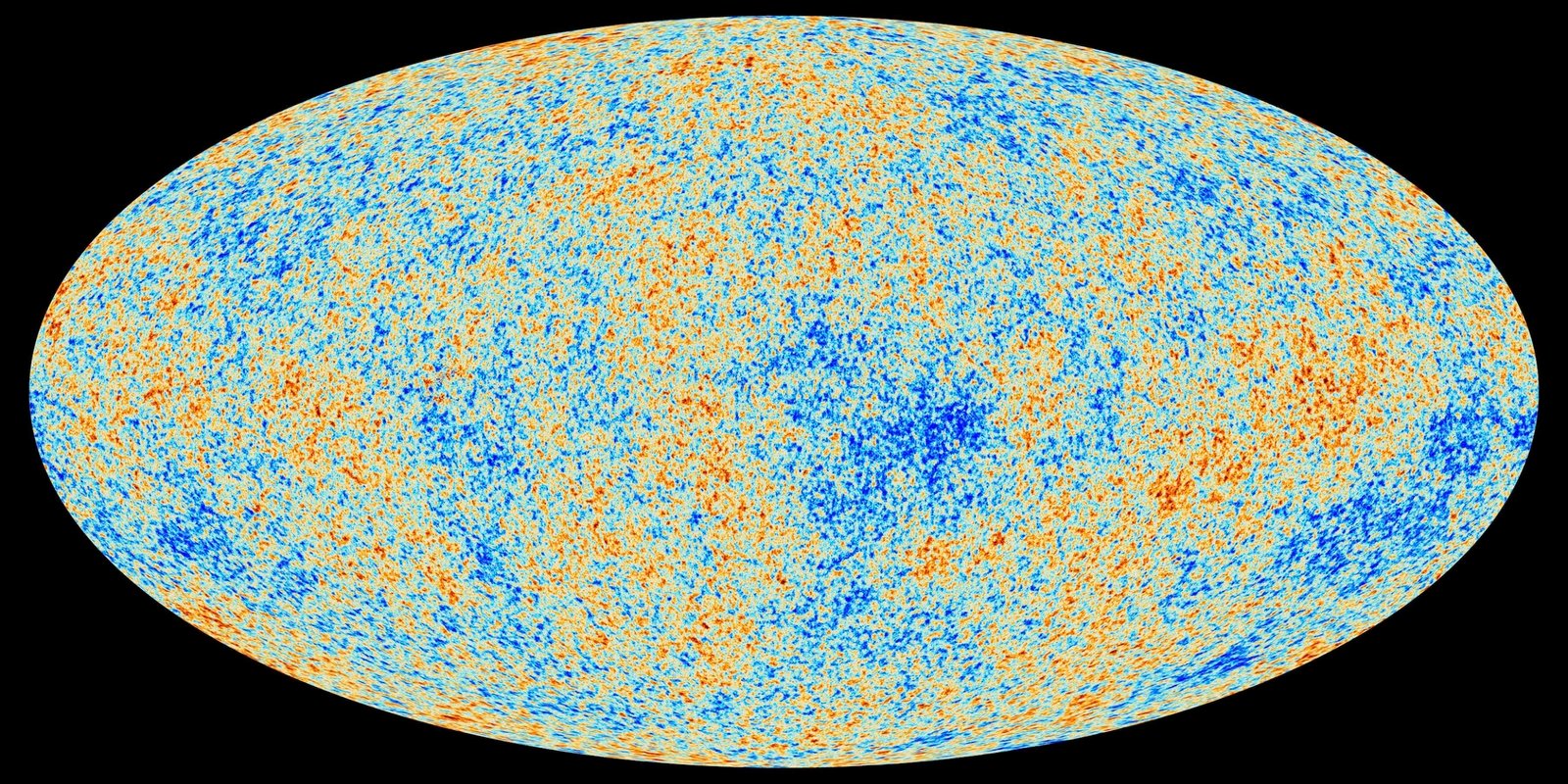
The competing measurement starts 13.8 billion years ago. The cosmic microwave background, or CMB, is light released when the universe was just 380,000 years old, a near uniform glow that fills the entire sky. Imprinted on it are faint temperature ripples left by sound waves that once sloshed through the hot plasma of the young cosmos.
The physics of those sound waves is remarkably well understood, which gives cosmologists a known yardstick: the sound horizon, the distance a sound wave could travel before the universe became transparent. Measuring the apparent size of that yardstick on the sky, most precisely with the European Space Agency’s Planck satellite, pins down the geometry and contents of the early universe.
Here is the crucial subtlety. The CMB does not measure today’s expansion rate directly. It measures the early universe, and cosmologists then run the standard model of cosmology forward in time to predict what H0 should be now. That model is called Lambda CDM, where Lambda is dark energy in its simplest form and CDM is cold dark matter. Given Lambda CDM, Planck data predict H0 = 67.4 ± 0.5 km/s/Mpc.
The prediction is only as good as the model. If Lambda CDM misses some physics between the infant universe and today, or just before the CMB was released, the extrapolated value would be wrong even though the underlying measurement is flawless. That conditional step is where most proposals for new physics try to intervene. the universe’s earliest moments
How Large Is the Gap, and Why It Will Not Go Away
Numerically the gap looks small: 73 versus 67.4, a difference of under 6 km/s/Mpc. Statistically it is enormous. With both sides quoting uncertainties near one percent, the disagreement exceeds five sigma, the same evidence threshold particle physicists demanded before announcing the Higgs boson. A five sigma fluke has odds of roughly one in three and a half million.
What elevated this from curiosity to a genuine cosmology crisis in many researchers’ eyes is that both sides have survived every attempted takedown.
On the early universe side, the Atacama Cosmology Telescope in Chile independently mapped the CMB from the ground and, in results culminating in 2025, confirmed Planck’s value in both temperature and polarization data. Analyses combining CMB data with galaxy clustering measurements from the Dark Energy Spectroscopic Instrument, DESI, keep returning the low value. The 67.4 figure is not one satellite’s quirk.
On the local side, the sharpest suspect was always crowding: the worry that Hubble’s blurry view of distant Cepheids blended their light with neighbouring stars. The James Webb Space Telescope settled it. JWST reobserved the same Cepheids with far crisper resolution and matched the Hubble Space Telescope distances almost exactly, with mean differences of 0.03 magnitudes against the 0.18 magnitudes the tension would require. Crowding is ruled out as the culprit.
Both measurements have been checked, rechecked and cross examined for over a decade. The tension is a property of the universe’s data, not of any one telescope.
Could the Measurements Simply Be Wrong?
Honest answer: possibly, and one respected team argues the case. The Chicago Carnegie Hubble Program, led by Wendy Freedman, builds the distance ladder using alternative stellar calibrators, chiefly the tip of the red giant branch, a sharp feature in the brightness of old red giant stars, and carbon rich JAGB stars. Their 2025 results give H0 = 70.39 with combined uncertainties near two percent, and their JWST only subsamples land even lower, at 68.8 for red giants and 67.8 for JAGB stars. Freedman’s group concludes their data remain consistent with Lambda CDM and that no new physics is required.
The SH0ES team counters that the CCHP samples are still small, that analysis choices around supernova samples and peculiar galaxy motions account for much of the offset, and that nearly every other local method lands high. That last point is the strongest argument that no single hidden error explains the tension, because several genuinely independent techniques bypass the Cepheid ladder entirely:
- Strong lensing time delays. When a distant quasar’s light takes multiple paths around a foreground galaxy, the arrival time differences encode cosmic distances. The TDCOSMO collaboration’s 2025 analysis of eight lensed quasars, using stellar motion data from JWST’s spectrograph to control its main systematic, found H0 = 71.6, with uncertainty around five percent.
- Water megamasers. Radio observations of gas orbiting black holes give geometric distances in one step. The Megamaser Cosmology Project measured 73.9 ± 3.0.
- Surface brightness fluctuations of galaxies give 73.7.
- Gravitational wave standard sirens, mergers whose gravitational waves reveal their distance with no ladder at all, currently give values consistent with both camps because uncertainties remain wide, though analyses of the latest catalogue of 142 events are beginning to sharpen the method. gravitational wave astronomy
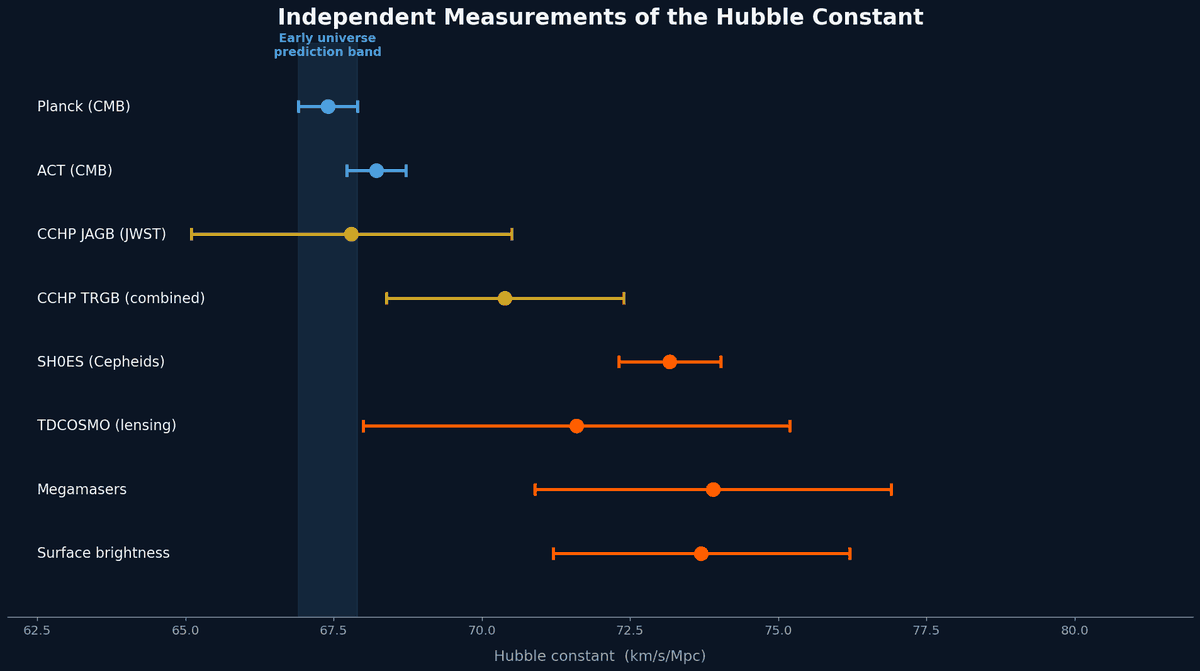
Illustration: Astrinova Editorial
A conspiracy of independent errors, in different instruments, wavelengths and physics, all pushing local values upward, is not impossible. But it grows less plausible with each new method that lands high.
Does the Hubble Tension Require New Physics?
Suppose the measurements hold. Then Lambda CDM is incomplete, and the fault most likely lies in the extrapolation step, the assumption that we know all the physics operating between the early universe and today.
Theorists have proposed well over a hundred fixes. They fall into two broad families.
Change the early universe. The CMB inference of H0 leans on the calculated size of the sound horizon. Shrink that yardstick by a few percent and the inferred expansion rate rises to meet the local value. The most studied idea is early dark energy, a brief burst of extra energy acting in the first tens of thousands of years, proposed in its modern form by Vivian Poulin and colleagues in 2019. Alternatives add extra relativistic particles, such as additional neutrino like species, which change the early expansion rate through the parameter physicists call Neff. extra neutrino like particles
Change the late universe. Perhaps dark energy is not a constant but evolves, or dark matter interacts in unexpected ways, or gravity itself deviates from general relativity over cosmic scales. Intriguingly, DESI’s 2025 galaxy survey data show independent hints that dark energy may indeed evolve with time. Yet in a twist that disappointed many, detailed analyses find that these evolving dark energy models do not raise the predicted H0. The combined data still favour the low value, so the dark energy hints and the Hubble tension currently look like two separate puzzles. the nature of dark energy
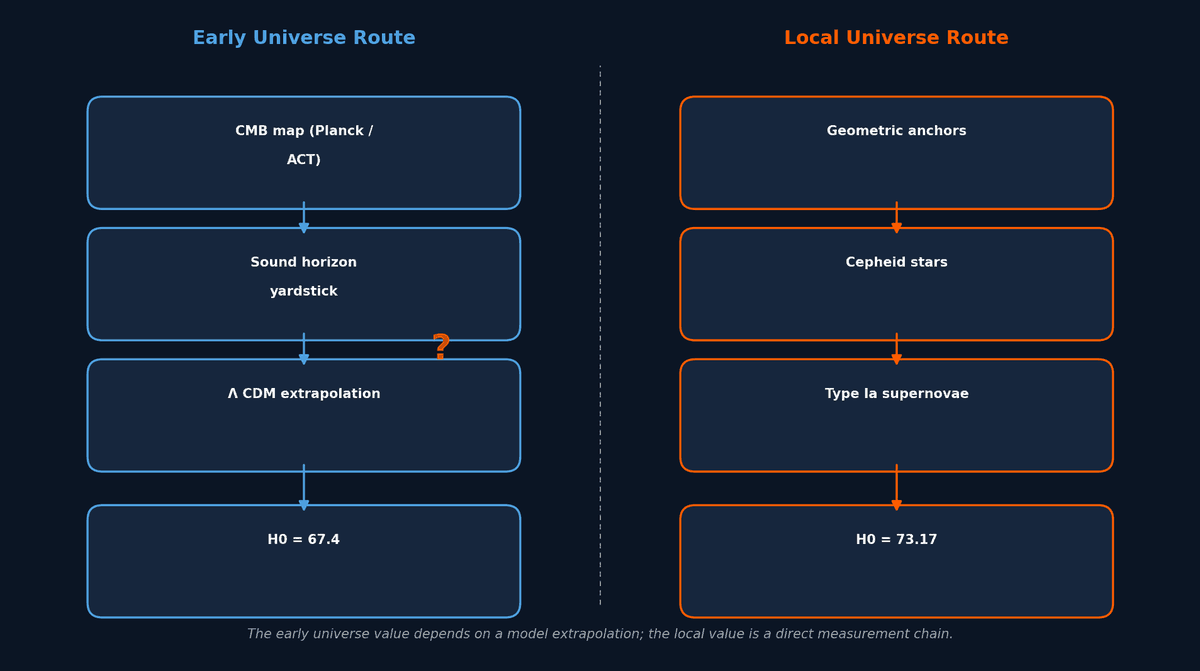
Illustration: Astrinova Editorial
Why Proposed Solutions Keep Creating New Problems
Cosmology is now so tightly constrained by data that fixing one number tends to break another. This is the central frustration of the field.
Early dark energy is the clearest case. Adding it does raise the H0 inferred from the CMB. But it also alters how matter clumped in the young universe, and restoring the fit typically requires more dark matter, which increases the predicted clumpiness of today’s cosmos. Weak lensing surveys already measure slightly less clumpiness than plain Lambda CDM expects, a milder discrepancy known as the S8 tension. Many early dark energy models make that second tension worse. Analyses of galaxy clustering data have repeatedly tightened the space such models can occupy, and the idea also carries a theoretical blemish: it needs a new energy component tuned to appear at just the right cosmic moment, a second coincidence problem stacked on the one dark energy already poses.
Extra relativistic particles face similar trouble. Enough of them to close the Hubble gap distorts the CMB’s fine structure and runs against limits from the primordial abundance of light elements. Late universe fixes, meanwhile, are squeezed by supernova and galaxy clustering data that trace the expansion history in detail and leave little room for the required distortions.
The 2025 results from the Atacama Cosmology Telescope compounded the difficulty, ruling out swathes of extended models at both ends of cosmic history. Some cosmologists frame this as progress by elimination: the surviving explanations are fewer, stranger and more testable.
In cosmology today, fixing one number tends to break another. Any real solution must thread a needle through every dataset at once.
What Could Finally Settle the Question
The next few years offer real prospects for a verdict rather than a stalemate.
JWST will keep expanding the samples of Cepheids, red giants and JAGB stars, which should either reconcile the SH0ES and CCHP ladders or expose exactly where they diverge. Gravitational wave standard sirens are the wild card: as detectors accumulate events, this ladder free method is projected to reach around two percent precision, sharp enough to take sides. The Vera C. Rubin Observatory will monitor thousands of lensed quasars, transforming time delay cosmography from a boutique method into a precision one, while the Nancy Grace Roman Space Telescope will harvest supernovae by the thousand.
On the early universe side, the Simons Observatory and the planned CMB S4 experiment will measure the microwave sky’s polarization finely enough to detect or exclude almost any pre recombination modification of the standard model, including early dark energy, on its own terms. DESI and the Euclid mission will map the expansion history with enough fidelity to confirm or dissolve the evolving dark energy hints. the cosmic microwave background
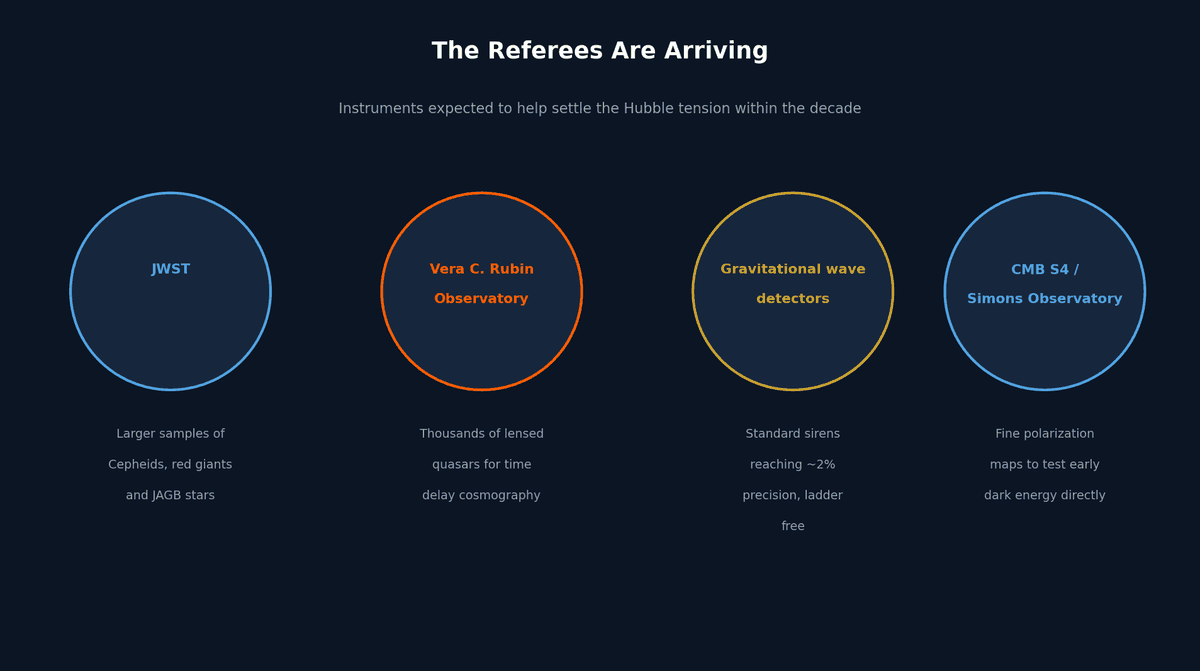
Illustration: Astrinova Editorial
A Crisis or an Opportunity?
So is cosmology in crisis? By the strict standard of the word, no. The standard model still describes an astonishing range of observations, from the first minutes of nuclear fusion to the web of galaxies today, with six parameters. A theory in genuine crisis does not keep passing tests this way.
But the Hubble tension is a genuine, unresolved, five sigma anomaly at the heart of that model, sustained by independent measurements that refuse to bend. It sits somewhere between a stubborn systematic error nobody has found and the first crack that leads to deeper physics, and honest cosmologists admit they do not yet know which. The last time expansion measurements misbehaved this persistently, in the 1990s, the resolution was the discovery of dark energy and a Nobel Prize.
Whether this cosmology crisis ends with a quiet correction or a new component of the universe, the outcome will be earned the same way the tension itself was: by measuring the same number, again and again, in every way the universe allows.
Key Takeaways
- The Hubble constant describes today’s expansion rate of the universe. Local measurements give about 73 km/s/Mpc while early universe inferences give 67.4, a gap of roughly 8 percent at more than five sigma significance.
- The early universe value is not a direct measurement of today’s rate. It is a prediction that assumes the standard Lambda CDM model correctly bridges 13.8 billion years of cosmic history.
- Both sides have survived intense scrutiny. JWST ruled out stellar crowding in the Cepheid data, and the Atacama Cosmology Telescope independently confirmed the Planck value.
- Independent methods such as lensing time delays, megamasers and surface brightness fluctuations mostly favour the higher local value, though the Chicago Carnegie program’s red giant results sit in between and keep the systematics debate alive.
- Proposed fixes such as early dark energy or extra relativistic particles tend to conflict with other precise data. Next generation experiments, from CMB S4 to gravitational wave sirens, should deliver a verdict within the decade.
Frequently Asked Questions
What is the Hubble tension in simple terms?
It is the disagreement between two precise ways of measuring how fast the universe expands today. Nearby stars and supernovae give about 73 km/s/Mpc, while the afterglow of the Big Bang, interpreted through the standard cosmological model, gives about 67.4. This is the gap people mean when they refer to a cosmology crisis.
Is the Hubble tension proof that the Big Bang theory is wrong?
No. Both measurements assume an expanding universe that began hot and dense, and both confirm it. The tension concerns the precise present day expansion rate, not whether the Big Bang happened.
Why can’t scientists just average the two Hubble constant values?
Because the uncertainties do not overlap. Each side claims roughly one percent precision, so at least one of them contains an unrecognized error, or the model connecting them is incomplete. Averaging would hide the problem rather than solve it.
Could the James Webb Space Telescope resolve the Hubble tension?
It already eliminated one leading suspect by confirming that Hubble Space Telescope measurements of Cepheid stars were not corrupted by crowding. Larger JWST samples of multiple stellar distance indicators may yet reveal, or rule out, remaining systematic errors.
What is early dark energy?
A proposed short lived energy component in the universe’s first tens of thousands of years. It would shrink the sound horizon used to interpret the cosmic microwave background, raising the inferred expansion rate, but it tends to worsen the fit to galaxy clustering data.
Will the Hubble tension ever be solved?
Very likely yes. Gravitational wave standard sirens, the Rubin Observatory, the Roman Space Telescope, DESI, Euclid, the Simons Observatory and CMB S4 will all measure the relevant quantities independently within roughly a decade.
References
- Riess, A. et al. (SH0ES Collaboration), local distance ladder measurement H0 = 73.04 ± 1.04 km/s/Mpc (2022), as reviewed in Poulin, V., “The Hubble tension,” CERN Courier (2025). cerncourier.com/a/the-hubble-tension
- Breuval, L. et al. (SH0ES Team), “Latest updates on the Hubble Tension from JWST by the SH0ES Team,” 246th AAS Meeting (2025), reporting H0 = 73.17 ± 0.86 and JWST cross checks. ui.adsabs.harvard.edu
- Planck Collaboration, H0 = 67.4 ± 0.5 km/s/Mpc from Lambda CDM fits to CMB data (2020).
- Freedman, W. L., Madore, B. F., Hoyt, T. J., Jang, I. S., Lee, A. J., Owens, K. A., “Status Report on the Chicago Carnegie Hubble Program (CCHP),” The Astrophysical Journal 985, 203 (2025). arxiv.org/abs/2408.06153
- TDCOSMO Collaboration, Birrer, S. et al., “TDCOSMO 2025: Cosmological constraints from strong lensing time delays,” Astronomy and Astrophysics (2025), H0 = 71.6 (+3.9 / −3.3) km/s/Mpc. aanda.org
- ETH Zurich Department of Physics, “Cosmological tension confirmed” (December 2025). phys.ethz.ch
- Space.com, “Hubble tension is back again as a new cosmic map deepens the puzzle” (2025). space.com
- Scientific American, “The Hubble Tension Is Becoming a Hubble Crisis” (2025). scientificamerican.com
- DESI Collaboration, “DESI DR2 Results: Measurements of Baryon Acoustic Oscillations and Cosmological Constraints” (2025), arXiv:2503.14738. desi.lbl.gov
- Zhang, Z., Xu, T., Chen, Y., “Dynamical Dark Energy and the Unresolved Hubble Tension: Multi model Constraints from DESI 2025 and Other Probes” (2025). arxiv.org/abs/2512.07281
- Poulin, V., Smith, T. L., Karwal, T., Kamionkowski, M., “Early Dark Energy Can Resolve The Hubble Tension,” Physical Review Letters 122, 221301 (2019). arxiv.org/pdf/1811.04083
- Poulin, V., Smith, T. L., Karwal, T., “The Ups and Downs of Early Dark Energy solutions to the Hubble tension,” Physics of the Dark Universe (2023). ui.adsabs.harvard.edu
- Pesce, D. et al. (Megamaser Cosmology Project), H0 = 73.9 ± 3.0 km/s/Mpc (2020), and Blakeslee, J. et al., surface brightness fluctuations H0 = 73.7 (2021), as cited in TDCOSMO XII, Astronomy and Astrophysics 673, A9 (2023). aanda.org
- Xiong, E.-Y., Song, J.-Y., Zhang, J.-F., Zhang, X., “Model independent H0 from GWTC-4 standard sirens and TDCOSMO 2025 strong lensing time delays” (2026). arxiv.org/abs/2606.03634
- “The Hubble tension: A decade review” (2026), arXiv:2606.20434. arxiv.org/html/2606.20434v1
- Physics World, “Cosmic conflict continues: new data fuel the Hubble tension debate” (2025). physicsworld.com
Join the discussion
Comments are moderated and may take a little while to appear.