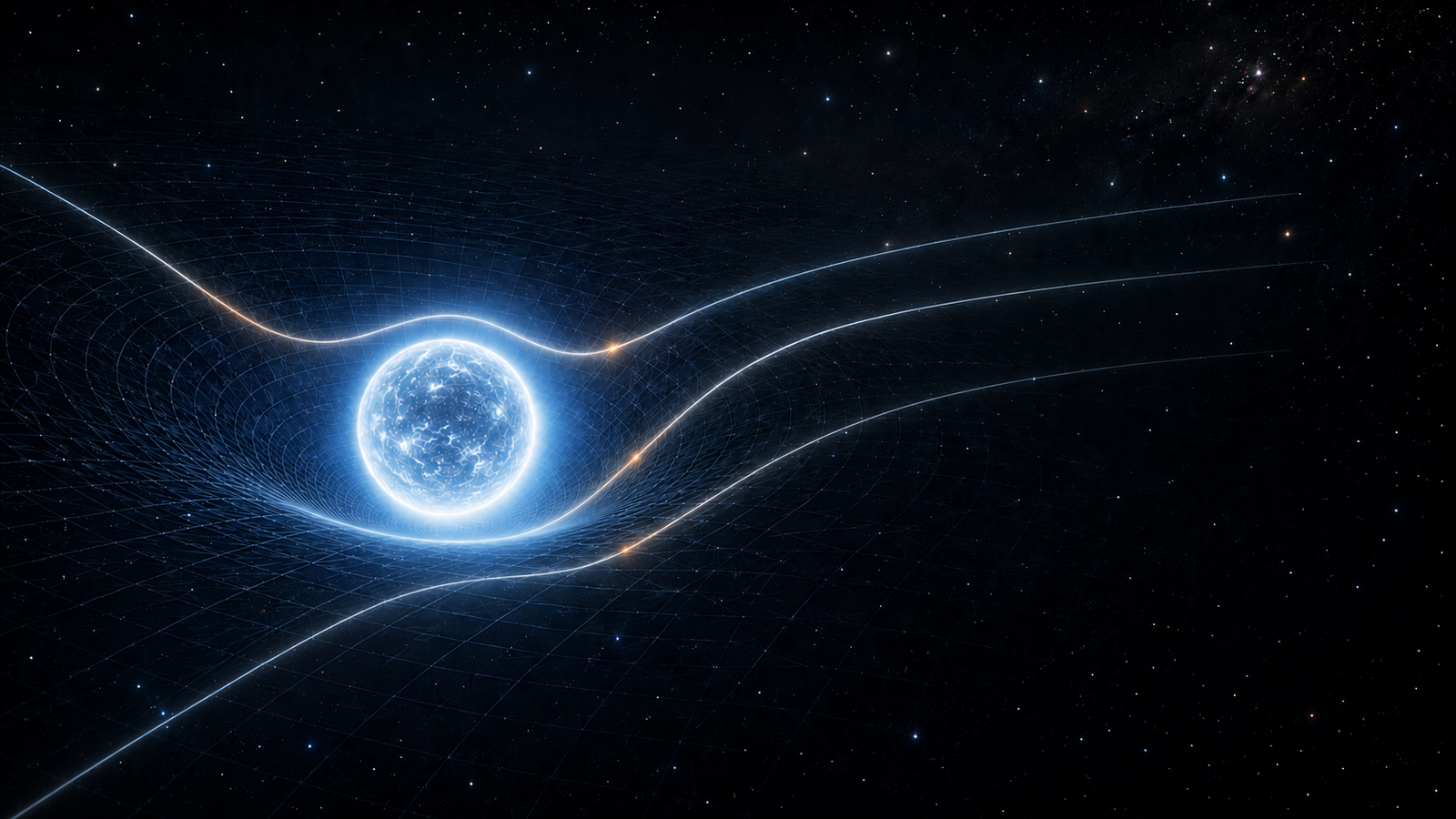
Albert Einstein published general relativity in 1915. The idea replaced Newton’s picture of gravity as a force acting between objects with something far stranger: mass and energy bend the shape of space and time itself, and everything else just follows the curve. On paper it read almost like philosophy. What turned it into physics was more than a century of experiments that kept confirming it, at every scale scientists could test.
Here are five of them, from a 1919 eclipse to a black hole collision detected in 2015, that turned Einstein’s equations into some of the most rigorously verified results in science.
So is the theory of relativity proven? As close to yes as science gets. General relativity has passed every experimental test aimed at it for more than a century, from a 1919 solar eclipse to the direct detection of gravitational waves in 2015, and no observation has ever contradicted it. The five experiments below are the clearest evidence of that record.
The Eclipse That Made Einstein Famous
In 1919, general relativity was still an unproven idea from a physicist most of the English speaking world had barely heard of. Arthur Eddington, a British astronomer, saw a way to settle the question during a total solar eclipse on May 29 that year.
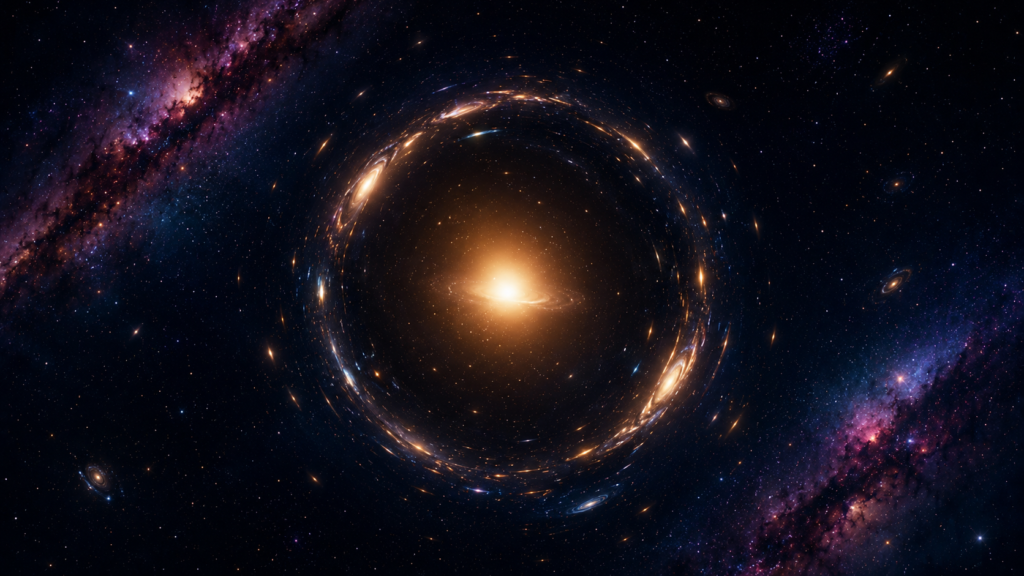
Einstein’s theory made a precise prediction. Light from distant stars should bend as it passes near the Sun’s mass, by exactly 1.75 arcseconds, almost double what Newtonian physics predicted. The only way to measure that bend was during totality, when the Sun’s glare wouldn’t drown out the faint starlight skimming past its edge.
Eddington led one expedition to the island of Príncipe off West Africa. A second team traveled to Sobral, Brazil. When the photographic plates were developed and measured, the star positions had shifted by roughly 1.98 and 1.61 arcseconds, close enough to Einstein’s number and far enough from Newton’s to count as confirmation. The results were announced that November at a joint meeting of the Royal Society and the Royal Astronomical Society in London, and newspapers carried the story around the world. Einstein woke up famous.
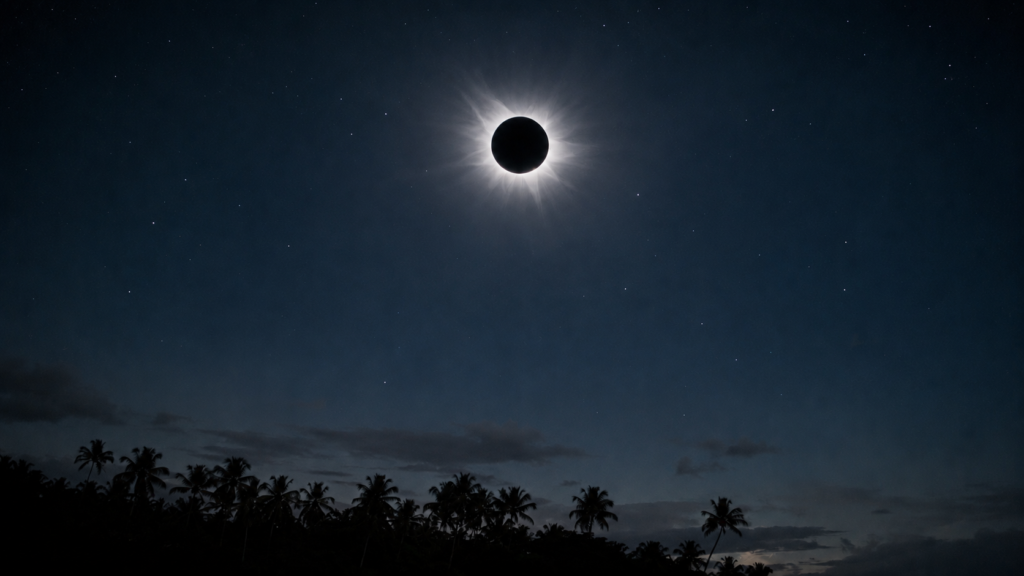
Totality over Príncipe, the sixty seconds during which starlight bent just enough around a hidden Sun to move a name from physics journals into world headlines.
Mercury’s Wobbling Orbit
Long before Einstein was born, astronomers already knew something was off about Mercury. The planet’s orbit doesn’t trace a clean ellipse. It precesses, meaning the point where Mercury swings closest to the Sun slowly rotates over time. Newtonian gravity, once you account for the pull of every other planet in the solar system, explains almost all of that precession. Almost. A stubborn 43 arcseconds per century was left over, and nobody could account for it.
Some astronomers proposed an undiscovered planet, nicknamed Vulcan, tucked in closer to the Sun than Mercury, tugging on it gravitationally. It was never found, because it doesn’t exist.
Einstein’s theory closed the gap without inventing a new planet. Mercury sits close enough to the Sun to feel noticeably stronger spacetime curvature than the outer planets, and the field equations predicted the missing 43 arcseconds almost exactly. This wasn’t a number fitted after the fact. It fell straight out of the math. More than a century later, physicists are still refining the calculation, including a 2018 paper in Physical Review Letters that identified additional relativistic contributions to Mercury’s motion, and the agreement with observation still holds.
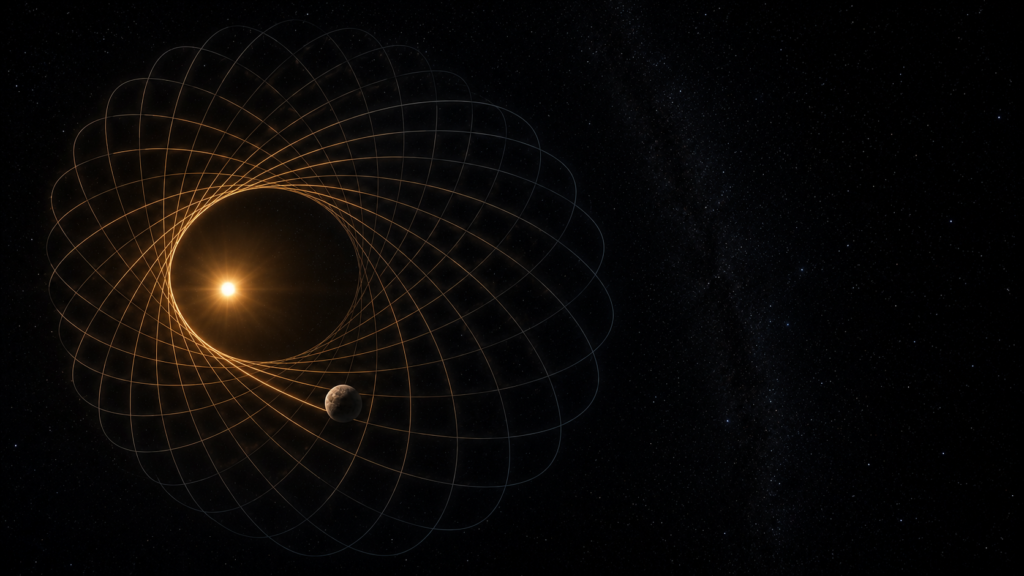
Mercury’s orbit traced across decades, the ellipse itself slowly rotating in a way no undiscovered planet was ever needed to explain.
Light Losing Energy on Its Way Up
Here’s a prediction that sounds almost too strange to measure: gravity should cause light climbing out of a gravitational field to lose a sliver of energy, stretching its wavelength toward the red end of the spectrum. Physicists call it gravitational redshift.
In 1959, Robert Pound and Glen Rebka set out to catch the effect in a lab at Harvard. They built a 22.5 meter tower, fired gamma rays from the bottom, and measured the frequency shift at a detector near the top. The tower was tall by lab standards and nearly nothing by cosmic ones, so the predicted shift was correspondingly tiny, a difference of a few parts in ten quadrillion.
Using a technique built around the Mössbauer effect to detect a change that small, Pound and Rebka measured a shift matching the prediction to within about 10 percent, later refined to roughly 1 percent. It remains one of the most elegant confirmations of Einstein’s model ever performed, proof that even Earth’s comparatively weak gravity leaves a measurable fingerprint on light.

The twenty two meter tower at Harvard where gamma rays climbed straight up and arrived measurably poorer for the trip.
The GPS in Your Pocket Runs on Relativity
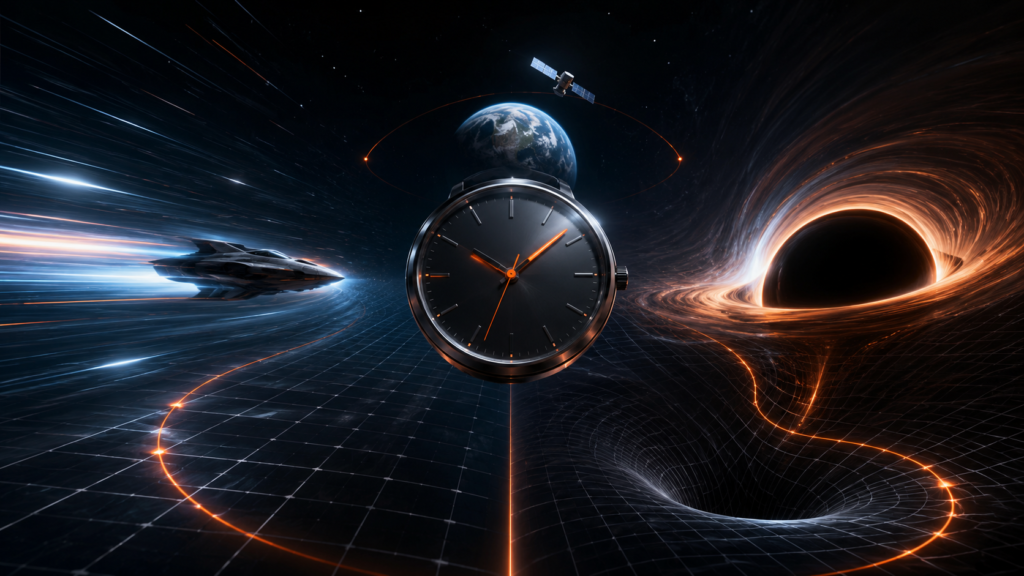
Most people don’t realize they’re relying on general relativity every time they check a map app. GPS satellites orbit roughly 20,000 kilometers above Earth, where gravity is noticeably weaker than at the surface. Relativity predicts that clocks sitting in weaker gravity run faster than clocks closer to a massive body, so the clocks on board those satellites tick faster than clocks on the ground.
At the same time, the satellites are moving fast enough that special relativity’s time dilation slows their clocks down slightly, from the point of view of someone standing on Earth. The two effects don’t cancel. Gravity wins, and the net result is that GPS satellite clocks gain about 38 microseconds per day relative to clocks at sea level.
That sounds negligible until you remember GPS depends on nanosecond level timing to calculate position. Left uncorrected, that drift would introduce positioning errors compounding to roughly 10 kilometers per day, turning a precise navigation system into a useless one within hours. Engineers built the relativistic correction directly into the satellites’ onboard clocks before launch. Every time a phone pins your location accurately, it’s quietly leaning on a hundred year old theory of gravity.
A clock running 38 microseconds too fast each day sounds trivial, until that same error would send GPS positions drifting by ten kilometers within a single day.
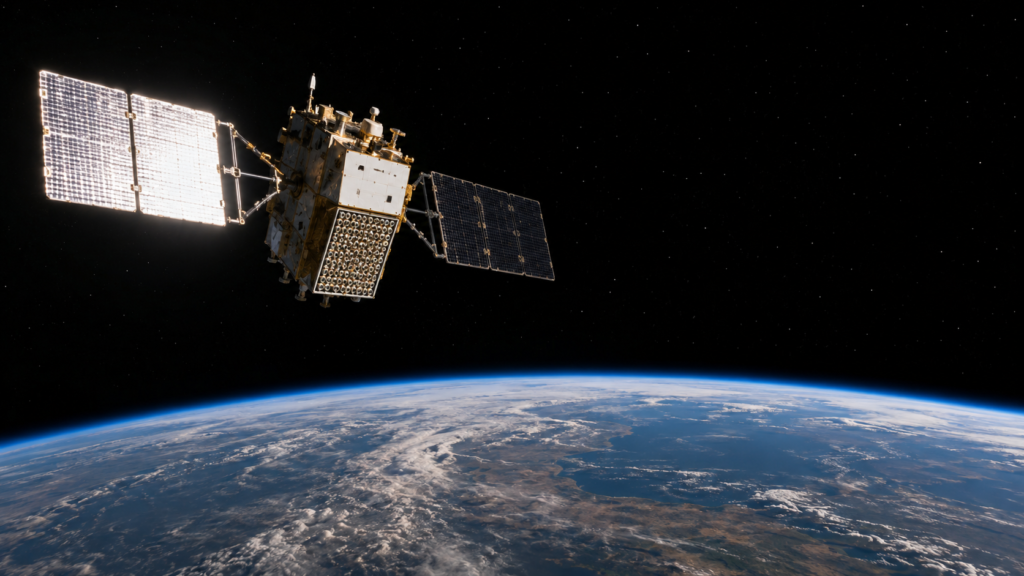
A GPS satellite circling twenty thousand kilometers above Earth, carrying a clock correction built into it before launch, quietly canceling out a drift no one on the ground would ever notice.
Catching a Ripple in Spacetime
The most dramatic confirmation arrived almost exactly a century after Einstein’s original papers. In 1916 he predicted that violent cosmic events, like two massive objects spiraling into each other, should send ripples through spacetime itself. Physicists call them gravitational waves. For decades they stayed purely theoretical. The expected effect was so faint that many researchers doubted it could ever be measured directly.
On September 14, 2015, twin detectors belonging to the Laser Interferometer Gravitational Wave Observatory, one in Hanford, Washington, and one in Livingston, Louisiana, picked up the same signal within milliseconds of each other. The waveform matched, almost perfectly, the signature predicted for two black holes, roughly 36 and 29 times the mass of the Sun, spiraling together and merging over a billion years ago. The statistical confidence of the detection exceeded 5.1 sigma, meaning the odds of it being a random fluke were vanishingly small.
The event, now known as GW150914, was published in Physical Review Letters and marked two milestones at once: the first direct detection of gravitational waves, and the first direct evidence that binary black holes exist and merge. It earned the 2017 Nobel Prize in Physics for LIGO’s founders.
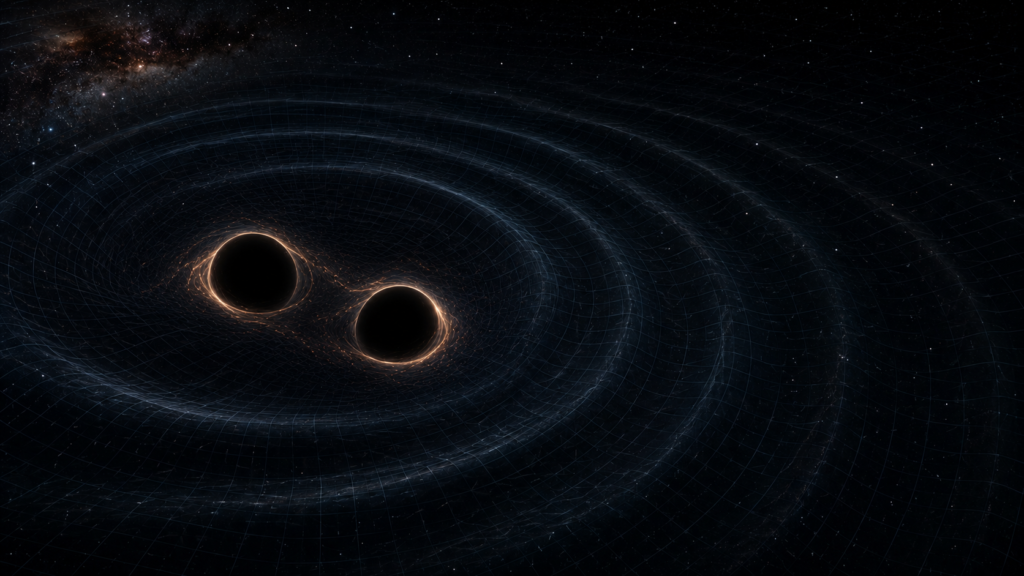
Two black holes completing their final orbits in a fraction of a second, the collision that reached Earth as a ripple in spacetime a billion years later.
Why This Matters
What makes these five results remarkable isn’t just that they confirmed Einstein’s math. It’s how differently each one got there. One test watched starlight bend during a few minutes of eclipse darkness. Another tracked a wobble in Mercury’s orbit that took decades to add up to anything measurable. A third caught a shift in gamma ray frequency inside a university basement. A fourth corrects satellite clocks by microseconds so a phone can find your location within meters. A fifth listened for a signal that had been traveling for a billion years before two detectors on opposite sides of the country felt it arrive within milliseconds of each other. Every one of those tests came from a different era, used different instruments, and looked at a completely different piece of the universe, and general relativity held up in all of them. That kind of agreement across such different tests is rare, and it is why physicists trust the theory as much as they do.
Key Takeaways
- The 1919 eclipse expedition gave general relativity its first public confirmation, measuring starlight bending near the Sun to within range of Einstein’s predicted value.
- Mercury’s leftover orbital precession, unexplained for decades, matched Einstein’s field equations without requiring a new undiscovered planet.
- The Pound Rebka experiment in 1959 directly measured gravitational redshift in a Harvard lab, confirming that gravity affects light’s energy.
- GPS satellites require built in relativistic corrections for both gravitational and velocity based time dilation, or the system would drift by kilometers within a day.
- The 2015 LIGO detection of gravitational waves from a black hole merger confirmed a prediction Einstein made a century earlier, in 1916.
References
- Dyson, F. W., Eddington, A. S., and Davidson, C., “A Determination of the Deflection of Light by the Sun’s Gravitational Field, from Observations Made at the Total Eclipse of May 29, 1919,” Philosophical Transactions of the Royal Society A, 220, 291 to 333 (1920)
- Gilmore, G., and Tausch-Pebody, G., “The 1919 Eclipse Results That Verified General Relativity and Their Later Detractors: A Story Re-Told,” Notes and Records of the Royal Society, 76(1), 155 to 180 (2022)
- Royal Astronomical Society, “World Celebrates Centenary of Confirmation of Relativity,” press release, 2019
- Will, C. M., “New General Relativistic Contribution to Mercury’s Perihelion Advance,” Physical Review Letters, 120, 191101 (2018)
- Pound, R. V., and Rebka, G. A., “Apparent Weight of Photons,” Physical Review Letters, 4, 337 to 341 (1960)
- LIGO Caltech, “LIGO Opens New Window on the Universe with Observation of Gravitational Waves from Colliding Black Holes,” press release, 2016
- Abbott, B. P., et al. (LIGO Scientific Collaboration and Virgo Collaboration), “Observation of Gravitational Waves from a Binary Black Hole Merger,” Physical Review Letters, 116, 061102 (2016)
Further Reading
- “A Century of Correct Predictions,” Nature Physics, 15, 415 (2019), a short centennial overview tying these tests together
- John Baez, “General Relativity and Mercury’s Perihelion,” University of California Riverside physics explainer, for a plain language walk through of the precession calculation
Join the discussion
Comments are moderated and may take a little while to appear.