Imagine your 10-year-old son asks,
“Dad, what exactly is spacetime?”
Could you explain it without saying “four-dimensional differentiable manifold”?
Could you explain it so well that a university physics professor would still agree with every sentence?
That is exactly what this article will do.
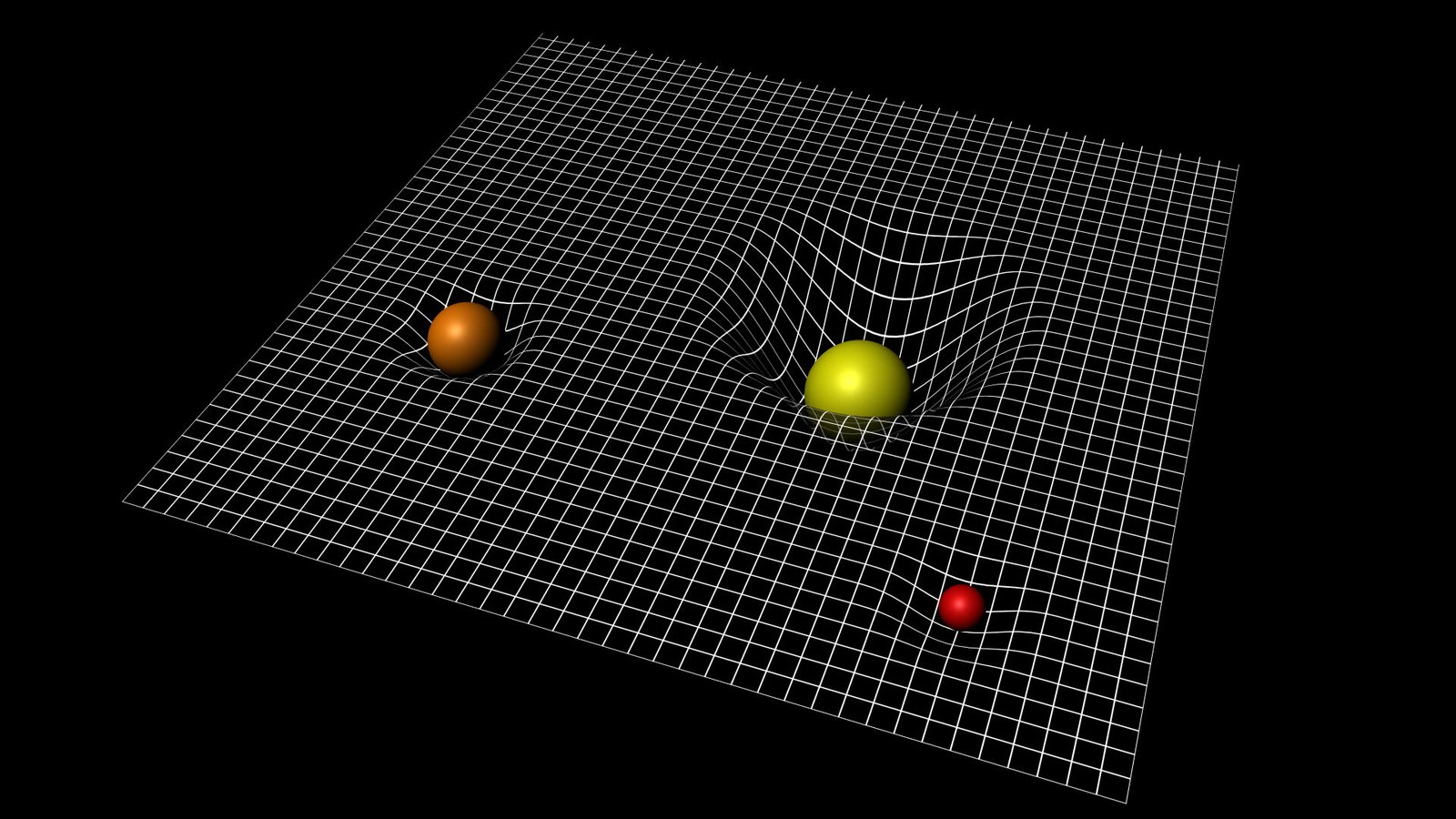
The short answer to what is spacetime is that it is the single structure modern physics uses instead of two separate ideas called space and time. It is what gravity actually is. It is what your clock and your ruler are both reading. And it is described by a definition that sounds impenetrable until you take it apart, at which point every word in it turns out to be something you already understand.
We are going to build that understanding slowly, starting with a birthday party, and finishing with the equations Einstein published in 1915. Nothing will be introduced before you are ready for it. Every technical word will arrive only after you already know the idea it names.
Part One: Where and When
A birthday, a kick, and a bolt of lightning
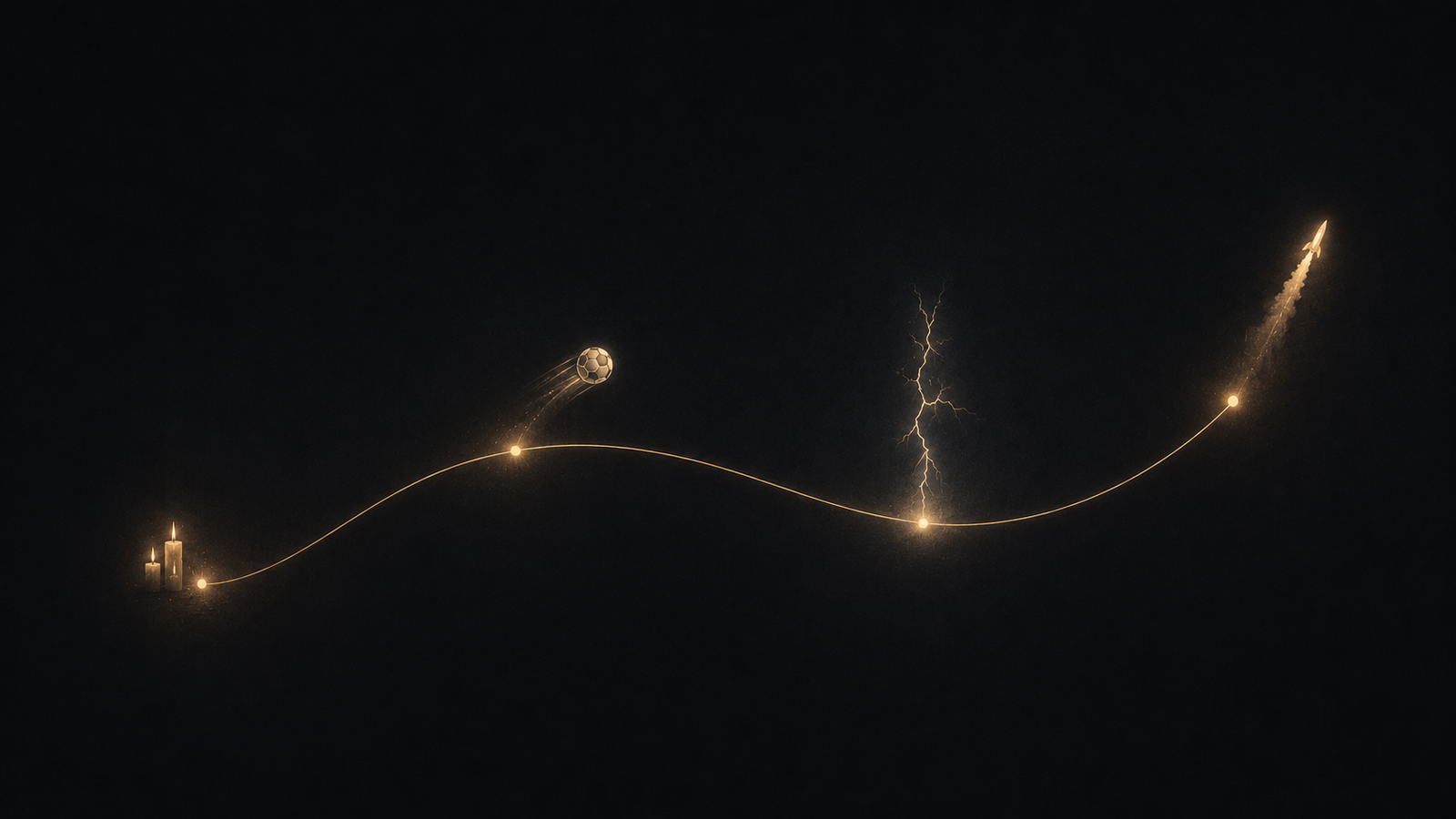
Think about a birthday party. Somebody blows out the candles. That happens in one room, at one moment. Tell a friend only the room and they wander into an empty kitchen at midnight. Tell them only the time and they stand outside in the street, wondering where everybody went.
Now a football match. Someone kicks the ball: a spot on the pitch, a second on the clock. Now lightning: it strikes a field, there and then gone. To describe it at all you need the place and the moment.
The football is a thing. The kick is a happening. The ball existed before and after the kick, but the kick occupies exactly one place and one instant, then it is finished. Physics spends most of its time studying happenings, not things.
A helicopter you cannot meet
A helicopter is hovering four kilometres east of the airport, two kilometres north, three hundred metres up. Three numbers, very precise. Can you meet it? No. You have no idea when it will be there. Add one more number, half past four this afternoon, and the description is complete. You can be there.
Three numbers pin down a place. It takes a fourth to pin down a happening. A map tells you where, a timetable tells you when, and neither alone is enough to meet a helicopter.
The word for a happening
Physicists needed a word for “one thing happening at one place at one moment”: event. The candles going out is an event. The kick is an event. The lightning strike is an event. The rocket itself is not an event; it exists across millions of moments. Objects are not single happenings; they are enormous strings of happenings.
A life is a line
Follow a football through every moment of its existence and you get a continuous thread of events. Physicists call that thread the object’s worldline. Your own worldline started when you were born and has been unbroken since. Even sitting still, you keep moving to later moments.
Why bother thinking this way
The old way says space is a fixed container and time ticks the same for everyone. But observers moving relative to each other do not always agree on how long something took, or whether two distant events were simultaneous.
They do agree on one thing: what events there are. Einstein Online, the public physics resource of the Max Planck Institute for Gravitational Physics, defines spacetime as exactly that: the observer-independent collection of all events, which different observers slice into space and time in different ways.
If you want to see this idea worked out with real clocks and real numbers, we cover it in Time Dilation Explained.
Part Two: Counting the Numbers
A dimension is one number you need to say where something is. A train needs one (along the track). A ship needs two (east, north). A helicopter needs three (east, north, height). Add time and you need a fourth to specify one event. That is all “spacetime is four dimensional” means.
(t, x, y, z)
t is time; x, y, z are the three space distances. These are called coordinates: labels we choose. The universe does not choose them.
The one place the pattern breaks
Time is not simply a fourth distance. You can walk east then west; you cannot revisit yesterday. And when combining the four coordinates to find the separation between two events, the time part enters with the opposite sign from the three space parts. Not a different size, a different sign. That single minus sign divides events you could reach from events forever out of reach, giving spacetime its structure of before and after.
Terms like these get their own plain language entries in our physics glossary, worth keeping open in another tab as you read.
Part Three: So What Is Spacetime?
Spacetime is the complete collection of all events, treated as one geometric object with a shape of its own: not space with a clock attached, but one structure in which “where” and “when” are two aspects of the same thing.
Newton’s universe
Space is a fixed container; time flows the same for everyone; gravity is a force pulling masses together. This works beautifully and deserves respect.
Einstein’s universe
Einstein Online, the Max Planck Institute’s public relativity primer, describes the shift plainly: spacetime is a dynamic entity, distorted by the matter it contains, and that distorted geometry in turn tells the matter how to move and evolve. Gravity stops being an ordinary force at all. It becomes a property of spacetime geometry.
This picture has been checked, hard. Physicist Clifford M. Will’s review for Living Reviews in Relativity collects the record: light deflection, the Shapiro time delay, the perihelion advance of Mercury, and frame dragging have all been measured at high precision, and the orbital decay of the Hulse-Taylor binary pulsar matches the predicted gravitational wave damping to better than half a percent.
Part Four: The Shape of the Arena
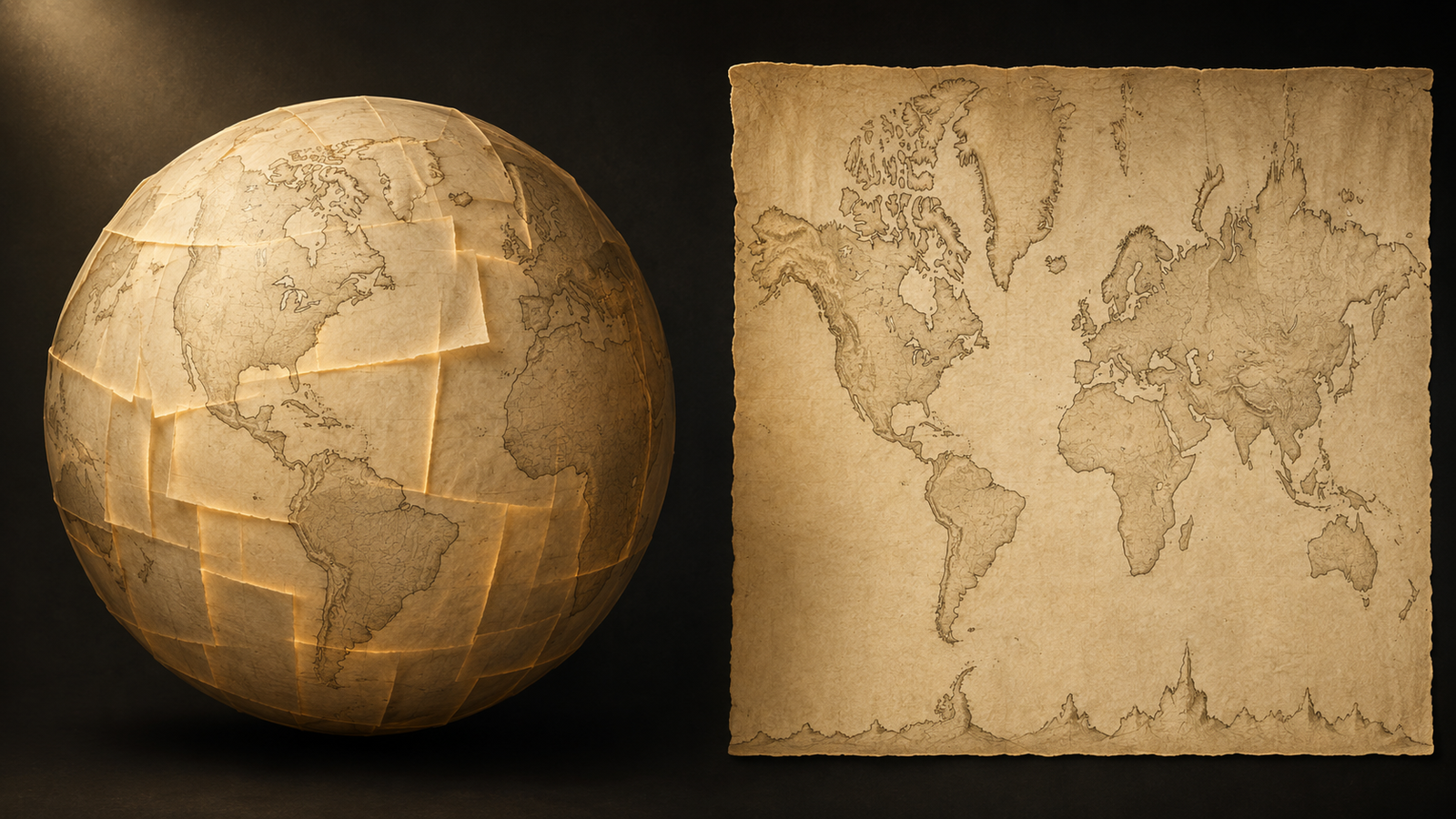
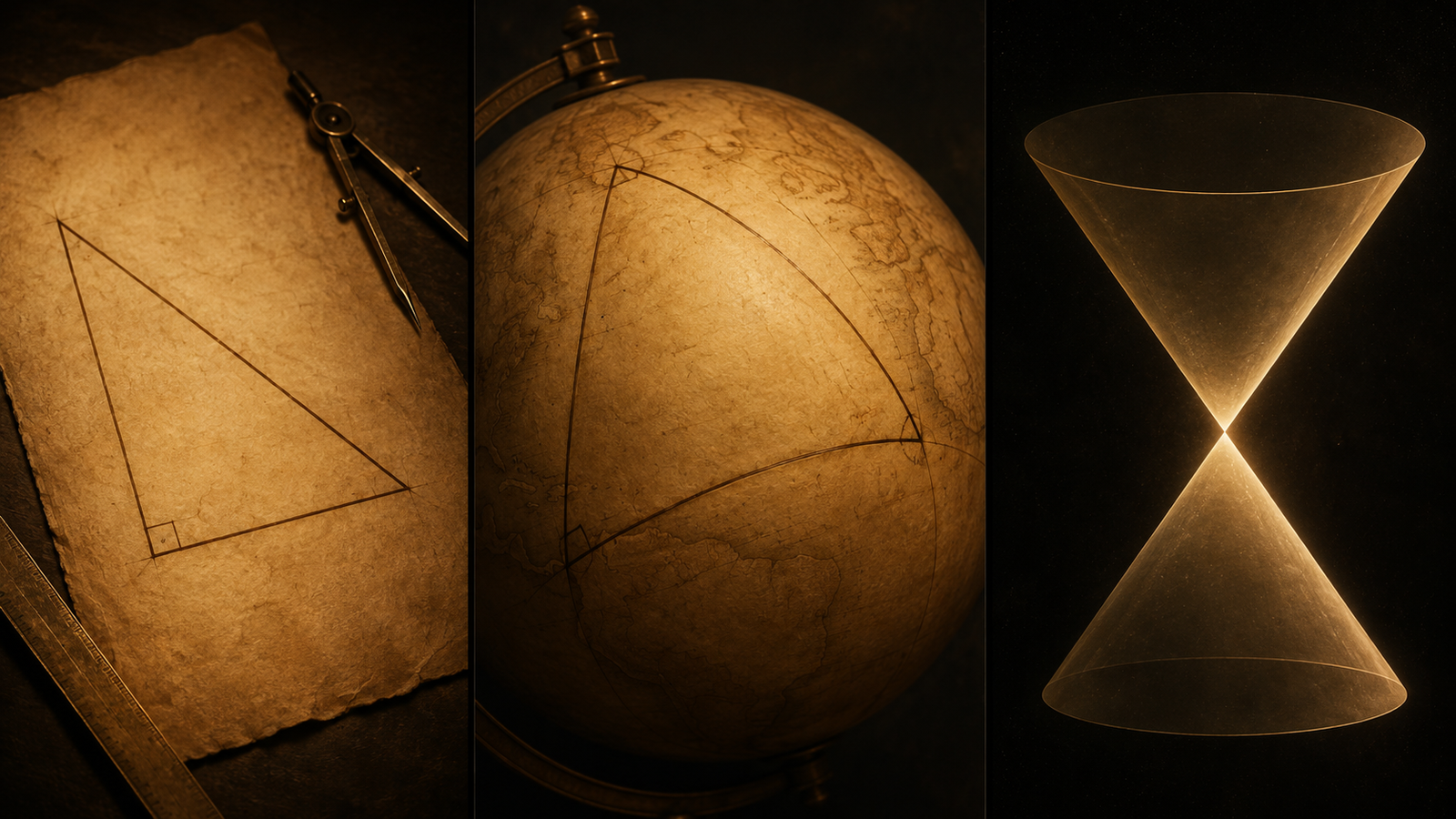
No flat map of the Earth is fully honest; every projection distorts area, shape, distance, or direction. But a small local map (your neighbourhood) works perfectly. Small pieces of a curved surface behave as though flat, even though the whole is not. So an atlas of overlapping local charts describes the whole Earth accurately.
A space with this property (curved overall, flat on small patches, covered by overlapping local charts) is called a manifold. The Earth’s surface is a two-dimensional manifold; spacetime is a four-dimensional one. Each local map is a coordinate chart; the full collection is an atlas.
Why “coordinates are labels” matters
Two physicists can use completely different coordinates for the same region and both be correct. In Schwarzschild’s 1916 coordinates, quantities appear to run to infinity at the black hole horizon, but a different chart shows perfectly ordinary geometry there. That false alarm is a coordinate singularity. The singularity deep inside a black hole is different: it does not go away under any relabelling, marking where general relativity stops applying.
We walk through what actually happens at that boundary, and past it, in What If You Fell Into a Black Hole?
Smoothness
The definition also calls spacetime differentiable. Picture a ramp versus a staircase: on a ramp you can always ask “how steep here?” and get one answer; on a staircase edge you cannot. A differentiable manifold is one whose overlapping charts are joined by smooth transition rules, so calculus, and with it curvature, built from second derivatives of the metric, can be defined everywhere.
Hausdorff
Two distinct points must be genuinely separable by non-overlapping neighbourhoods, like two houses with their own patch of ground. Formally: for any two distinct points there exist disjoint open neighbourhoods containing them. This keeps the topology well behaved, though it alone does not establish cause and effect; causal structure needs the Lorentzian metric and further conditions on top of it.
Part Five: Measuring Things
Two dots on graph paper: distance² = Δx² + Δy² (Pythagoras). That formula is a property of flat paper. On a globe, equal coordinate differences (a degree of longitude) cover wildly different real distances depending on latitude. Coordinates are not distances.
A rule converting coordinate differences into real measurements is a metric. In flat spacetime, the separation between two nearby events is:
ds² = −c²dt² + dx² + dy² + dz²
ds² is the interval, agreed on by all observers. dt, dx, dy, dz are coordinate differences; c is the speed of light, converting time units to length units. The minus sign on the time term is what makes spacetime geometry different from ordinary geometry.
Depending on the sign of ds², separations are spacelike (positive, unreachable), timelike (negative, reachable by a slower-than-light object) or null (zero, the path of light). This sorts spacetime into light cones, the causal structure.
Near a mass, the coefficients vary point to point. The object holding all of them is the metric tensor, gμν: a symmetric rule (gμν = gνμ, ten independent components) that, like a wind described in different rotated axes, gives the same physical answer regardless of coordinate choice. From the metric come proper time (a clock’s own elapsed time along its worldline), proper distance along a chosen spacelike slice, angles, light cones, volumes, and the Levi-Civita connection that defines “straight” and therefore curvature.
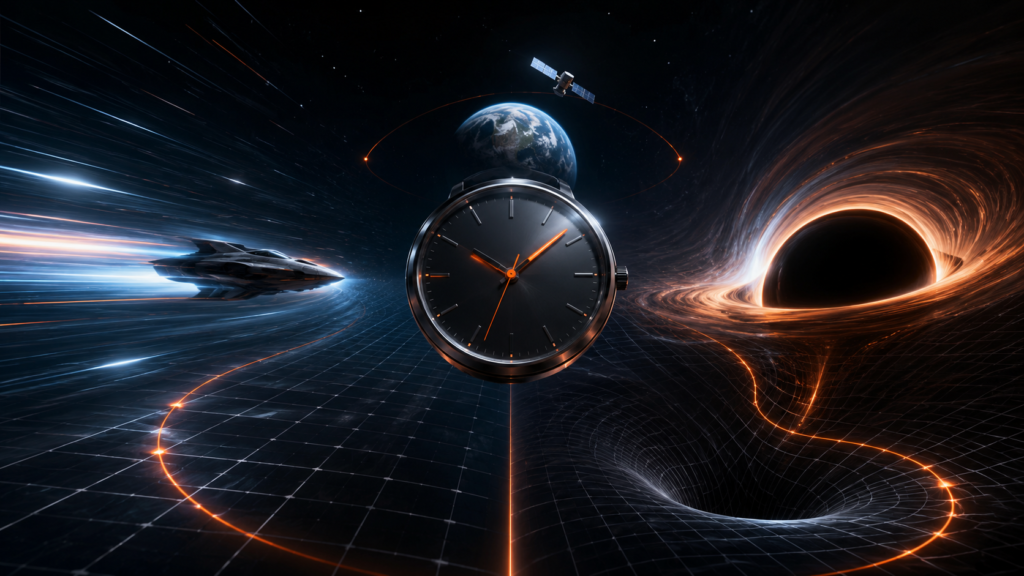
This is measurable. In a 2022 paper in Nature, Tobias Bothwell and colleagues at JILA resolved the gravitational redshift across a single millimetre-scale sample of atoms, after improving their fractional frequency measurement uncertainty by more than a factor of ten, down to 7.6 × 10⁻²¹. Raise a clock by one millimetre in Earth’s gravity and it ticks measurably faster. NIST’s publication record for the experiment carries the same result.
Part Six: The Straightest Possible Path
Fly Lahore to Toronto: on a flat map the route curves absurdly north; on a globe it is close to the shortest path: a geodesic, the straightest possible route a curved surface allows.
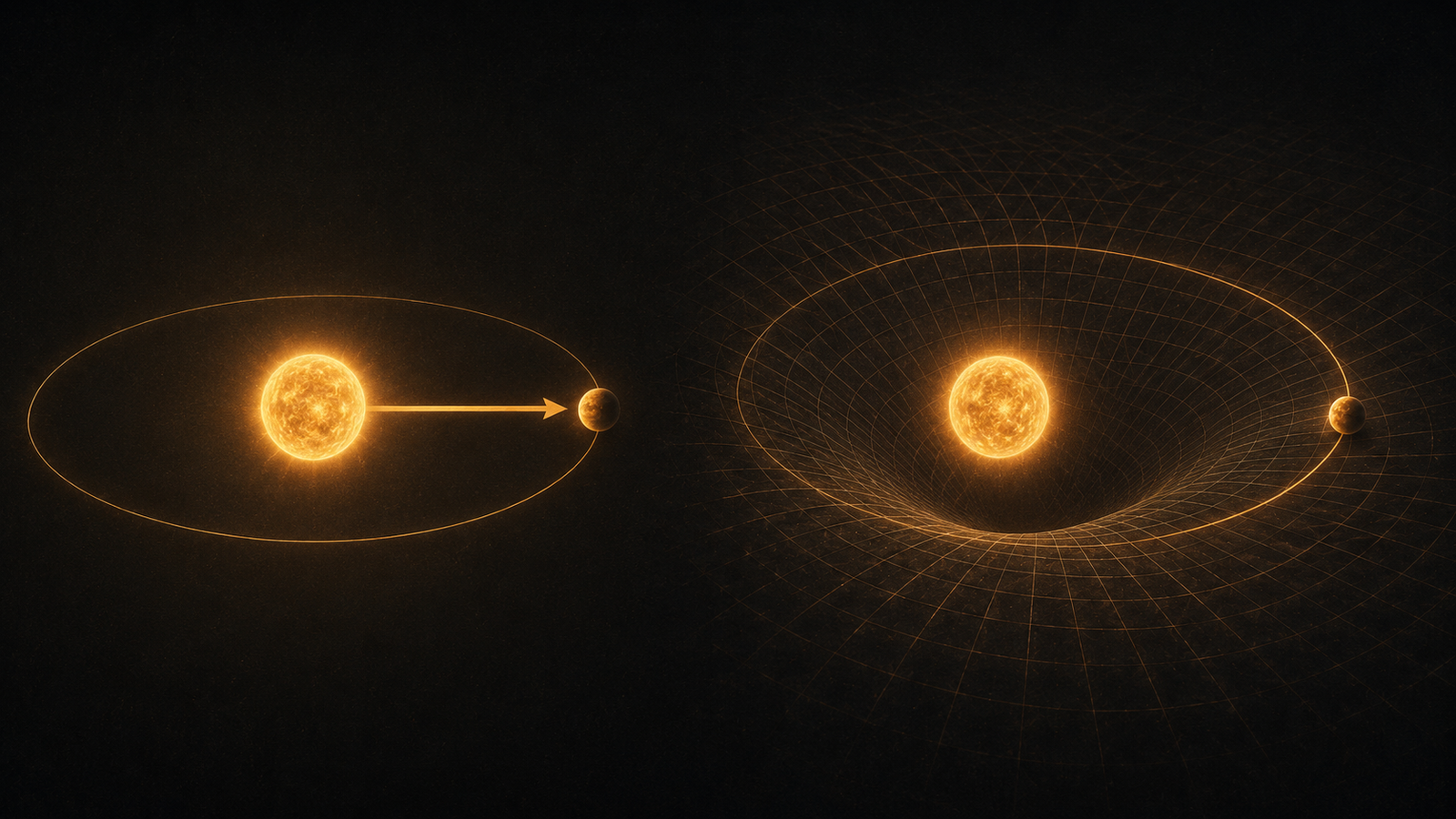
A freely falling object (no engine, rope, air resistance, or electric force) follows a spacetime geodesic. Earth is not tethered to the Sun; the Sun curves spacetime and Earth follows the straightest available path, which closes into an orbit.
On an ordinary curved surface a geodesic is the shortest path. A timelike geodesic in spacetime is different: because of the minus sign, it is the path of greatest proper time (commonly a local maximum, not minimum). Null geodesics are light’s paths, with zero proper time. Spacelike geodesics are mathematical constructs, not the history of any particle.
Astronauts float not because gravity vanishes but because they are in free fall, following a geodesic undisturbed. Weight is the sensation of something preventing you from following your geodesic: the floor pushing up on you. An accelerometer in free fall reads zero; one on a table reads about 9.8 m/s² upward. This is the equivalence principle.
Curvature still shows up as tidal acceleration: neighbouring free-fall paths converge or diverge (the cause of ocean tides), and no choice of coordinates removes it. It is the honest local signature of curvature.
Curvature is not just chalkboard theory here. The Gravity Probe B satellite tracked orbiting gyroscopes for years to measure how Earth curves and twists the spacetime around it. As the American Physical Society’s review of the results records, principal investigator C.W.F. Everitt announced a geodetic precession rate of 6602 ± 18 milliarcseconds per year and a frame dragging rate of 37.2 ± 7.2, against general relativity’s predictions of 6606 and 39.2 respectively.
For the practical side of following a geodesic, how a spacecraft actually gets into orbit and stays there, see How Hard Is Rocket Science, Really?
Part Seven: What Decides the Shape
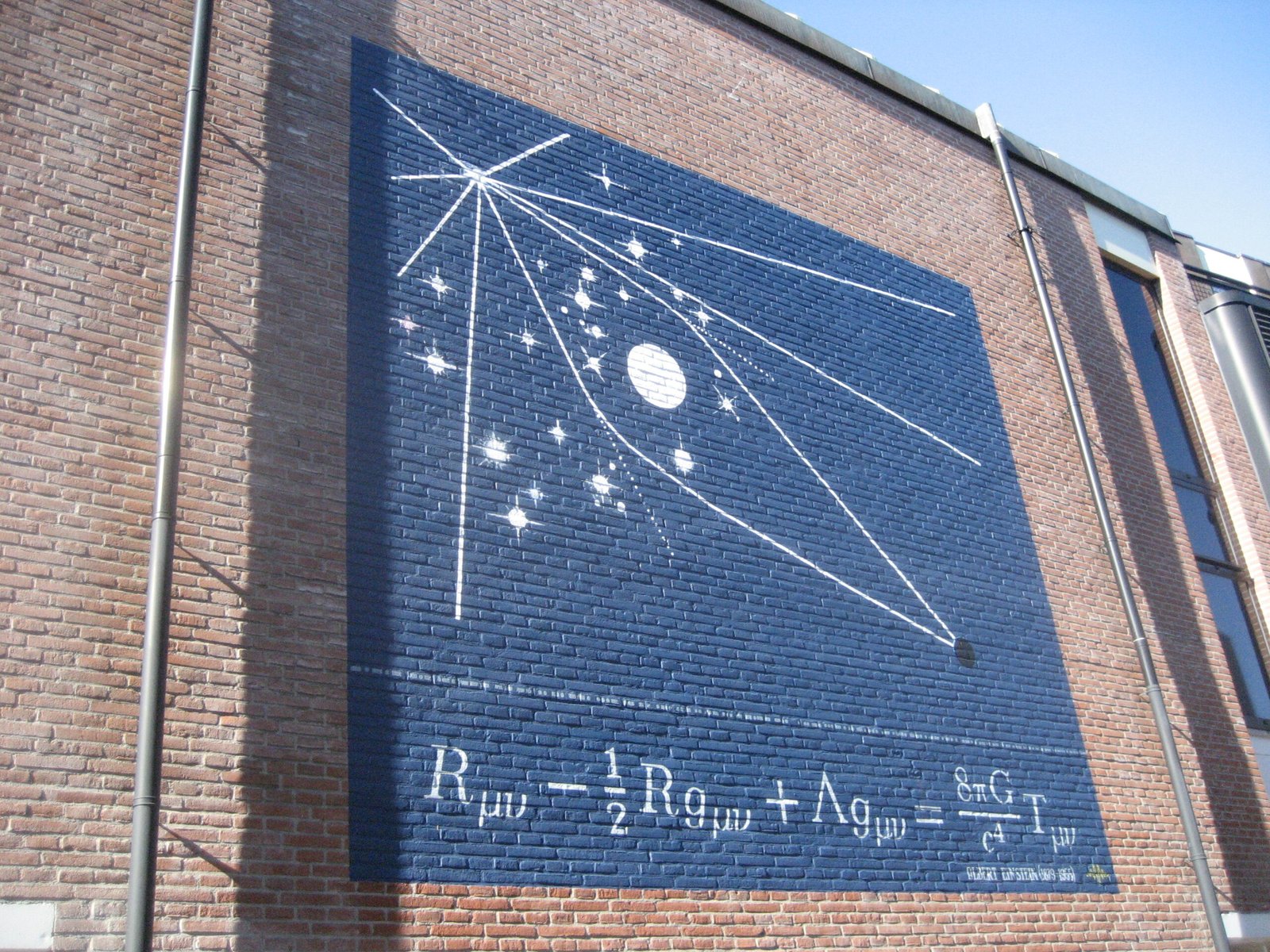
Gμν + Λgμν = (8πG/c⁴) Tμν
gμν is the metric. Gμν, the Einstein tensor, is built from the metric and its derivatives and describes curvature. Tμν, the stress-energy tensor, holds energy density, momentum, pressure and stresses. G is Newton’s gravitational constant, c the speed of light, Λ the cosmological constant.
Gμν = Rμν − ½Rgμν is built from the Ricci curvature, not the full Riemann tensor. The leftover Weyl curvature is not tied to local matter, which is why vacuum spacetime can still be curved, and why gravitational waves travel through empty space.
John Wheeler’s famous summary, that matter tells spacetime how to curve and curved spacetime tells matter how to move, is a useful first pass but loose: Tμν covers all non-gravitational energy and momentum (light, pressure included); gravitational energy itself has no ordinary local stress-energy tensor and cannot generally be localised; the equations are nonlinear; they are local differential equations requiring initial or boundary data; and geodesic motion follows from energy-momentum conservation (via the Bianchi identity) only in the appropriate test-body limit, not for every material body unconditionally.
The cosmological constant Λ is consistent with observations of cosmic expansion, but what underlies it physically, whether vacuum energy, a dynamical field, or something else, remains open.
The field equations have now been tested in their most violent regime. In their 2016 paper in Physical Review Letters, the LIGO and Virgo collaborations reported a signal sweeping upward from 35 to 250 Hz with a peak strain of 1.0 × 10⁻²¹, matching the waveform general relativity predicts for two black holes spiralling together, merging, and ringing down into one. Three years later the Event Horizon Telescope Collaboration published its image of the M87 black hole in The Astrophysical Journal Letters: an asymmetric bright ring, 42 ± 3 microarcseconds across, surrounding a central depression in brightness. A companion paper in the same issue lays out the imaging methods behind it.
The full story of how that signal was actually caught is in How We Know Einstein Was Right.
We dig into that geometry, and what it means for the edge of what we can ever observe, in What Lies Beyond the Observable Universe?
Part Eight: The Complete Definition
Spacetime is a four-dimensional Hausdorff differentiable manifold equipped with a metric tensor satisfying Einstein’s field equations. The metric determines the geodesics followed by freely falling objects.
Four-dimensional: four numbers name one event. Hausdorff: distinct points are always separable. Differentiable: overlapping charts join smoothly, so calculus and curvature are defined. Manifold: locally flat, globally possibly curved, described by an atlas. Metric tensor: the measuring rule giving proper time, distance, angles, light cones, volumes and the connection. Satisfying Einstein’s equations: curvature relates precisely to energy and momentum, with the Weyl part left free. Geodesics: the natural paths of freely falling matter and light.
Part Nine: What Remains Unsettled
General relativity is classical and does not incorporate quantum mechanics; inside black holes and at the universe’s earliest moments no confirmed theory exists. Whether spacetime is fundamental or emergent from something deeper is active research, not established fact. Whether spacetime is smooth at the Planck scale (~10⁻³⁵ m) is untested by any current experiment.
We look at exactly where general relativity runs out of road, and what a theory of quantum gravity would need to fix, in Is General Relativity Wrong?
Key Takeaways
- Spacetime is the four-dimensional collection of all events; four numbers (t, x, y, z) specify one event.
- Time enters the geometry with the opposite sign from space, producing the light cone structure of causal order, not the psychological arrow of time, which is a separate, entropy-based problem.
- Spacetime is a manifold: locally flat, globally possibly curved; coordinates are labels, and some famous “infinities” are coordinate singularities, not physical ones.
- The metric tensor (ten independent components) yields proper time, proper distance on a chosen slice, angles, null cones, volumes and the connection from which geodesics and curvature follow.
- Freely falling bodies follow timelike geodesics (locally maximising proper time); light follows null geodesics. An accelerometer in free fall reads zero; one on the ground reads real proper acceleration.
- Tidal acceleration between neighbouring free-fall paths cannot be removed by any coordinate choice; that is the true local signature of curvature.
- Einstein’s field equations are nonlinear, local, and leave the Weyl curvature unconstrained by local matter, which is why vacuum can be curved and gravitational waves can exist.
Frequently Asked Questions
What is spacetime, in one sentence a child could repeat?
Spacetime is everything that ever happens, places and moments together, treated as one shape. A map tells you where, a timetable tells you when, and spacetime is what you get when you stop treating those as separate documents. Its curvature is what we experience as gravity, and clocks and rulers both read out that same geometry.
Is spacetime a physical object or just a useful description?
Physicists genuinely disagree philosophically, but spacetime has measurable properties: it can be curved, that curvature has been detected directly, and gravitational waves carry energy, confirmed by the orbital decay of binary pulsars. Whether it is a substance, a web of relationships, or something emergent remains open.
Can spacetime exist with nothing in it?
Yes. The field equations have vacuum solutions that are not flat, gravitational waves and the geometry outside a star among them, because the equations constrain only part of the curvature locally, leaving the Weyl part free.
Does spacetime have atoms, or a smallest possible piece?
Nobody knows. General relativity treats it as smooth at every scale, untested near the Planck length. Some quantum gravity approaches propose discreteness there; none has experimental support.
Can spacetime tear?
Not in classical general relativity. Singularities inside black holes and at the universe’s start mark where the theory’s validity ends, not actual tears in a physical fabric.
Does spacetime expand, and what is it expanding into?
Distances between distant galaxies increase, described as expansion of the geometry itself. The question assumes spacetime sits inside something bigger; the mathematics requires no such outside.
Why is time treated differently from space?
The minus sign in the metric produces the light cone structure of cause and effect. It does not by itself explain why we remember the past and not the future; that is a separate, entropy-based problem.
Do I need mathematics to understand spacetime?
Not to follow the concepts, as this article shows. To actually calculate with them, using differential geometry and tensor calculus, yes, if you want actual numerical predictions.
References
- Einstein Online. “Spacetime.” Max Planck Institute for Gravitational Physics. https://www.einstein-online.info/en/explandict/spacetime/
- Einstein Online. “General Relativity.” Elementary Einstein. https://www.einstein-online.info/en/category/elementary/general-relativity-elementary/
- Will, Clifford M. “The Confrontation between General Relativity and Experiment.” Living Reviews in Relativity 17, article 4, 2014. https://link.springer.com/article/10.12942/lrr-2014-4 (also available as an arXiv preprint)
- Bothwell, T. et al. “Resolving the gravitational redshift across a millimetre-scale atomic sample.” Nature 602, 2022, pp. 420 to 424. https://www.nature.com/articles/s41586-021-04349-7
- NIST publication record, 2022. https://www.nist.gov/publications/resolving-gravitational-redshift-across-millimetre-scale-atomic-sample
- Abbott, B. P. et al. (LIGO/Virgo). “Observation of Gravitational Waves from a Binary Black Hole Merger.” Phys. Rev. Lett. 116, 061102, 2016. https://link.aps.org/doi/10.1103/PhysRevLett.116.061102
- American Physical Society. “Finally, results from Gravity Probe B.” Physics 4, 43, 2011. https://physics.aps.org/articles/v4/43
- Event Horizon Telescope Collaboration. “First M87 EHT Results I.” ApJL 875, L1, 2019. https://iopscience.iop.org/article/10.3847/2041-8213/ab0ec7
- Event Horizon Telescope Collaboration. “First M87 EHT Results VI.” ApJL 875, L6, 2019. https://iopscience.iop.org/article/10.3847/2041-8213/ab1141
Join the discussion
Comments are moderated and may take a little while to appear.