
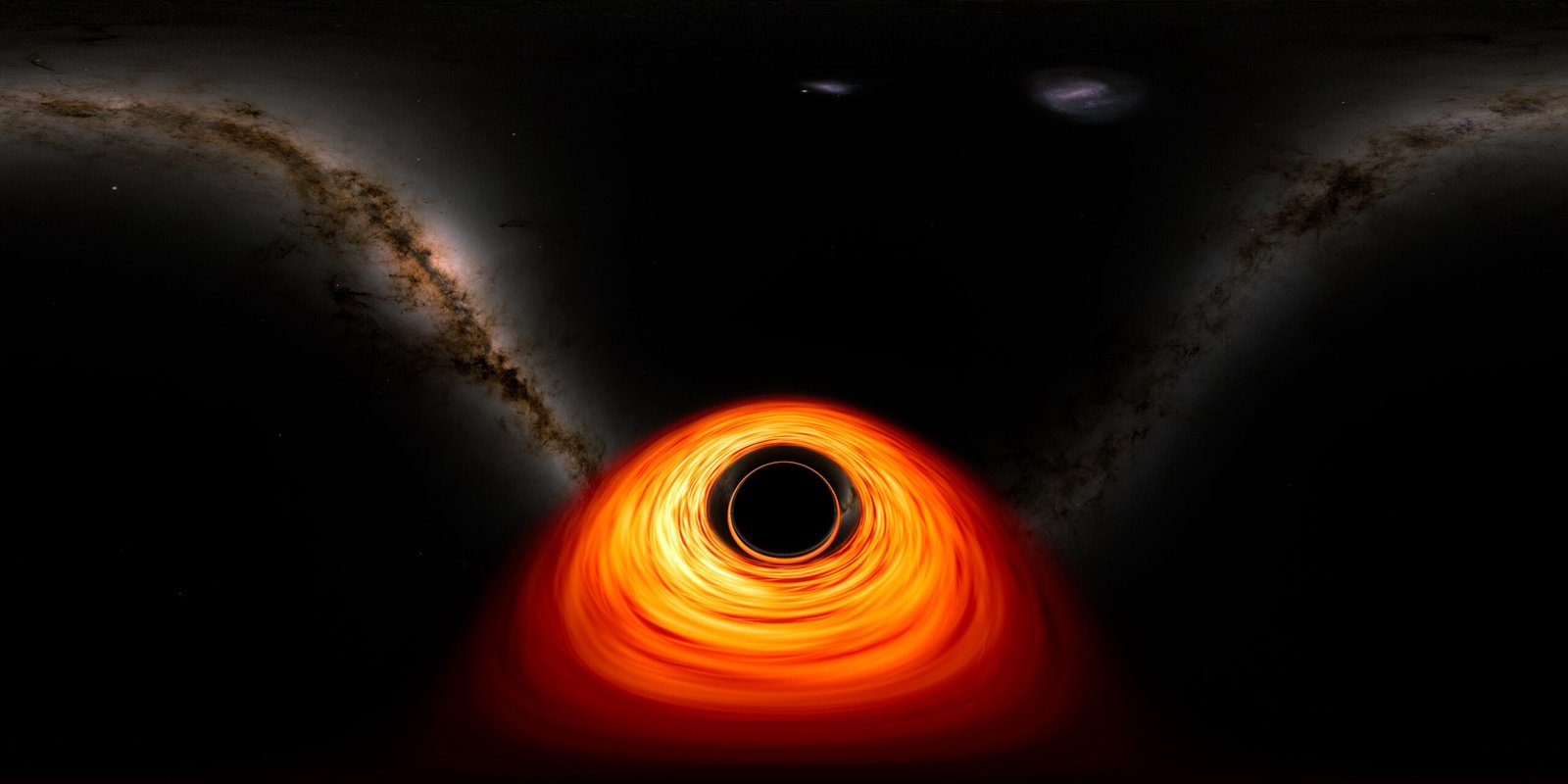
In April 2019, the Event Horizon Telescope collaboration released the first direct image of a black hole, a blurred ring of light wrapped around a dark core roughly forty billion kilometers across. That image confirmed something physicists had already worked out from Einstein’s equations decades earlier: cross into that dark core, and nothing that goes in, not light, not information, not a spacecraft firing every engine it has, ever comes back out.
What if you fell into a black hole? It is a question physics can actually answer, and the answer depends heavily on one detail most people never think to ask about: how big the black hole actually is. Picture a spacecraft drifting toward the nearest one, already close enough that turning back is no longer an option. What happens next is not guesswork. General relativity, the theory Einstein published in 1915 and the only theory ever to correctly predict that black holes exist in the first place, describes the fall in exact mathematical detail.
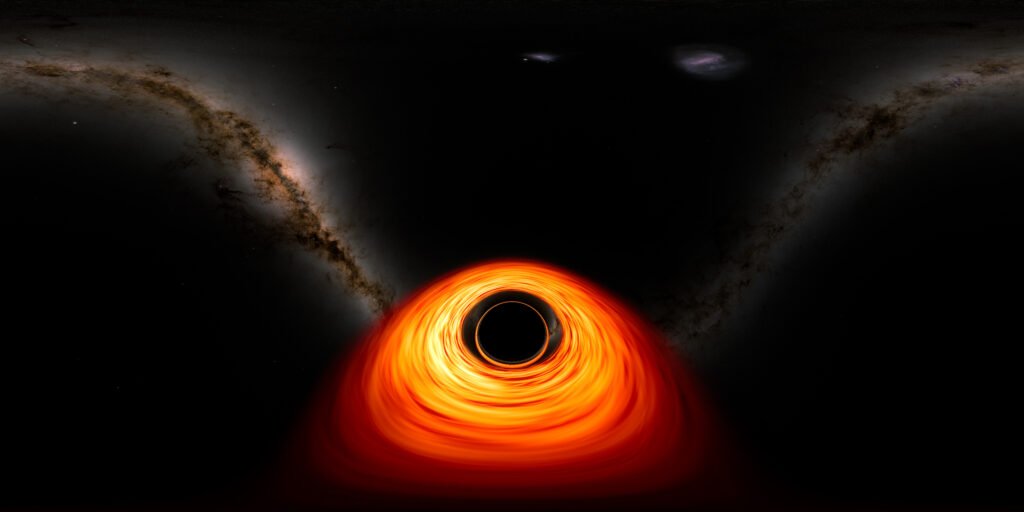
Physicists call the edge of that dark region the event horizon. A simple way to picture it is a one way waterfall. Nothing about the surface of the water marks the exact spot where the current becomes too strong to swim back against, but past that point the outcome is already decided, whether the swimmer notices or not. The event horizon works the same way for anything falling toward a black hole, a spacecraft included.
NASA describes it more formally as the boundary surrounding a black hole beyond which escape becomes physically impossible, no matter how powerful the engine pushing against it. It is not a physical surface. There is nothing to bump into and nothing that would look unusual as you approached it from a distance.
That last point surprises most people. General relativity’s equivalence principle means there is no local experiment that can tell you exactly where the horizon is while you are falling through it. You would not feel a jolt, hear an alarm, or see a wall of light. You would simply continue falling, already committed to a one way trip, without any signal marking the moment your fate was sealed.
The Fall Begins: Tidal Forces and Spaghettification
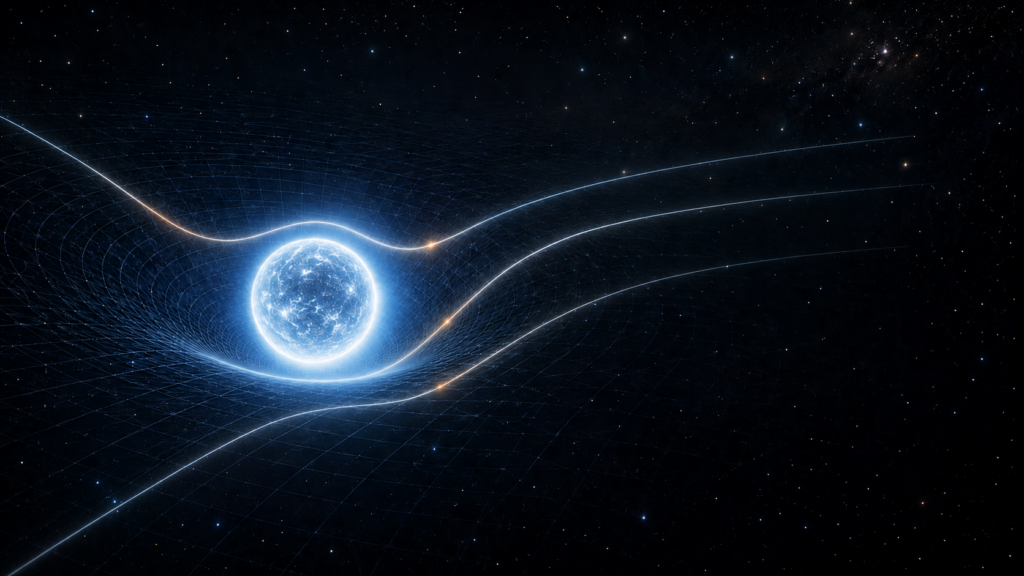
Long before reaching the horizon of a small black hole, your body would start to feel the effects of gravity pulling unevenly on different parts of it. NASA explains that any object approaching a black hole experiences tidal forces, the same basic effect that gives Earth its ocean tides, except scaled up to extreme levels. The part of you closer to the black hole gets pulled far harder than the part farther away.
As the difference grows, you would be stretched along the direction of the fall and squeezed from the sides, a process physicists call spaghettification.
For an average sized stellar mass black hole, this stretching becomes lethal hundreds of kilometers before you even reach the event horizon. Your body would be pulled apart well outside the point of no return.
What If You Fell Into a Black Hole of a Different Size?
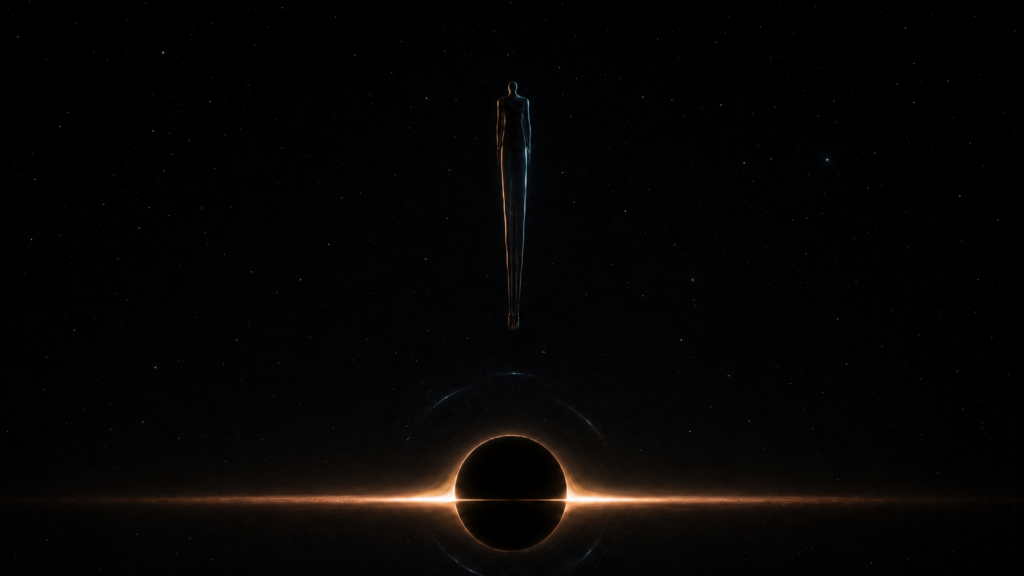
Here is the twist that most people never hear about: bigger black holes are gentler, not harsher. Tidal force at the event horizon actually gets weaker as a black hole’s mass increases, scaling with the inverse square of the mass. According to Wikipedia’s summary of supermassive black hole physics, a person crossing the horizon of a black hole with 10 million solar masses would feel roughly the same tidal stretching between head and feet as they do standing on Earth right now, nothing dramatic at all.
That means falling into Sagittarius A*, the supermassive black hole at the center of our own galaxy with about 4.3 million solar masses, would not shred you at the horizon. Falling into a black hole only a few times the mass of our Sun almost certainly would, long before you got there. Size, in this one specific sense, is protective. Mass, along with spin and electric charge, is also one of only a handful of properties a black hole has in the first place, a fact explored further in Astrinova’s piece on why black holes have no hair.
What an Outside Observer Would See
If a friend stayed behind on a spaceship and watched you fall, they would never actually see you cross the horizon. As Astronomy Magazine’s Ask Astro column explains, light climbing out of a black hole’s gravity well gets progressively more redshifted and dimmer the closer its source gets to the horizon. Your friend would watch you fall slower and slower, redden, and fade, approaching the horizon forever without ever appearing to touch it.
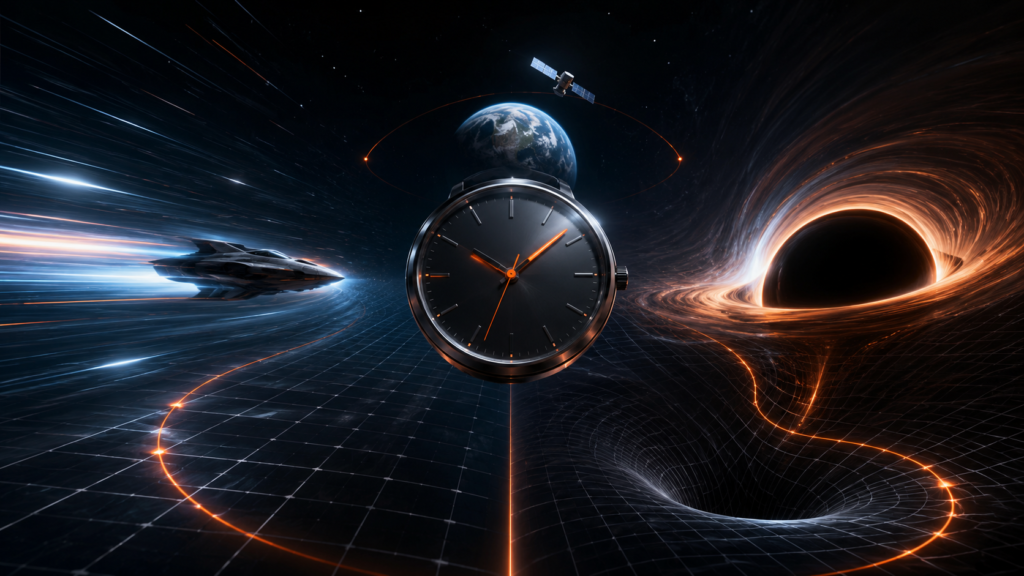
This is a real prediction of general relativity, not an optical trick. Time itself runs at different rates for you and your friend because of gravitational time dilation, the same effect, on a vastly smaller scale, that lets GPS satellites keep accurate time only after their clocks are corrected for the weaker gravity they experience in orbit. Gravitational time dilation is one of several real world confirmations of general relativity covered in Astrinova’s rundown of experiments that proved Einstein right.
What You Would Actually Experience
From your own point of view, the story is completely different. You would not feel yourself slow down, and you would not see the universe outside freeze. According to the physics education resource LibreTexts, an observer falling toward a black hole crosses the event horizon in a finite amount of their own time, feeling nothing unusual at the moment of crossing.
The mismatch between what you experience and what your friend sees is not a contradiction. It is one of general relativity’s cleanest lessons: time and simultaneity are not universal. Two observers in sufficiently different gravitational environments can have genuinely different, equally valid accounts of when an event happened.
The Journey Inside: Racing Toward the Singularity
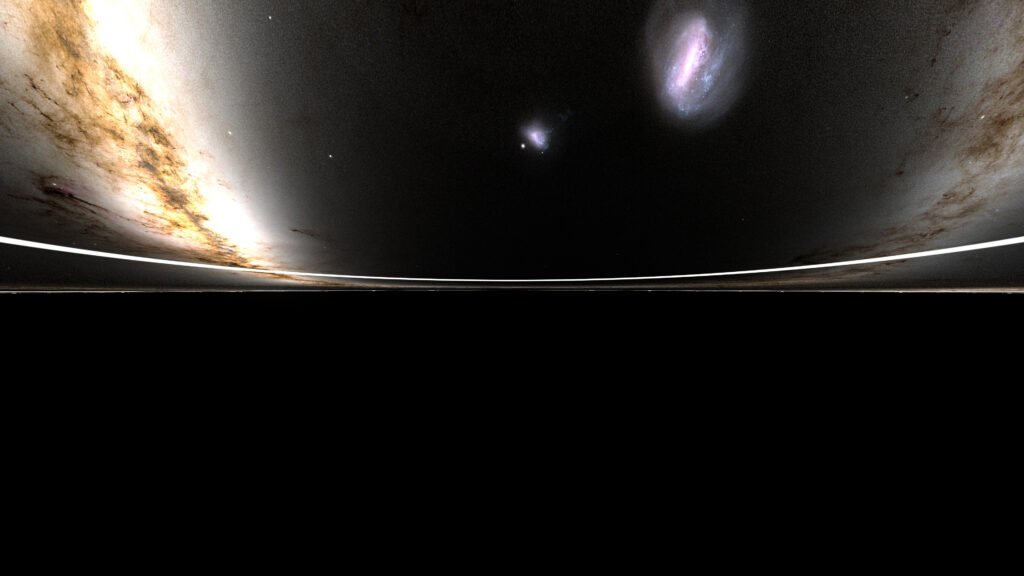
Once past the horizon, there is no stopping, no hovering, and no changing your mind. Inside a black hole, the roles of space and time effectively swap. Moving toward the singularity becomes as unavoidable as moving forward in time is for the rest of us. Every possible path, no matter how you steer or fire your engines, leads inward.
How long that final leg takes depends entirely on the black hole’s mass. A 2007 physics paper by Geraint F. Lewis and Juliana Kwan, working through the standard general relativity equations, calculated the maximum proper time an infalling observer can survive between the horizon and the singularity, and showed it scales directly with the black hole’s mass. For a stellar mass black hole, that trip lasts a tiny fraction of a second. For a supermassive black hole, the same calculation stretches to hours, with nothing violent happening for most of that fall.
What the Singularity Represents
Eventually, whether the trip takes a fraction of a second or the better part of a day, you would reach the singularity, the point where general relativity predicts that spacetime curvature and density become infinite. The equations of general relativity simply stop making sensible predictions there. As the Stanford Encyclopedia of Philosophy notes in its entry on spacetime singularities, the theory itself signals its own breakdown at this point rather than describing what physically happens.
Physicists generally agree this signals that general relativity is incomplete at these scales, not that infinities are literally realized in nature. A full description would require a theory of quantum gravity that does not yet exist. What is well established, through the Penrose singularity theorems that helped earn Roger Penrose a share of the 2020 Nobel Prize in Physics, is that once you cross the horizon of a black hole that has no rotation or charge, reaching some kind of singularity is mathematically unavoidable.
Whether You Could Ever Come Back Out
This is where established science ends and speculation begins. Some exact solutions to Einstein’s equations, including the mathematically idealized eternal black hole, technically connect to a separate region sometimes called a white hole or an Einstein Rosen bridge, a type of wormhole. It is a genuine feature of the math for these simplified, non realistic cases.
Almost all physicists agree this does not describe real black holes. Real black holes form from collapsing stars, not from an idealized eternal geometry, and the interior structure that would allow a passage through almost certainly does not survive contact with real infalling matter and radiation. Any depiction of using a black hole to travel somewhere else remains firmly in the territory of speculation, not a demonstrated consequence of general relativity.
Why This Matters
Working through what if you fell into a black hole is more than a thought experiment for late night curiosity. It forces a genuinely rigorous theory, tested to extraordinary precision by gravitational wave detections and the Event Horizon Telescope’s black hole images, to make concrete predictions about an environment no laboratory on Earth could ever recreate. It also cleanly separates settled science, the existence of event horizons, tidal forces, and time dilation, from the genuine open frontier of what happens at a singularity, where physicists know their current theories run out of answers.
Key Takeaways
- The event horizon is a boundary of no return, but crossing it produces no local sensation or detectable signal.
- Tidal forces, not the horizon itself, are usually what would kill you, and smaller black holes are more dangerous at the horizon than larger ones.
- An outside observer would never actually see you cross the horizon, watching you redden and fade instead, due to gravitational time dilation.
- From your own perspective, you would cross the horizon and reach the singularity in a finite amount of time, ranging from a fraction of a second to several hours depending on the black hole’s mass.
- What happens exactly at the singularity is not yet known, since general relativity’s equations break down there and a full theory of quantum gravity does not yet exist.
FAQs
Would you feel anything crossing a black hole’s event horizon?
For a sufficiently large black hole, no. Crossing the horizon itself produces no local, detectable sensation, though tidal forces would grow steadily worse as you continued inward.
Do all black holes kill you instantly?
No. Tidal forces at the horizon are weaker for more massive black holes. A supermassive black hole like the one at the center of our galaxy would not tear you apart at the horizon, though the deeper interior remains lethal.
Would someone watching you fall in ever see you disappear?
Not exactly. They would see you appear to slow down, redden, and fade due to gravitational time dilation and redshift, without ever seeing you actually cross the horizon.
Can you escape a black hole once you cross the horizon?
According to general relativity, no. Every possible path inside the horizon leads inward toward the singularity, with no route back out.
Could a black hole be a shortcut to somewhere else, like in science fiction?
Only in simplified, idealized mathematical solutions that do not describe real black holes. There is no evidence this applies to actual black holes formed from collapsing stars.
References
- NASA Science, What Happens When Something Gets Too Close to a Black Hole: science.nasa.gov
- Wikipedia, Supermassive Black Hole (tidal force at the event horizon): en.wikipedia.org
- Astronomy Magazine, Ask Astro: Can an Observer Ever See Something Fall Into a Black Hole?: astronomy.com
- LibreTexts, Falling Into a Black Hole (Basic Astronomy course materials): phys.libretexts.org
- Lewis, G. F. and Kwan, J., No Way Back: Maximizing Survival Time Below the Schwarzschild Event Horizon, arXiv:0705.1029 (Publications of the Astronomical Society of Australia, 2007): arxiv.org
- Stanford Encyclopedia of Philosophy, Singularities and Black Holes: plato.stanford.edu
- Einstein Online (Max Planck Institute for Gravitational Physics), The Singularity Theorem, Nobel Prize in Physics 2020: einstein-online.info
Join the discussion
Comments are moderated and may take a little while to appear.