
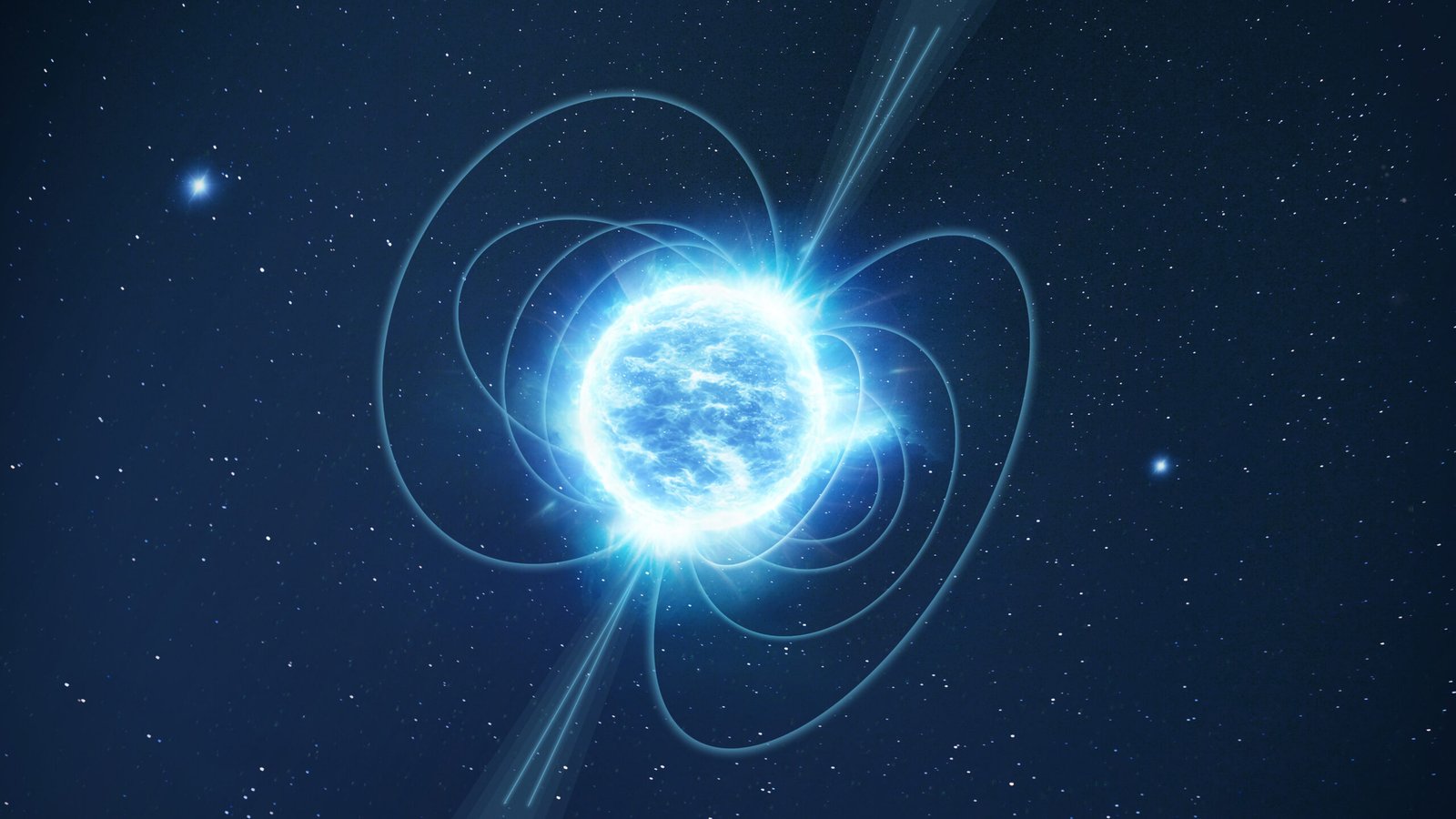
About fifty days after a distant star finished exploding, its light did something it wasn’t supposed to do. Instead of fading smoothly into darkness the way a dying supernova normally does, the brightness kept bumping upward in four distinct pulses, each one arriving faster than the last. Astronomers who studied that pattern have now traced it back to something nobody had ever caught in the act before: the birth of a magnetar.
What Is a Magnetar?
A magnetar is a neutron star with an extraordinarily powerful magnetic field, thousands of times stronger than an ordinary neutron star’s, and often a spin fast enough to complete hundreds of rotations every second. Neutron stars themselves form when a massive star runs out of fuel and its core collapses under its own gravity, squeezing roughly one and a half times the mass of the Sun into a sphere barely 20 kilometers across.
Most of what’s left behind after a supernova is an ordinary neutron star. A magnetar is the rare, extreme version, one so magnetically violent that scientists have long suspected it could power some of the brightest explosions in the universe. Until now, that suspicion had never been confirmed by a direct observation.
The Supernova That Wouldn’t Fade
The event responsible is called SN 2024afav, discovered in December 2024 and sitting more than a billion light years from Earth. It belongs to a category known as superluminous supernovae, explosions that shine at least ten times brighter than a typical star’s death and stay bright for months instead of weeks. Since astronomers first identified this class of supernova in the early 2000s, the extra brightness has been a genuine puzzle. A normal supernova gets its glow from the radioactive decay of elements forged in the blast. That mechanism alone can’t account for a superluminous event’s extended, extreme light.
In 2010, UC Berkeley theorist Dan Kasen proposed an answer: a newborn magnetar at the heart of the explosion, using its spinning magnetic field to accelerate charged particles that slam into the surrounding debris, feeding energy into the wreckage for months after the initial blast. The idea explained the numbers well. What it lacked was direct proof.
A Four Beat Chirp
That’s what changed with SN 2024afav. A team led by Joseph Farah, a researcher at UC Santa Barbara and the Las Cumbres Observatory, tracked the supernova with high cadence, multiband observations, essentially taking frequent, detailed brightness readings across several wavelengths of light. Around fifty days after peak brightness, the smooth decline gave way to something unusual: four separate bumps in brightness, each one arriving at shorter intervals than the one before it. Astronomers describe an oscillating signal that speeds up over time as a chirp, the same basic pattern gravitational wave detectors picked up when they first recorded two black holes spiraling together.
Here, the chirp wasn’t gravitational waves. It was light. And the team, publishing their results in Nature, traced its cause to a tilted disk of material spinning around the newly formed magnetar.
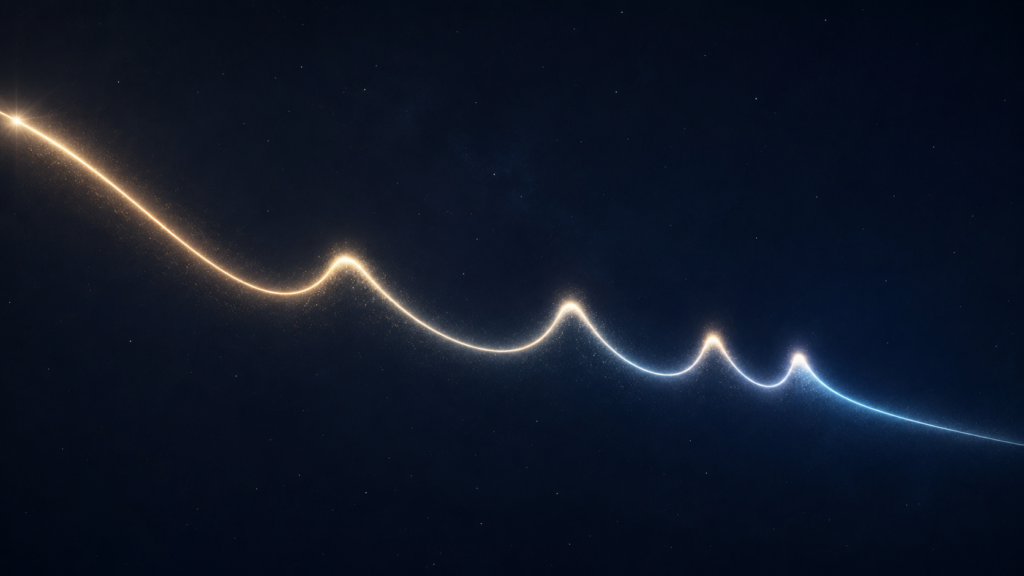
A stylized illustration of the light-curve chirp in SN 2024afav, four brightness pulses arriving at shortening intervals as the magnetar’s disk precesses. This is an AI-generated illustration, not the actual data plot.
Where Einstein Comes In
A spinning, extremely dense object doesn’t just sit in space, it drags the fabric of spacetime around itself, an effect general relativity predicts and calls frame dragging, or more formally, Lense Thirring precession. Around an object as compact and rapidly spinning as a magnetar, that drag is strong enough to make a tilted accretion disk wobble, the same way a spinning top slowly tips and circles before it settles. As the disk spirals inward toward the magnetar, that wobble speeds up, and each wobble produces a brightening pulse. Four wobbles, four pulses, each one closer together than the last: the chirp.
This is, according to the researchers, the first observational evidence of the Lense Thirring effect showing up around a magnetar. It’s also the detail that let them measure something that would otherwise be invisible.
Measuring a Star You Can’t See Directly
Neither the magnetar nor its disk can be resolved by any telescope; SN 2024afav is a billion light years away, and the object itself is smaller than a city. But the chirp’s timing carries information. By modeling how quickly the precession accelerated, Farah’s team calculated that the magnetar spins once every 4.2 milliseconds, roughly 240 times a second, with a magnetic field around 1.6 times ten to the fourteenth power gauss. For comparison, that’s about 300 trillion times stronger than Earth’s own magnetic field.
“This is definitive evidence for a magnetar forming,” said co-author Alex Filippenko, describing the observation.
Two independent lines of evidence, the overall shape of the light curve and the timing of the four bumps within it, pointed to the same magnetar properties. That agreement is what turns a suggestive pattern into a confirmed detection.
Why This Matters
For sixteen years, the magnetar engine model existed mostly as a well argued theory fit to smooth, general light curves, the kind of evidence that’s persuasive but not conclusive. SN 2024afav gives astrophysics something closer to a signature, a specific, physically predicted pattern that can only be explained by a spinning magnetar and general relativity acting together. It doesn’t mean every superluminous supernova works this way. It does mean at least one confirmed case now exists, and with it, a template for finding more.
That template arrives at a useful moment. The Vera C. Rubin Observatory, now conducting its Legacy Survey of Space and Time, is designed to scan the entire visible sky repeatedly, catching exactly the kind of fast changing brightness patterns that revealed SN 2024afav’s chirp. Researchers involved in this discovery expect Rubin to turn up dozens more chirping supernovae in the years ahead, each one a chance to test how consistently magnetars power the universe’s brightest deaths.
Key Takeaways
- What is a magnetar? A neutron star with an extreme magnetic field and typically a very fast spin, formed when a massive star’s core collapses.
- Astronomers observed SN 2024afav, a superluminous supernova a billion light years away, produce four accelerating brightness pulses roughly fifty days after peak brightness.
- The pattern, a light curve chirp, matches what general relativity predicts from a tilted disk precessing around a newly formed magnetar.
- The measured magnetar spins every 4.2 milliseconds with a magnetic field about 300 trillion times stronger than Earth’s.
- The discovery confirms a sixteen year old theory and gives astronomers a specific signal to search for in future supernovae.
References
- Farah, J.R., Prust, L.J., Howell, D.A., et al. “Lense-Thirring precessing magnetar engine drives a superluminous supernova.” Nature 651, 321-325 (2026). DOI: 10.1038/s41586-026-10151-0
- Ingram, A. “Magnetar emergence in a superluminous supernova.” Nature News & Views (2026). DOI: 10.1038/d41586-026-00490-3
- University of California, Berkeley. “Astronomers capture birth of a magnetar, confirming link to some of universe’s brightest exploding stars.” Berkeley News, March 11, 2026.

Join the discussion
Comments are moderated and may take a little while to appear.