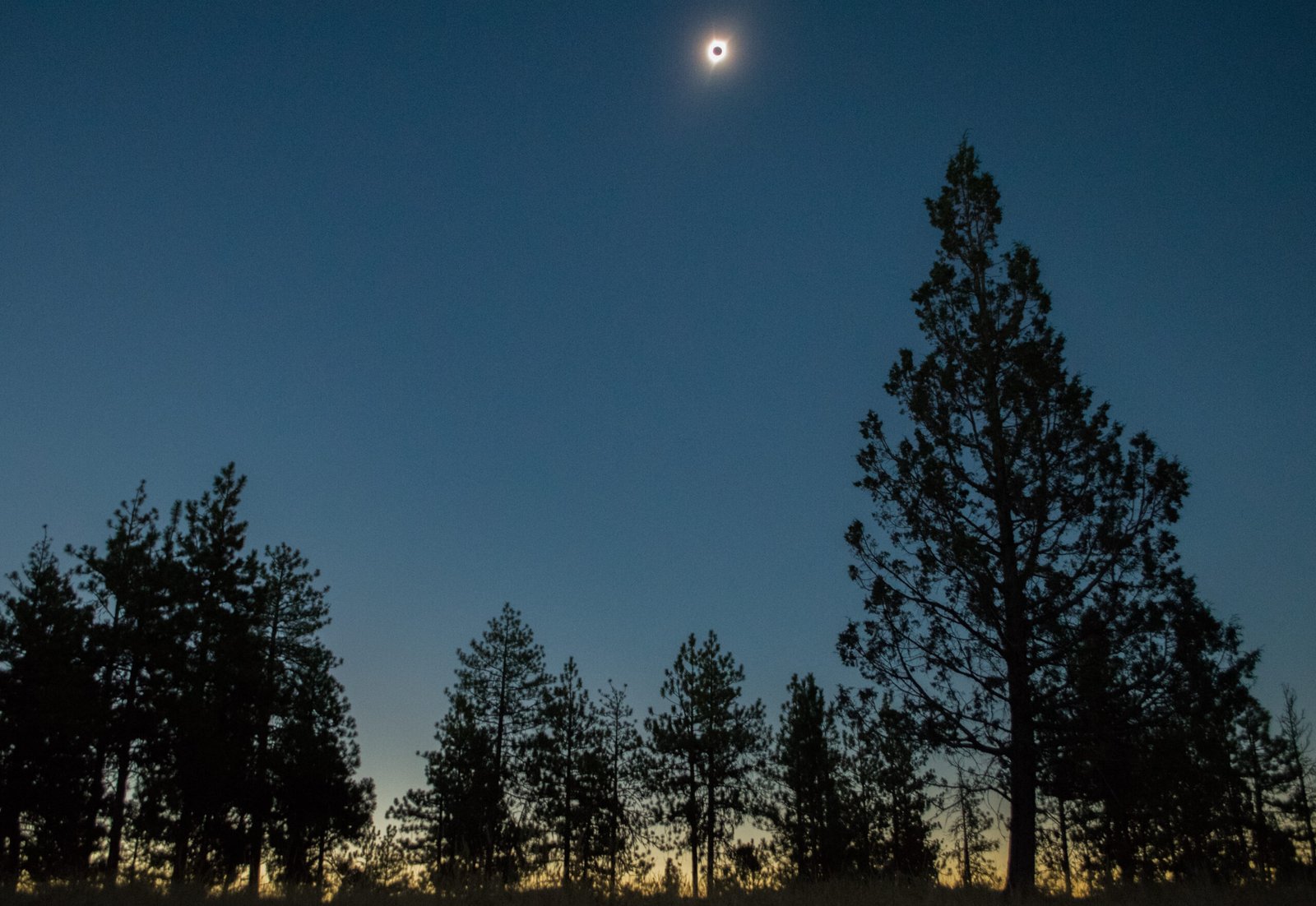
Five weeks from now, on the evening of August 12, 2026, the Sun will go dark over northern Spain. It will be the first total solar eclipse visible from mainland Europe since 1999, and the first from Spain since 1905. Then, almost exactly one year later, on August 2, 2027, an even greater eclipse will cross North Africa and the Middle East, holding the Sun in darkness for as long as 6 minutes and 23 seconds. Nothing on land will match it again until 2114.
Two total eclipses in twelve months, both reachable from Europe, Africa, and Asia, is a rare alignment of fortune. But the two events could hardly be more different in character. One is brief, low on the horizon, and painted in sunset colors. The other is long, high, and staged over the deserts of Egypt. Understanding that difference is the key to planning for either one.
See the real motion
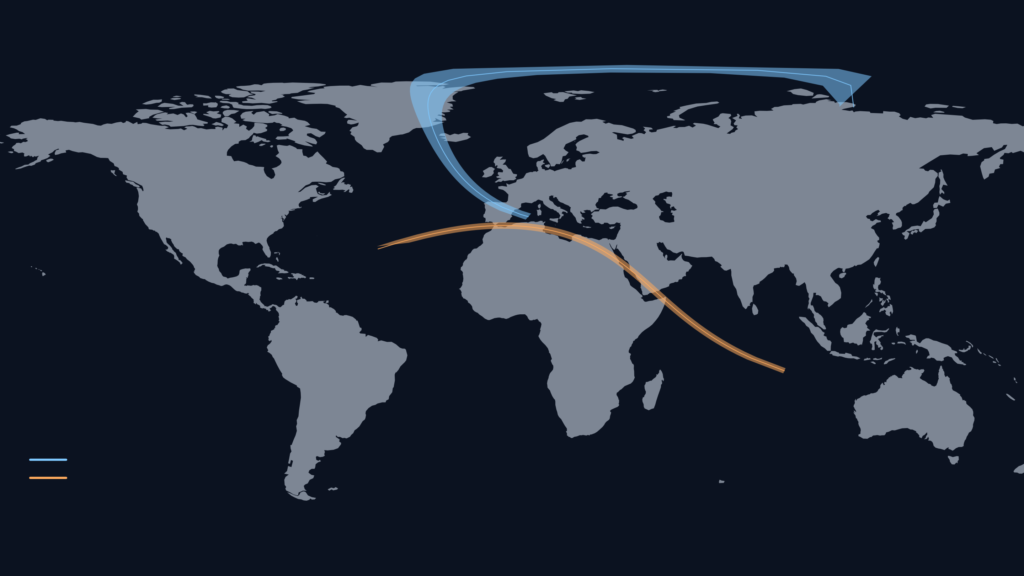
This map shows the true path and width of both eclipses. NASA also publishes the actual animated version of each one. Watch the shadow move across the 2026 eclipse or the 2027 eclipse directly from NASA.
The eclipse of August 12, 2026
The 2026 eclipse follows one of the strangest paths of any eclipse this century. Most eclipse tracks race across the planet roughly west to east. This one begins at local midnight sunrise on the Taymyr Peninsula in Arctic Russia, arcs over the top of the world about a hundred kilometers from the North Pole, then drops southward across eastern Greenland, the west of Iceland, and the open Atlantic before making landfall on the Iberian Peninsula in the evening.
The Moon’s shadow, roughly 290 kilometers wide, completes the entire journey in about 96 minutes.
Totality is short everywhere along this path. The maximum, 2 minutes and 18 seconds, occurs over the ocean just west of Iceland. On land, the best window belongs to Iceland’s western edge. The cliffs of Látrabjarg in the Westfjords get about 2 minutes and 13 seconds, and the shadow then crosses the Snæfellsnes peninsula and Reykjavík itself. It is the first total eclipse seen from Reykjavík since 1433. For Reykjavík, the wait has lasted almost six centuries.
The last time the Moon’s shadow crossed Reykjavík, Gutenberg had not yet printed a book.
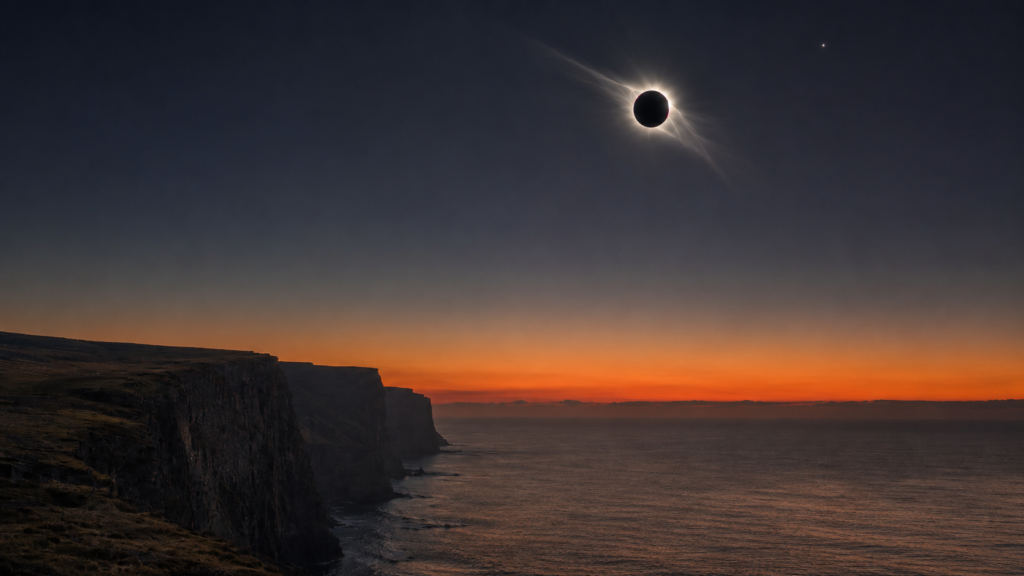
This is an illustration of what totality should look like from the cliffs of Latrabjarg, based on the eclipse’s real position and timing. The event itself has not happened yet at the time of publication.
Then comes Spain. The shadow arrives at the Galician coast around 8:27 in the evening local time and sweeps across the northern half of the country, passing over A Coruña, Oviedo, León, Bilbao, Zaragoza, and Valencia before ending near Palma de Mallorca at sunset. Madrid and Barcelona sit just outside the path. Close is not enough. A 99 percent partial eclipse and a total eclipse are not similar experiences, and the difference between them is the difference between a dimmed afternoon and seeing the Sun’s atmosphere with your own eyes.
Spanish viewers face one specific challenge. Because Spain lies at the end of the eclipse track, totality happens with the Sun very low, roughly 10 degrees above the horizon or less, only minutes before sunset. In A Coruña the Sun stands at 12 degrees during its 76 seconds of totality. In Palma it will hang barely 2 degrees above the sea. Anyone planning to watch from Spain needs a completely open western horizon: a coastline, a ridge, a high rooftop. A single hill or apartment block in the wrong place will erase the event entirely.
The compensation is beauty. A totally eclipsed Sun near the horizon, ringed by its pale corona and surrounded by sunset light along the entire horizon, is one of the rarest sights in observational astronomy. August also happens to be one of the most reliably clear months across northern Spain.
For readers in North America, the news is more modest. The United States and Canada will see only a partial eclipse. Alaska gets a substantial one in the morning. Across the northern contiguous states, from Montana eastward, the Moon will take a small bite from the solar disk beginning around midday and lingering into the early afternoon, with the deepest coverage in the Northeast and Atlantic Canada, the regions closest to the totality path. A partial eclipse is worth stepping outside for, but it demands proper eye protection from the first moment to the last, because the exposed part of the Sun remains as dangerous as ever.
The eclipse of August 2, 2027
If 2026 is the elegant eclipse, 2027 is the monumental one.
On August 2, 2027, the Moon’s shadow crosses the Strait of Gibraltar, clips southern Spain, then runs the length of North Africa through northern Morocco, Algeria, Tunisia, and Libya into central Egypt, before continuing across the Red Sea to southwest Saudi Arabia, Yemen, and the tip of Somalia. The shadow is wider than in 2026, about 258 kilometers, and takes over three hours to cross the planet.
The number that sets this eclipse apart is its duration. At the point of greatest eclipse, near Luxor in Egypt, totality lasts 6 minutes and 23 seconds. That is the longest totality experienced on land since 1991, and no eclipse will exceed it until 2114. Almost everyone alive today gets exactly one chance at an eclipse like this.
No one alive today will see a longer eclipse from land. The next one arrives in 2114.
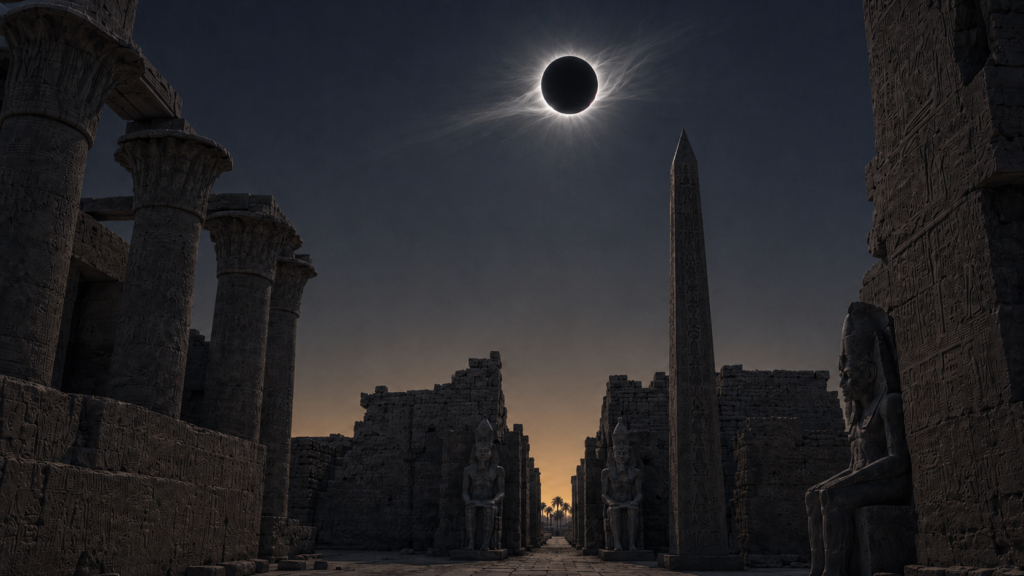
This is an illustration of what totality should look like above the temples of Luxor, based on the eclipse’s real position and timing. The event itself has not happened yet at the time of publication.
Six minutes changes what an eclipse feels like. In a two minute totality, the experience is a controlled panic: glasses off, look up, try to absorb the corona, and it is already ending. In six minutes there is time. Time to watch the corona’s streamers, to notice planets appearing in a daytime sky, to feel the temperature fall, to look at the strange metallic light on the landscape, and then to simply stand there while the Sun remains a black disk wrapped in its atmosphere.
The geography carries a warning, though. Upper Egypt in early August routinely reaches 43 degrees Celsius. Luxor offers nearly guaranteed clear skies and the surreal backdrop of ancient temples under a black Sun, but watching from there means planning for extreme heat: shade, water, and transport arranged well in advance. Southern Spain and the Mediterranean coast of North Africa offer shorter totality with gentler conditions. Cruise ships are already booking routes near the Strait of Gibraltar, while the stretch of the Mediterranean off Tunisia and Libya has some of the most dependable August skies anywhere along the track.
Why one eclipse lasts three times longer than the other
This NASA animation shows how the Moon’s umbral and penumbral shadows sweep across Earth during a total eclipse. It depicts the 2017 eclipse as an example, but the same geometry applies to both the 2026 and 2027 events. Credit NASA Scientific Visualization Studio, Ernie Wright.
The gap between 2 minutes and 6 minutes is not luck. It comes from orbital geometry, and the logic is simple once laid out.
A total eclipse happens when the Moon’s apparent disk fully covers the Sun’s. How long it stays covered depends on how large the Moon appears, how large the Sun appears, and how fast the shadow moves across the ground.
The apparent sizes are actually quite similar in both years. Both eclipses catch the Moon near perigee, the closest point of its orbit, so it looks larger than average. Both fall in August, a few weeks after Earth’s greatest distance from the Sun, so the Sun looks slightly smaller than average. A larger Moon covering a smaller Sun buys extra darkness either way, and the 2027 Moon is only a little closer than the 2026 one.
The decisive difference is where the shadow lands. The 2027 track runs close to the equator, where the rotating surface of the Earth moves in nearly the same direction as the Moon’s shadow. The ground effectively chases the shadow, cutting its speed and letting darkness linger. The 2026 path, by contrast, skims the high Arctic, where Earth’s rotation offers almost no help. The result is a shadow that sprints across Iceland and strolls across Egypt.
How to watch without damaging your eyes
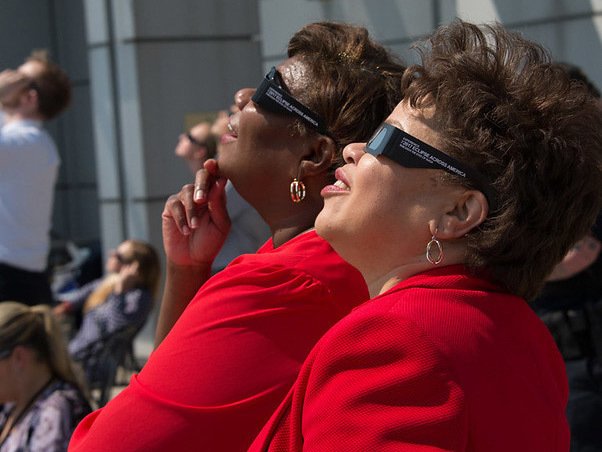
NASA employees wear protective glasses to view a partial solar eclipse from the rooftop at NASA Headquarters in Washington, DC, on August 21, 2017. Credit NASA, Connie Moore.
The rules of eclipse safety are strict because the injury they prevent is permanent. Solar retinopathy, the burning of the retina by focused sunlight, is painless while it happens and often irreversible.
During every partial phase of either eclipse, the Sun must only be viewed through proper solar filters. That means eclipse glasses or handheld viewers meeting the ISO 12312-2 international standard, which are thousands of times darker than any sunglasses. Ordinary sunglasses, no matter how dark, are never safe. Neither are smoked glass, exposed film, CDs, or any of the folk remedies that resurface before every eclipse.
A printed ISO number on the packaging is not proof of safety, because anyone can print one. The American Astronomical Society advises buying only from manufacturers and resellers it has verified through accredited laboratory testing, and it publishes a list of them. A quick home check helps too: through genuine eclipse glasses, indoors, you should see essentially nothing except perhaps the faint glow of a bright lamp. If everyday objects are visible, the filters are not dark enough. Torn, scratched, or loose filters should be thrown away.
Optics demand even more caution. Never point a camera, telescope, or pair of binoculars at the Sun while wearing eclipse glasses. Concentrated sunlight will burn through the filter in seconds and reach the eye. Any optical instrument needs a purpose made solar filter mounted on the front, where the light enters, not at the eyepiece.
There is one exception to all of this, and it is the entire reason people travel across the world for these events. During totality, and only during totality, when the Moon completely covers the Sun’s bright face, it is safe to look directly at the eclipse with the naked eye. The moment the first sliver of Sun returns, the glasses go back on.
Photographing the eclipse without missing it
A smartphone can capture a total eclipse, with realistic expectations. Phone shots work best during totality itself, held steady or braced on something solid, ideally with manual exposure settings, and framed wide enough to include the landscape and the people around you. The wide shot, with the darkened sky and the glowing horizon, often ends up being the photograph that actually communicates what totality felt like.
During the partial phases, the same rule that protects your eyes protects your camera: a solar filter over the lens, always. During totality the filter comes off, because the corona is about as bright as a full Moon and a filter would blind the sensor to it.
For the 2026 eclipse especially, the honest advice is to make photography secondary. Totality in Spain lasts between one and two minutes. That is not enough time to troubleshoot a camera and also witness the event. Set everything up in advance, take a few frames, then put the phone down and look up. The photograph can be imperfect. The memory should not be.
Why this matters
Total solar eclipses are the only occasions on which the Sun’s corona, the million degree outer atmosphere that shapes space weather across the entire solar system, becomes visible to the unaided human eye. For most of scientific history they were the only way to study it at all. Helium was discovered in an eclipse spectrum before it was found on Earth, and the 1919 eclipse gave general relativity its first great observational triumph.
But the deeper reason these two eclipses matter is simpler. The alignment that makes them possible, a Moon 400 times smaller than the Sun sitting almost exactly 400 times closer, is a cosmic coincidence that belongs to our era alone. The Moon drifts away from Earth by nearly four centimeters every year, and in the distant future total eclipses will cease to exist. For now, the geometry still works, and in the next two summers it works spectacularly, first over the cliffs of Iceland and the evening coast of Spain, then over the temples of Luxor.
If there was ever a time to stand inside the shadow of the Moon, it is now.
Key takeaways
- On August 12, 2026, a total solar eclipse crosses Arctic Russia, Greenland, Iceland, and northern Spain, with a small corner of Portugal. Maximum totality is 2 minutes and 18 seconds, near Iceland.
- In Spain, totality occurs in the late evening with the Sun barely above the horizon, so an unobstructed western view is essential. Madrid and Barcelona are outside the path.
- The United States sees only a partial eclipse in 2026, strongest in Alaska and slight across the northern states.
- On August 2, 2027, totality crosses southern Spain, North Africa, and the Arabian Peninsula, peaking at 6 minutes and 23 seconds near Luxor, Egypt. It is the longest totality on land between 1991 and 2114.
- The 2027 eclipse lasts longer mainly because its near equatorial path lets Earth’s rotation slow the shadow’s ground speed, an assist the 2026 Arctic path never receives.
- Partial phases always require ISO 12312-2 certified solar viewers from verified sellers. Only during totality is it safe to look at the eclipse directly.
- Cameras, telescopes, and binoculars need a solar filter mounted on the front of the optics during partial phases.
References
- NASA Science, Total Solar Eclipse on August 12, 2026. science.nasa.gov
- Instituto Geográfico Nacional (Spain), Total Solar Eclipse of August 12, 2026. astronomia.ign.es
- Eclipse2026.is, The August 12, 2026 Total Solar Eclipse in Iceland. eclipse2026.is
- NationalEclipse.com, 2026 Total Solar Eclipse Maps and Overview. nationaleclipse.com
- Space.com, Total Solar Eclipse 2027: A Complete Guide. space.com
- Sky & Telescope, Luxor 2027. skyandtelescope.org
- American Astronomical Society, How to Tell if Your Eclipse Viewers Are Safe. eclipse.aas.org
- BBC Travel, How to Safely Photograph the Total Solar Eclipse. bbc.com
Join the discussion
Comments are moderated and may take a little while to appear.