
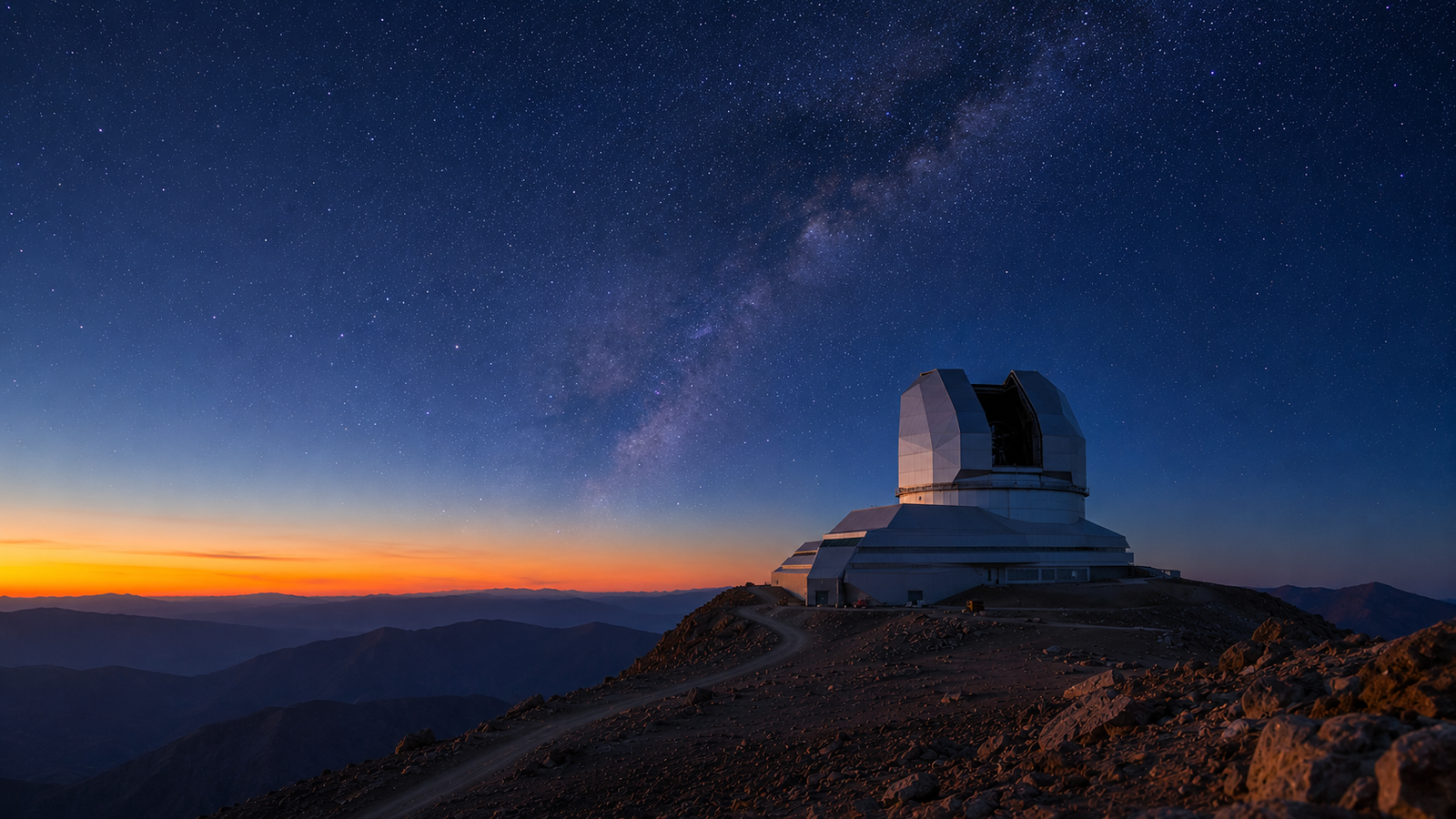
Look up at the night sky on any ordinary evening and it seems unchanging. Same stars, same quiet dark, night after night. The Vera C. Rubin Observatory was built on the opposite assumption, that the sky is never actually still, and now that it is fully operational, it is proving that assumption wrong every single night.
What the Vera Rubin Observatory Actually Does
The Vera C. Rubin Observatory is a new astronomical facility in the Andes mountains of Chile, built for a single ambitious purpose, the Legacy Survey of Space and Time, known as LSST. It combines an 8.4 meter telescope, formally named the Simonyi Survey Telescope, with a 3.2 gigapixel camera, the largest digital camera ever built for astronomy. As of late June 2026, Rubin began its full ten year survey, photographing the entire visible southern sky every few nights, over and over, for the next decade.
That repetition is the whole point. A single image tells you what is there. The same patch of sky photographed hundreds of times over ten years tells you what is changing, and that shift from a snapshot to a running record is what separates Rubin from almost everything that came before it.

The Simonyi Survey Telescope’s primary mirror during an assembly check (illustration)
Why Scientists Call It a Movie of the Universe
Each night, the telescope captures a new image roughly every 40 seconds, producing around 10 terabytes of data. Over the full ten year survey, Rubin will image every region of its footprint, an area spanning about 18,000 square degrees of sky, close to 800 times.
Objects that move, brighten, fade, or explode only reveal themselves through repetition.
That is where the movie comparison comes from, and it is not poetic exaggeration. Rubin’s entire design exists to catch that motion systematically instead of by chance.
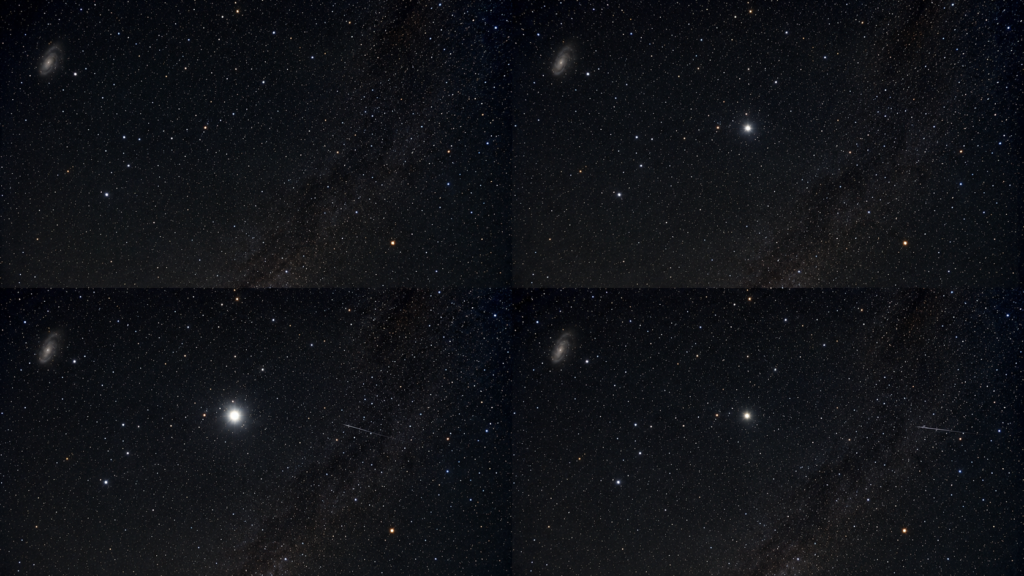
The same patch of sky imaged repeatedly, showing a star brightening and an object trail across several exposures (illustration)
The Camera Making This Possible
At the center of the project sits the LSST Camera, mounted at the telescope’s focal plane, the instrument responsible for the observatory’s 3.2 gigapixel resolution, roughly the size of a small car. Its field of view covers about 9.6 square degrees in a single exposure, letting it survey enormous stretches of sky far faster than a conventional telescope could manage.
That speed is not a convenience, it is a requirement. A survey built to revisit the same regions of sky hundreds of times over a decade cannot afford to move slowly, and the camera’s field of view is what makes the pace realistic. Paired with automated detection software, the observatory now issues public alerts within about a minute of a detected change in the sky, roughly seven million of them every night.
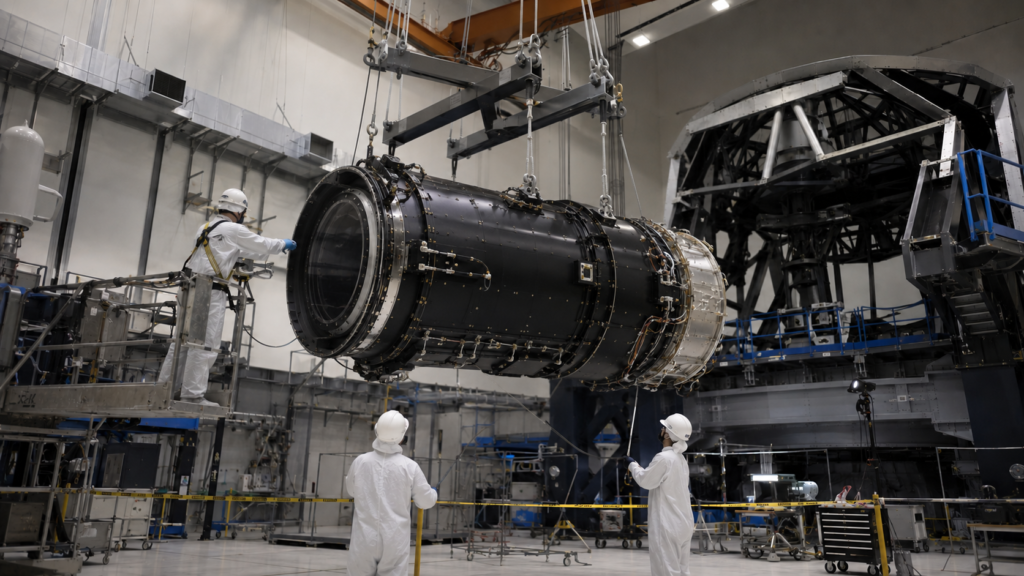
The 3.2 gigapixel LSST camera being lowered onto the telescope structure inside the clean room (illustration)
What Rubin Is Finding
The most immediate payoff has already appeared in our own solar system. During its early optimization period, before the official survey even began, Rubin discovered more than 11,000 previously unseen asteroids in a matter of weeks, including near Earth objects and distant trans Neptunian bodies. Over the full ten year survey it is expected to catalogue more than 5 million small solar system bodies, a number that dwarfs what earlier sky surveys achieved in total.
That scale comes directly from being able to compare the same region of sky across many nights and notice what has shifted position. The same method applies beyond the solar system. Exploding stars and other short lived events are now being caught systematically across the whole survey area instead of by luck, giving researchers genuinely new coverage in time domain astrophysics, spanning timescales from minutes to a full decade.
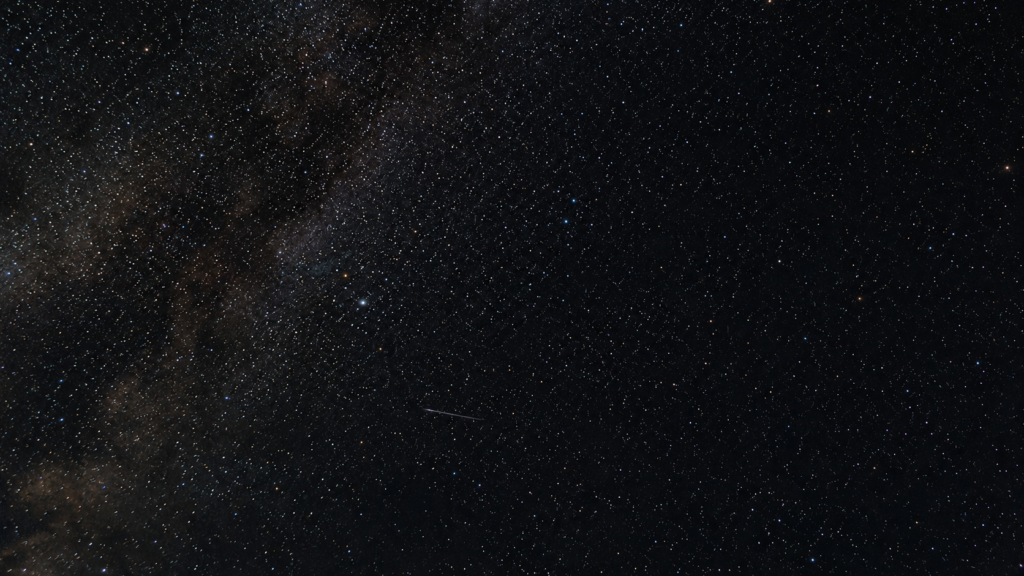
A faint object trail crossing a dense star field, the kind of detail repeated imaging reveals over time (illustration)
Where Dark Matter and Dark Energy Fit In
This is worth being precise about. Rubin does not directly detect dark matter or dark energy, and describing the observatory that way overstates what the survey can do. What LSST produces is an unprecedented dataset on how cosmic structure forms and evolves, data that researchers use to test existing theories about the universe’s hidden mass and its accelerating expansion.
The observatory’s own scientific case frames this contribution carefully, as evidence such as weak lensing patterns and large scale structure mapping that will hold clues to the physics involved, not as a single conclusive measurement. The more grounded, near term contribution comes from tracking how galaxies are distributed and how that distribution changes over cosmic time, since that pattern is shaped by both invisible mass and the expansion of space itself.
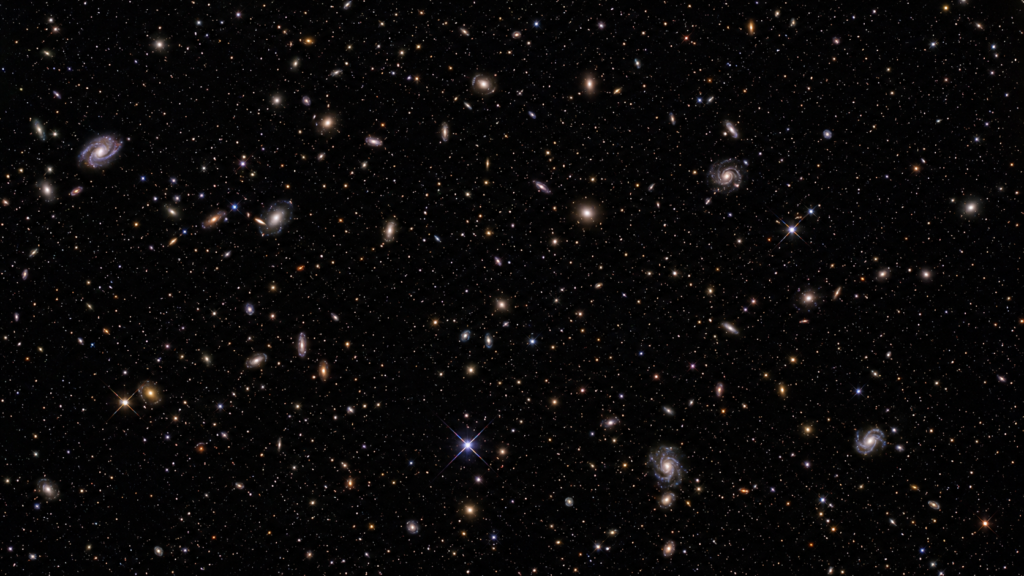
Thousands of distant galaxies captured in a single field, spirals and ellipticals in cool blues and warm golds (illustration)
Why This Matters
The real significance of this telescope and the observatory built around it has less to do with any single discovery and more to do with what a continuously updated decade long record of the sky makes possible that a static one never could. Because the same regions are revisited so often, astronomy stops being a series of isolated observations and becomes something closer to a living archive, one that will keep producing new findings throughout its ten year run rather than front loading its results at launch.
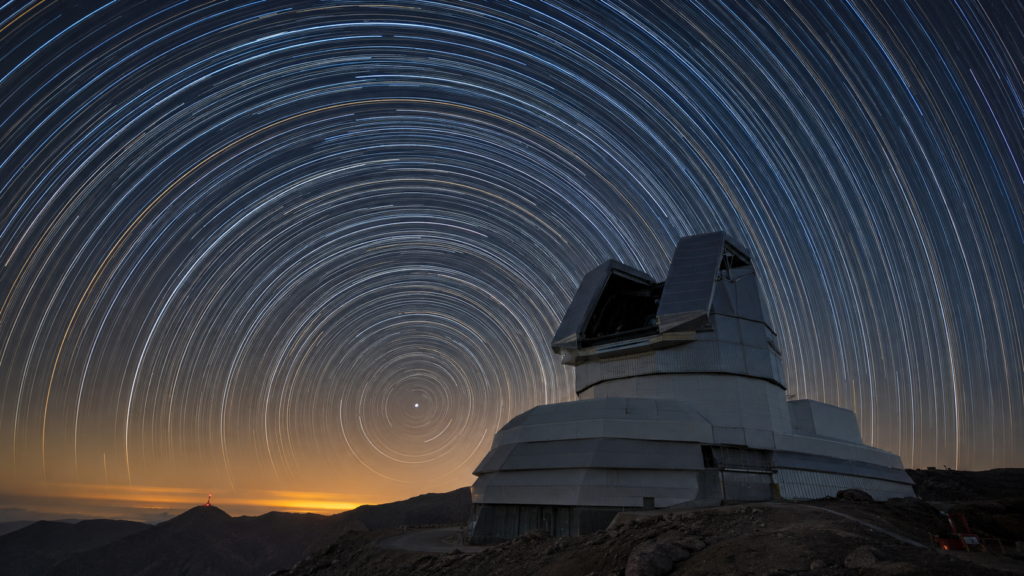
The observatory dome standing beneath a full night of star trails circling overhead (illustration)
Key Takeaways
- The Vera C. Rubin Observatory is running the Legacy Survey of Space and Time, imaging the visible southern sky every few nights for ten years, having begun full operations on June 30, 2026.
- Its 3.2 gigapixel camera, mounted on the telescope, is the largest digital camera ever built for astronomy, with a field of view of about 9.6 square degrees per exposure.
- The survey has already found over 11,000 new asteroids in its early weeks and is expected to catalogue more than 5 million small solar system bodies in total.
- Repeated imaging allows systematic detection of transient events such as exploding stars, across timescales from minutes to a decade.
- Rubin does not directly detect dark matter or dark energy, but its structure and lensing data will help test existing theories about both.
References
- Rubin Observatory, About Rubin Observatory, rubinobservatory.org/about
- Rubin Observatory, The Legacy Survey of Space and Time, rubinobservatory.org/for-scientists/rubin-101/the-legacy-survey-of-space-and-time-lsst
- NSF NOIRLab, Vera C. Rubin Observatory, noirlab.edu/public/programs/vera-c-rubin-observatory
- AURA Astronomy, Vera C. Rubin Observatory, aura-astronomy.org/centers/nsfs-oir-lab/rubinobservatory
- U.S. National Science Foundation, NSF DOE Vera C. Rubin Observatory, nsf.gov/focus-areas/astronomy-space/rubin-observatory
- SLAC National Accelerator Laboratory, Action NSF DOE Vera C. Rubin Observatory Begins Capturing the Greatest Cosmic Movie Ever Made, www6.slac.stanford.edu
- NASA Jet Propulsion Laboratory, Legacy Survey of Space and Time Dark Energy Science Collaboration, science.jpl.nasa.gov/projects/lsst-desc
- Wikipedia, Vera C. Rubin Observatory, background reference only


Join the discussion
Comments are moderated and may take a little while to appear.