General relativity is one of the most accurate and beautiful theories in physics, underpinning everything from GPS navigation to the modelling of black holes. Yet the same equations that work so well for planets and pulsars point towards their own limitations in extreme regimes, from black hole interiors to the earliest stages of the universe.
The real puzzle is not simply, “Was Einstein wrong?” It is: “Where must his theory give way to something deeper?”
Is General Relativity Wrong?
Is general relativity wrong? In the ordinary sense of a scientific theory being contradicted by reliable experiments, the answer is no.
Within every regime where it has been carefully tested, from laboratories and the Solar System to binary pulsars and gravitational waves, Einstein’s theory has agreed with observation to impressive precision.
At the same time, when general relativity is pushed into situations where quantum effects can no longer be ignored, it predicts geodesic incompleteness and, in many familiar solutions, divergent curvature. These results suggest that the theory is incomplete rather than simply false.
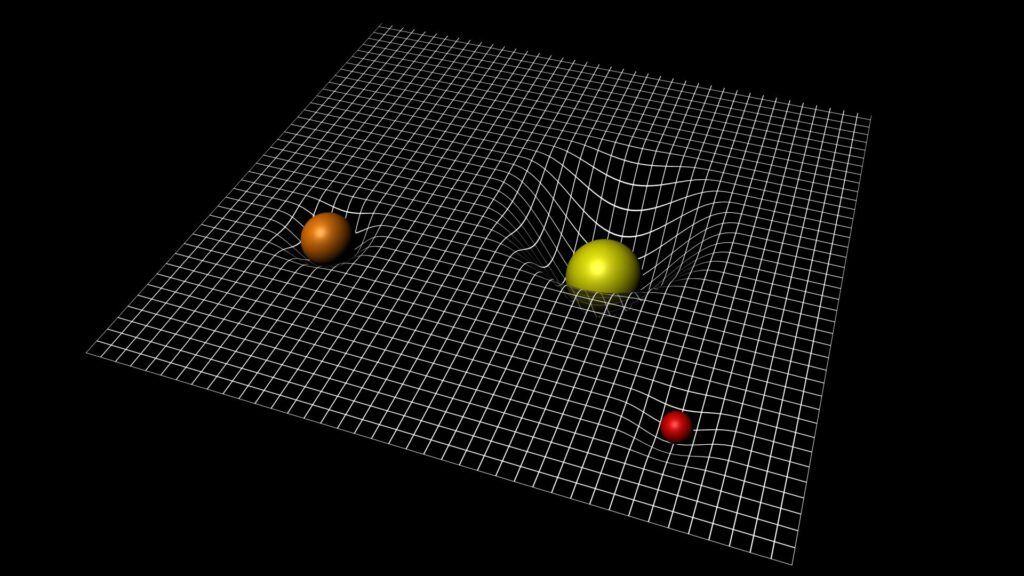
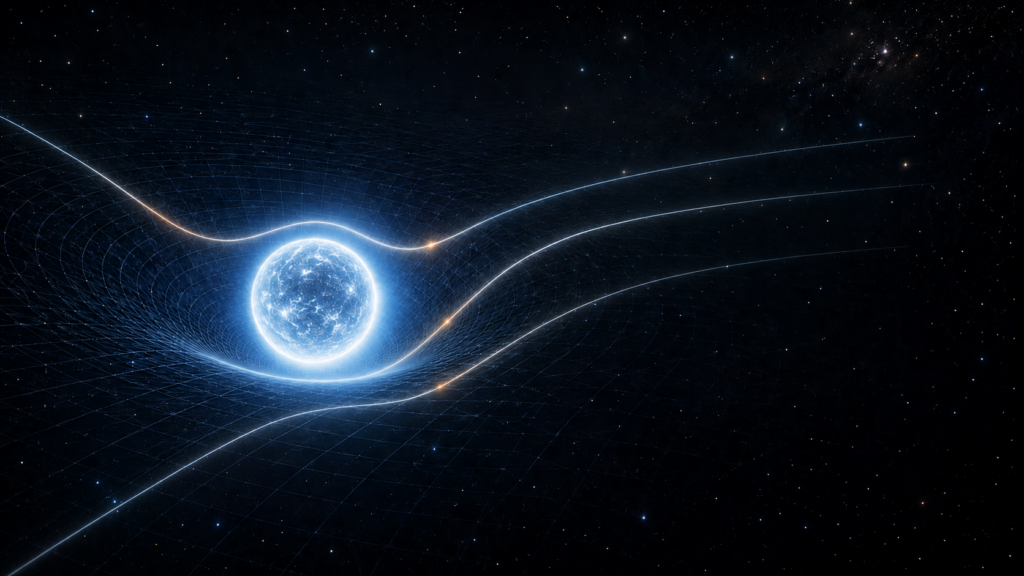
General relativity describes gravity not as an invisible force pulling objects together, but as the curvature of spacetime created by energy and momentum. Matter influences the geometry of spacetime, and that geometry determines how matter and light move.
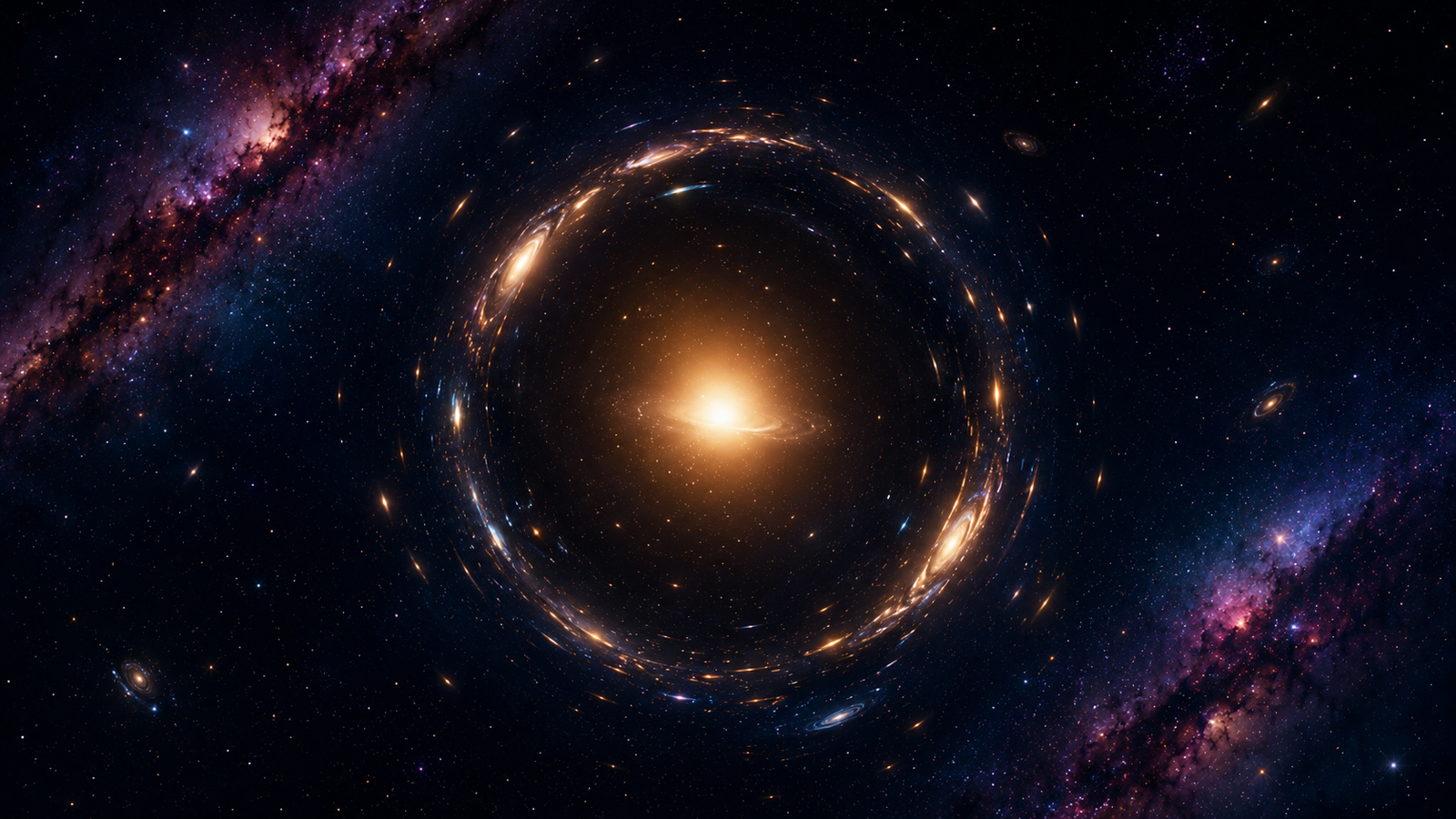
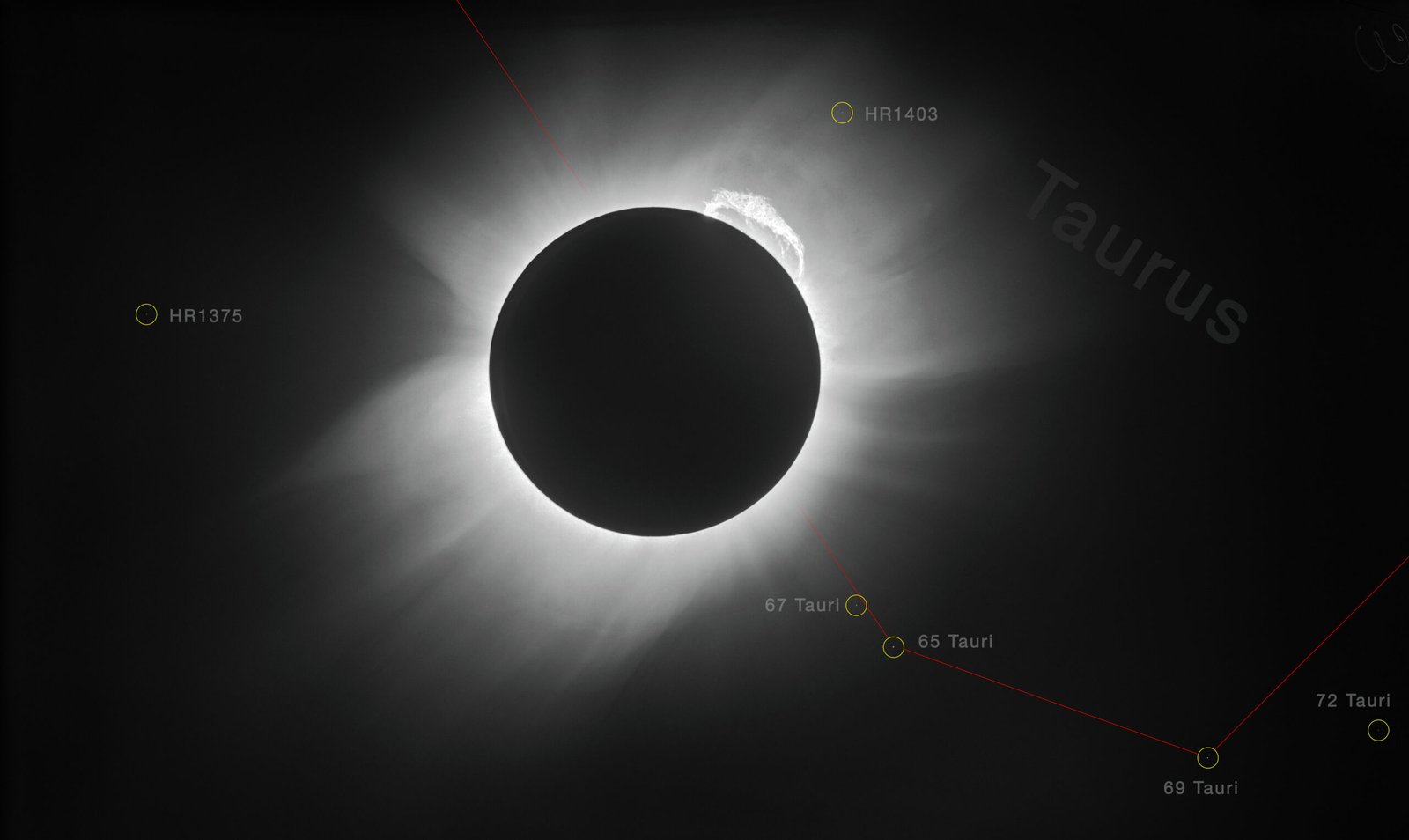
This picture explained the anomalous precession of Mercury’s orbit, which Newtonian gravity could not fully account for. It also predicted that light would bend around massive objects, producing gravitational lenses, arcs and Einstein rings that astronomers now observe routinely.
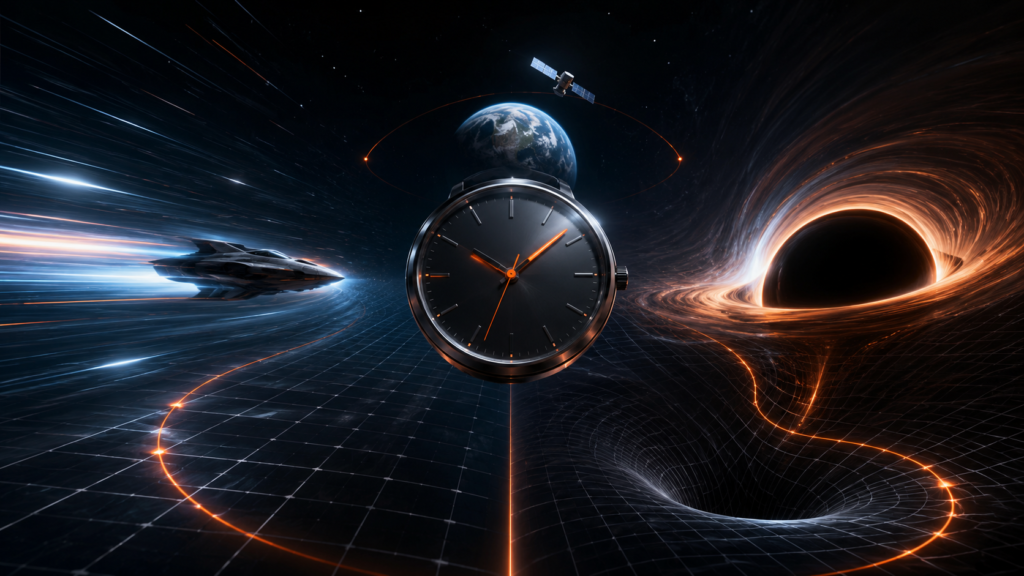
Modern tests extend far beyond Einstein’s original predictions. Atomic clock experiments confirm gravitational time dilation: clocks deeper in a gravitational field run slightly more slowly than clocks farther away.
The Global Positioning System would rapidly lose accuracy without relativistic corrections in GPS. Engineers must account for both special relativistic effects caused by satellite motion and general relativistic effects caused by differences in gravitational potential.
Readers interested in the evidence behind Einstein’s theory can explore Astrinova’s detailed article on experimental tests of general relativity.
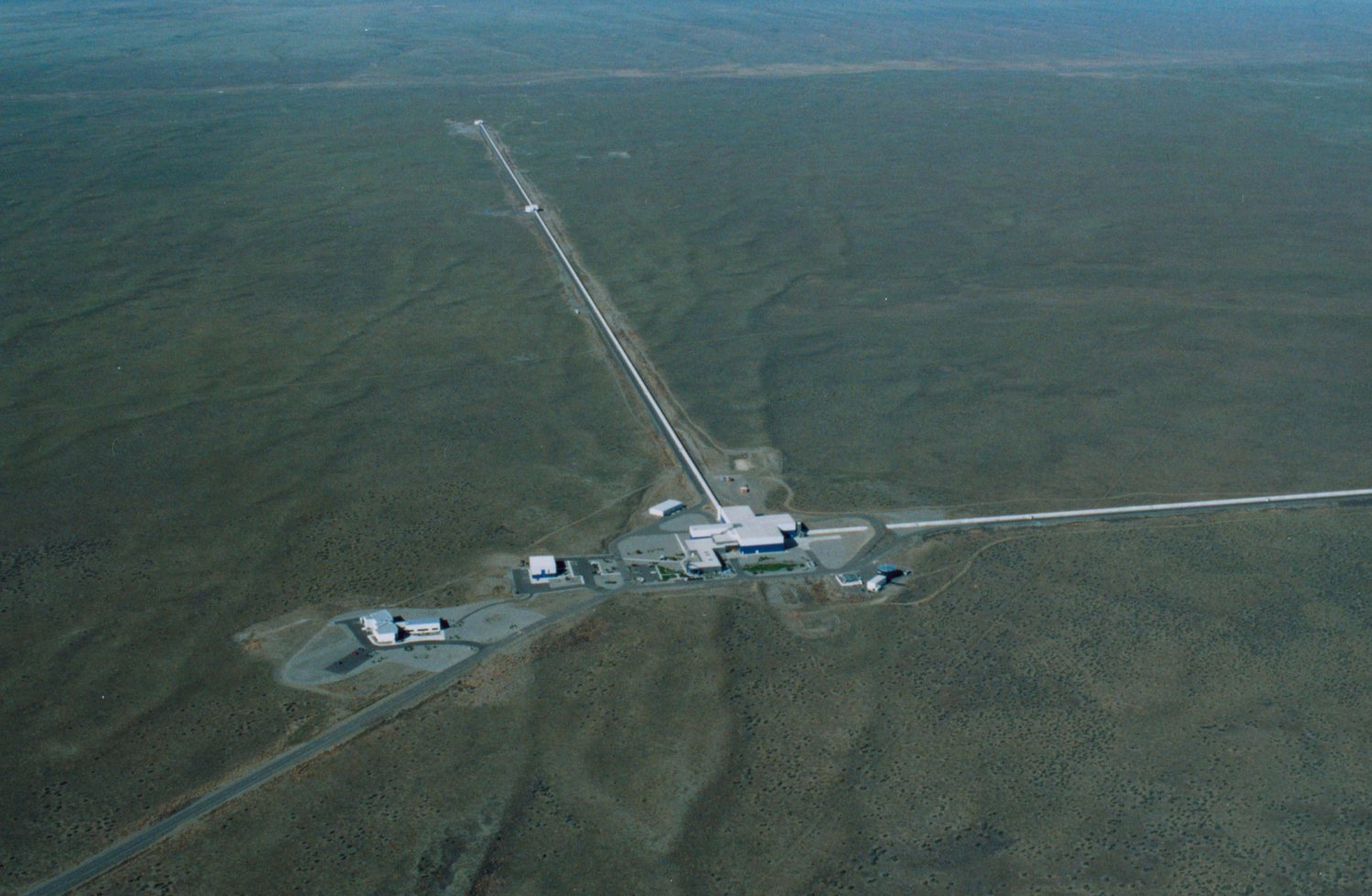
The detection of gravitational waves by LIGO and Virgo provided another major test. The observed signals from merging black holes and neutron stars closely match waveforms calculated using Einstein’s equations.
The Event Horizon Telescope has also produced images of M87* and Sagittarius A*. Their measured ring diameters and shadow-like structures are consistent with black hole models based on general relativity, within current observational and modelling uncertainties.
General relativity has therefore not failed where it has been properly tested. The deeper question is why such a successful theory seems unable to describe every possible physical regime.
The real puzzle is not simply, “Was Einstein wrong?” It is: “Where must his theory give way to something deeper?”
For more articles about Einstein’s theory, curved spacetime and gravity, visit Astrinova’s General Relativity topic page.
A Theory Can Be Correct Without Being Complete
A scientific theory can be extremely accurate without being the final description of nature.
Physicists often describe such a framework as an effective theory: a theory that works extraordinarily well within a particular range of distances, energies or physical conditions, even though it may require modification outside that range.
Newtonian gravity is the classic example.
Newton’s law successfully describes falling objects, planetary motion, tides and many spacecraft trajectories. It remains useful in engineering and astronomy today. But it assumes an instantaneous gravitational interaction and does not account for the relationship between space, time, energy and motion revealed by relativity.
In weak gravitational fields and at speeds much lower than the speed of light, Einstein’s theory reduces to Newton’s gravity as an excellent approximation. Newton was not rendered useless; his theory became part of a larger framework.
General relativity may occupy a similar position.
Across the scales accessible to present experiments, it is an extraordinarily successful classical theory of gravity. But in regimes where quantum fluctuations of spacetime become important, it appears to reach the edge of its validity.
A deeper theory should not simply discard general relativity. It must reproduce Einstein’s equations under ordinary conditions, just as general relativity reproduces Newtonian gravity in the appropriate limit.
Where General Relativity Breaks Down
When physicists say that general relativity “breaks down,” they do not necessarily mean that an experiment has directly contradicted it.
They usually mean that the mathematical framework ceases to provide a complete, physically extendable description of spacetime.
The Penrose–Hawking singularity theorems are central to this issue. Under specific assumptions about matter, energy and causal structure, the theorems show that spacetime can become geodesically incomplete.
A geodesic is the closest equivalent to a straight path through curved spacetime. Freely falling objects and light rays follow these paths.
Geodesic incompleteness means that some such paths cannot be extended indefinitely within the classical theory. The equations reach a boundary beyond which they no longer provide a complete description.
In many important solutions, curvature quantities also diverge near that boundary. However, the singularity theorems themselves establish geodesic incompleteness, not necessarily infinite curvature in every conceivable spacetime.
The two most famous examples arise inside black holes and in the backward extrapolation of the expanding universe.
Black Hole Singularities
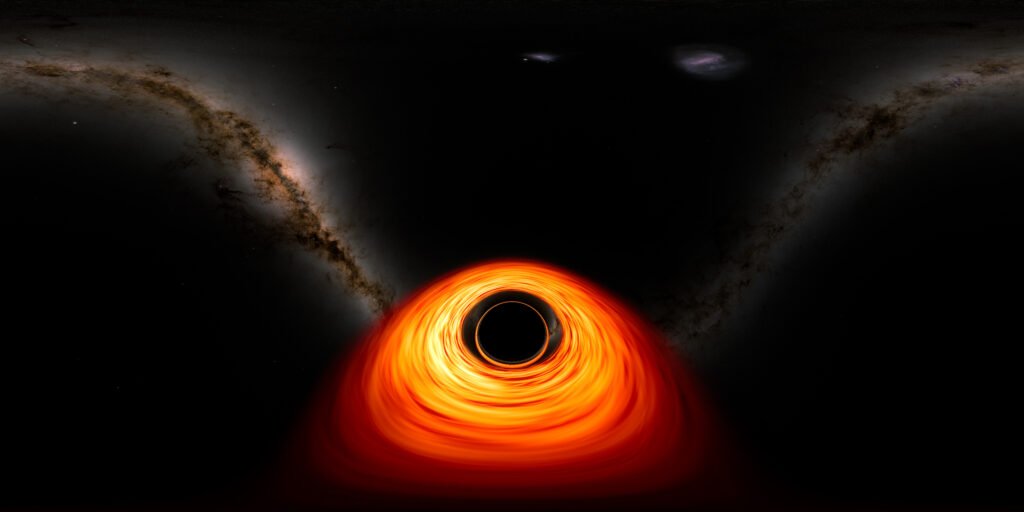
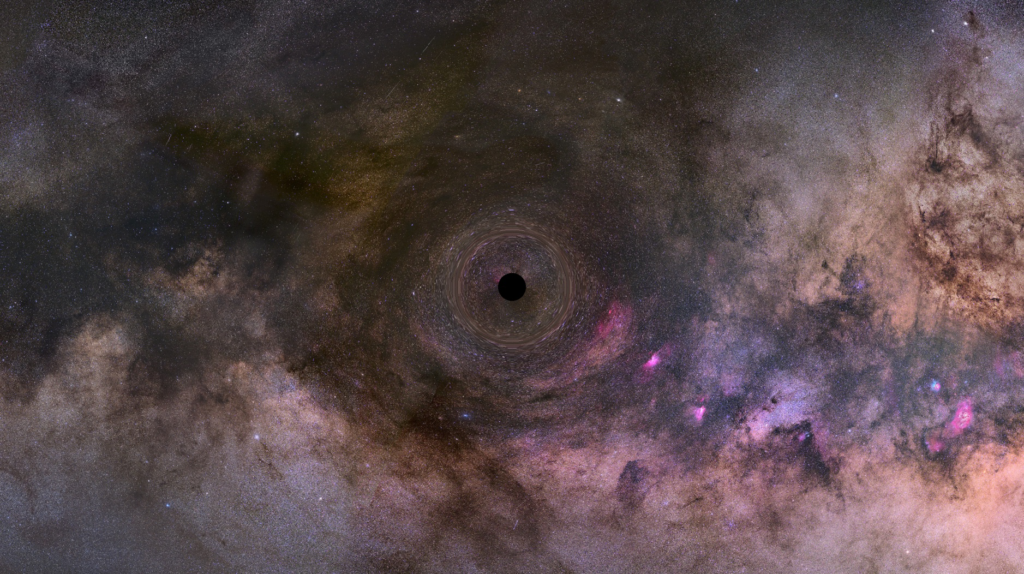
When a sufficiently massive star collapses, general relativity predicts that it can form a black hole surrounded by an event horizon.
The event horizon is not a solid surface. It is a causal boundary: once matter or light crosses it, no signal can return to a distant outside observer.
Under suitable physical assumptions, the singularity theorems indicate that a spacetime containing gravitational collapse becomes geodesically incomplete. Some worldlines inside the black hole cannot be continued indefinitely within classical general relativity.
In explicit black hole solutions such as the Schwarzschild and Kerr geometries, curvature quantities diverge near an interior singular region. But the singularity itself is not directly observable because it lies behind the event horizon.
Observations instead test the strong gravitational field outside the horizon.
So far, general relativity has remained consistent with data from accretion flows, stellar orbits near the centre of the Milky Way and gravitational waves produced by black hole mergers.
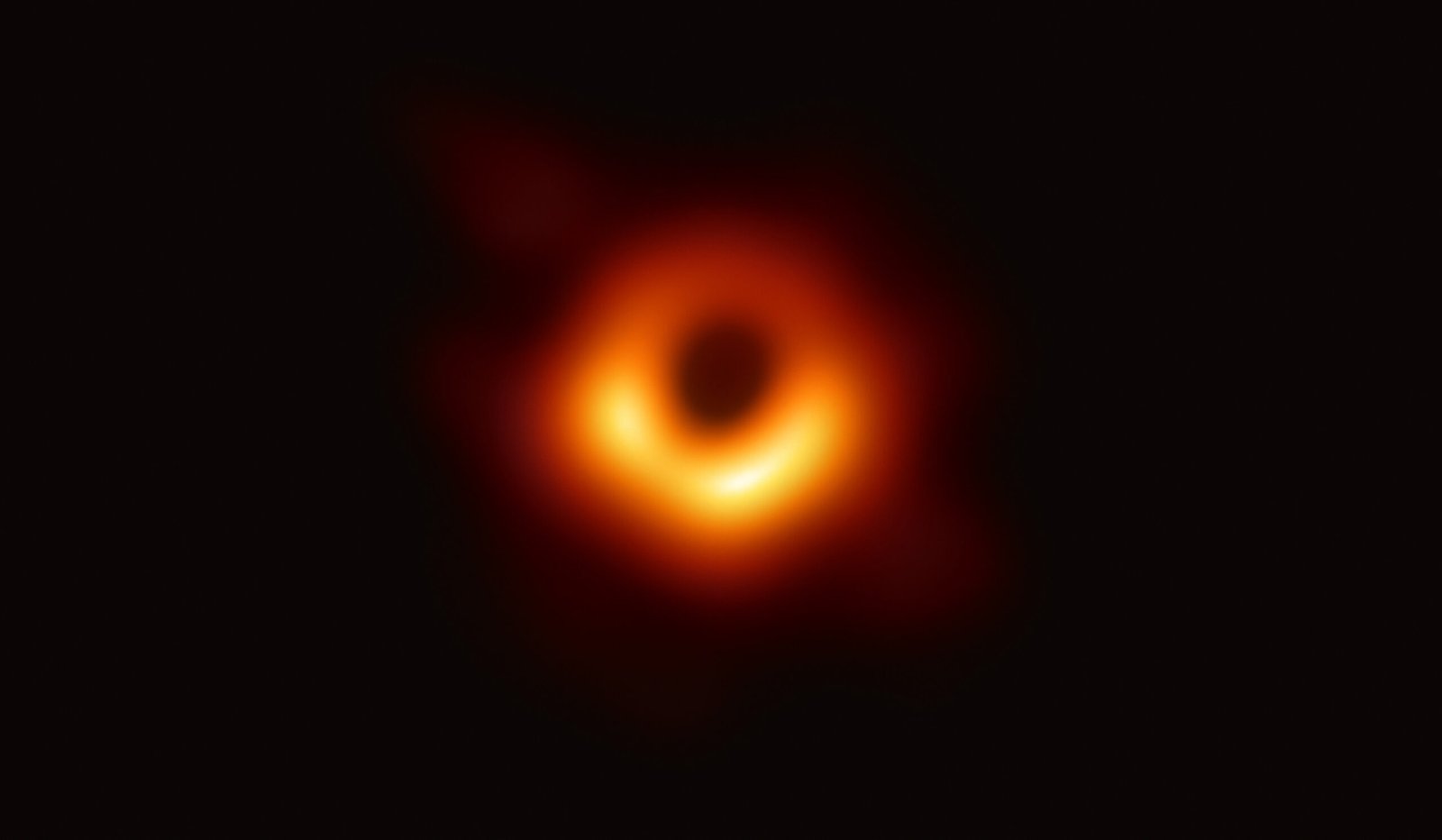
Most physicists do not regard the mathematical singularity as proof that nature literally contains a point, or in a rotating black hole, a ring, of infinite density and curvature.
Instead, they interpret it as evidence that the classical theory has been pushed beyond the conditions where it can be trusted.
A quantum theory of gravity may replace the classical singularity with a new physical structure, but no experimentally confirmed description of what happens inside a black hole currently exists.
The Big Bang Singularity
A related problem appears when general relativity is applied to the universe as a whole.
Standard cosmological solutions of Einstein’s equations describe an expanding, approximately homogeneous universe. When these classical solutions are extrapolated backwards, the cosmic scale factor tends towards zero and spacetime becomes geodesically incomplete.
This boundary is commonly called the Big Bang singularity.
It should not be imagined too casually as an ordinary moment in time, like a historical event occurring within an already existing universe. Rather, it marks a boundary where the classical description ceases to be extendable.
In many models, density, temperature and curvature increase without bound as this boundary is approached. But these divergences may indicate that the equations are being applied beyond their legitimate domain.
The modern Big Bang model successfully describes the universe’s hot, dense early evolution: nucleosynthesis, the formation of atoms, the cosmic microwave background, galaxy formation and the subsequent expansion of the cosmos.
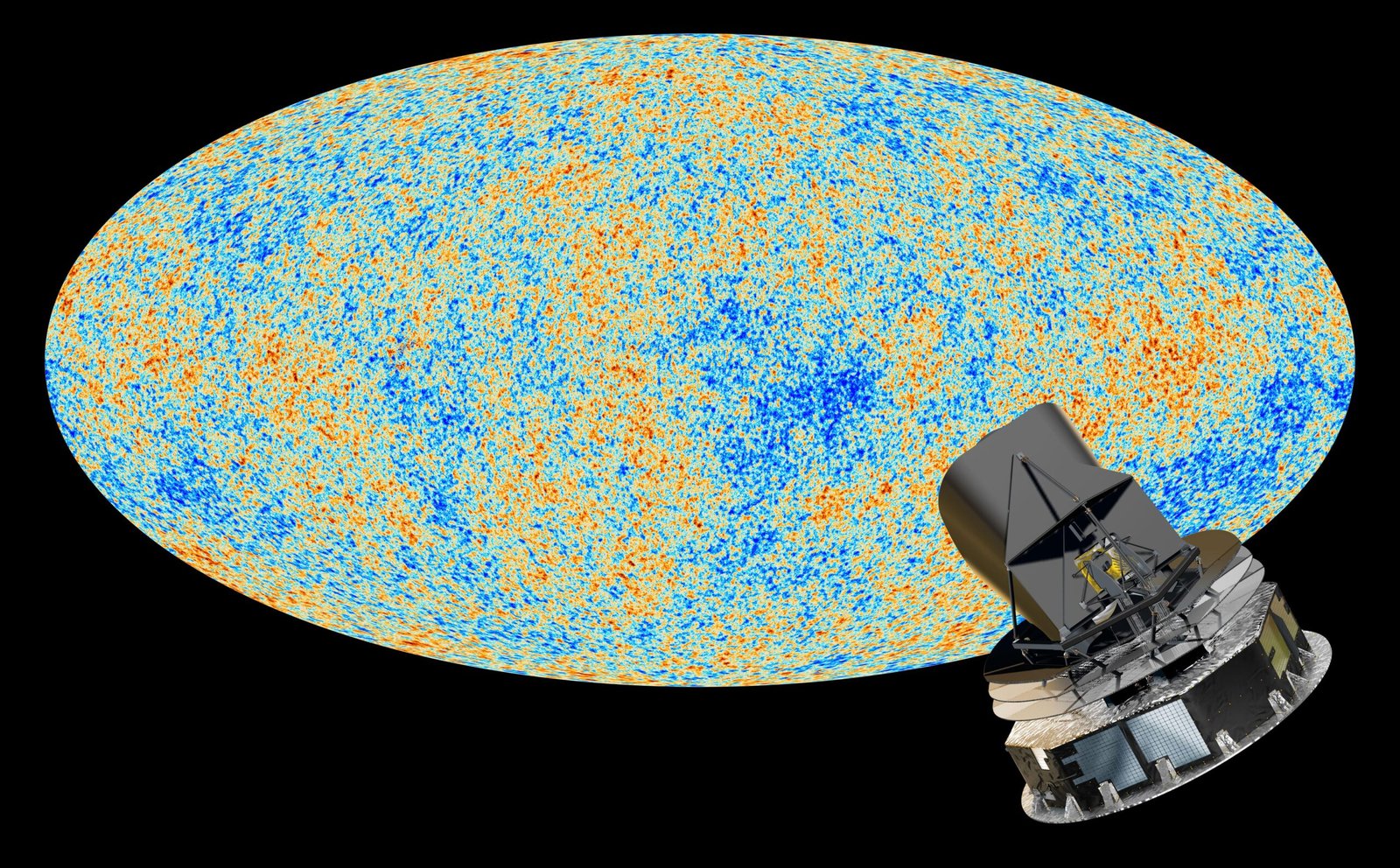
It does not provide a verified description of an absolute beginning or of the earliest quantum gravitational regime.
Most cosmologists expect that a quantum theory of gravity will modify the classical picture near this boundary. Proposed possibilities include a quantum bounce, an emergent phase of spacetime or another non-singular transition, but none has been experimentally established.
More articles about the early universe, cosmic expansion and large scale structure are available on Astrinova’s Cosmology topic page.
General Relativity and Quantum Mechanics
The relationship between general relativity and quantum mechanics is more nuanced than the claim that the two theories are simply incompatible.
At energies far below the Planck scale, gravity can be treated as a low energy quantum effective field theory. Small quantum corrections can, in principle, be calculated systematically.
In that limited regime, quantum field theory and general relativity can coexist successfully.
The deeper problem emerges when physicists try to extend this quantum treatment to arbitrarily high energies using standard perturbative methods.
Treated as a quantum field theory of a massless spin-2 particle called the graviton, Einstein’s theory is perturbatively non-renormalisable.
Renormalisation is the procedure physicists use to absorb troublesome infinities into a finite set of measurable quantities. In successful quantum field theories such as quantum electrodynamics, this process preserves predictive power.
In perturbatively quantised general relativity, each higher level of calculation introduces new divergences requiring additional parameters. An unlimited number of measurements would eventually be needed to make predictions at arbitrarily high energies.
This means the theory is not ultraviolet complete.
In physics, “ultraviolet” refers to very short distances and very high energies. An ultraviolet complete theory remains mathematically meaningful and predictive even in those extreme regimes.
General relativity can therefore operate as a low energy quantum effective theory, but it does not appear sufficient as a fundamental quantum description of gravity at all scales.
This means the theory is not ultraviolet complete.
This is one reason physicists continue to search for quantum gravity: a deeper framework capable of describing both curved spacetime and quantum phenomena.
For accessible explanations of superposition, quantum fields and the microscopic world, explore Astrinova’s Quantum Physics topic page.
The Planck Scale
The Planck scale provides a natural estimate of where quantum gravitational effects may become important.
By combining the gravitational constant, the speed of light and Planck’s constant, physicists obtain several characteristic quantities.
The Planck length is approximately 1.616 × 10⁻³⁵ metres.
The Planck time is approximately 5.391 × 10⁻⁴⁴ seconds.
These are extraordinarily small scales. The Planck length is many orders of magnitude smaller than the dimensions currently accessible to particle accelerators.
Near this regime, quantum fluctuations of spacetime may become too significant for the smooth continuum used in classical general relativity to remain adequate.
However, the Planck scale is theoretically motivated, not an experimentally proven boundary where spacetime suddenly becomes discrete.
Different quantum gravity proposals describe it differently. Some suggest that spacetime has a granular or discrete structure. Others preserve a form of continuity but alter its underlying dynamics.
The shared expectation is that Einstein’s smooth spacetime should emerge as a large scale approximation of a deeper quantum framework.
The Black Hole Information Problem
The black hole information problem reveals another tension between gravity and quantum theory.
In the 1970s, Stephen Hawking showed that quantum fields in the curved spacetime surrounding a black hole produce thermal radiation. This Hawking radiation causes an isolated black hole to lose mass and, over an extremely long period, potentially evaporate.
The problem concerns what happens to information about the matter that formed the black hole or later fell into it.
In standard quantum mechanics, the evolution of a closed system is unitary. Information about its initial quantum state is not fundamentally destroyed.
Hawking’s original calculation appeared to imply that the radiation was purely thermal and carried no detailed information about the matter that entered the black hole. If the black hole evaporated completely, a pure quantum state could apparently evolve into a mixed thermal state.
This apparent violation of unitarity became known as the black hole information paradox.
Recent theoretical developments involving holography, quantum extremal surfaces and “island” calculations suggest that information may be encoded in subtle correlations within Hawking radiation.
These ideas can reproduce the expected Page curve, which describes how the entropy of the radiation should evolve if information is ultimately preserved.
However, these results remain theoretical and are often derived in simplified models. There is no direct experimental observation of Hawking radiation from an astrophysical black hole.
The paradox therefore does not show that an experiment has disproved general relativity. It shows that the combination of classical spacetime and quantum fields appears incomplete in the deepest black hole regime.
Do Dark Matter and Dark Energy Show That Einstein Was Wrong?
Dark matter and dark energy are sometimes presented as evidence that general relativity has failed on cosmic scales.
The situation is more subtle.
Galaxy rotation curves, gravitational lensing, the cosmic microwave background and the distribution of large scale structure indicate that visible matter alone cannot explain all observed gravitational behaviour if general relativity is assumed.
The standard cosmological model addresses this by including dark matter and dark energy.
Dark matter contributes additional gravity without emitting or absorbing ordinary light. Dark energy, often represented by a cosmological constant, accounts for the observed acceleration of cosmic expansion.
Within this framework, general relativity still governs the geometry of spacetime. Dark matter and dark energy appear as components of the universe’s energy and matter content.
The resulting ΛCDM model successfully describes a broad range of observations.
Nevertheless, the physical nature of dark matter and dark energy remains unknown. Some physicists investigate whether modifying gravity could explain at least part of the evidence currently attributed to dark components.
Proposed alternatives include scalar tensor theories and other extensions of Einstein’s equations. These models face strict constraints from Solar System measurements, binary pulsars, gravitational waves and cosmological surveys.
At present, dark matter and dark energy do not by themselves prove that general relativity is false. They may instead reveal gaps in our understanding of the contents of the universe.
Possible Successors to General Relativity
Several research programmes attempt to construct a deeper theory of gravity.
String Theory
String theory proposes that fundamental particles are different vibrational states of tiny one dimensional strings. One of these states behaves like a massless spin-2 graviton, allowing general relativity to emerge at low energies.
The framework naturally includes quantum gravity, but its characteristic scales remain far beyond direct experimental reach.
Loop Quantum Gravity
Loop quantum gravity attempts to quantise spacetime geometry itself. Areas and volumes acquire discrete spectra represented through structures called spin networks.
Some loop based cosmological and black hole models replace classical singularities with non-singular quantum geometries, although these results have not yet been experimentally confirmed.
Asymptotic Safety
The asymptotic safety programme proposes that gravity may become predictive at high energies if its interactions approach a special ultraviolet fixed point.
If correct, this could provide ultraviolet completion without replacing the basic field theoretic description of gravity entirely.
Emergent Spacetime
Emergent spacetime approaches propose that space, time and gravity are not fundamental. Instead, they arise collectively from deeper quantum degrees of freedom, much as fluid behaviour arises from the motion of molecules.
Ideas from holography, quantum information and tensor networks provide examples of how geometric spacetime might emerge from underlying quantum relationships.
No candidate has yet achieved decisive experimental confirmation.
Any successful theory must reproduce general relativity under the conditions where Einstein’s equations already work.
What Would Actually Prove General Relativity Wrong?
General relativity would face a genuine empirical crisis if reproducible observations contradicted its predictions in a regime where the theory should apply.
One possibility would be a clear violation of the equivalence principle.
The equivalence principle states, in simplified form, that freely falling objects respond to gravity in the same way regardless of their composition. Precision experiments have tested this principle extremely well.
A repeatable composition dependent deviation could indicate a new gravitational interaction or other physics beyond Einstein’s theory.
Gravitational wave astronomy provides another testing ground.
Unexpected propagation speeds, additional polarisation modes or consistent deviations in inspiral and ringdown waveforms could reveal departures from general relativity in strong gravitational fields.
Detailed observations near black holes could also expose unexpected horizon scale structures or quasi-normal modes inconsistent with Einstein based predictions.
On cosmological scales, discrepancies in the growth of structure or gravitational lensing that could not be explained by any reasonable dark matter or dark energy model might point towards modified gravity.
Researchers also investigate speculative quantum spacetime effects, including possible Lorentz invariance violations, energy dependent photon propagation or signatures of spacetime discreteness.
These possibilities are highly model dependent. They are not universal predictions of quantum gravity, and many are already strongly constrained by astronomical observations and precision experiments.
At present, no such result has been accepted as robust evidence that general relativity is wrong.
So, Is General Relativity Wrong?
The best answer to “is general relativity wrong?” is layered.
General relativity is not wrong in the sense of having failed experimental tests within its proper domain. It remains our most successful classical description of gravity and continues to guide astronomy, cosmology, engineering and fundamental physics.
Yet the theory also reveals its own boundaries.
Black hole interiors and the backward extrapolation of cosmological models lead to geodesic incompleteness. Attempts to extend Einstein’s theory into a fundamental perturbative quantum theory produce non-renormalisable divergences. The black hole information problem further suggests that classical spacetime and quantum theory cannot together provide the final account.
Most physicists therefore regard general relativity as extraordinarily accurate but incomplete.
A future theory of quantum gravity must reproduce Einstein’s equations under ordinary conditions while extending physics into regimes where classical spacetime loses its descriptive power.
Most physicists therefore regard general relativity as extraordinarily accurate but incomplete.
Einstein’s theory may not be the final chapter in our understanding of gravity. But any deeper theory will have to explain why general relativity has been so remarkably successful.
Key Takeaways
- General relativity has passed every major experimental and observational test within the regimes where it is expected to apply.
- The Penrose–Hawking singularity theorems establish geodesic incompleteness under specified physical assumptions.
- General relativity can be treated as a low energy quantum effective field theory, but it is not perturbatively ultraviolet complete.
- The Planck scale marks a theoretically motivated quantum gravity regime, not an experimentally proven boundary where spacetime must become discrete.
- Dark matter and dark energy do not, by themselves, demonstrate that Einstein’s theory is false.
- No candidate theory of quantum gravity has yet received decisive experimental confirmation.
- Any successful successor must reproduce general relativity in its tested classical limit.
References
- Will, C. M. “The Confrontation between General Relativity and Experiment.” Living Reviews in Relativity 17, 4 (2014). DOI: 10.12942/lrr-2014-4
- Abbott, B. P., et al., LIGO Scientific Collaboration and Virgo Collaboration. “Observation of Gravitational Waves from a Binary Black Hole Merger.” Physical Review Letters 116, 061102 (2016). DOI: 10.1103/PhysRevLett.116.061102
- The Event Horizon Telescope Collaboration. “First M87 Event Horizon Telescope Results. I. The Shadow of the Supermassive Black Hole.” The Astrophysical Journal Letters 875, L1 (2019). DOI: 10.3847/2041-8213/ab0ec7
- ’t Hooft, G., and Veltman, M. “One Loop Divergencies in the Theory of Gravitation.” Annales de l’Institut Henri Poincaré A 20, 69–94 (1974).
- Hawking, S. W. “Particle Creation by Black Holes.” Communications in Mathematical Physics 43, 199–220 (1975). DOI: 10.1007/BF02345020
- Harlow, D. “Jerusalem Lectures on Black Holes and Quantum Information.” Reviews of Modern Physics 88, 015002 (2016). DOI: 10.1103/RevModPhys.88.015002
- Almheiri, A., et al. “The Entropy of Bulk Quantum Fields and the Entanglement Wedge of an Evaporating Black Hole.” Journal of High Energy Physics 2020, 013 (2020). DOI: 10.1007/JHEP12(2020)013
- Ashtekar, A., and Lewandowski, J. “Background Independent Quantum Gravity: A Status Report.” Classical and Quantum Gravity 21, R53–R152 (2004). DOI: 10.1088/0264-9381/21/15/R01
- Reuter, M., and Saueressig, F. “Quantum Einstein Gravity.” New Journal of Physics 14, 055022 (2012). DOI: 10.1088/1367-2630/14/5/055022
- Capozziello, S., and De Laurentis, M. “Extended Theories of Gravity.” Physics Reports 509, 167–321 (2011). DOI: 10.1016/j.physrep.2011.09.003
- Peebles, P. J. E., and Ratra, B. “The Cosmological Constant and Dark Energy.” Reviews of Modern Physics 75, 559–606 (2003). DOI: 10.1103/RevModPhys.75.559
- Joyce, A., Jain, B., Khoury, J., and Trodden, M. “Beyond the Cosmological Standard Model.” Physics Reports 568, 1–98 (2015). DOI: 10.1016/j.physrep.2014.12.002
Join the discussion
Comments are moderated and may take a little while to appear.