
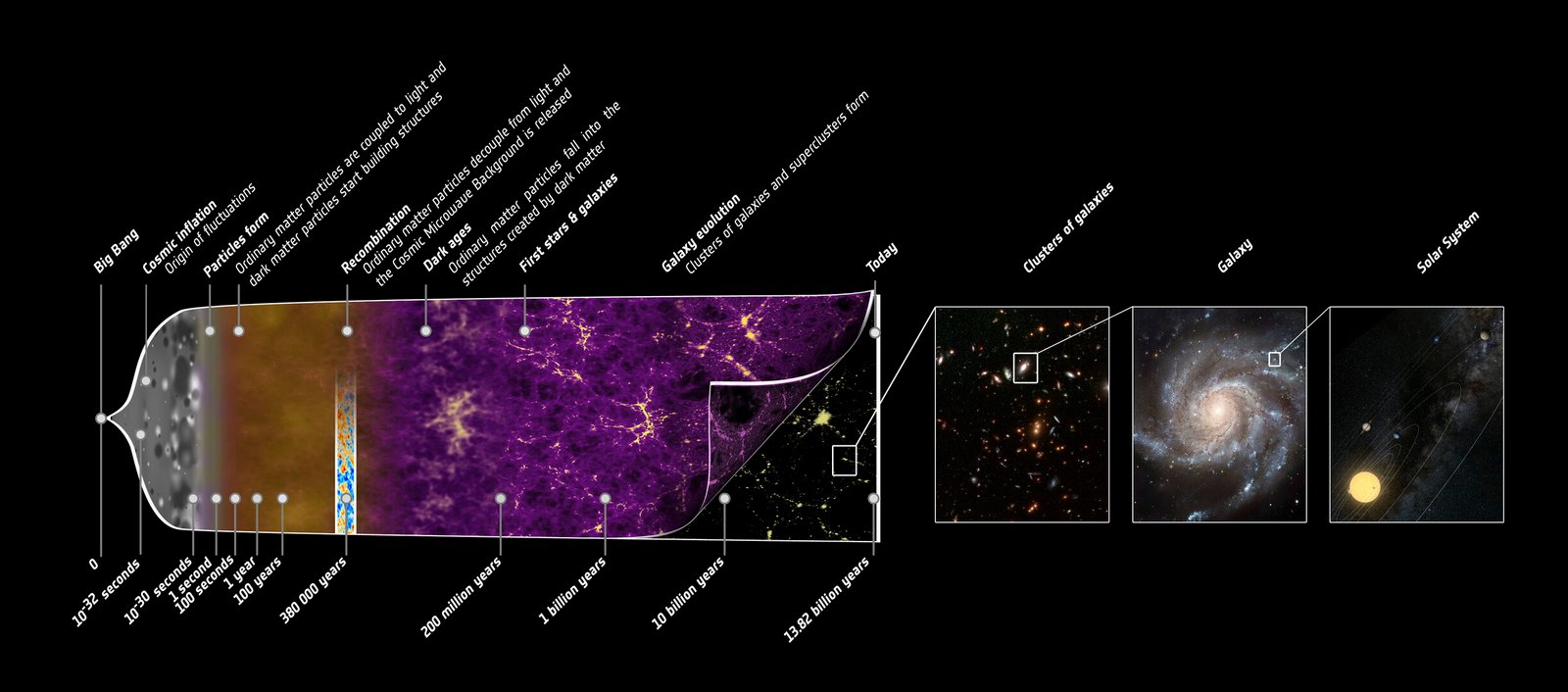
A fraction of a second after the Big Bang, cosmic inflation drove space itself to do something that sounds impossible. Regions of the cosmos raced away from each other faster than light travels. No law of physics was broken. Nothing sped past the cosmic speed limit. What happened instead was stranger and, once you see how it works, more satisfying than a simple violation of relativity would have been.
This is the idea of cosmic inflation, a brief and extreme phase of expansion thought to have occurred within the first fraction of a second of the universe’s existence. It was proposed to fix problems that the plain Big Bang model could not solve on its own, and decades of observation of the cosmic microwave background have since lined up with what inflation predicts. The evidence is strong. It is not, however, final proof, and the honest version of this story includes both the triumphs and the open questions.
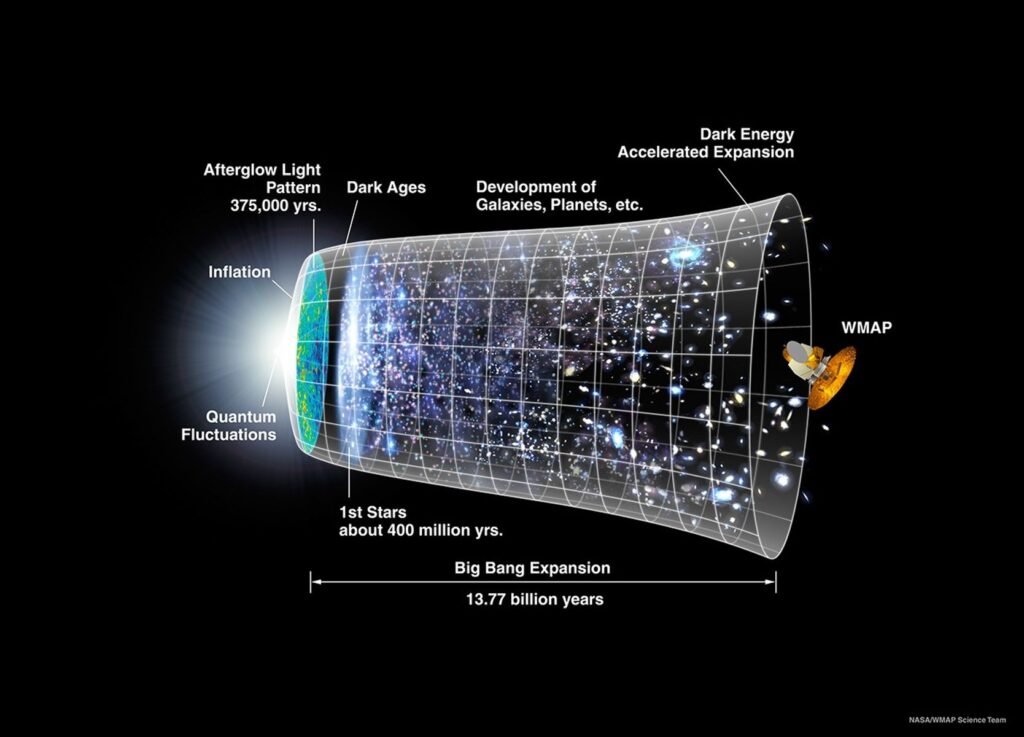
The Speed Limit Nobody Broke
Special relativity puts a hard ceiling on how fast anything can move through space, the speed of light, and nothing with mass gets there. That rule has never failed a test. But general relativity describes something different: how space itself can stretch, and stretching space is not the same as an object moving through it.
Picture two galaxies sitting at fixed points in a cosmic grid. Neither one is moving relative to that grid. But if the grid itself expands, the distance between them grows anyway. Cosmologists write this using a scale factor, usually called a(t), which describes how the universe’s overall size changes with time. The physical distance between two points is that scale factor multiplied by their fixed comoving separation. As the scale factor grows, so does the distance, even though neither galaxy has taken a single step.
The rate at which that distance grows depends on how far apart the points already are. Nearby galaxies recede slowly. Distant ones recede faster, in direct proportion to their distance. Push that relationship out far enough, and the recession speed exceeds the speed of light. This is not a loophole or a technicality. It is a direct consequence of general relativity, and it applies to the ordinary expansion of the universe today, not just to inflation.
During inflation, the expansion rate was so extreme that regions once close enough to exchange light signals were pushed apart by more than light could cross in the time available. Their present day separation now corresponds to superluminal recession, exactly as relativity allows.
What Cosmic Inflation Actually Proposes
The leading picture describes cosmic inflation as a period when the universe’s energy was dominated by a field, usually called the inflaton, sitting at a high point on its energy landscape. While that field sat there, its pressure was nearly the negative of its energy density, which is the same basic condition that drives today’s dark energy, just at an almost unimaginably higher energy scale.
A field in that state pushes space outward. If it stays there long enough, the scale factor grows close to exponentially, doubling and doubling again on an extraordinarily short timescale. Models generally place inflation between roughly 10 to the negative 36 and 10 to the negative 35 seconds after the initial hot state, ending somewhere around 10 to the negative 32 to 10 to the negative 30 seconds. These numbers come from theoretical models rather than direct measurement, and readers should treat them as estimates rather than fixed facts.
For inflation to solve the problems it was built to solve, the expansion needed to continue for at least 50 to 60 e folds, meaning the scale factor grew by a factor on the order of 10 to the 22nd to 10 to the 26th power. A useful way to picture this: something the size of a proton stretched out to dimensions far larger than the observable universe, all before that first fraction of a second had ended.
A patch of space smaller than a proton stretched out to dimensions far larger than the observable universe, all before that first fraction of a second had ended.
Physicists describe the specific version where the field creeps slowly down a nearly flat potential as slow roll inflation. The field’s motion is gentle enough that its energy density barely changes while it happens, which is exactly what keeps the expansion rate close to constant for as long as it needs to run.
Three Problems the Plain Big Bang Model Could Not Solve
Before inflation was proposed, cosmologists working with the standard hot Big Bang model ran into three separate puzzles that a universe without any early accelerated phase struggled to explain.
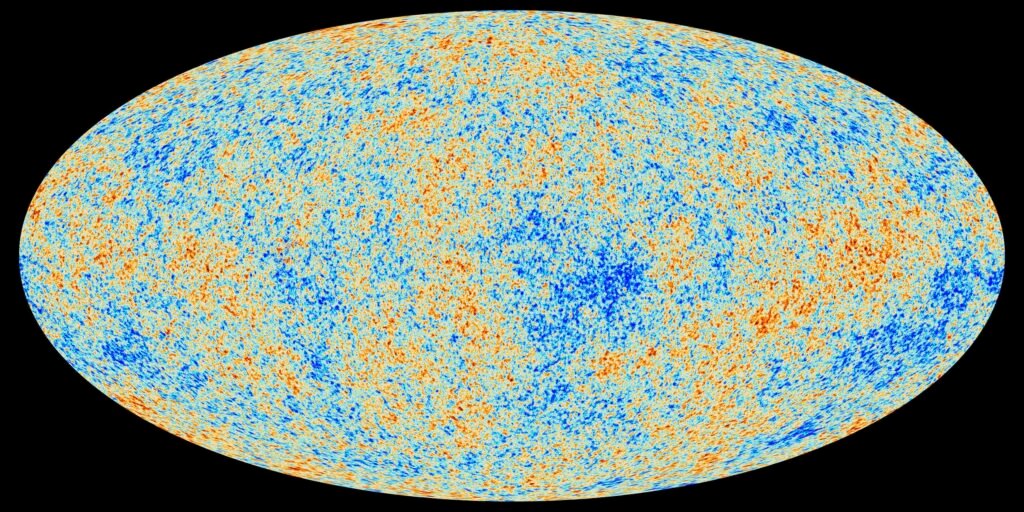
The horizon problem. The cosmic microwave background has almost the same temperature in every direction we look, varying by only about one part in 100,000. In a universe that expanded at the ordinary, decelerating rate assumed by the plain Big Bang model, regions on opposite sides of the sky would never have been close enough, early enough, to exchange light or heat and settle into the same temperature. Yet they somehow match almost perfectly. Something needed to bring them into contact before the expansion carried them out of reach.
The flatness problem. The overall geometry of the universe today looks flat, or extremely close to it, based on measurements from missions like WMAP and Planck. In a universe without inflation, that flatness would require an almost absurdly precise starting condition, since any small deviation from perfect flatness tends to grow larger over cosmic history rather than shrink. Finding the universe this flat today, without inflation, would mean it started out flat to a degree that has no natural explanation.
The monopole problem. Grand unified theories predict that extremely heavy magnetic monopoles should have formed in large numbers during the very early universe’s high energy phase transitions. None have ever been detected. Without some mechanism to dilute them to unobservable levels, they should be common enough to notice.
Cosmic inflation solves all three by the same basic move. A small patch of space, small enough that its contents could interact and equalize before inflation began, gets stretched to enormous size. That solves the horizon problem, because the whole observable universe descends from a region that really was in causal contact early on. It flattens any curvature almost to zero, the same way stretching a wrinkled sheet tight removes its wrinkles locally. And it dilutes any monopoles that formed earlier to a density so low they would be essentially impossible to find today.
Where Galaxies Came From: Quantum Fluctuations Made Cosmic
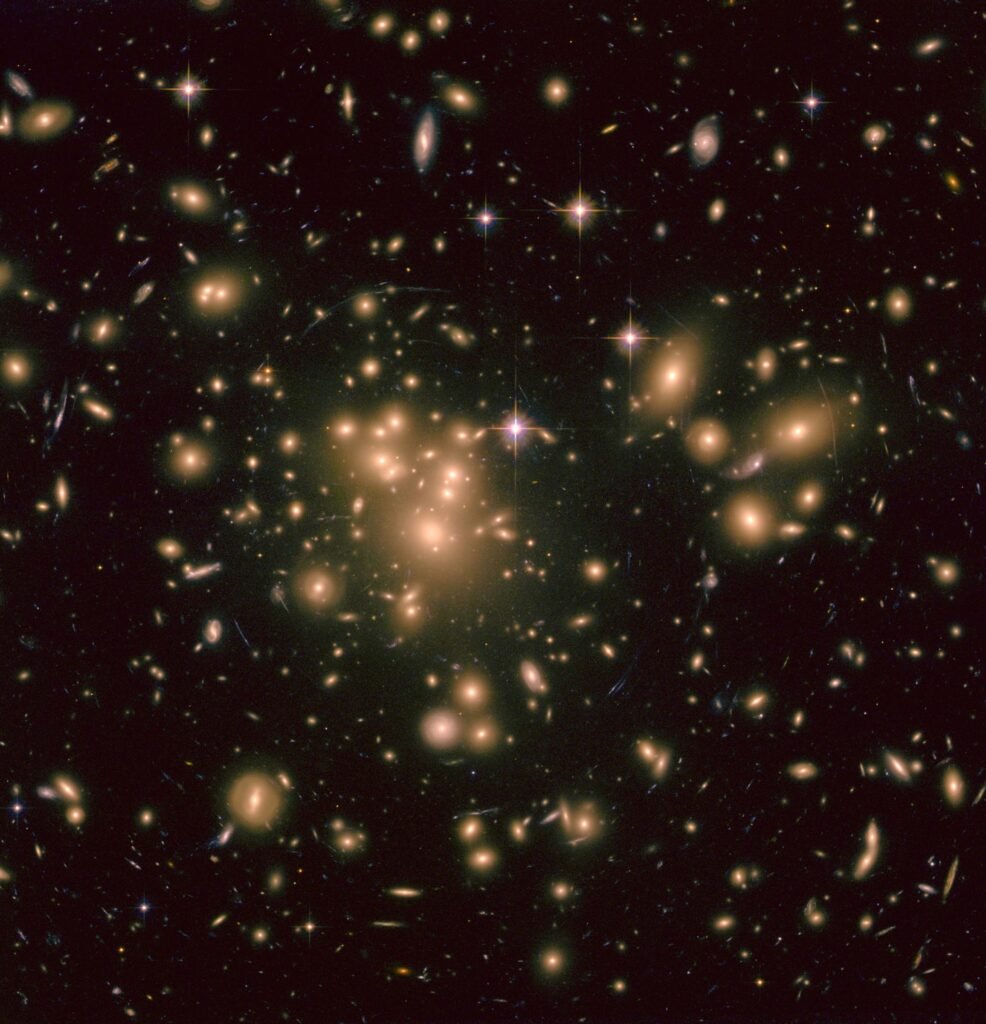
Cosmic inflation does more than solve old problems. It also offers an origin story for the structure we see around us today, the galaxies, clusters, and vast filaments of matter strung across the observable universe.
Quantum fields fluctuate. Even the inflaton field itself would have had small, random quantum fluctuations rippling across it during inflation. Under ordinary circumstances those ripples would stay microscopic and average out to nothing. But inflation stretched them the same way it stretched everything else, carrying them out beyond the horizon so fast that they effectively froze in place, turning quantum randomness into a fixed pattern of slightly denser and slightly sparser regions.
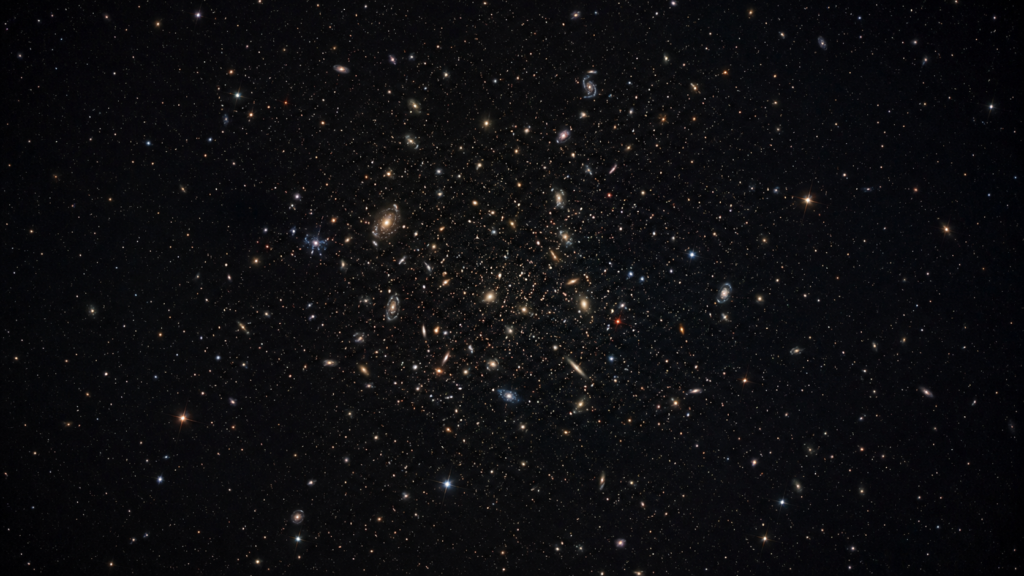
After inflation ended, these frozen patterns eventually came back within reach of ordinary causal processes, and gravity took over from there, slowly pulling ordinary and dark matter into the denser spots and building the cosmic web over billions of years. Simple slow roll models predict that this pattern of fluctuations should be nearly the same size across all scales, with only a slight tilt away from perfect uniformity. Observations of the cosmic microwave background have measured that tilt directly, and it matches what these models expect closely enough to count as one of inflation’s strongest pieces of supporting evidence.
The Cosmic Microwave Background: Reading the Afterglow
The cosmic microwave background is relic light from about 380,000 years after the Big Bang, the moment when the universe cooled enough for electrons and nuclei to combine into neutral atoms, letting photons travel freely for the first time. It arrives today as a near perfect blackbody glow at about 2.7 kelvin, with tiny temperature variations imprinted across the sky.
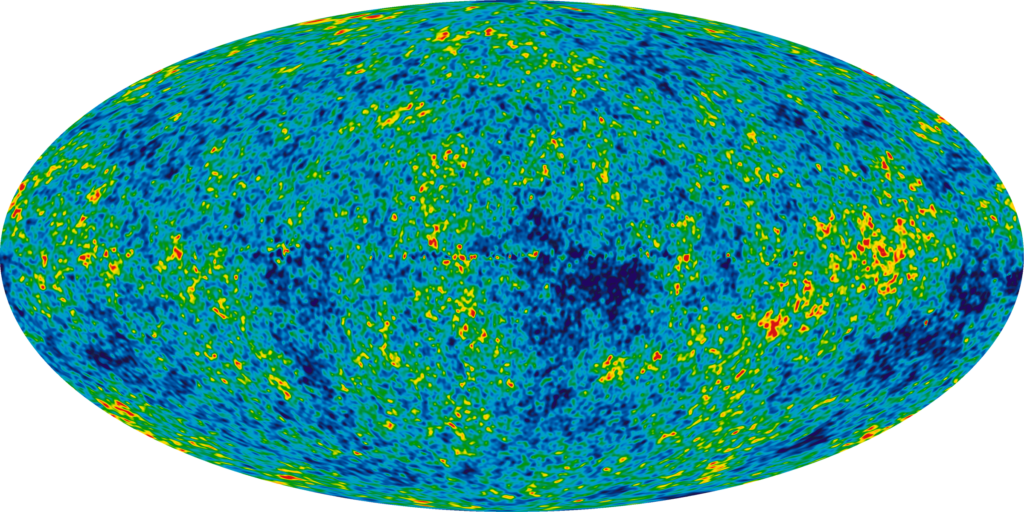
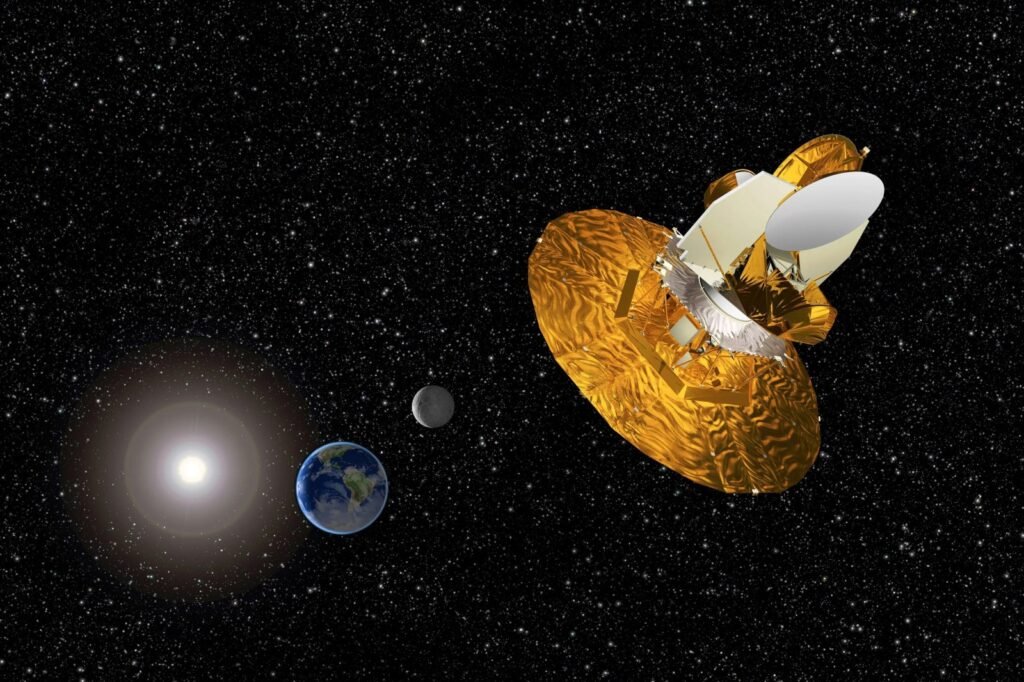
Three space missions have measured this glow with increasing precision. COBE, launched in 1989, confirmed the blackbody spectrum and detected the first hints of anisotropy. WMAP, operating through the 2000s, mapped those variations in far greater detail and measured the scalar spectral index at roughly 0.96 to 0.98, ruling out perfect scale invariance and matching the slight tilt that slow roll inflation predicts. Planck, flying through the early 2010s, tightened that measurement further, to around 0.965, and placed strong limits on the tensor to scalar ratio, a number tied to how many gravitational waves inflation might have produced.
Polarization adds another layer. Scattering off free electrons in the early plasma imprinted polarization patterns on the cosmic microwave background, split into two types, E modes, which look like simple gradients, and B modes, a curling pattern that gravitational waves from inflation would be expected to produce. Detecting genuine primordial B modes would be strong evidence for those gravitational waves, and by extension for inflation at very high energy.
The BICEP2 Lesson
In 2014, the BICEP2 collaboration announced exactly that kind of detection, degree scale B mode polarization consistent with primordial gravitational waves at a fairly high energy scale. It made headlines everywhere. Then came the harder work of ruling out mundane explanations. Joint analysis with Planck’s dust maps showed that polarized emission from dust in our own galaxy could account for most or all of the signal. The claim did not hold up.
The episode is worth remembering not as an embarrassment but as a demonstration of how cosmology actually checks its own work. Separating a genuine primordial signal from galactic foregrounds is difficult, and the field’s response, going back to the data with more information and revising the conclusion, is exactly how the process is supposed to function. Primordial gravitational waves from cosmic inflation remain an open target, not a confirmed detection.
Cosmic Inflation Is Not One Theory But a Family of Models
It helps to think of cosmic inflation less as a single finished theory and more as a framework that many specific models fit inside. Slow roll inflation describes the general behavior. Chaotic inflation, developed by Andrei Linde, starts the inflaton at large field values on simple potentials and can lead to eternal inflation, where some regions keep inflating indefinitely while others break off into their own separate bubble universes. Starobinsky inflation takes a different route entirely, building the accelerated expansion out of a modification to gravity itself rather than a separate field, and its predictions currently fit Planck’s data especially well.
Eternal inflation and the multiverse scenarios that follow from it are genuinely speculative extensions, arising in particular models rather than as an unavoidable consequence of inflation generally. It is a common point of confusion worth clearing up directly: accepting inflation does not commit anyone to accepting a multiverse.
What We Still Don’t Know
Cosmic inflation is well supported, not proven. The inflaton has never been observed directly, and nobody knows whether it connects to particle physics fields we already understand, such as the Higgs field, or to something entirely separate. The exact shape of its potential remains undetermined. Whether inflation left behind a detectable background of gravitational waves is still an open experimental question, one that future CMB polarization experiments and space based observatories are built to chase.
There are also legitimate criticisms. Some researchers argue that inflation trades one fine tuning problem for another, shifting the puzzle from initial conditions onto the choice of inflaton potential. Others point out that with so many possible potentials available, the framework risks becoming difficult to falsify in practice. And alternative early universe models, including bouncing cosmologies and other proposals built without inflation, continue to be developed, even though none currently matches the observational record as well as inflation does.
Why This Matters
Cosmic inflation is the reason the observable universe looks the way it does: uniform in temperature across vast distances, flat in geometry, and seeded with just enough irregularity to eventually grow into galaxies. It connects the physics of quantum fields to the largest structures we can see, across a span of scale that is hard to grasp in ordinary terms. And it does this while staying fully consistent with relativity, offering one of the clearest illustrations available of the difference between motion through space and the stretching of space itself.
Key Takeaways
- Cosmic inflation describes an extremely brief period of accelerated expansion in the early universe, generally placed between about 10 to the negative 36 and 10 to the negative 30 seconds after the Big Bang.
- Regions of space separated faster than light during inflation because the metric of spacetime expanded, not because anything moved through space faster than light, which remains forbidden.
- Inflation solves the horizon, flatness, and monopole problems by stretching a small, causally connected patch of the early universe to a vast size.
- Quantum fluctuations in the inflaton field, stretched to cosmic scales, are thought to have seeded the density variations that later grew into galaxies and large scale structure.
- Observations from COBE, WMAP, and Planck support key inflationary predictions, including a nearly scale invariant spectrum of primordial fluctuations and a spatially flat universe.
- The 2014 BICEP2 announcement of primordial gravitational wave evidence was later attributed largely to galactic dust, and a confirmed detection of inflationary gravitational waves remains an open goal.
- Inflation is a broad framework encompassing many specific models, including slow roll, chaotic, and Starobinsky inflation, and it does not by itself require a multiverse.
- Key details, including the exact nature of the inflaton and the precise shape of its potential, remain unresolved and are active areas of research.
References
- Five Year Wilkinson Microwave Anisotropy Probe (WMAP) Observations: Cosmological Interpretation
- Nine Year Wilkinson Microwave Anisotropy Probe (WMAP) Observations: Final Maps and Results
- Inflationary paradigm after Planck 2013
- Linde, Albrecht, Steinhardt and related work on new inflation and slow roll dynamics, including Spontaneous Creation of Almost Scale Free Density Perturbations in an Inflationary Universe
- Inflationary Cosmology Revisited: An Overview of Contemporary Scientific Cosmology After the Inflationary Proposal
- Topics in Cosmology, Clearly Explained by Means of Simple Examples (MDPI Universe)
- Measuring the Polarization of the Cosmic Microwave Background with BICEP3, and related BICEP and Keck Array papers
- Horizon, homogeneity and flatness problems, do their resolutions really depend upon inflation?
- WMAP Overview, NASA Science, image and mission credits: NASA / WMAP Science Team
Join the discussion
Comments are moderated and may take a little while to appear.