Nearly everything familiar, stars, planets, air, rocks, machines and living bodies, is built mainly from electrons and just two types of quark. That single fact captures the central puzzle particle physics explained: the visible universe holds immense complexity, yet its stable matter rests on a remarkably small number of elementary ingredients.
Particle Physics Explained: What the Field Actually Studies
Particle physics studies the smallest currently known constituents of matter and the fundamental interactions between them, including quarks, leptons, gauge bosons, the Higgs field, particle decays and the symmetries that govern them [1]. It differs from its neighboring fields. Atomic physics focuses on electrons bound to nuclei and atomic spectra. Nuclear physics focuses on protons, neutrons and the forces that hold nuclei together. Particle physics goes a layer deeper, beneath protons and neutrons, into quarks and gluons themselves [2].
Quantum mechanics is not simply another branch sitting alongside these three. It is the broad mathematical framework all of them use. Modern particle physics is built on a more complete version of that framework called quantum field theory, which treats particles not as objects but as excitations of fields that fill space [3].
Particles Are Not Tiny Solid Balls
Illustrations often show particles as small colored spheres. That image helps with classification, but it is physically misleading. In quantum field theory, fundamental fields exist throughout space, and a particle is a quantized ripple in the corresponding field. An electron is an excitation of the electron field. A photon is an excitation of the electromagnetic field [3].
The ripple analogy helps, but it has limits. Quantum fields are not literal water surfaces, and their excitations do not behave like ordinary waves on a pond. Quantum particles are not miniature classical objects following fixed paths either. They are described by probability amplitudes, and depending on the experiment, they can display particle like or wave like behavior, a topic explored further in how decoherence explains why we never see the blur. The more accurate statement is that classical categories such as particle and wave are simply incomplete descriptions of something quantum mechanical.
A particle is not a tiny ball traveling through space. It is a quantized ripple in a field that already fills all of space.
The Standard Model: Our Best Map of the Subatomic World
The Standard Model is a quantum field theory describing the known fundamental matter particles along with three of the four known fundamental interactions: electromagnetism, the weak interaction and the strong interaction [1]. It does not contain a complete quantum theory of gravity, a gap physicists have not yet closed.
Within this framework, particles fall into four categories.
- Quarks: fundamental particles that carry color charge and take part in the strong interaction.
- Leptons: fundamental particles that do not carry color charge. Charged leptons feel electromagnetism and the weak force. Neutrinos feel only the weak force and gravity.
- Gauge bosons: particles associated with the electromagnetic, weak and strong interactions.
- The Higgs boson: the quantum excitation of the Higgs field, tied to how other particles acquire mass.

Public domain image via Wikimedia Commons.
Quarks and leptons are matter particles, arranged in three generations, with the first generation, the up quark, the down quark, the electron and the electron neutrino, forming essentially all of stable ordinary matter [4].
The Matter Particles: Quarks and Leptons
There are six quarks: up, down, charm, strange, top and bottom. The up type quarks (up, charm, top) carry an electric charge of positive two thirds; the down type quarks (down, strange, bottom) carry negative one third. Quarks also carry color charge, the charge associated with the strong interaction. The labels red, green and blue are just names borrowed from color for a mathematical property with nothing to do with what anything looks like [4].
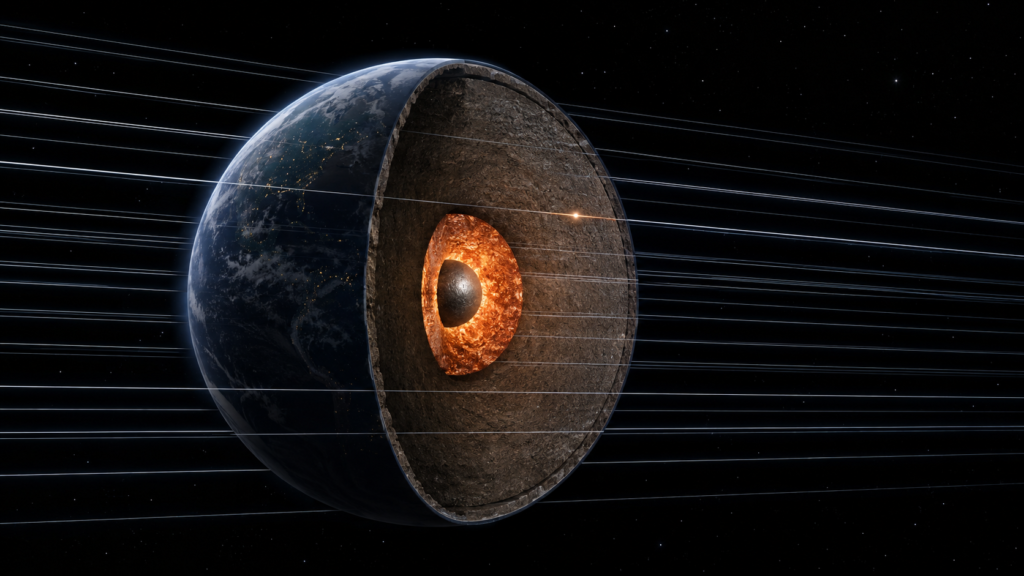
There are six leptons: the electron, muon and tau, each carrying negative charge, along with their three corresponding neutrinos, which carry no charge at all. Neutrinos interact so weakly that enormous numbers pass through ordinary matter with almost no effect. Experiments have shown that neutrinos change flavor as they travel, called oscillation, which proves they carry a small but nonzero mass, something the original Standard Model did not include [4].
| Category | Examples | Main role | Forces experienced |
|---|---|---|---|
| Quarks | up, down, charm, strange, top, bottom | build hadrons such as protons and neutrons | strong, electromagnetic, weak, gravity |
| Charged leptons | electron, muon, tau | elementary matter particles unaffected by the strong interaction | electromagnetic, weak, gravity |
| Neutrinos | electron, muon and tau neutrinos | weakly interacting neutral leptons | weak, gravity |
| Gauge bosons | photon, gluons, W and Z | associated with the fundamental interactions | depends on the boson |
| Higgs boson | Higgs boson | excitation of the Higgs field | interacts according to its couplings |
The Force Carriers: Photons, Gluons, W and Z Bosons
The photon carries electromagnetism. It is massless, electrically neutral and gives electromagnetism its effectively infinite range. Gluons carry the strong interaction. They are massless, but unlike the photon they carry color charge themselves, which lets them interact with one another as well as with quarks; there are eight gluon states in total [5].
The W and Z bosons carry the weak interaction. The W bosons carry electric charge, while the Z is neutral. All three are far more massive than the photon, and that heaviness is exactly why the weak force has such a short range, unlike electromagnetism [8].
It helps to picture these as particles being tossed back and forth, but that picture is only shorthand. In quantum field theory, interactions arise from the way fields are coupled together mathematically. Gauge bosons are the detectable, on shell excitations tied to those interactions, and should not be confused with the virtual contributions that show up as internal pieces of a calculation but are never directly observed as free particles.
How Quarks Build Protons and Neutrons
Protons and neutrons are not fundamental. They are composite particles built from quarks and gluons. A proton’s valence content is two up quarks and one down quark; a neutron’s is one up quark and two down quarks. But describing a proton as simply three quarks in a bag understates what is really there. A proton is a dynamic quantum system containing three valence quarks, a sea of transient quark and antiquark pairs, and gluon fields carrying much of the system’s energy [6].
That last point matters enormously. Deep inelastic scattering experiments in the late 1960s revealed point like constituents inside protons and neutrons, establishing the quark model and the theory of the strong interaction, quantum chromodynamics [6]. One consequence of that theory is confinement: pulling quarks apart takes so much energy that new quark and antiquark pairs form before a single quark can ever be isolated. That is why experiments see jets of composite particles called hadrons rather than free quarks. Baryons, like protons and neutrons, contain three valence quarks; mesons contain a valence quark and antiquark pair. Exotic hadrons keep turning up too, including the doubly charmed baryon observed by the LHCb collaboration in 2017 [7].
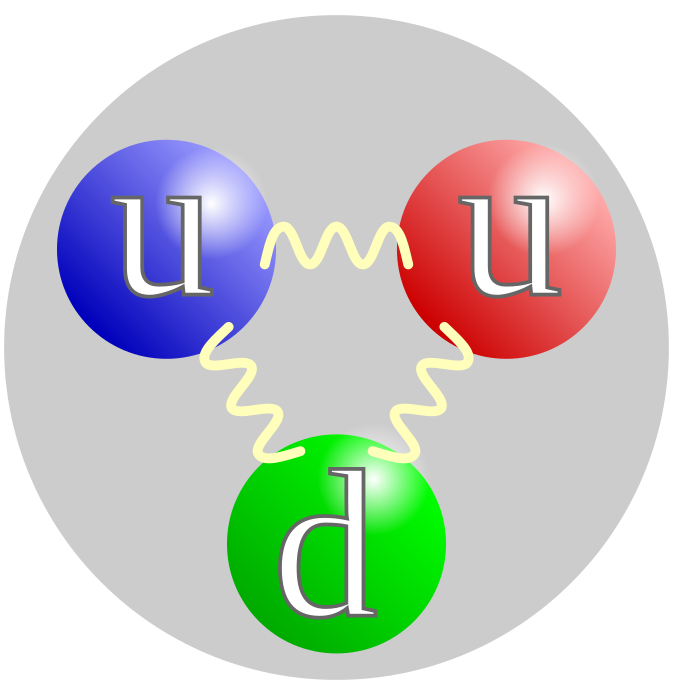
Image by Arpad Horvath via Wikimedia Commons, licensed CC BY-SA 2.5.
Why Ordinary Matter Uses Only Three Main Ingredients
Stable matter depends almost entirely on up quarks, down quarks and electrons, the lightest, stable members of the first generation. The heavier quarks, charm, strange, top and bottom, along with the muon and tau, are unstable and decay quickly into lighter particles through the weak interaction. Neutrinos are abundant throughout the universe, but they do not form the structural framework of atoms the way quarks and electrons do.
Stability itself needs care. A free neutron decays within minutes, yet neutrons remain stable for as long as the universe has existed once bound inside most atomic nuclei. The first generation of matter particles dominates ordinary matter simply because it contains the lightest stable charged particles and the quarks needed to build stable nucleons.
The Higgs Field and the Origin of Particle Mass
The Higgs field has a nonzero value everywhere in space, even in a vacuum. Through the Brout Englert Higgs mechanism, the W and Z bosons acquire mass while the underlying gauge structure of the theory stays intact, and fermions acquire mass through couplings to the same field, with different particles coupling at different strengths [11]. ATLAS and CMS announced the discovery of a new boson near 125 GeV in 2012, with properties consistent with the predicted Higgs boson [9] [10].
Several popular claims about the Higgs need correcting. It does not give mass to everything: most of the mass of protons and neutrons, and therefore most of the mass of ordinary objects, comes from the energy of quarks and gluons interacting inside them, not from the Higgs field directly [5]. The Higgs field does not work through friction or drag, and it does not explain gravity. It also does not explain why each particle’s coupling has the specific value it does; those values are measured, not derived. The popular nickname calling it the God particle is scientifically misleading and should not be treated as an explanation [22].
Most of the mass in an ordinary object never touches the Higgs field at all. It comes from the energy locked inside its protons and neutrons.
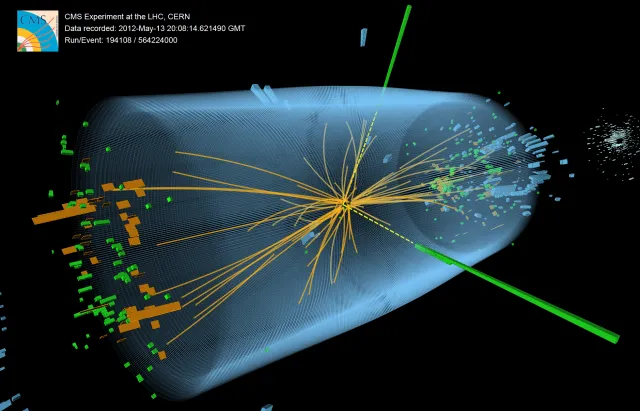
Image: CERN. Used for educational purposes with credit, per CERN’s terms of use for audiovisual media.
Antimatter: Matter’s Quantum Counterpart
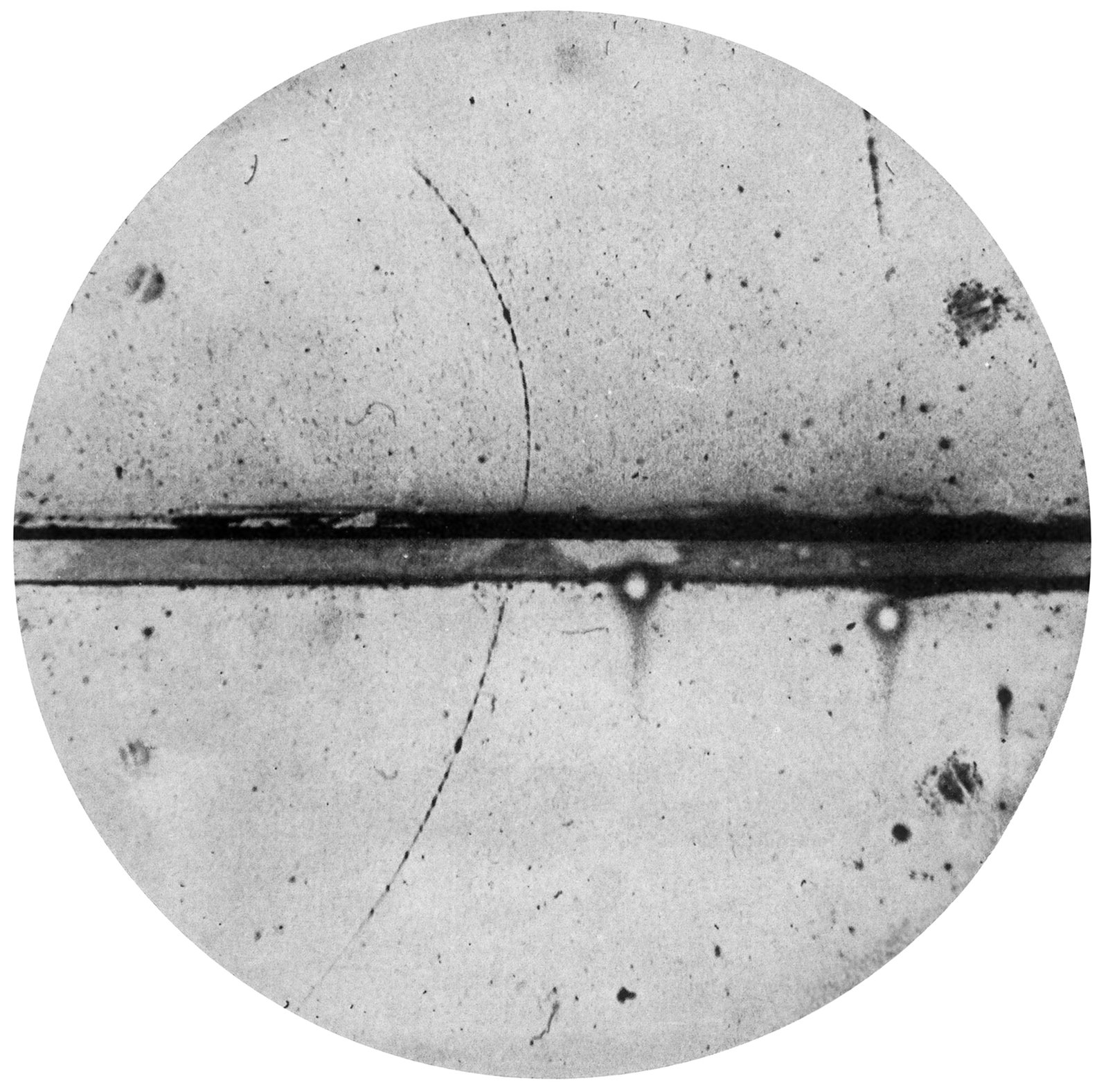
Every charged particle has a corresponding antiparticle with identical mass but opposite electric charge. The positron, the antimatter counterpart of the electron, was discovered in 1932, and antiprotons and antineutrons have since been produced as well. When matter and antimatter meet, they can annihilate into other particles, often photons, with energy and momentum fully conserved throughout, nothing simply disappears [24].
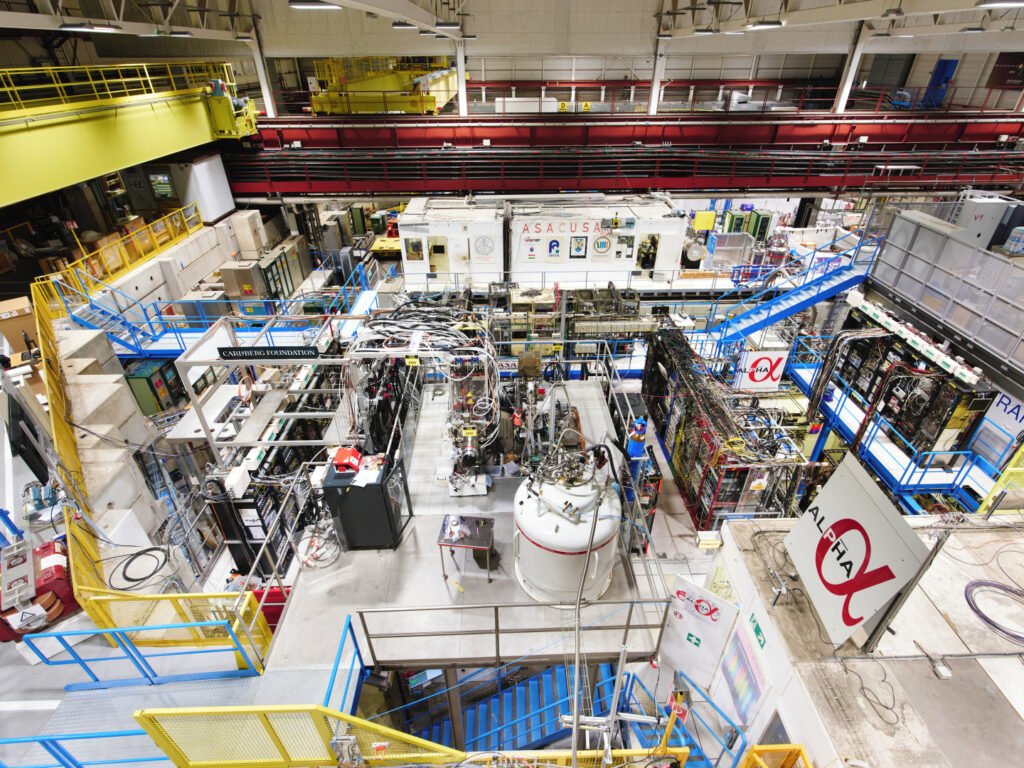
Antimatter is not just a theoretical curiosity. The ALPHA collaboration at CERN trapped antihydrogen atoms for 1,000 seconds in a 2011 experiment [23]. Yet the observable universe is made overwhelmingly of matter rather than antimatter, and that imbalance is not fully explained. The Standard Model contains a small amount of the relevant asymmetry, called CP violation, but by current measurements it appears far too small to account for the cosmic imbalance we see [25].
Public domain image via Wikimedia Commons.
How Particle Accelerators Reveal the Invisible
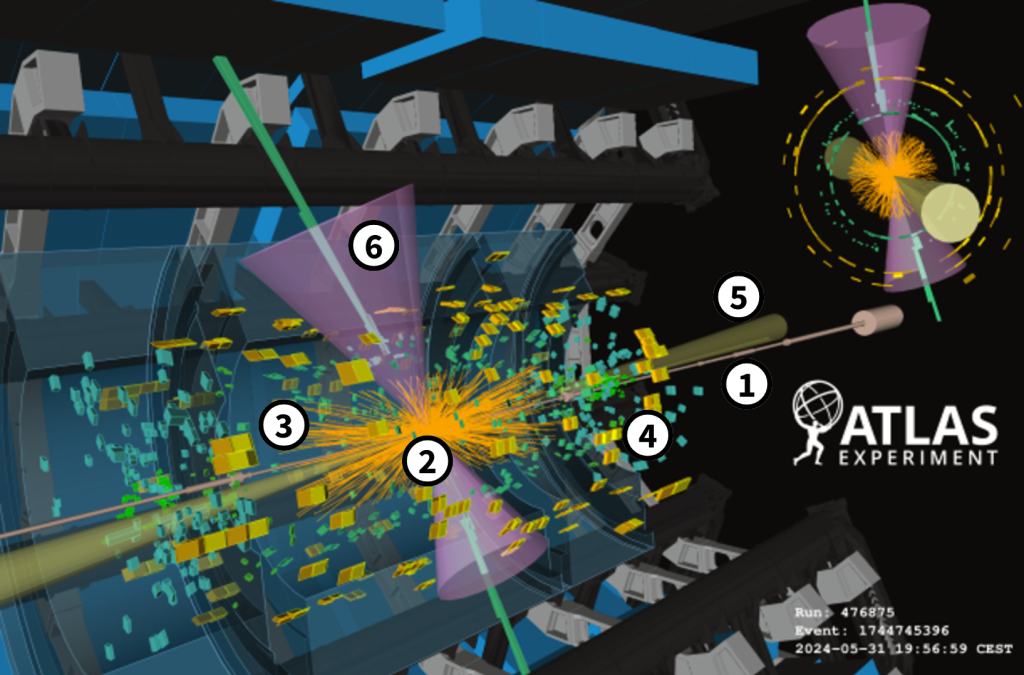
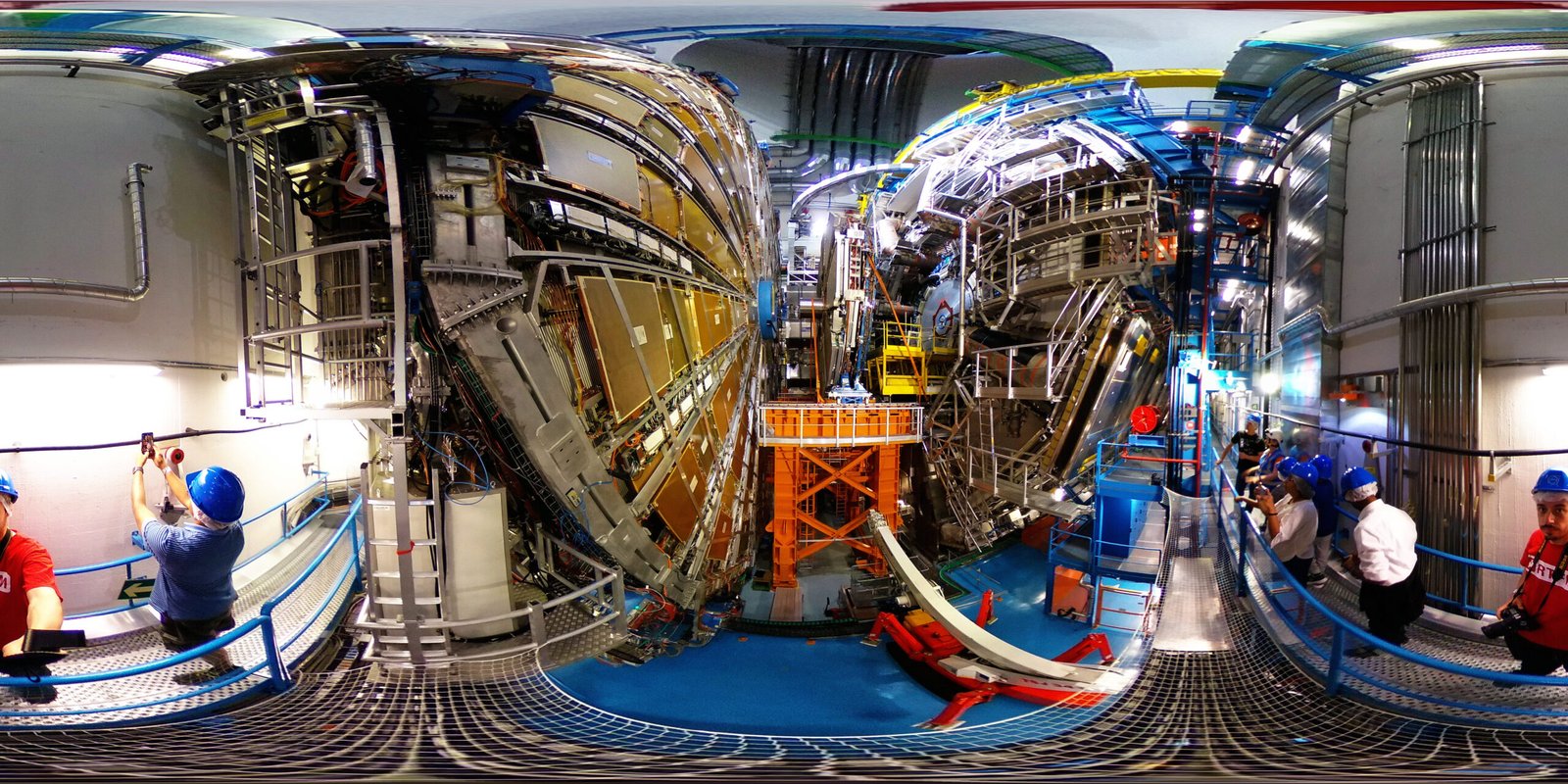
Image: ATLAS/CERN. Used for educational purposes with credit, per CERN’s terms of use for audiovisual media.
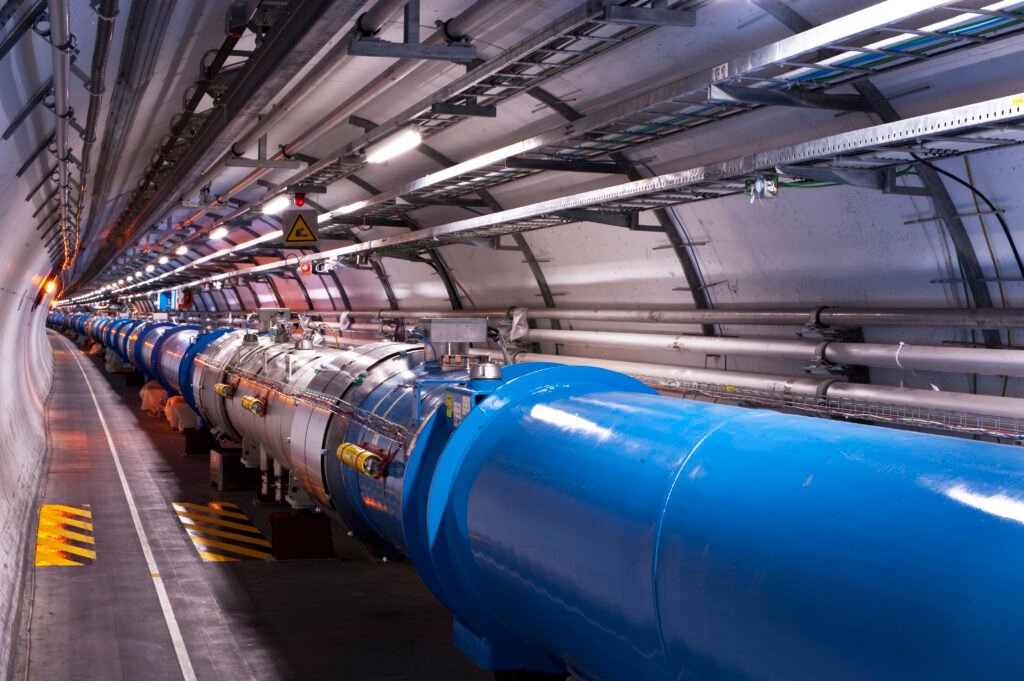
Accelerators use electric fields to boost the energy of charged particles and magnetic fields to bend and focus their paths. Higher collision energy serves two purposes at once: higher momentum probes shorter distances, and collision energy can convert into the mass of new, heavier particles [27] [28]. The Large Hadron Collider accelerates and collides proton beams at the highest energies humans have produced, with detectors such as ATLAS and CMS built around the collision points [29] [30].
Those detectors do not take photographs. They are built from layered subsystems, tracking detectors that follow charged particle paths, calorimeters that measure deposited energy, and muon systems that catch the most penetrating particles. Particles like neutrinos escape without leaving a direct trace, and their presence is inferred from an imbalance in the total momentum recorded. Short lived particles, including the Higgs boson, are never observed directly; they are reconstructed statistically from their decay products, energy, momentum and the patterns those leave behind.
What the Standard Model Cannot Explain
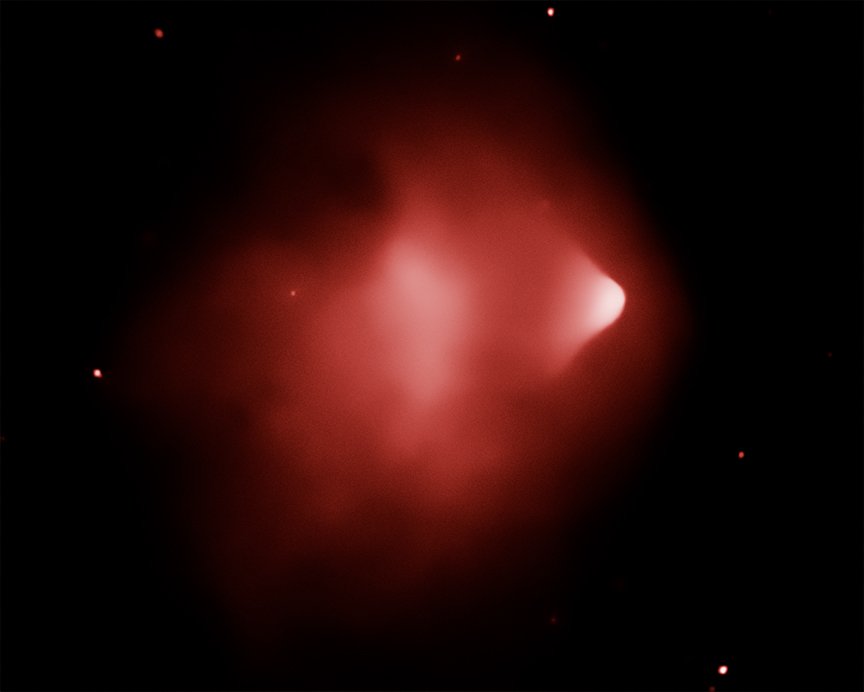
For all its precision, the Standard Model leaves major questions open. Galaxy dynamics, gravitational lensing and cosmic structure all point to dark matter, but no known particle accounts for it, and candidates such as WIMPs, axions and sterile neutrinos remain unconfirmed [17]. Neutrino oscillations prove neutrinos have mass, yet the mechanism generating that mass is still unknown, the matter over antimatter imbalance still lacks a full explanation, and the theory contains no working quantum theory of gravity; general relativity and quantum field theory each work beautifully alone, but nobody has combined them into an experimentally confirmed framework [18].
The theory also carries many measured parameters, masses, mixing angles, coupling strengths, whose values it does not explain, and no reason why matter comes in exactly three generations. These are less failures than the sharp edges of an otherwise successful theory, marking where the next layer of physics is expected to be found.
Public domain image, credit NASA/CXC/CfA/M. Markevitch et al., via Wikimedia Commons.
Why Particle Physics Matters
Beyond the pursuit of the simplest known description of matter, particle physics has contributed real technology. Proton and ion beams are used in cancer therapy for precise tumor targeting. Detector techniques developed for particle and nuclear physics have shaped modern medical imaging, including positron emission tomography, and accelerator technology supports materials science, industrial processing and isotope production. The huge data volumes generated at facilities like the LHC helped drive advances in distributed computing and statistical analysis [19]. The World Wide Web itself was created at CERN so physicists could share information more easily [20].
Quantum computers are increasingly tested as a complementary tool for this kind of physics, simulating particle interactions and quantum field behavior that classical supercomputers struggle with, though meaningful advantages over classical methods remain rare and narrow as of 2026.
Key Takeaways
- Particle physics studies the elementary fields, particles and interactions that lie beneath atoms.
- Fundamental particles are not tiny classical balls; they are quantum excitations of fields.
- Ordinary matter depends almost entirely on up quarks, down quarks and electrons.
- The Standard Model successfully describes known particles and three of the four fundamental interactions, but it excludes quantum gravity.
- Major open problems, dark matter, neutrino mass, and the matter over antimatter imbalance, remain unresolved.
Frequently Asked Questions
What is particle physics in simple terms?
Particle physics studies the smallest known building blocks of matter, quarks, leptons and force carrying particles, along with the fundamental interactions between them. It looks beneath protons and neutrons to the more elementary constituents and fields that make them up, using high energy experiments to probe distances far smaller than an atomic nucleus.
What are the fundamental particles of the universe?
The Standard Model’s fundamental particles are six quarks, six leptons, the photon, eight gluons, the W and Z bosons and the Higgs boson. Protons and neutrons are not on this list because they are composite, built from quarks bound together by the strong interaction, not elementary particles themselves.
Are particles really tiny balls?
No. In quantum field theory, a particle is a quantized excitation of a field that fills space, not a miniature solid object. This picture explains why particles can show wave like and particle like behavior depending on the experiment, something a classical ball image cannot account for.
What is the Standard Model of particle physics?
It is the quantum field theory describing all known elementary particles along with the electromagnetic, weak and strong interactions. It has been tested to extraordinary precision, but it does not include a working quantum theory of gravity.
Why is gravity not part of the Standard Model?
Gravity is described extremely well by general relativity at the scales physicists can currently test, but nobody has combined it with quantum field theory into a single experimentally verified framework. Proposals exist, but none has direct experimental confirmation yet.
How do particle accelerators detect invisible particles?
Accelerators produce high energy collisions, and layered detectors measure the tracks, energy deposits and momentum of the particles that come out. Short lived or neutral particles are identified indirectly, through missing momentum or by statistically reconstructing them from their decay products.
Conclusion
The Standard Model is one of the most precisely tested theories in science, and it rests on a remarkably short list of ingredients: a handful of quarks and leptons, a small set of force carrying bosons, and the Higgs field that helps give them mass. Ordinary matter, everything from stars to living bodies, comes down mainly to two quarks and one lepton. Underneath all of it, particles are not tiny objects but quantized ripples in fields that fill space.
None of this means physics is finished. Dark matter, the origin of neutrino mass, the imbalance between matter and antimatter, and the absence of a quantum theory of gravity remain open. These are not vague mysteries so much as sharply defined problems, marked out precisely because the Standard Model works so well everywhere else. That combination, extraordinary success alongside clearly bounded gaps, is what makes particle physics one of the most active frontiers in science today.
References
- CERN, “The Standard Model.”
- IPPOG / CERN, “Introduction to the Standard Model.”
- David Tong, University of Cambridge, “Quantum Field Theory.”
- Particle Data Group, “Review of Particle Physics 2024, Quarks and Leptons.”
- Particle Data Group, “Review of Particle Physics 2024, Quantum Chromodynamics.”
- Particle Data Group, “Review of Particle Physics 2024, Deep Inelastic Scattering.”
- LHCb Collaboration, “Observation of the Ξcc++ Baryon in pp Collisions at √s = 13 TeV,” Physical Review Letters, 2017.
- Particle Data Group, “Review of Particle Physics 2024, Electroweak Model and Constraints.”
- ATLAS Collaboration, “Observation of a New Particle in the Search for the Standard Model Higgs Boson with the ATLAS Detector at the LHC,” Physics Letters B, 2012.
- CMS Collaboration, “Observation of a New Boson at a Mass of 125 GeV with the CMS Experiment at the LHC,” Physics Letters B, 2012.
- Nobel Prize, “The Nobel Prize in Physics 2013, Scientific Background.”
- Particle Data Group, “Review of Particle Physics 2024, Dark Matter.”
- Royal Society, Philosophical Transactions A, “Beyond the Standard Model of Particle Physics.”
- CERN, “Particle Accelerators and Society.”
- CERN, “Birth of the Web.”
- Nobel Prize, “The Nobel Prize in Physics 2013, Popular Information.”
- ALPHA Collaboration, “Confinement of Antihydrogen for 1,000 Seconds,” Nature Physics, 2011.
- CERN, “Antimatter.”
- Brookhaven National Laboratory, “CP Violation and the Matter–Antimatter Asymmetry.”
- CERN, “Particle Accelerators.”
- CERN, “Large Hadron Collider.”
- ATLAS Collaboration, “ATLAS.”
- CMS Collaboration, “CMS.”
Join the discussion
Comments are moderated and may take a little while to appear.