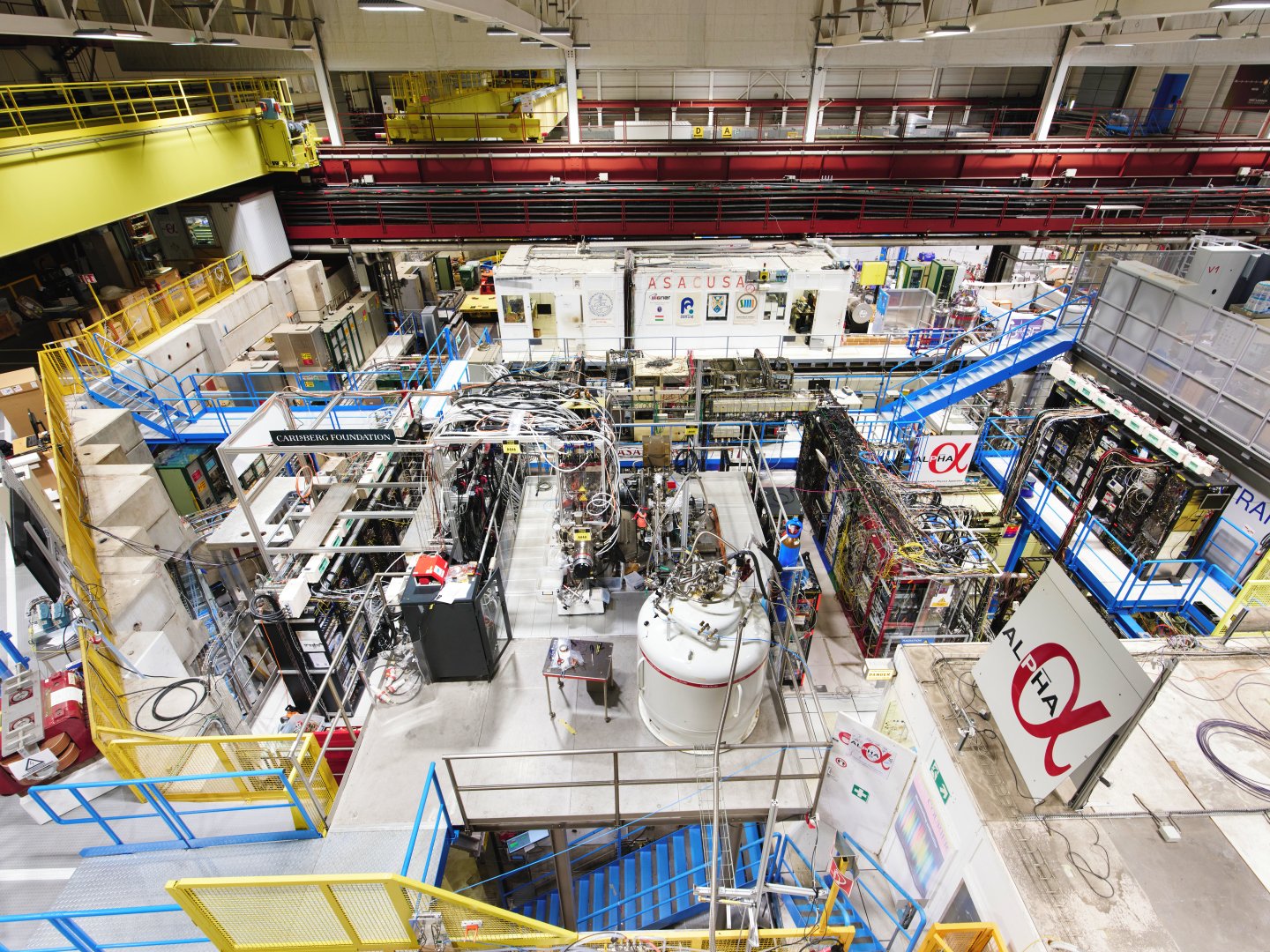
In March 2026, a truck drove slowly across CERN’s main site carrying 92 antiprotons in a superconducting trap (CERN BASE Transport Announcement, 2026). The cargo weighed nothing worth measuring. It was still a world first, because antiparticles annihilate as soon as they meet their matter counterparts, and nobody had ever moved any of it from one building to another and kept it alive.
That is the honest state of antimatter research: real, difficult, and vastly smaller in scale than the films suggest. Antimatter is a class of particles that mirror ordinary matter with certain properties reversed. It exists, it has been measured to eleven and twelve significant figures, and positrons are created briefly inside patients during millions of PET examinations every year. What nobody has is a container of it. This guide covers what antimatter is, how physicists make and trap it, what happens when it meets matter, what it is actually used for, and why the universe held on to almost none of it.
What Is Antimatter?
Antimatter is made of antiparticles. Every antiparticle has the same mass as its ordinary counterpart but carries opposite values for certain properties, most obviously electric charge. An electron’s antiparticle is the positron, identical in mass but positively charged. When a particle meets its antiparticle, the two can annihilate, and their combined mass-energy is converted into other particles and radiation rather than disappearing.
Charge is not the only thing that flips. The antiproton has negative charge, but it also carries the opposite baryon number and is built from antiquarks instead of quarks. The neutron is electrically neutral and still has a distinct antiparticle: the antineutron differs from the neutron in baryon number and quark content, even though both have zero net charge. So it is wrong to say that antiparticles differ from particles only in charge.
A few particles are their own antiparticles. The photon is the standard example. Whether neutrinos belong on that list is still an open experimental question.
Put an antiproton and a positron together and you get antihydrogen, the antimatter version of the simplest atom in the universe. That is what most modern antimatter experiments are built around, because hydrogen is the best understood system in physics and any discrepancy between the two would be a serious crack in the Standard Model.
Who Predicted and Discovered Antimatter?
Antimatter arrived as a piece of algebra before anyone saw it. In 1928, Paul Dirac wrote an equation combining quantum mechanics with special relativity to describe a fast-moving electron. The equation had two families of solutions, one with positive energy and one that appeared to describe negative energy. Rather than discard the awkward half, physicists eventually read it as describing a particle with the electron’s mass and the opposite charge (CERN70, 2024).
Carl Anderson found that particle in cosmic rays in 1932 and published the result under the title “The Positive Electron” (Anderson, 1933). The positron was real.
The heavier antiparticles took another two decades and a purpose-built machine. Owen Chamberlain, Emilio Segrè, Clyde Wiegand, and Thomas Ypsilantis reported the antiproton at Berkeley’s Bevatron in 1955. A second Bevatron team announced the antineutron the following year (CERN Timeline).
Assembling those pieces into a complete anti-atom took another forty years. In 1995, the PS210 experiment at CERN’s Low Energy Antiproton Ring produced nine atoms of antihydrogen. Each survived roughly forty billionths of a second while travelling at nearly light speed (CERN, 1995). Cold, slow antihydrogen suitable for actual measurement arrived in 2002, and the first magnetically trapped antihydrogen came in 2010.
Is Antimatter Real?
Yes, antimatter is real. It is one of the best-tested parts of particle physics.
The evidence is not subtle. Positrons appear in cosmic-ray interactions, in beta-plus radioactive decay, and above thunderstorms, where NASA’s Fermi telescope has detected beams of them launched into space by terrestrial gamma-ray flashes (NASA, 2011). Antiprotons and antineutrons are produced in accelerators worldwide. Antihydrogen has been trapped, laser-cooled, and spectroscopically compared with ordinary hydrogen. The ALPHA collaboration has measured antihydrogen properties to twelve significant digits, and BASE has compared the charge-to-mass ratio of protons and antiprotons to eleven digits (CERN Antimatter FAQ).
There is a catch, though. Individual antiparticles are routine. Bulk antimatter is not. No laboratory has ever accumulated a visible quantity, and on current technology none is close.
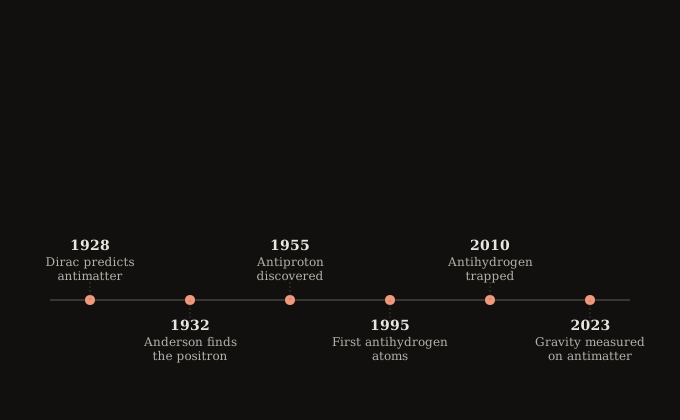
Image: Astrinova.io.
What Does Antimatter Look Like?
Not like anything, in the case of a single antiparticle. Individual particles have no colours or surfaces, and a positron looks no more exotic than an electron does.
A hypothetical lump of antimatter would not glow simply for being antimatter. Antihydrogen absorbs and emits light at frequencies that track ordinary hydrogen extremely closely: ALPHA measured the antihydrogen 1S-2S transition to a precision of two parts in a trillion, and the 1S-2P Lyman-alpha line matched the hydrogen prediction to five parts in a hundred million (ALPHA Collaboration, 2018). An isolated anti-iron object would be expected to have essentially the same optical properties as ordinary iron, though anti-iron has never been made.
What you would actually see is the annihilation. Any antimatter object sitting in a normal room would be reacting continuously with the air around it, and the visible drama would come from the annihilation products, not from the material. The blue and purple glow that films use is set decoration.
How Is Antimatter Made?
There are several routes, and all of them start with energy.
Pair production. A sufficiently energetic photon passing near a nucleus can convert into a particle and its antiparticle together. Energy becomes mass, and charge, energy, momentum, and the relevant quantum numbers stay conserved throughout, which is why the pair appears together rather than singly.
High-energy collisions. Smash protons into a fixed target hard enough and some of the collision energy materialises as new particle-antiparticle pairs. This is how antiprotons are made.
Beta-plus decay. Certain unstable nuclei convert a proton into a neutron and emit a positron. Fluorine-18, carbon-11, nitrogen-13, and oxygen-15 all do this, which is exactly why PET imaging exists.
Nature. Cosmic rays striking the upper atmosphere produce antiparticles constantly. So do thunderstorms. Very rarely, the potassium-40 in natural potassium emits a positron too, in roughly one decay in a hundred thousand.
What does not work is treating any of this as energy storage. You cannot plug an accelerator into the grid and fill a tank. Every one of these routes costs far more energy than the resulting antimatter could return.
How Does CERN Produce Antimatter?
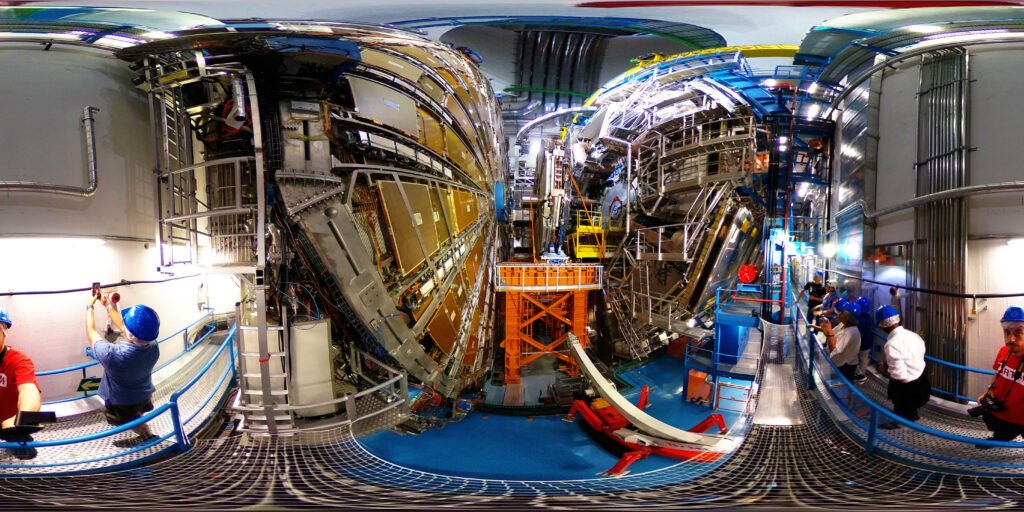
CERN runs the only facility on Earth that makes low-energy antiprotons in usable numbers, the Antimatter Factory.
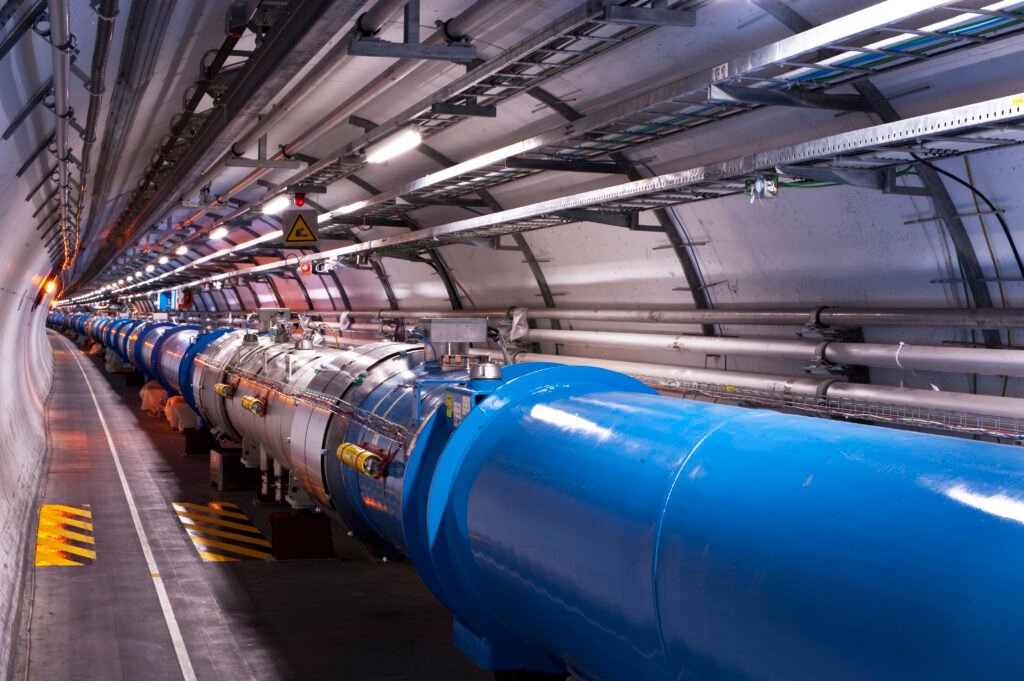
The sequence starts violently and ends delicately. Protons from the accelerator complex are slammed into a metal target, producing a spray of particles that includes antiprotons. Those antiprotons emerge far too fast to study, so they pass through the Antiproton Decelerator and then ELENA, which slow them in stages. The beam is cooled to shrink its spread in energy and position, and the antiprotons are then held in electromagnetic traps.
Making antihydrogen means introducing positrons, usually from a radioactive source, into the same trapping region and persuading the two species to combine. The resulting anti-atoms are electrically neutral, so they escape electric traps, which is why experiments such as ALPHA use a magnetic minimum trap that exploits antihydrogen’s weak magnetism.
Six collaborations share the supply. ALPHA, AEgIS, and GBAR work on antihydrogen and gravity, ASACUSA studies antiprotonic atoms, BASE runs precision Penning-trap comparisons of protons and antiprotons, and PUMA uses antiprotons to probe neutron-rich nuclei. When running, the Antimatter Factory delivers roughly 400 million antiprotons per hour, of which experiments capture about ten per cent. ALPHA can build antihydrogen at up to 3,000 atoms per hour and hold them for up to 100 hours (CERN Antimatter FAQ).
What Happens When Antimatter Touches Matter?
They annihilate, and popular accounts usually get what happens next wrong.
Nothing vanishes into undefined energy. The mass-energy of the pair is converted into other particles and radiation, with energy, momentum, electric charge, and the relevant quantum numbers all conserved.
When an electron meets a positron at low energy, the usual outcome is two gamma-ray photons of 511 keV each, flying in nearly opposite directions. The reason there are two rather than one is momentum conservation: in the frame where the pair is at rest, total momentum is zero before annihilation, and a single photon can never have zero momentum. Two photons back to back can.
Proton-antiproton annihilation is messier. The quarks and antiquarks rearrange, and the typical result is a shower of several particles, commonly pions, which then decay further into gamma rays, muons, and neutrinos. So it is not true that annihilation produces only light. It depends on what annihilated.
Nothing disappears. The mass-energy becomes other particles and radiation, and every conservation law holds.
How Much Energy Does Antimatter Release?
Annihilation is the most efficient mass-to-energy conversion known, roughly fifty times better than nuclear fusion (CERN Antimatter FAQ). That fact is real, and it is also where most of the exaggeration starts.
Take the standard example. If one gram of antimatter annihilates with one gram of matter, the reacting mass is two grams, not one. Both sides are consumed. Using E = mc² with m = 0.002 kg:
E = 0.002 × (3.00 × 10⁸)² ≈ 1.8 × 10¹⁴ joules
That is about 43 kilotons of TNT equivalent, or roughly 50 million kilowatt hours. It is an enormous number for two grams of material.
It is also completely hypothetical. Nobody has a gram, nobody is close to a gram, and the energy spent producing that antimatter would dwarf the energy released.
How Is Antimatter Stored?
The core problem is that antimatter cannot touch its container. Any wall is made of matter, and contact means annihilation. Storage therefore means suspending particles in a vacuum using fields, and keeping the vacuum better than almost anywhere else in the solar system.
Charged antiparticles are the easier case. Penning traps use a strong magnetic field plus shaped electric fields to hold antiprotons in place without contact. BASE has stored antiprotons for more than a year this way, in the best vacuum ever reported in a terrestrial experiment, about 5 × 10⁻¹⁹ mbar (CERN Antimatter FAQ).
Neutral antihydrogen is much harder. With no net charge, it ignores electric fields entirely. Trapping relies on the atom’s weak magnetic moment and a carefully shaped magnetic minimum, which holds only the very coldest atoms. Everything else escapes and annihilates on the walls within moments.
Capacity is limited too. Same-charge particles repel, so a trap holding more of them must be bigger and hungrier. The largest current traps hold roughly a billion antiparticles of the same charge, around 10⁻¹⁸ kilograms, and current magnetic traps could in principle hold about 100,000 antihydrogen atoms (CERN Antimatter FAQ). Calling any of this a magnetic bottle oversells it considerably.
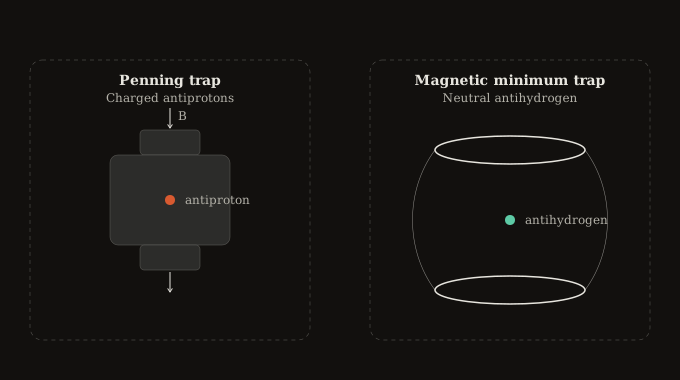
Image: Astrinova.io.
Why Is Antimatter So Expensive?
There is no market price for antimatter, because there is no market. It is not sold by the gram, and no institution has a gram to sell. The famous price tags are extrapolations, not quotations.
The most widely cited figure comes from a 1999 NASA technical presentation on antimatter propulsion, which estimated the cost of one gram of antiprotons at 62.5 trillion US dollars (Gerrish, NASA, 1999). That number is an engineering extrapolation from accelerator production costs at the time, not a price anyone has ever paid or charged, and it should be read as an order-of-magnitude illustration of inefficiency rather than a settled fact.
The inefficiency is the real story. CERN estimates that producing and storing antimatter returns only about a ten-billionth of the energy invested (CERN Antimatter Media Kit, 2026). Add the accelerator infrastructure, the cryogenics, the vacuum systems, the microscopic yields, and the losses during capture and storage, and the cost per unit mass becomes absurd by construction.
How Much Antimatter Have Humans Made?
Enormous numbers of antiparticles. Almost no mass.
CERN’s own idealised annual illustration, assuming a full year of running and perfect storage, comes to about 30 million antihydrogen atoms, roughly 3 × 10⁻²⁰ kilograms, alongside 300 billion antiprotons, roughly 3 × 10⁻¹⁶ kilograms (CERN Antimatter FAQ).
Those quantities are almost unimaginably small. Working from CERN’s antiproton figure, accumulating a single gram would take something on the order of a trillion years, far longer than the current age of the universe, and even a nanogram remains far beyond present production and storage. CERN’s own summary is blunt: annihilating all the antimatter ever made at the laboratory would light one electric bulb for a few minutes (CERN Antimatter Media Kit, 2026).
A trillion years of continuous production would still not fill a single gram.
What Is Antimatter Used For?
In use today. Positron emission tomography is the big one, and it is mainstream medicine. Beyond the clinic, antiparticles are working tools in physics: tests of CPT symmetry, precision proton and antiproton comparisons, antihydrogen spectroscopy, gravity measurements on neutral antimatter, and positron annihilation spectroscopy, which maps atomic-scale defects in materials.
Proposed or experimental. Antiproton cancer therapy has been studied but is not clinical. CERN’s Antiproton Cell Experiment ran from 2003 to 2013 and reported that antiprotons were about four times more effective than protons at terminating cells in its test setup (CERN, 2006). That is a laboratory result on cell samples, not a treatment. Antimatter propulsion, antimatter energy storage, and advanced antimatter imaging all remain theoretical, and the production bottleneck is the reason.
How Does a PET Scan Use Antimatter?
A PET scan is antimatter physics running quietly in a hospital basement.
The patient receives a tracer, most commonly fluorodeoxyglucose labelled with fluorine-18, which concentrates in metabolically active tissue. The fluorine-18 decays by beta-plus emission, releasing a positron. That positron travels about a millimetre through tissue, meets an electron, and annihilates. Two 511 keV gamma photons leave the site in almost exactly opposite directions, and a ring of detectors around the patient records pairs arriving in coincidence. Each pair defines a line, and enough lines reconstruct a three-dimensional map of where the tracer went (National Academies Press, 2013).
Nobody is injected with stored antimatter. The positrons are created one at a time inside the body and annihilate within nanoseconds of being born.
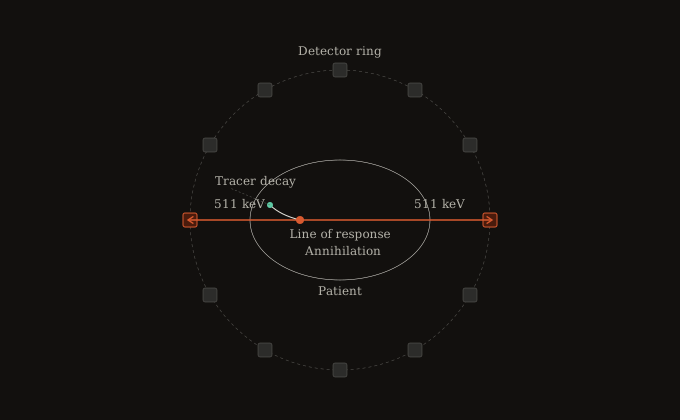
Image: Astrinova.io.
Does Antimatter Have Negative Mass?
There is no evidence that antimatter has negative mass.
Antiparticles have positive inertial mass, identical to their matter partners within measurement precision. Opposite electric charge says nothing about gravitational behaviour; charge and mass are different properties.
The direct test came in 2023. The ALPHA collaboration released trapped antihydrogen atoms from a vertical magnetic trap and watched where they went. They fell down. The best fit gave a local acceleration of 0.75 ± 0.13 (statistical and systematic) ± 0.16 (simulation) times ordinary gravitational acceleration (ALPHA Collaboration, 2023). That strongly excludes upward-falling antimatter, but it is not yet precise enough to establish exact equality with matter, which is what the next generation of experiments is built to test.
Antimatter Versus Dark Matter
These get confused constantly, and they have almost nothing in common.
Table 1. How antimatter and dark matter differ across identity, detection, and cosmological role.
| Antimatter | Dark matter | |
|---|---|---|
| What it is | Antiparticles of known Standard Model particles | Unidentified matter inferred from gravitational effects |
| Experimental status | Directly produced, trapped, and measured | Never directly detected in a laboratory |
| Interaction with light | Interacts electromagnetically, emits and absorbs light | No detected electromagnetic interaction |
| Interaction with matter | Annihilates on contact | Interacts gravitationally, otherwise very weakly at most |
| Can we make it? | Yes, routinely | No |
| Cosmological role | Almost absent from the observable universe | Dominates the mass budget of galaxies and clusters |
| Identity known? | Yes | No |
Dark matter is not invisible antimatter. If the dark matter in our galaxy were ordinary antimatter, it would be annihilating against ordinary matter continuously and producing a gamma-ray signature that telescopes would have found long ago.
Why Is the Universe Made Mostly of Matter?
In the hot early universe, particles and antiparticles were produced in pairs and annihilated back into radiation. If the books had balanced perfectly, the universe would now contain radiation and essentially nothing else. Instead there are galaxies.
The standard explanation is that a tiny excess of matter survived, roughly one extra matter particle for every billion antiparticles (CERN Antimatter FAQ). Everything else annihilated. All the stars, planets, and people are made from that leftover.
Generating such an excess is called baryogenesis, and in 1967 Andrei Sakharov set out three conditions any successful mechanism must satisfy: processes that change the number of baryons, violation of C and CP symmetry so matter and antimatter behave measurably differently, and a departure from thermal equilibrium so the excess is not immediately undone (Sakharov, 1967).
CP violation is real and measured. It was first seen in kaons in 1964, and in 2025 the LHCb collaboration reported the first observation of CP violation in baryon decays, an asymmetry of about 2.45 per cent between a beauty baryon and its antimatter counterpart (LHCb Collaboration, 2025). That discovery does not by itself explain the cosmic imbalance, because a decay asymmetry is not a demonstrated mechanism for generating a net excess of matter. The trouble is also quantitative: the CP violation described by the Standard Model is orders of magnitude too small to account for what we observe. Physicists have well-developed ideas about where the rest might come from, none of them confirmed. This one is still open.
The universe kept one matter particle in every billion and annihilated the rest. Everything you have ever seen is built from what was left over.
Could There Be Antimatter Stars or Galaxies?
Probably not nearby, and there is no confirmed evidence for any.
An antimatter star would produce atomic spectra closely matching a matter star, so light alone is a poor way to tell them apart. The giveaway would be annihilation. Wherever a matter region touched an antimatter region, the boundary would light up in gamma rays, and no such boundary has been seen. Cohen, De Rújula, and Glashow concluded that a matter-antimatter symmetric universe is excluded by the diffuse gamma-ray background unless the antimatter domains lie far beyond our observable horizon (Cohen, De Rújula, and Glashow, 1998).
Searches continue at the level of individual nuclei. The AMS-02 spectrometer on the International Space Station has reported a few candidate antihelium events, but these remain unpublished and unconfirmed.
Could Antimatter Power a Spacecraft?
The physics is appealing and the engineering is not.
Nothing beats annihilation for energy per kilogram, which is why antimatter propulsion keeps appearing in mission studies. Then the problems start. Production is the killer, since global output sits many orders of magnitude below what any mission would need. Containment scales badly. The annihilation products are mostly penetrating gamma rays and pions, hard to convert into directed thrust and dangerous to crew and electronics. Waste heat has to go somewhere. And the fuel has no natural source, so every microgram would have to be manufactured.
Three ideas often get blurred together. Antimatter as a primary energy source would need grams and is far out of reach. Antimatter-catalysed propulsion, where a small quantity of antiprotons triggers fission or fusion reactions, needs far less and has been studied seriously, though never built. The antimatter engine of science fiction, which runs on a fuel cell someone bought, is fiction. The 1999 NASA study behind the famous price figure said much the same thing, noting that kilogram-scale applications would require dramatic improvements in production efficiency (Gerrish, NASA, 1999).
Common Antimatter Myths
- Antimatter has negative mass. Its inertial mass is positive, and antihydrogen falls downward.
- Antimatter is dark matter. Antimatter is identified and producible; dark matter is neither.
- Antimatter explodes on its own. It annihilates when it contacts matter. Isolated in a trap, it just sits there.
- Antimatter is radioactive by definition. Radioactivity is nuclear instability. An antiproton is stable in isolation.
- You can store it in glass. Glass is matter. Contact means annihilation.
- CERN has grams of it. All the antimatter CERN has ever made would run one light bulb for a few minutes.
- Antimatter could destroy the planet. Not at any quantity that exists. CERN notes that if the entire BASE-STEP trap failed, the released energy would be about a millionth of a joule, thousands of times less than a single keystroke (CERN Antimatter FAQ).
- Antimatter always looks different from matter. Antihydrogen’s spectrum matches hydrogen to the precision achieved so far.
- Antimatter violates conservation of energy. It is created in pairs, at full energy cost.
- Antimatter is purely theoretical. It is measured to eleven and twelve significant digits.
Final Verdict
So, what is antimatter? Real, well understood, and much smaller than its reputation. It is manufactured routinely in accelerators, produced constantly by cosmic rays and radioactive decay, trapped for months at a time in cryogenic vacuum, and used in hospitals through PET imaging. It is also, on any practical scale, unavailable. Total human production remains microscopic, storage remains fragile, and antimatter fuel remains a thought experiment.
The interesting question is not whether we can use antimatter. It is why there is so little of it. The universe made matter and antimatter in near-equal amounts, kept one part in a billion of the matter, and threw the rest away. Nobody yet knows why.
Key Takeaways
- Antimatter is real and routinely produced. Positrons, antiprotons, and complete antihydrogen atoms are routinely made and studied in laboratories.
- Antiparticles have the same mass as their matter partners. What flips is electric charge and certain other quantum properties, not mass.
- Annihilation does not make matter vanish. The mass-energy of the pair is converted into other particles and radiation, most often gamma-ray photons or pions.
- Producing and storing antimatter is brutally inefficient. CERN estimates that only about a ten-billionth of the invested energy comes back out (CERN Antimatter Media Kit, 2026).
- The matter-antimatter imbalance is still unexplained. Known CP violation is far too small to account for a universe made almost entirely of matter.
Frequently Asked Questions
What is antimatter in simple terms?
Antimatter is made of antiparticles, which are mirror versions of ordinary particles. An antiparticle has exactly the same mass as its matter counterpart but carries opposite electric charge and opposite values of certain other quantum properties. Put antiparticles together and you can build anti-atoms, such as antihydrogen. When an antiparticle meets its matching particle, both are converted into other particles and radiation.
Is antimatter real?
Yes. Positrons were discovered in 1932, antiprotons in 1955, and complete antihydrogen atoms in 1995. Antimatter is produced routinely in particle accelerators, appears in cosmic-ray showers and radioactive decay, and is generated inside patients during PET scans. Physicists have measured antihydrogen properties to twelve significant digits. What does not exist is antimatter in any bulk quantity.
What happens when antimatter touches matter?
They annihilate. The pair’s mass-energy is converted into other particles and radiation, with energy, momentum, and charge conserved throughout. An electron meeting a positron usually produces two gamma-ray photons of 511 keV each, travelling in nearly opposite directions. A proton meeting an antiproton typically produces several particles, often pions, which decay further. Nothing disappears into nothing.
How is antimatter created?
Through energy conversion. A high-energy photon near a nucleus can convert into a particle-antiparticle pair. High-energy collisions in accelerators produce antiprotons. Certain unstable nuclei emit positrons during beta-plus decay. Cosmic rays hitting the atmosphere and thunderstorms both generate antiparticles naturally. In every case the antimatter appears alongside matter, and the energy cost far exceeds anything recoverable later.
What does antimatter look like?
Nothing special. Individual particles have no appearance at all, and a hypothetical antimatter object would not glow simply for being antimatter. Antihydrogen absorbs and emits light almost identically to hydrogen, matching it to two parts in a trillion in one measured transition. Any visible effect would come from annihilation with surrounding matter, not from the antimatter itself.
How much does antimatter cost?
There is no market price, because nobody sells it. The widely quoted figure of 62.5 trillion US dollars per gram comes from a 1999 NASA technical presentation on propulsion and is an extrapolation from accelerator production costs, not a transaction price. Production returns roughly a ten-billionth of the energy invested, which is the real reason the theoretical cost is so extreme.
Can antimatter be stored?
In tiny amounts, yes. Charged antiparticles such as antiprotons are held in Penning traps using magnetic and electric fields inside extreme vacuum, and BASE has kept antiprotons for over a year. Neutral antihydrogen is far harder, since it ignores electric fields and must be held magnetically, which works only for the coldest atoms. Current magnetic traps could hold roughly 100,000 anti-atoms.
How much antimatter has humanity made?
An enormous number of particles with almost no mass. CERN’s idealised annual illustration, assuming a full year of running and perfect storage, comes to about 30 million antihydrogen atoms, roughly 3 × 10⁻²⁰ kilograms, alongside 300 billion antiprotons, roughly 3 × 10⁻¹⁶ kilograms. Even a nanogram is far beyond present capability. Annihilating all antimatter ever made at CERN would light one bulb for minutes.
Does antimatter have negative mass?
No. Antiparticles have positive inertial mass identical to their matter partners, and opposite electric charge implies nothing about gravity. In 2023 the ALPHA collaboration released trapped antihydrogen and measured its downward acceleration at 0.75 ± 0.13 ± 0.16 times ordinary gravity. That excludes upward-falling antimatter, though it is not yet precise enough to confirm exact equality with matter.
Is antimatter the same as dark matter?
No, and the two are not related. Antimatter consists of known particles that physicists can produce, trap, and measure. Dark matter is an unidentified substance inferred from gravitational effects on galaxies and never detected directly in a laboratory. If galactic dark matter were antimatter, it would annihilate against ordinary matter and produce a gamma-ray glow that telescopes would have detected.
Is antimatter used in medicine?
Yes, indirectly and routinely. Positron emission tomography relies on tracers containing positron-emitting isotopes such as fluorine-18. Inside the body, each positron annihilates with an electron and produces two gamma photons that detectors record in coincidence to build a three-dimensional image. No stored antimatter is involved: the positrons are created and destroyed within the patient in nanoseconds.
Can antimatter be used as fuel?
Not with current or foreseeable technology. Annihilation has unmatched energy density, but producing antimatter consumes vastly more energy than annihilating it returns, and total world production is many orders of magnitude short of what any engine would need. Containment, radiation shielding, waste heat, and converting gamma rays and pions into thrust are all unsolved engineering problems.
Could antimatter destroy Earth?
No quantity that exists could do meaningful damage. CERN notes that if a transport trap holding hundreds of antiprotons failed completely, the released energy would be around a millionth of a joule, far less than a single keystroke. Planetary destruction would require quantities that are not merely unavailable but unreachable by many orders of magnitude on any current technology.
Where is antimatter found naturally?
In several places, always in trace amounts. Cosmic rays striking the atmosphere create antiparticles continuously. Thunderstorms produce positron beams during terrestrial gamma-ray flashes, which NASA’s Fermi telescope has detected directly. A few radioactive isotopes emit positrons, including potassium-40 in bananas and in the human body, though for potassium-40 that decay route is extremely rare. None of it accumulates, because it annihilates almost immediately.
Why is the universe not made equally of matter and antimatter?
Nobody knows yet, and it is one of the major unsolved problems in physics. The early universe produced pairs that mostly annihilated, leaving roughly one extra matter particle per billion. Explaining that excess requires baryon-number violation, CP violation, and departure from equilibrium. CP violation has been measured, including in baryons in 2025, but that is not itself a mechanism for producing the excess, and the Standard Model amount is far too small.
References
- CERN. “Antimatter.” CERN Antimatter FAQ, accessed July 2026. https://home.cern/science/physics/antimatter
- CERN. “BASE experiment at CERN succeeds in transporting antimatter.” CERN press release, 24 March 2026. https://home.cern/base-experiment-cern-succeeds-transporting-antimatter/
- CERN. “Antimatter Transportation Media Kit.” CERN, 2026, accessed July 2026. https://home.cern/press/media-kits/antimatter-transportation-media-kit/
- CERN. “CERN70: Into the antiworld.” CERN, 2024. https://cern70.cern/into-the-antiworld/
- CERN. “The story of antimatter.” CERN Timeline, accessed July 2026. https://timeline.web.cern.ch/timeline-header/86
- CERN. “Antiprotons four times more effective than protons for cell irradiation.” CERN press release, 2006. https://cerncourier.com/a/antiprotons-could-help-fight-against-cancer/
- CERN. “ACE.” CERN Experiments, accessed July 2026. https://home.cern/science/experiments/ace/
- ALPHA Collaboration (Anderson, E. K. et al.). “Observation of the effect of gravity on the motion of antimatter.” Nature, volume 621, 2023. https://www.nature.com/articles/s41586-023-06527-1
- ALPHA Collaboration. “Observation of the 1S-2P Lyman-α transition in antihydrogen.” Nature, volume 561, 2018. https://www.nature.com/articles/s41586-018-0435-1
- Baker, C. J. et al. (ALPHA Collaboration). “Laser cooling of antihydrogen atoms.” Nature, volume 592, 2021. https://www.nature.com/articles/s41586-021-03289-6
- LHCb Collaboration. “Observation of charge-parity symmetry breaking in baryon decays.” Nature, volume 643, 2025. https://www.nature.com/articles/s41586-025-09119-3
- BASE Collaboration. “Proton transport from the antimatter factory of CERN.” Nature, volume 641, 2025. Precursor test using ordinary protons, not the 2026 antiproton transport. https://www.nature.com/articles/s41586-025-08926-y
- Cohen, A. G., De Rújula, A., and Glashow, S. L. “A Matter-Antimatter Universe?” The Astrophysical Journal, volume 495, 1998. https://iopscience.iop.org/article/10.1086/305328
- NASA. “NASA’s Fermi Catches Thunderstorms Hurling Antimatter into Space.” NASA, 2011. https://www.nasa.gov/universe/nasas-fermi-catches-thunderstorms-hurling-antimatter-into-space/
- Gerrish, H. “Antimatter Production for Near-Term Propulsion Applications.” NASA Technical Reports Server, 1999. https://ntrs.nasa.gov/citations/19990080056
- US Department of Energy, Office of Science. “Antihydrogen Falls Downward!” DOE, 2023. https://www.energy.gov/science/fes/articles/antihydrogen-falls-downward
- National Research Council. “Nuclear Physics: Exploring the Heart of Matter.” National Academies Press, 2013. https://www.nationalacademies.org/read/13438/chapter/5
- Anderson, C. D. “The Positive Electron.” Physical Review, volume 43, 1933. https://journals.aps.org/pr/abstract/10.1103/PhysRev.43.491
- Chamberlain, O., Segrè, E., Wiegand, C., and Ypsilantis, T. “Observation of Antiprotons.” Physical Review, volume 100, 1955. doi:10.1103/PhysRev.100.947
- Sakharov, A. D. “Violation of CP invariance, C asymmetry, and baryon asymmetry of the Universe.” Pis’ma Zh. Eksp. Teor. Fiz., volume 5, 1967.
Join the discussion
Comments are moderated and may take a little while to appear.