

Sixty-five billion solar neutrinos pass through every square centimeter of your body each second. Almost none of them ever interact with anything on the way through, which is what makes neutrinos so difficult to catch in a laboratory.
The Weak Force Problem
Most particle detection relies on electric charge. Electromagnetic fields steer charged particles, trap them, and trace their paths through a detector. Neutrinos carry no electric charge and no color charge, so electromagnetism and the strong nuclear force simply do not see them. What’s left is the weak nuclear force, and at the energies a typical neutrino carries, that force barely registers at all.
Wolfgang Pauli proposed the neutrino in 1930 to explain missing energy in radioactive decay. He suspected at the time that the particle might never be observed directly, given how weakly it would interact with anything. Twenty-six years passed before Clyde Cowan and Frederick Reines finally detected one in 1956, closing a gap between theory and confirmation that few predictions in physics have matched.
A Cross Section Smaller Than Almost Anything
Physicists describe how likely a particle is to interact using a number called a cross section. For solar neutrinos, at energies around a few million electron volts, that cross section works out to roughly 10⁻⁴⁴ square centimeters per nucleon, about a trillion trillion times smaller than a typical electromagnetic interaction.
A solar energy neutrino would need to travel through about a light year of solid lead before it had even odds of being stopped.
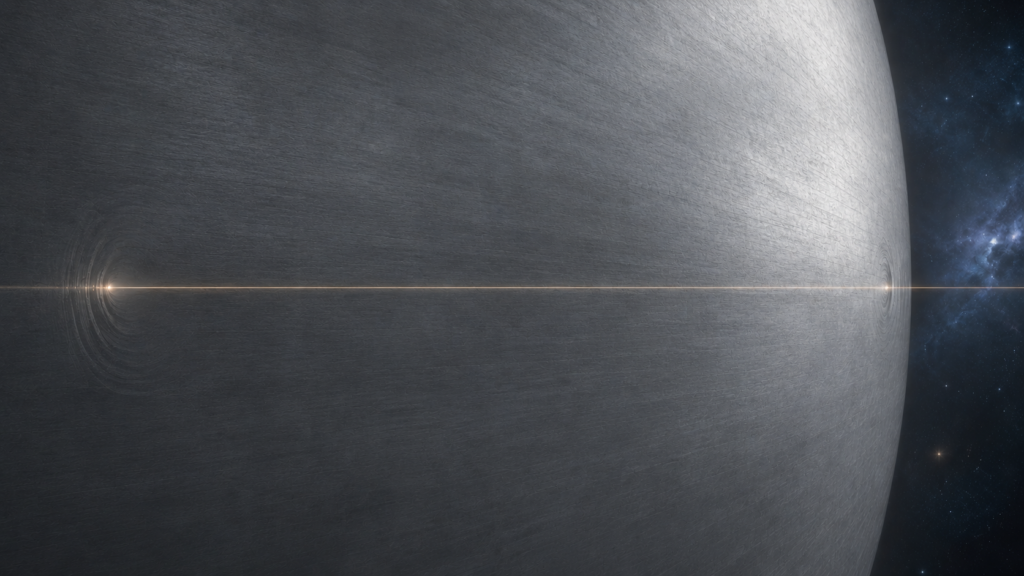
The visual scale behind the number above, a neutrino’s path drawn straight through a slab of solid lead a light year deep, with nothing left behind to mark that it passed.
Meanwhile tens of billions of these particles pass through Earth, through oceans and mountains and every person on it, every single second, without leaving a trace behind.
No Charge, Barely Any Mass
Most detectors work by tracking the ionization trail a particle leaves as it passes through matter. Neutrinos carry no charge, so there is no trail to track in the first place.
Their mass is nearly as absent as their charge. The combined mass of all three neutrino types is constrained to sit below roughly 0.13 electron volts, millions of times lighter than an electron. That lack of mass lets neutrinos travel close to the speed of light, moving past any given nucleus too quickly for most interactions to have a real chance of happening.
Neutrinos Keep Changing Identity
Three flavors of neutrino exist, electron, muon, and tau, and a neutrino does not necessarily arrive as the flavor it started as. Through a purely quantum mechanical process called oscillation, neutrinos shift between flavors mid flight. A detector tuned to catch electron neutrinos from the Sun may find that a substantial share arrived as muon or tau neutrinos instead, having changed identity somewhere along the journey.
Proving this took decades of dedicated experimental work, and it earned Takaaki Kajita and Arthur B. McDonald the 2015 Nobel Prize in Physics. For detector design, oscillation means flavor has to be accounted for from the start, not treated as an afterthought once particles are counted.
Building Detectors Massive Enough to Notice
A neutrino interaction is rare enough that catching a usable number of them requires detectors on an industrial scale, built deep underground to keep cosmic ray muons from the surface out of the signal entirely.
Super Kamiokande in Japan holds 50,000 tonnes of ultra pure water inside a cylindrical tank lined with more than 11,000 photomultiplier tubes. On the rare occasion a neutrino strikes a water molecule, the resulting charged particle emits a faint cone of Cherenkov light, the optical version of a sonic boom, and that glow is what the tubes are built to catch.
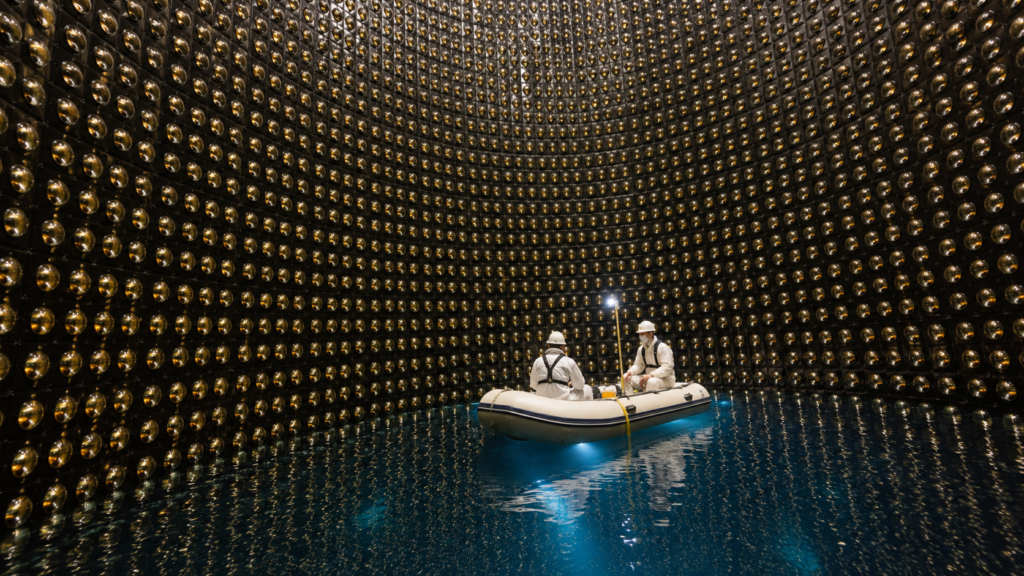
Two technicians afloat inside Super Kamiokande’s tank, the same chamber whose gold tubes wait years for a single flash of light most neutrinos will never trigger.
IceCube solves the same problem differently. Sunk into Antarctic glacier ice at depths between 1,450 and 2,450 meters, it turns a full cubic kilometer of frozen water into a detector using 5,160 optical sensors strung across 86 vertical cables. It reads the same Cherenkov signature Super Kamiokande does, across a volume that could not be built any other way, and in 2013 it produced the first confirmed detection of high energy astrophysical neutrinos arriving from beyond the solar system.
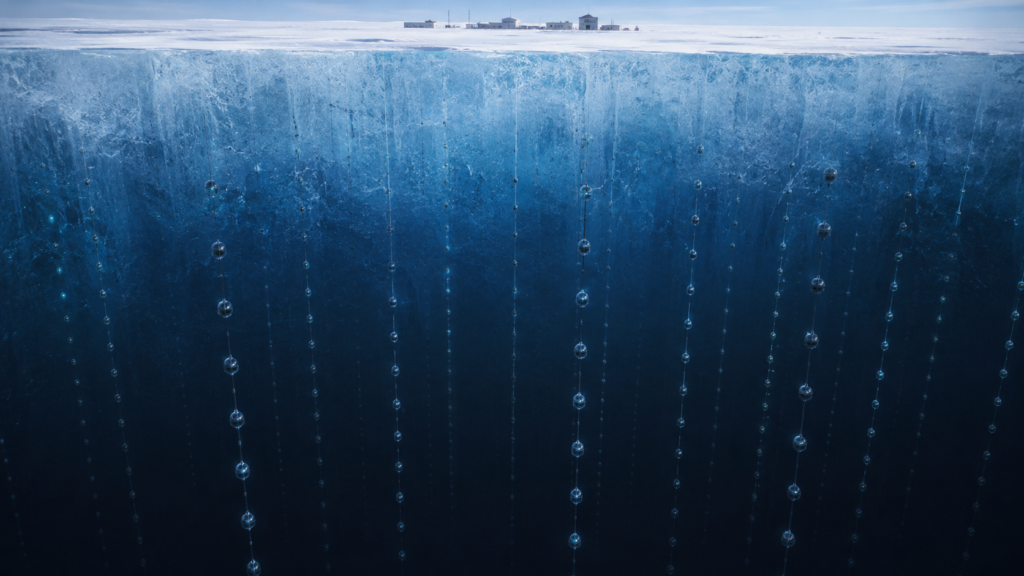
What no camera will ever capture directly, sensor strings sealed a kilometer down in ancient ice, standing watch through decades of cold and dark most neutrinos will pass right through.
Why This Matters
Every property that makes neutrinos difficult to detect also makes them worth detecting. Photons scatter and get absorbed on their way here. Charged cosmic rays get bent off course by magnetic fields long before they arrive. Neutrinos do neither, so they carry information in something close to a straight line from wherever they were produced.
That straight line reaches places nothing else can. Neutrinos escape the crushing density of a collapsing stellar core, carrying away roughly 99 percent of a supernova‘s total energy seconds before the explosion becomes visible from Earth. They stream out of the Sun’s fusion core continuously, letting physicists observe nuclear reactions as they happen rather than waiting on light that takes thousands of years to climb out. Deep inside the Earth, geoneutrinos rising from radioactive decay give researchers a way to study the planet’s interior without drilling a single hole.
Key Takeaways
- Neutrinos interact only through the weak nuclear force and carry no electric charge, which keeps them nearly invisible to standard detection methods.
- Their interaction cross section is about 10⁻⁴⁴ square centimeters per nucleon at solar energies, meaning a solar neutrino could pass through a light year of lead with only even odds of being stopped.
- Roughly 65 billion solar neutrinos pass through every square centimeter of Earth each second, almost all without interacting.
- Neutrinos oscillate between three flavors during flight, a discovery that earned the 2015 Nobel Prize in Physics and complicates how detectors are built.
- Massive underground detectors like Super Kamiokande and IceCube rely on Cherenkov light from rare interactions to catch neutrinos at scale.
- Because neutrinos travel undeflected across the universe, they carry information from supernovae, the Sun’s core, and Earth’s interior that no other particle can deliver.
References
- Wikipedia, “Neutrino.”
- IceCube Collaboration, “1956: First Discovery of the Neutrino by an Experiment.”
- Aghanim et al., “Cosmological Implications of a Neutrino Mass Detection,” arXiv:2111.01096.
- The Nobel Prize, “The Nobel Prize in Physics 2015, Press Release.”
- Kobe University, Super Kamiokande Particle Physics Group.
- Aartsen et al., “Evidence for High-Energy Extraterrestrial Neutrinos at the IceCube Detector,” Science 342, 1242856 (2013).
- Mueller, B. and Sykes, B., “Core-Collapse Supernovae and Supernova Neutrinos,” arXiv:2605.25879 (2026).
Join the discussion
Comments are moderated and may take a little while to appear.