

In this article (15 sections)
- The Sense of Number Before Mathematics Begins
- When Mathematics Becomes an Emotional Event
- Why Anxiety Steals the Mental Workspace Mathematics Needs
- The Trouble With Speed
- Why Mistakes in Mathematics Feel So Exposed
- The Myth of the Math Person
- Mathematics Really Can Be Difficult
- Dyscalculia: A Real and Separate Difficulty
- How Attitudes Pass From Adults to Children
- Why People Hate Mathematics—and Is It Really Hard?
- Mathematics Is Far More Than Calculation
- Learning Mathematics Again, From the Beginning
- Key Takeaways
- Frequently Asked Questions
- References
Why do people hate mathematics? Ask a room full of adults how they feel about it, and you will hear the same handful of lines again and again. I was never a math person. I hated algebra. My brain just doesn’t work that way. Yet many of the same people compare prices, estimate travel times, judge distances and split a bill without ever thinking of it as mathematics.
Understanding why people hate mathematics means asking a more useful question than why people are bad at math. It’s why so many otherwise capable people become convinced that they are, in a way they rarely apply to any other subject. Nobody says they were born without a history brain after failing to recall a date, but one hard equation is often enough to convince someone that math simply isn’t for them.
Cognitive science, neuroscience and international education research point to several things happening at once: genuine cognitive demands, anxiety, working-memory limits, classroom experience, and beliefs about ability that get set early and rarely get questioned. And the story starts well before anyone sits down at a school desk.
The Sense of Number Before Mathematics Begins
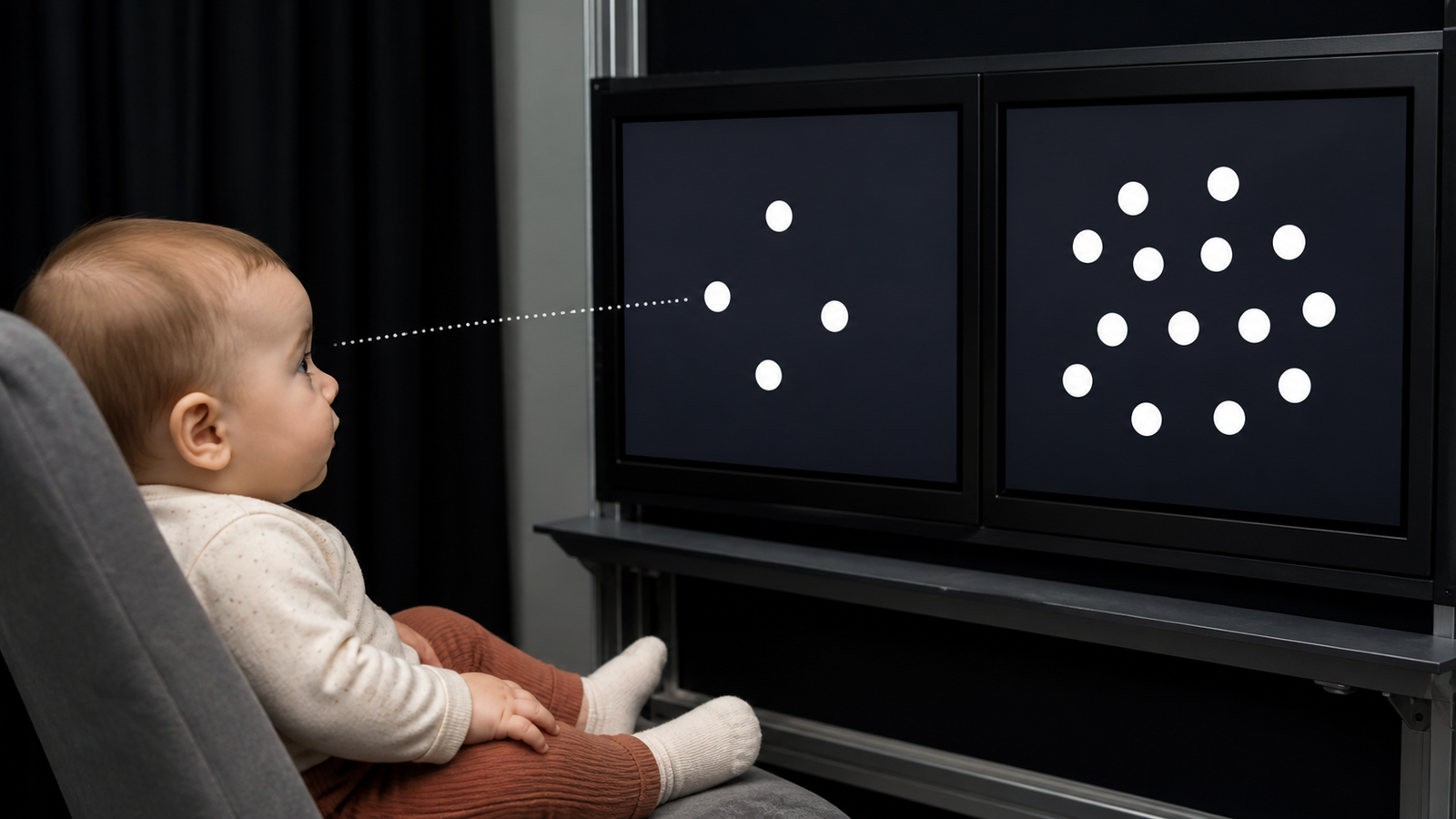
A newborn has no concept of “three.” It can’t count to three or write the symbol 3. But the brain seems to arrive with something more basic than counting: a rough, built-in sensitivity to quantity, often called the Approximate Number System, or ANS. It’s what lets you glance at two clusters of objects and sense, without counting, that one group is clearly bigger.
That sensitivity shows up remarkably early. In a study of newborns only a few days old, researchers matched sound sequences of a given quantity to visual displays containing similar or different numbers of objects, and the infants tended to look longer at displays that matched the quantity they had just heard. The findings offered evidence for abstract numerical representations present at the very start of postnatal life.
That doesn’t mean a newborn can do arithmetic, and it doesn’t prove the brain contains mathematics in anything like its symbolic form. What it suggests is more modest: an early sensitivity to quantity that later, formal number understanding gets built on top of. A child can grasp that eight sweets are more than three long before understanding the notation 8 > 3. The intuition comes first. The symbol comes later.
Longitudinal research backs this up. One study tested numerical sensitivity in sixty infants at twelve months and followed them to age four, finding that early ANS acuity predicted aspects of symbolic mathematics performance years later, even after other cognitive factors were taken into account.
None of this means a baby’s number sense determines whether they become a mathematician. But it undermines a common assumption. Nobody starts life hating numbers. Whatever changes that early relationship with numbers happens later, through a mixture of experience, education, expectations and emotion.
When Mathematics Becomes an Emotional Event
For some people, a math problem isn’t just a cognitive task; it’s an emotional one. Psychologists call this mathematics anxiety: tension, fear or apprehension tied specifically to numerical situations. It isn’t the same thing as being bad at math. A person can have real mathematical ability and still feel considerable dread when asked to use it, and that dread can itself get in the way of performance.
One of the clearest demonstrations of this came from psychologists Ian Lyons and Sian Beilock, who used fMRI to scan people with high levels of math anxiety. They found that when these participants anticipated an upcoming math task, activity increased in brain regions associated with visceral threat detection and the experience of pain, particularly the dorsoposterior insula. The effect showed up during anticipation, not while participants were actually doing the math.
For someone who has math anxiety, the anticipation of doing math prompts a similar brain reaction as when they experience pain, say, burning one’s hand on a hot stove.Sian Beilock, Professor of Psychology, University of Chicago
In other words, for someone with severe math anxiety, the prospect of doing math can be more distressing than the math itself. That’s a useful clue. Part of what people experience as mathematical difficulty may start well before the first calculation is even attempted.
Why Anxiety Steals the Mental Workspace Mathematics Needs
There’s a second, more mechanical reason anxiety matters. Solving many math problems requires working memory, the limited mental space that lets you hold and manipulate information temporarily. Try 37 × 14 in your head. You might break it into 37 × 10 = 370 and 37 × 4 = 148, then combine them, and while you do that, several intermediate numbers have to stay mentally accessible.
Now imagine doing that same calculation while also thinking I always get these wrong, everyone else is faster, I’m going to look stupid. Those thoughts consume working memory too, and they’re competing for the same limited resource the calculation needs. Research by Mark Ashcraft and Elizabeth Kirk helped establish this relationship directly: math anxiety produces a transitory disruption of working memory during math-related tasks, likely through interference with central executive processes.
The result can become self-reinforcing. Anxiety consumes working memory, performance drops, the poor result reinforces the anxiety, and the next math problem feels even more threatening than the last one. Someone caught in that loop might reasonably conclude I can’t do math, but that conclusion confuses performance under anxiety with underlying capacity. They aren’t the same thing, even though they feel identical from the inside.
The Trouble With Speed
Picture a timed multiplication sheet: twenty questions, five minutes, go. For some students that’s a harmless challenge. For others it changes the entire task. The question stops being what is 8 × 7? and becomes can I answer fast enough while my speed is being judged?
Stanford mathematics educator Jo Boaler has argued for years against treating rapid recall as a proxy for mathematical ability. Her research points toward number sense, built by working with numbers in different ways, as the more reliable path to genuine fluency, rather than blind memorization under time pressure.
There is a common and damaging misconception in mathematics, the idea that strong math students are fast math students.Jo Boaler, Professor of Mathematics Education, Stanford University
That doesn’t mean timed testing is the single cause of math anxiety, and the evidence doesn’t support that stronger claim. Children arrive at school with different temperaments, prior experiences and family attitudes, and math anxiety almost certainly has several causes working together. What the evidence does support is a subtler point: schools often teach, implicitly, that doing math fast is the same thing as doing math well. It isn’t. A professional mathematician facing an unfamiliar problem might spend months on it. Mathematics at its highest level is reasoning, not a race.
Why Mistakes in Mathematics Feel So Exposed
Mathematics also differs from most other school subjects in how visible failure is. Two readers can disagree about an essay. Historians can argue over an interpretation of an event. But if you write 7 × 8 = 54, there’s nowhere to hide. You’re simply wrong.
That precision is one of mathematics’ real strengths, and also one reason mistakes in it can feel unusually personal. Over time, students can start avoiding experimentation because every error feels like it exposes a deficiency, which is close to the opposite of how mathematics actually develops. Working mathematicians routinely spend enormous amounts of time following approaches that eventually fail. The polished proof in a textbook hides the mess that produced it. Students usually see the finished building. They rarely see the scaffolding that held it up.
The Myth of the Math Person
Few sentences have done more quiet damage to math education than “I’m just not a math person.” It sounds harmless. But it carries a hidden theory of intelligence: that mathematical ability is something you either have or don’t, fixed at birth.
Large-scale international data tells a more complicated story. The OECD’s PISA assessments track mathematics performance and attitudes among fifteen-year-olds across dozens of education systems. In PISA 2022, mathematics anxiety was negatively associated with mathematics performance in every single participating education system. Across OECD countries, a one-point increase on PISA’s mathematics-anxiety index corresponded to an average drop of about 18 score points in math performance, even after accounting for students’ and schools’ socioeconomic background.
At the country and system level, differences in average math anxiety statistically accounted for roughly a quarter of the variation in average math performance across all participating countries and economies. That figure needs care in how it’s read. It’s not saying anxiety causes 25 percent of any individual student’s score. It’s a pattern observed across entire education systems, not a claim about any one person.
Which causes which is genuinely unclear, and probably runs both ways. Difficulty can create anxiety. Anxiety can impair performance. Avoidance reduces practice, which creates more difficulty. It’s a feedback loop, not a straight arrow from one cause to one effect.
Mathematics Really Can Be Difficult
None of this means math is secretly easy and schools just ruin it. That would be its own kind of overstatement, the same overstatement that shows up whenever a subject’s real difficulty gets exaggerated into myth or waved away entirely. Mathematics places unusual demands on abstraction. Trace the progression from three apples, to the symbol 3, to a variable x, to a function f(x), to something like a partial derivative, and at every step the learner moves further from physical objects and deeper into pure symbolic relationships.
Negative numbers were once controversial among mathematicians themselves. Imaginary numbers sounded absurd when first proposed. Non-Euclidean geometry contradicted basic intuitions about space. Infinity still produces genuine conceptual traps even for sophisticated thinkers. Advanced mathematics is hard because abstraction is hard, full stop. The Schrödinger equation is a good example: intimidating in raw form, but explainable once the underlying idea is separated from its notation.
But there’s an enormous gap between saying this idea is difficult and saying my brain cannot understand this idea. The first describes the subject. The second defines the learner, permanently, on the basis of one difficult encounter. Confusing the two is often enough to stop learning before it really starts.
Dyscalculia: A Real and Separate Difficulty
There’s an important exception to keep in view here. Some people experience persistent difficulty with numerical processing that can’t be explained away by anxiety, bad teaching or lack of effort. This is commonly called developmental dyscalculia, a specific and durable neurodevelopmental learning difficulty affecting arithmetic, numerical magnitude and number-fact retrieval. A major clinical review estimated that three to seven percent of children, adolescents and adults are affected.
Dyscalculia is not the same thing as disliking math, and it shouldn’t be waved away with “you just need more practice.” At the same time, most people who casually say I’m terrible at math don’t have dyscalculia. Mathematical difficulty has several possible sources, and telling them apart matters, because each one calls for a different response.
How Attitudes Pass From Adults to Children
Mathematical attitudes also spread socially, sometimes in ways adults don’t intend. A widely cited study led by Sian Beilock followed early-elementary classrooms taught by female teachers over a school year. By the end of the year, girls whose teachers reported higher math anxiety were more likely to endorse the stereotype that boys are better at math than girls, and their math achievement had fallen relative to boys and to girls whose teachers were less anxious.
The finding doesn’t show that women make worse math teachers, and it doesn’t prove teacher anxiety alone caused the achievement gap. What it suggests is that a child’s beliefs about mathematics can be shaped by the attitudes adults around them casually express. When an adult says in front of a child, don’t ask me, I’ve always been terrible at math, the child may absorb something bigger than the sentence itself: that mathematical ability is fixed, and adults simply either have it or don’t. A throwaway line can quietly become a theory of intelligence.
Why People Hate Mathematics—and Is It Really Hard?
Yes, and no, depending on what’s being asked. Basic mathematical thinking seems to grow out of cognitive abilities present extraordinarily early in life. Formal mathematics then stacks layer after layer of abstraction and notation on top of those early foundations, and each layer depends on the one before it. Miss a concept, and the next one gets harder to reach.
Add anxiety and working-memory interference, and it gets harder still. Add speed pressure, social comparison and the belief that math talent is something you’re simply born with or without, and difficulty can calcify into identity: I cannot do mathematics. That’s probably where most of the hatred actually comes from, not from mathematics itself but from everything that tends to surround it in a classroom. And that distinction changes what’s worth fixing.
Mathematics Is Far More Than Calculation
One more misconception sits underneath many of the others. For much of school, math looks like a stack of procedures: multiply this, divide that, move this term, find x. But mathematics is a far bigger field than calculation. It’s the study of patterns, quantities, structures, relationships, transformations, symmetry, uncertainty and logical consequence.
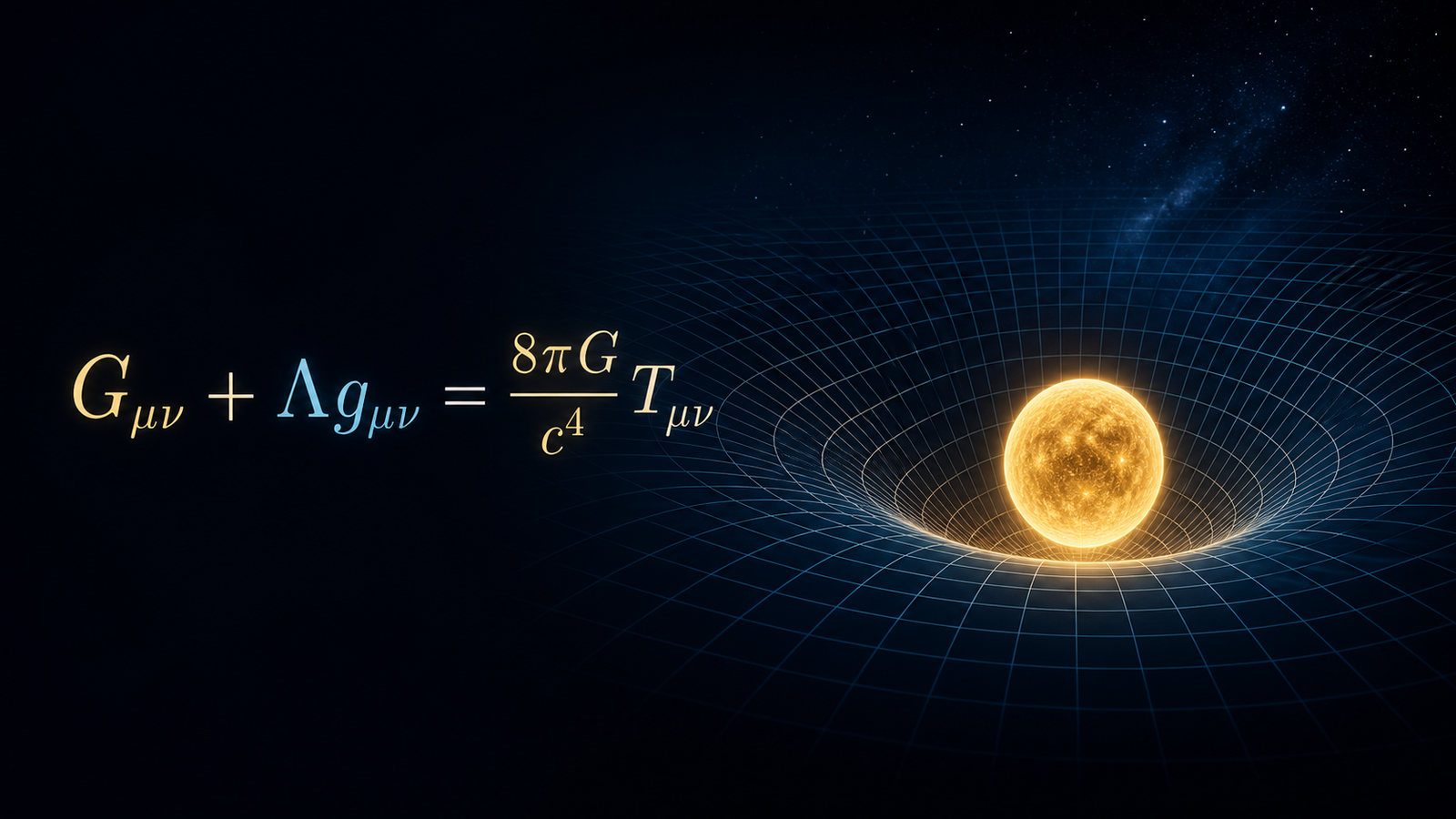
Arithmetic is mathematics. So is topology, probability, number theory, calculus, linear algebra and group theory, along with the mathematical structures running through modern physics. The equation E = mc² isn’t interesting because multiplying two numbers is interesting. It’s interesting because of the relationship it expresses between mass and energy. Einstein’s field equations aren’t remarkable for how their notation looks. They’re remarkable because they let spacetime geometry and the distribution of matter and energy be connected in one precise physical theory.
Mathematics turns beautiful the moment the symbols stop being arbitrary marks and start representing real relationships. A lot of people never get far enough to feel that shift. They meet the grammar and never make it to the poetry.
Learning Mathematics Again, From the Beginning
For an adult coming back to mathematics, the most useful starting point usually isn’t multiplication tables or algebra. It’s permission to ask elementary questions again. What exactly is a number? Why do negative numbers behave the way they do? What is an equation actually claiming? What is a function, really, and why does anyone need a variable in the first place? These aren’t childish questions. Some of them occupied mathematicians and philosophers for centuries.
That’s the thinking behind Astrinova Mathematics. We don’t start by assuming the reader already gets it. We build from first principles: not just how do you use this formula? but why does this formula exist?; not just how do you solve the equation? but what is the equation telling us?; not just what should I memorize? but what should I actually understand?
Continue exploring Astrinova’s science and mathematics coverage.
In the end, why people hate mathematics may have less to do with mathematics itself than with how they first encountered it. Because maybe the real problem was never that everyone hated mathematics. Maybe a lot of people were handed its symbols before anyone showed them its ideas, and those are two very different ways of meeting the same subject.

Key Takeaways
- Humans show measurable sensitivity to quantity within days of birth, well before any formal math instruction, suggesting the roots of number sense predate schooling.
- Mathematics anxiety is a well-documented psychological phenomenon, distinct from raw mathematical ability, and it is linked to poorer performance across every education system PISA has studied.
- Brain imaging shows highly math-anxious people activate pain- and threat-related brain regions when anticipating math, not necessarily while doing it.
- Anxiety competes with mathematical reasoning for the same limited working-memory resources, which can create a self-reinforcing cycle of avoidance and poor performance.
- Timed testing and speed pressure can worsen anxiety for some learners, but they are not established as the single cause of math anxiety.
- Developmental dyscalculia is a genuine neurodevelopmental learning difficulty affecting an estimated 3 to 7 percent of people.
- Adults’ casual attitudes toward math can shape children’s beliefs about their own ability and, in turn, their achievement.
- Mathematics is far larger than calculation: it is a language for describing patterns, structure and relationships, and advanced abstraction is genuinely difficult even for capable learners.
Frequently Asked Questions
Is math anxiety a real psychological condition?
Yes. Mathematics anxiety is a well-established, situation-specific form of anxiety involving tension, apprehension or fear around numerical tasks. It can interfere with performance even when a person has the underlying ability to solve the problem.
Does math anxiety mean someone is bad at mathematics?
No. Ability and anxiety are related, but they are not the same. Anxiety can reduce performance by consuming working-memory resources, so a test result obtained under pressure may underestimate what a learner understands.
Are some people naturally “math people”?
People differ in temperament, experience and some cognitive abilities, but mathematical skill is not a simple fixed trait that a person either possesses or lacks. Knowledge, practice, teaching quality, confidence and anxiety all influence performance.
Do timed tests cause mathematics anxiety?
They can intensify anxiety for some learners, especially when speed is treated as a measure of intelligence, but the evidence does not support timed testing as the single cause. Mathematics anxiety usually develops through several interacting influences.
What is dyscalculia?
Developmental dyscalculia is a neurodevelopmental learning difficulty involving persistent problems with number processing, arithmetic, numerical magnitude or retrieving number facts. It is distinct from ordinary dislike of mathematics or anxiety about it.
Can adults overcome a fear of mathematics?
Often, yes. Helpful approaches include returning to foundational concepts without shame, removing unnecessary time pressure, using visual and intuitive explanations, practising in manageable steps, and treating errors as information rather than proof of inability.
Why does mathematics feel harder than other subjects?
Mathematics is cumulative and highly abstract. New ideas often depend on earlier ones, symbolic notation compresses a great deal of meaning, and errors can feel unusually visible. Anxiety and speed pressure can add another layer of difficulty.
References
- Izard, V., Sann, C., Spelke, E. S., & Streri, A. (2009). Newborn infants perceive abstract numbers. Proceedings of the National Academy of Sciences. https://www.pnas.org/doi/10.1073/pnas.0812142106
- Decarli, G., Zingaro, D., Surian, L., & Piazza, M. (2023). Early approximate-number-system acuity and later symbolic mathematics. Developmental Science. https://doi.org/10.1111/desc.13386
- Lyons, I. M., & Beilock, S. L. (2012). When math hurts: Math anxiety predicts pain-network activation in anticipation of doing math. PLOS ONE. https://doi.org/10.1371/journal.pone.0048076
- Ashcraft, M. H., & Kirk, E. P. (2001). The relationships among working memory, math anxiety, and performance. Journal of Experimental Psychology: General. APA source PDF
- Boaler, J., Williams, C., & Confer, A. Fluency Without Fear. Stanford Youcubed. https://www.youcubed.org/evidence/fluency-without-fear/
- OECD. (2023). PISA 2022 Results, Volume I: The State of Learning and Equity in Education. OECD publication
- Haberstroh, S., & Schulte-Körne, G. (2019). The diagnosis and treatment of dyscalculia. Deutsches Ärzteblatt International. https://doi.org/10.3238/arztebl.2019.0107
- Beilock, S. L., Gunderson, E. A., Ramirez, G., & Levine, S. C. (2010). Female teachers’ math anxiety affects girls’ math achievement. Proceedings of the National Academy of Sciences. https://doi.org/10.1073/pnas.0910967107
Join the discussion
Comments are moderated and may take a little while to appear.