
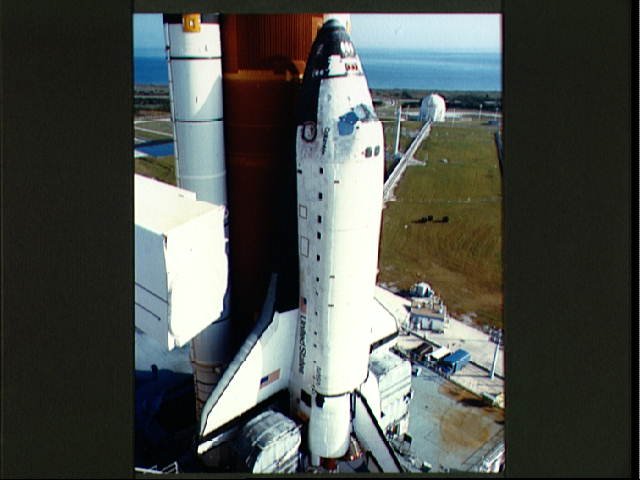
How hard is rocket science, really? People use the phrase to mean something almost impossibly difficult, but that reputation only tells half the story. The physical principles behind rocket flight come from ideas most people meet in an introductory physics class: Newton’s laws of motion, conservation of momentum, and a bit of orbital mechanics. What actually makes rocket science hard is not the existence of some hidden, mysterious set of laws. It is the engineering problem of forcing all those principles to work together, at the same time, inside a machine that must survive extreme heat, extreme pressure, violent vibration, and razor thin performance margins.
So the honest answer is this: rocket science, the physics, is understandable. Rocket engineering, the practice of building a vehicle that actually reaches orbit, is one of the hardest things humans build.
Rocket science, the physics, is understandable. Rocket engineering is one of the hardest things humans build.
What People Actually Mean by “Rocket Science”
In everyday conversation, calling something “rocket science” means it belongs to a small category of problems that only specialists can handle. That reputation did not appear out of nowhere. Rockets involve dangerous propellants, extreme speeds, demanding mathematics, and outcomes that are either a clean success or a very public failure. Over decades, that combination turned rockets into a cultural shorthand for difficulty.
It helps to separate two things people often lump together. Rocket science explains why a rocket moves the way it does. Rocket engineering is the work of building a rocket that performs that way reliably, on a specific schedule, without killing anyone or losing the payload. The first can usually be taught with school level physics. The second is where careers, and sometimes entire space programs, are spent.
The Physics That Makes a Rocket Move
Rocket flight starts with something familiar: Newton’s second law, which says that force equals mass times acceleration. If a rocket experiences a net upward force, it accelerates upward, and a larger net force produces a larger acceleration. That part is not the hard part. The real question is where the force comes from in the first place.
Newton’s third law offers the usual explanation: for every action, there is an equal and opposite reaction. A rocket engine accelerates hot gas out through the nozzle, and the rocket is pushed the other way. That picture is correct as far as it goes, but it is incomplete, and treating it as the full explanation is one of the more common oversimplifications in popular science writing.
A more accurate description uses conservation of momentum. When a rocket expels mass backward at high speed, that exhaust carries momentum away from the vehicle, and the rocket gains an equal amount of momentum in the opposite direction. This is also why a rocket does not need anything to push against. It is not pushing against the air. It is pushing against its own exhaust, which is exactly why rockets work in the vacuum of space, where there is no air to push against at all.
Why Rockets Work Without Air
A rocket carries everything it needs to burn fuel, including its own oxidizer, so it does not depend on the surrounding atmosphere the way a jet engine does. Once the propellants ignite, the resulting hot gas expands through the nozzle and accelerates outward, generating thrust regardless of what, if anything, surrounds the vehicle.
Many rocket engines actually perform better in vacuum than they do at sea level. Lower outside pressure changes the balance of forces at the nozzle exit in the engine’s favor, which is one reason vacuum optimized engines and sea level engines are often designed differently, even when they burn the same propellants.
The Thrust Equation and What Newton’s Third Law Leaves Out
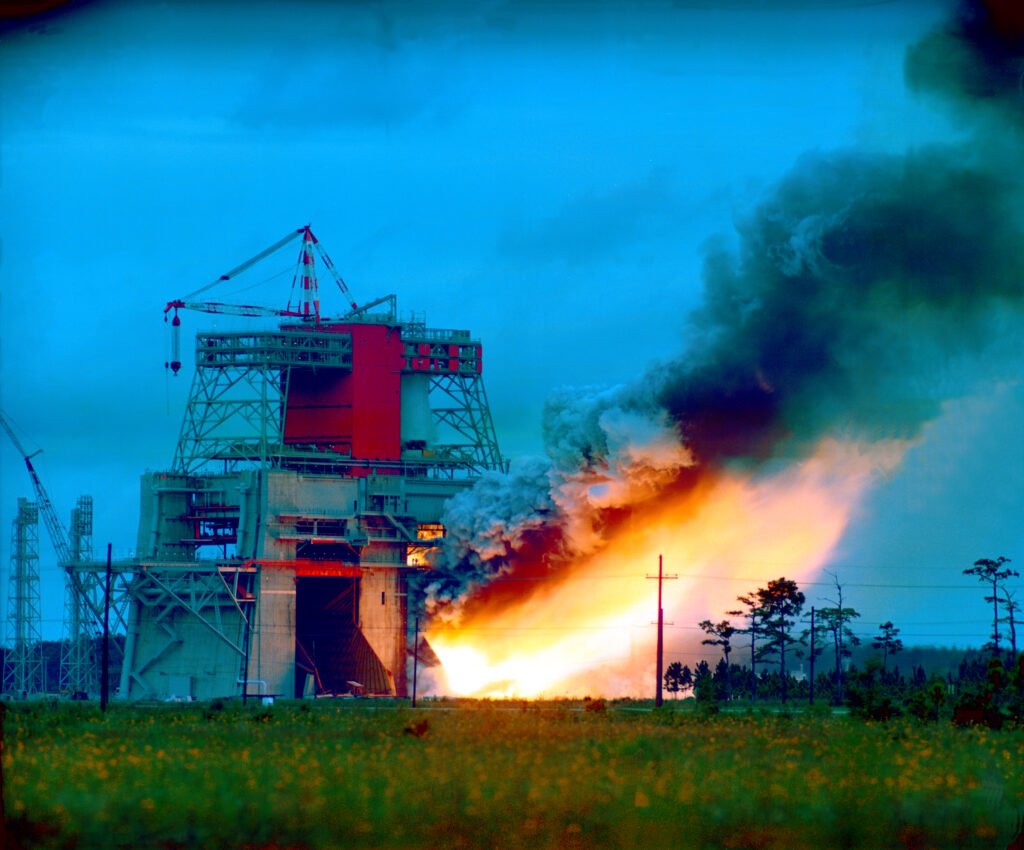
The full thrust equation for a rocket engine says that total thrust comes from two contributions added together: the mass flow rate of exhaust multiplied by exhaust velocity, plus the difference between exit pressure and ambient pressure multiplied by the nozzle exit area.
That equation has two distinct parts. The first term, mass flow rate times exhaust velocity, is called momentum thrust, and it represents the basic effect of throwing mass backward. The second term, the pressure difference multiplied by exit area, is called pressure thrust, and it accounts for the fact that if the pressure of the exhaust at the nozzle exit does not match the surrounding pressure, that mismatch also contributes to the total force.
This is why “every action has an equal and opposite reaction” is a useful intuition but not a complete scientific explanation. The thrust equation shows that engine performance actually depends on mass flow, exhaust speed, and the pressure environment the engine is operating in, all at once.
Specific Impulse and Why Efficiency Matters
Exhaust velocity matters because it tells you how much momentum each kilogram of expelled propellant carries away from the rocket. Faster exhaust means more effective use of every unit of propellant.
That idea leads to specific impulse, a standard measure of propulsion efficiency defined as thrust divided by the product of propellant mass flow rate and standard gravity, roughly 9.8 meters per second squared. Specific impulse is equivalent to effective exhaust velocity divided by that same gravity constant. In plain terms, a higher specific impulse means an engine gets more thrust, or more velocity change, out of the same amount of propellant.
Specific impulse is not the only thing that matters, though. Chemical rockets have lower specific impulse than several electric propulsion systems, yet they remain the only practical option for launching from Earth, because getting off the ground requires enormous thrust, not just efficient use of propellant.
The Rocket Equation and the Mass Ratio Problem
The single most important equation in rocket science is the Tsiolkovsky rocket equation. It states that the total velocity change a rocket can achieve equals its effective exhaust velocity multiplied by the natural logarithm of its initial mass divided by its final mass, after the propellant has burned.
This equation explains why rocket science is so demanding to turn into working hardware. A rocket’s ability to change speed depends on how fast it can throw propellant backward and how much of its own mass it burns off in the process. Because that relationship is logarithmic rather than linear, adding more propellant helps, but with steadily diminishing returns.
That logarithmic relationship is often called the curse of rocket science. Carrying more propellant to gain more velocity change also adds mass, and that added mass then requires still more propellant to accelerate. It is a big part of why rockets are, by mass, mostly propellant. NASA Glenn Research Center’s educational materials note that for a simplified orbital launch case, propellant can make up roughly 90 percent of a rocket’s initial mass, though that figure should be read as illustrative rather than as a fixed number that applies to every vehicle.
Why the Rocket Equation Is Only an Ideal Model
NASA Glenn describes the Tsiolkovsky equation explicitly as the ideal rocket equation, and for good reason. Real launches introduce complications the ideal version does not account for, including gravity, aerodynamic drag, and the energy spent steering the vehicle onto its intended path. Real world performance always falls short of what the ideal equation alone would predict.
That distinction matters for anyone trying to understand actual launch vehicles. The ideal rocket equation describes what is possible in a simplified model. Real rockets have to spend part of their propellant budget fighting gravity, pushing through the atmosphere, and adjusting their trajectory, none of which the basic equation includes.
Why Rockets Carry Both Fuel and Oxidizer
One of the clearest differences between a rocket and a jet engine is that a rocket carries its own oxidizer instead of drawing oxygen from the surrounding air. A jet engine can rely on the atmosphere because it never leaves it. A rocket cannot make that assumption, since much of its flight happens far above the atmosphere or in space itself.
Carrying oxidizer adds significant mass to the vehicle, but it is also what makes independent spaceflight possible in the first place. It is why chemical rockets can operate in vacuum while ordinary air breathing engines cannot, and it is a large part of why launch vehicles need such large propellant tanks relative to their payload.
Chemical, Electric, and Nuclear Propulsion
Rocket propulsion is not a single technology. The main families differ sharply in thrust, efficiency, and where they are actually useful.
Solid rockets burn a solid mixture of fuel and oxidizer packed inside the motor casing. They are mechanically simple and can produce high thrust, but once ignited, they offer little ability to throttle or shut down.
Liquid propellant rockets store fuel and oxidizer in separate tanks and feed them into a combustion chamber. They are mechanically more complex, but that complexity usually buys better throttling, the ability to restart, and higher overall performance.
Hybrid rockets combine elements of both, typically pairing a solid fuel with a separate liquid or gaseous oxidizer. They can offer safety and simplicity advantages, though their performance depends heavily on the specific design.
Electric propulsion systems, including ion engines and Hall effect thrusters, accelerate charged particles using electric and magnetic fields. They achieve efficiency far beyond chemical rockets, but their thrust is extremely low, which makes them well suited to in space maneuvering and completely unsuited to launching from Earth.
Nuclear thermal and nuclear electric propulsion are frequently proposed for future deep space missions, since they may offer better efficiency than chemical systems for long journeys. Both remain technically demanding and politically difficult to pursue at scale.
Why Chemical Rockets Still Dominate Launch
Chemical propulsion remains the standard choice for launch because leaving Earth is fundamentally a thrust problem. A launch vehicle has to overcome gravity, push through the atmosphere, and build speed quickly enough that it does not waste performance during ascent. That requires high thrust, not just high efficiency.
Electric propulsion can be remarkably efficient once a spacecraft is already in space, but it generally cannot generate enough thrust to lift a vehicle off the launch pad. Chemical rockets can. That single fact keeps them at the center of launch vehicle design, even though they are far from the most efficient propulsion option available overall.
Reaching Space Is Not the Same as Reaching Orbit
One of the most persistent misconceptions in rocket science is treating “reaching space” and “reaching orbit” as the same achievement. They are not.
A rocket can climb high enough to briefly cross a commonly used boundary of space and still fall back to Earth on a suborbital path. That is a genuine technical achievement, but it is far easier than reaching orbit, which requires enormous sideways speed in addition to altitude.
NASA’s Basics of Space Flight explains orbital motion through a simple but powerful idea: an orbiting spacecraft is continuously falling toward Earth, but it is moving sideways so quickly that the surface curves away beneath it just as fast as the spacecraft falls. That constant falling, combined with constant sideways motion, is what an orbit actually is.
For an ideal circular orbit, the required speed depends on the gravitational constant, Earth’s mass, and the distance from Earth’s center. For low Earth orbit, that works out to roughly 7.8 kilometers per second, though the exact figure shifts with altitude.
That single number makes the distinction concrete. Reaching space is mostly a problem of altitude. Staying in orbit is mostly a problem of speed.
Reaching space is mostly a problem of altitude. Staying in orbit is mostly a problem of speed.
Escape Velocity and a Common Misunderstanding
Escape velocity is a separate concept from orbital velocity. In an idealized two body model, escape velocity equals the square root of two multiplied by the circular orbital velocity at that same distance.
This idea gets misunderstood often. Escape velocity is not a speed a spacecraft must instantly hit the moment it leaves the launch pad. It is an energy threshold within a simplified model, not a description of how real missions actually fly. Two mistakes commonly follow from this misunderstanding: assuming that reaching space automatically means reaching orbit, and assuming that reaching orbit requires an immediate jump to escape velocity. Neither is true.
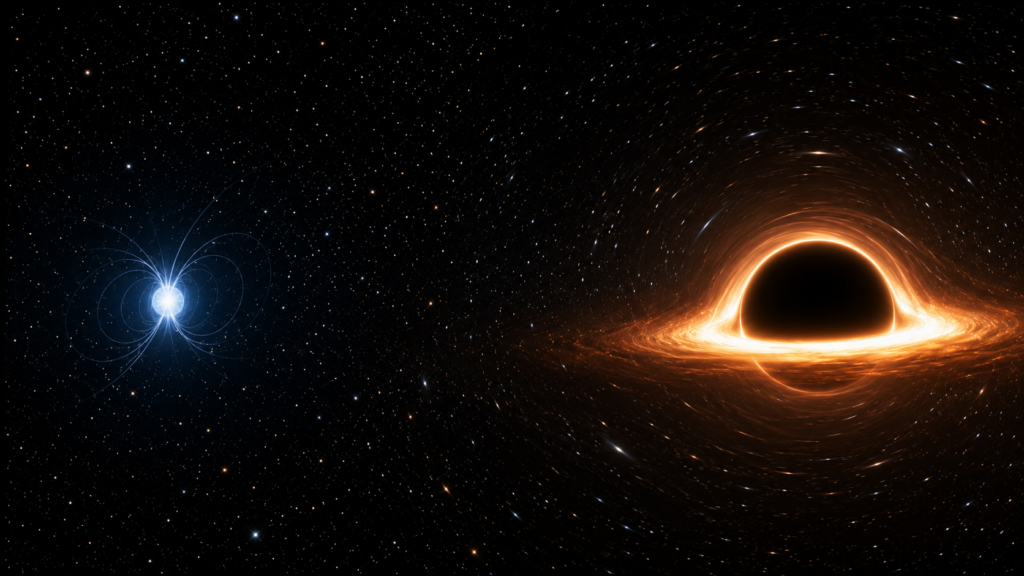
Taken to its extreme, the same escape velocity concept explains one of the strangest objects in physics. Around a black hole, gravity is so intense that the escape velocity exceeds the speed of light, which is why nothing, not even light itself, can leave once it crosses the event horizon.
Why Rockets Launch Straight Up and Then Tilt
If orbit ultimately requires sideways speed, the near vertical launch of most rockets can look strange at first. The answer is practical rather than theoretical. At liftoff, a rocket needs to clear the ground, get safely away from the launch structure, and climb through the densest part of the atmosphere as efficiently as possible. A largely vertical path handles that first phase well.
The vehicle does not continue straight up for long, though. It gradually pitches over and starts building horizontal speed, in a maneuver commonly called a gravity turn.
A gravity turn works by tipping the rocket slightly and then letting gravity itself help curve the flight path toward horizontal, rather than forcing a sharp turn later through active steering alone. Since orbit ultimately depends on sideways velocity, a rocket spends much of its powered ascent building speed that is almost entirely horizontal by the time engines cut off. This is one more reason rocket science looks simpler on paper than rocket flight is in practice. The vehicle is not simply going up. It is following a precisely shaped trajectory that balances gravity, drag, thrust, structural limits, and guidance constraints continuously.
Gravity Losses, Drag Losses, and Steering Losses
The gap between an idealized calculation and an actual launch becomes clear once you look at where performance is lost.
Gravity losses occur because the rocket spends time fighting Earth’s pull throughout ascent. A slower acceleration means more of the engine’s effort goes into simply holding the vehicle up rather than building orbital speed.
Drag losses occur because the vehicle is moving through air, which opposes motion and converts useful kinetic energy into heat.
Steering losses occur because thrust is rarely pointed in exactly the direction the final velocity needs to go. Any turning or correction the guidance system performs costs some efficiency.
Together, these losses explain why the total velocity change needed to reach low Earth orbit is noticeably higher than orbital velocity alone. A commonly cited approximate figure is 9 to 10 kilometers per second of total delta v, though the precise number always depends on the specific vehicle and trajectory.
Why Staging Exists
Staging is one of the most effective practical answers to the mass ratio problem. Once a rocket stage burns through its propellant, its empty tanks and now useless engines become dead weight. Carrying that weight all the way to orbit would badly hurt performance.
By dropping spent stages, a rocket sheds mass that its remaining engines no longer need to accelerate, which improves the effective mass ratio for the rest of the flight and increases the total delta v the vehicle can achieve. This is why most launch vehicles use two or more stages, with lower stages optimized for liftoff and atmospheric flight, and upper stages usually optimized for efficient performance in thin air or vacuum.
Why Structural Mass Is Its Own Battle
The rocket equation makes every kilogram consequential. Propellant has to be sufficient for the required delta v, but structure, engines, insulation, avionics, and payload all add mass of their own. The engineering challenge is making that structure as light as possible without making it too weak to survive pressure loads, bending forces, vibration, or heat.
This tension, light enough to fly and strong enough not to fail, sits at the core of why rocket engineering is so demanding, independent of anything related to the underlying physics.
Aerodynamic Stress, Heating, and Guidance
During ascent through the atmosphere, a rocket faces serious aerodynamic forces. Air resists the vehicle’s motion, generating drag and pressure loads that change rapidly as speed and altitude change together.
A key moment in that process is max Q, the point of maximum dynamic pressure during ascent, where the combination of speed and air density puts the greatest aerodynamic stress on the vehicle. Many launch vehicles deliberately throttle down near max Q specifically to reduce structural strain at that moment.
Heat and vibration create their own set of problems. Engine operation, aerodynamic buffeting, acoustic energy, and structural oscillation can all threaten the vehicle and its payload if they are not carefully managed.
None of this happens automatically. A rocket needs guidance, navigation, and control systems working continuously: navigation to determine where the vehicle actually is and how it is moving, guidance to determine where it needs to go, and control systems to adjust engines, nozzles, or thrusters accordingly. Small errors in this loop can grow quickly, wasting propellant, increasing structural loads, missing the intended orbit, or ending the mission outright. It is another clear example of physics that is teachable sitting next to engineering that is genuinely hard.
Why Reliability and Reuse Are So Difficult
This is where rocket science turns into rocket engineering in the least forgiving way. A rocket is not one machine. It is a hierarchy of interacting systems, propulsion, pressurization, avionics, software, structures, sensors, stage separation, thermal protection, and ground support, all of which have to function correctly, often in a strict sequence.
That interdependence is what makes reliability so hard to achieve. A single failure in one critical component can end the mission, and even when each individual part has a low failure probability on its own, the overall system still demands enormous care, because the margins are thin and the consequences of failure are severe.
Reusable rockets add another layer of difficulty on top of that. Launching a booster once is one challenge. Making that same booster survive launch, reentry, landing, inspection, and another full flight, while keeping refurbishment costs under control, is a much harder one. Reuse is easy enough to describe conceptually. Achieving it in practice requires a vehicle that tolerates repeated thermal cycles, repeated structural loads, engine wear, and precision landing, all without compromising safety. Modern reusable systems have meaningfully changed launch economics, though the actual savings vary by vehicle and operator, which is why it is worth describing that shift in general terms rather than with a single specific figure.
A Short History of Rocket Science
Rocket science predates the space age by centuries. Early gunpowder rockets were developed long ago, mostly for military use. The scientific foundation for modern rocket science arrived with Newton’s laws of motion and universal gravitation, which made it possible to understand not just how a rocket accelerates, but how an orbit works at all.
In the early twentieth century, Konstantin Tsiolkovsky worked out mathematically how mass and exhaust velocity govern rocket performance, producing the rocket equation that still defines launch physics today. Robert Goddard turned that theory into working hardware through his liquid fuel rocket experiments. Hermann Oberth and other early theorists expanded the intellectual foundation that later spaceflight would build on.
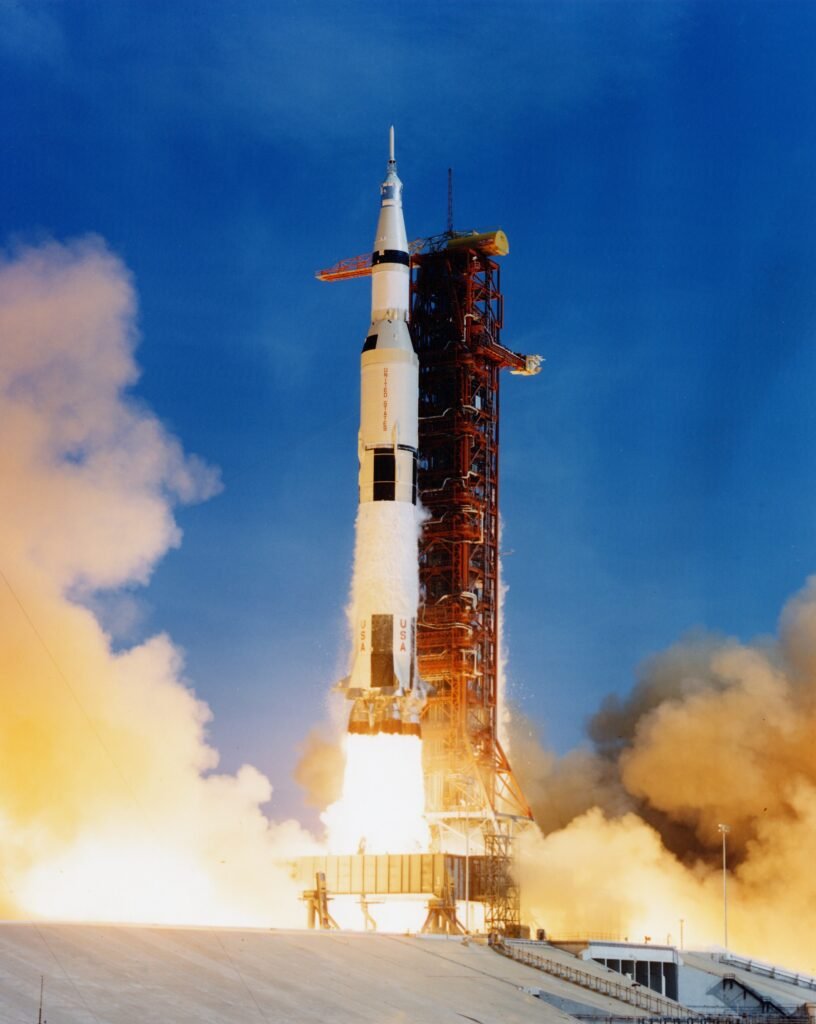
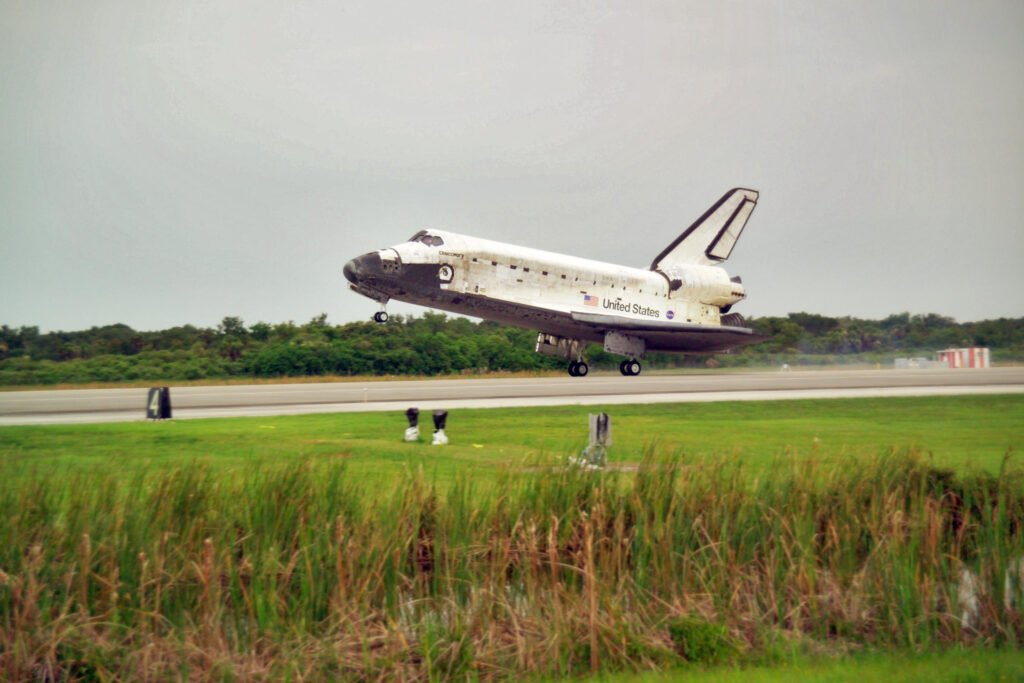
The V2 program demonstrated large scale guided rocket technology during the Second World War. Sputnik, launched in 1957, proved that artificial satellites could reach orbit and marked the start of the space age. The Apollo program showed what large multistage chemical rockets could accomplish in crewed lunar missions, while the Space Shuttle explored partial reusability along with its own complicated trade offs. More recent launch systems have pushed reusability further still, reshaping how space access gets planned and priced.
Common Misconceptions Worth Correcting
Rockets push against air. This is false. Rockets accelerate their own exhaust, which is exactly why they work in vacuum.
There is no gravity in orbit. This is false. Orbiting spacecraft remain fully under Earth’s gravity and are, in a real sense, continuously falling around the planet.
Reaching space means reaching orbit. This is false. A suborbital flight can reach space and still fall back to Earth, because it lacks the sideways speed orbit requires.
Escape velocity means a spacecraft must instantly travel that fast. This is false. Escape velocity is an idealized energy threshold, not a literal requirement at the moment of launch.
Heavier rockets always accelerate more slowly. This is false. Acceleration depends on net force divided by mass, so a heavier rocket with proportionally greater thrust can outaccelerate a lighter one.
Rocket engines cannot work in vacuum. This is false. Rockets are specifically designed to operate without surrounding air, since they carry their own oxidizer.
Why This Matters
Understanding the difference between rocket science and rocket engineering changes how you read every headline about a launch failure, a delayed mission, or a new reusable booster. The physics has been settled for a long time. What separates a successful launch from a failed one is almost always engineering: material choices, manufacturing tolerances, guidance software, and thousands of individual decisions that all have to hold up under conditions few other machines ever face. Once you see that distinction clearly, spaceflight stops looking like magic and starts looking like what it actually is, an extraordinarily disciplined engineering achievement built on physics that most people can genuinely understand.
Key Takeaways
Rockets work by throwing mass backward and gaining momentum forward, which is why they function in vacuum and do not need air to push against.
The full thrust equation includes both momentum thrust and pressure thrust, which is more complete than relying on Newton’s third law alone.
The Tsiolkovsky rocket equation shows why propellant mass grows so quickly relative to payload, and why staging exists to manage that problem.
Reaching space is primarily an altitude problem, while reaching and staying in orbit is primarily a sideways speed problem.
Real launches always underperform the ideal rocket equation because of gravity losses, drag losses, and steering losses.
The physics of rocket flight is teachable with school level mathematics. The engineering required to build a reliable, reusable vehicle around that physics is what makes rocket science genuinely hard.
References
- NASA Glenn Research Center, “Ideal Rocket Equation.”
- NASA Glenn Research Center, “Rocket Thrust Equation.”
- NASA Glenn Research Center, “Thrust Equations Summary.”
- NASA Glenn Research Center, “Mass Ratios.”
- NASA Glenn Research Center, “Guide to Rockets.”
- NASA, “Basics of Space Flight.”


Join the discussion
Comments are moderated and may take a little while to appear.