In the 1970s, astronomer Vera Rubin pointed a telescope at spiral galaxies and measured something that should not have been possible. Stars near the edge of a galaxy were orbiting just as fast as stars near its crowded center, as if the normal rules of gravity had stopped applying. They hadn’t. What Rubin had found was evidence of dark matter, an invisible form of matter that outweighs every star, planet, and galaxy we can see, combined.
NASA estimates that ordinary matter, the atoms making up stars, planets, and everything on Earth, accounts for only about 5% of the universe. Dark matter makes up roughly 27%. The remaining 68% is dark energy, a separate and unrelated mystery. In other words, almost everything that exists is something we have never directly detected.
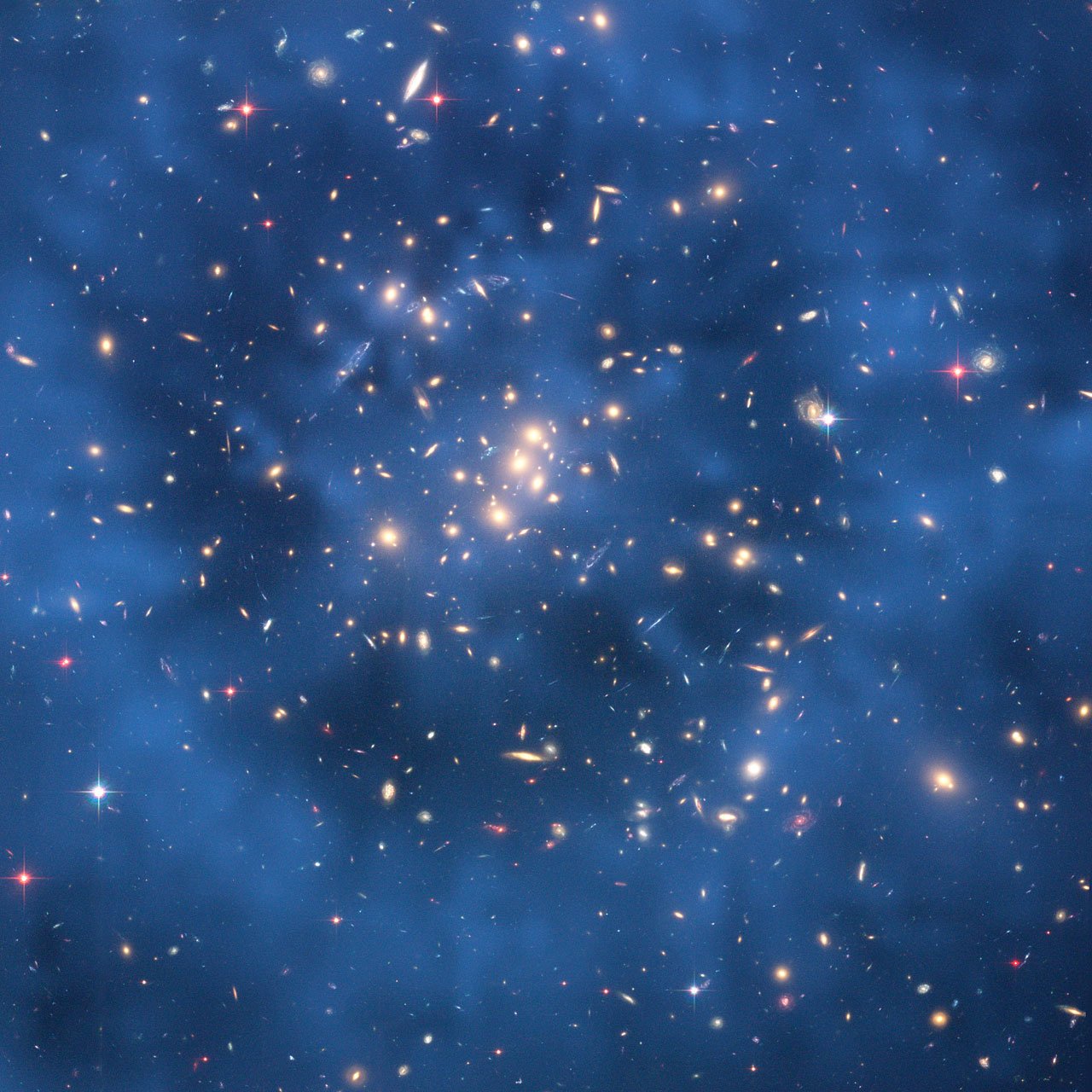
So what is this substance, how did scientists become confident it is real without ever seeing it directly, and what might it actually be made of? The answer runs from a skeptical 1930s astronomer through Rubin’s rotation curves to a violent collision between two galaxy clusters four billion light years away.
What Dark Matter Actually Means
Dark matter is not a placeholder term for “stuff we haven’t found yet.” It refers to a specific, well defined problem: something with mass and gravity that does not interact with light in any detectable way. NASA Science describes it as material that holds galaxies together gravitationally while remaining completely invisible to every kind of telescope, because it does not absorb, reflect, or emit electromagnetic radiation.
That last detail is what makes the search so difficult. Nearly every tool astronomers use, visible light, radio waves, X-rays, infrared, works by detecting how matter interacts with light. This material breaks that pattern entirely. It bends space and pulls on its surroundings through gravity, exactly as general relativity predicts for anything with mass, but it does not shine, scatter, or block light the way stars and gas do.
Scientists call it dark because it appears to interact with ordinary matter only through gravity, and despite decades of searching, no one yet knows what it is actually made of.
Zwicky’s Galaxy Cluster That Didn’t Add Up
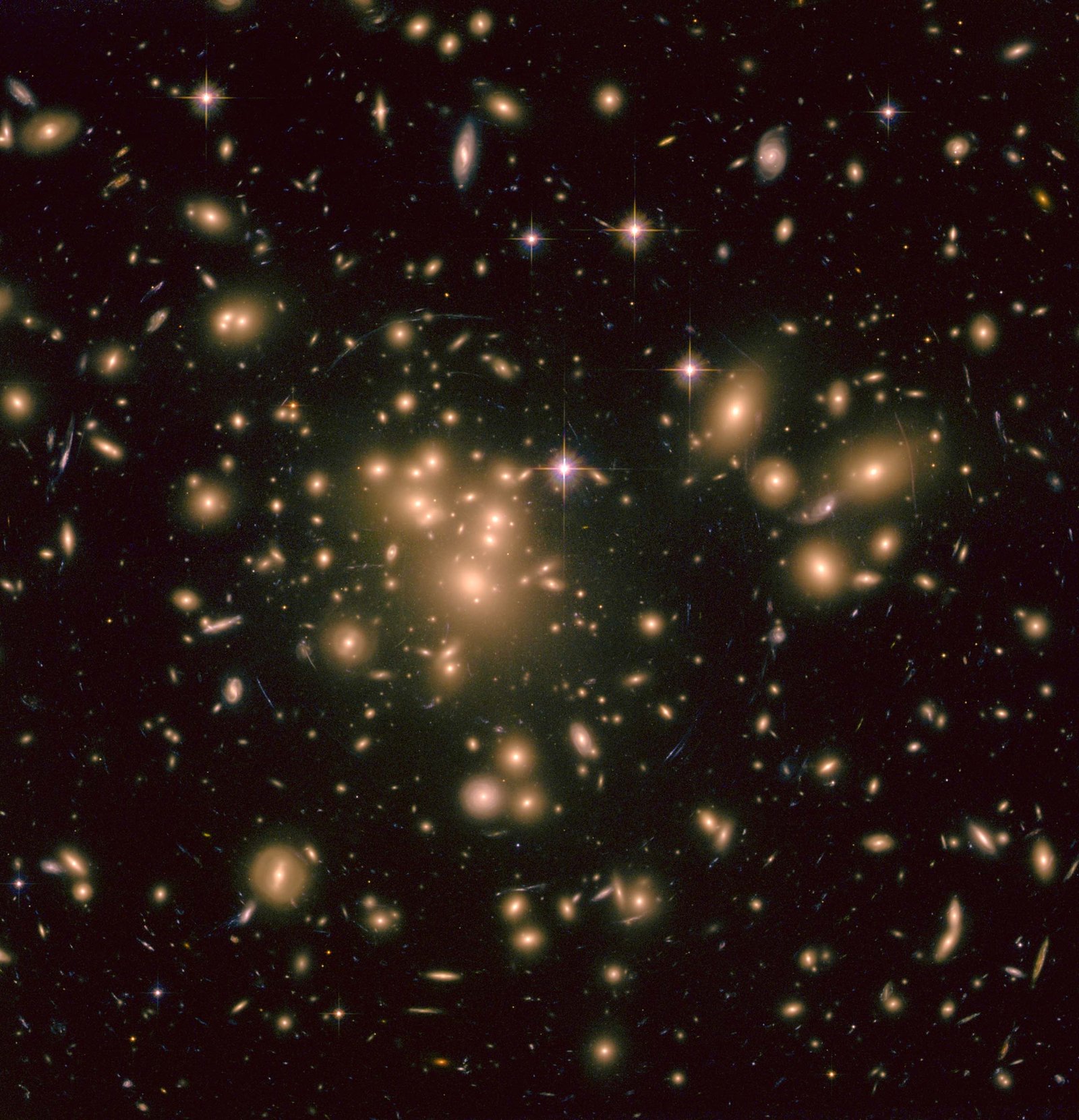
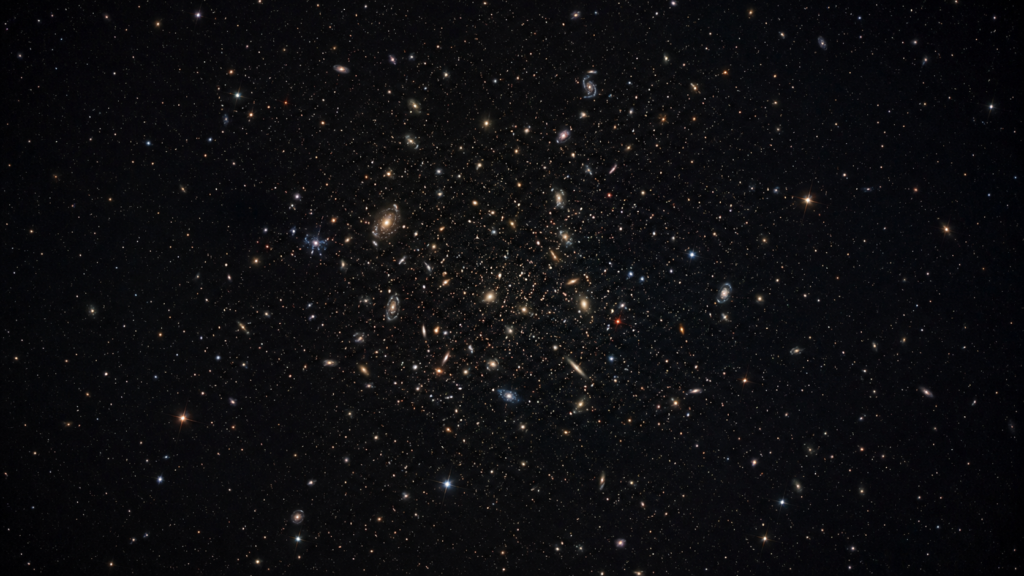
The story starts in 1933, when Swiss American astronomer Fritz Zwicky studied the Coma Cluster, a group of thousands of galaxies bound together by gravity. He measured how fast individual galaxies inside the cluster were moving and compared that speed to how much visible mass the cluster appeared to contain.
The numbers didn’t match. According to Brookhaven National Laboratory, Zwicky’s calculations showed the galaxies in Coma were moving far too quickly for the visible matter alone to hold the cluster together. Without much more mass than anyone could see, the cluster should have flown apart long before.
Zwicky called the missing material dunkle Materie, German for dark matter, and the name stuck. Most astronomers at the time were unconvinced. It took roughly forty years and a far more precise set of measurements before the idea moved from a curiosity to one of the best supported conclusions in modern astrophysics.
Vera Rubin’s Flat Rotation Curves
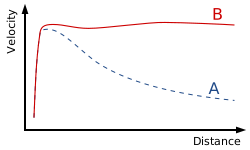
Zwicky raised the question. Vera Rubin, working with astronomer Kent Ford in the 1970s, provided the evidence that made the field take it seriously. The two measured how fast stars orbit at different distances from the center of spiral galaxies, producing what astronomers call a rotation curve.
Ordinary physics makes a clear prediction here. Just as Pluto orbits the Sun far more slowly than Mercury does, stars far from a galaxy’s crowded center should orbit more slowly than stars near it. NASA’s account of the discovery notes that Rubin and Ford found the opposite: the rotation curves came out flat. Stars at the outer edge of a galaxy were orbiting at nearly the same speed as stars much closer in.
There were only two ways to explain that. Either galaxies contained a large amount of unseen mass spread far beyond their visible disk of stars, or something was fundamentally wrong with how gravity works on galactic scales. Rubin’s measurements were precise and were soon confirmed across dozens of other galaxies using radio observations of hydrogen gas, which showed the same flat pattern well beyond where visible starlight faded out.
This connects directly to a project covered elsewhere on this site. The observatory now beginning a ten year survey of the changing sky is named after Rubin. Decades after her rotation curve measurements turned this into a serious scientific problem, a telescope built to map the universe in unprecedented detail carries her name into the next stage of that same search.
The Bullet Cluster and the Case for Direct Evidence
Rotation curves convinced most astronomers, but a skeptic could still argue that an incomplete theory of gravity, not invisible mass, was the real explanation. Then in 2006, a discovery made that argument much harder to sustain: the Bullet Cluster.
The Bullet Cluster is the aftermath of a collision between two enormous galaxy clusters roughly 3.8 billion light years away. NASA’s Chandra X-ray Observatory imaged the hot, X-ray glowing gas thrown off by the collision, visible in composite images as pink clouds, while a separate technique called gravitational lensing mapped where most of the system’s mass actually sits.
Gravitational lensing works because mass bends space, and bent space bends the path of light traveling through it, a consequence of general relativity discussed in our article on the experiments that confirmed Einstein’s theory. Astronomers measure how background galaxies appear distorted by a foreground cluster’s gravity and use that distortion to reconstruct where its mass is located, regardless of whether that mass produces any light.
When researchers compared the two maps for the Bullet Cluster, the mismatch was striking. The hot gas, carrying most of the cluster’s ordinary matter, sat concentrated in the middle, slowed by the collision. The lensing map, tracing the bulk of the mass, showed that mass had passed almost straight through the collision and come out the other side still paired with the visible galaxies. Chandra’s own analysis describes this as direct evidence that nearly all of the mass in the clusters does not interact with itself or with gas except through gravity, which is why it wasn’t dragged along with the ordinary gas.
NASA’s James Webb Space Telescope revisited the Bullet Cluster in 2025 with more precise imaging, remeasuring the mass distribution using the largest lensing dataset ever collected for the object. The new data confirmed the earlier picture: whatever makes up most of the cluster’s mass tracks the galaxies, not the gas, and shows no sign of dragging or slowing during the collision.
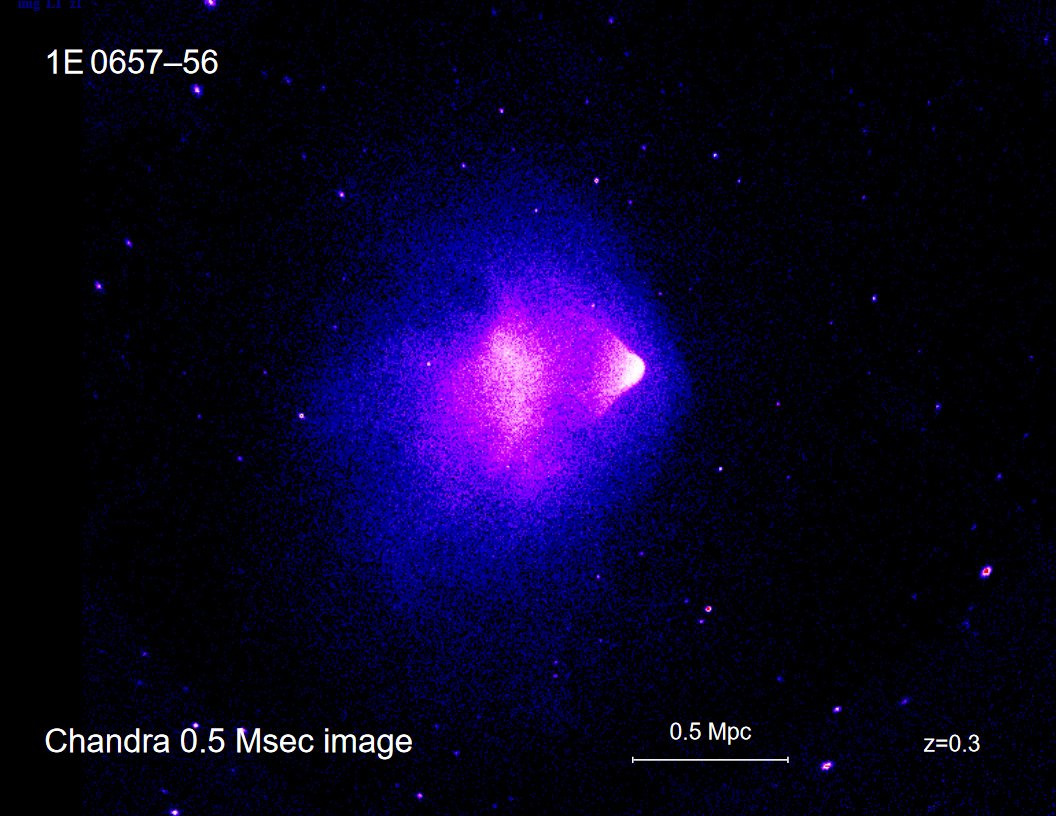
The case is not universally considered closed. A 2026 study from the University of Bonn argued that a modified theory of gravity, without invoking any unseen mass, could reproduce the Bullet Cluster’s lensing pattern if the visible mass estimate for the cluster is revised. That is a legitimate scientific challenge worth acknowledging, not a settled rebuttal. It has to compete with an independent, much larger body of evidence: rotation curves across many galaxies, other cluster collisions, and the fine structure of the cosmic microwave background, all of which point toward the same conclusion. The consensus explanation remains the one that fits that full body of evidence, though the debate itself is a healthy reminder that the question isn’t fully closed.
What This Missing Mass Might Actually Be
Knowing that something unseen is out there is different from knowing what it is made of, and that second question remains open. NASA Science lists a few candidates the research community takes most seriously.
WIMPs, short for Weakly Interacting Massive Particles, are heavy, slow moving particles that would interact with ordinary matter only through gravity and possibly the weak nuclear force, letting them pass through normal matter almost undisturbed. For roughly two decades WIMPs were the leading candidate, and physicists built increasingly sensitive underground detectors, including the LUX ZEPLIN (LZ) experiment, to look for the faint recoil of an atomic nucleus struck by a passing particle. So far, LZ and similar detectors have ruled out large portions of where WIMPs would need to be hiding without finding one.
Axions are a much lighter, more elusive alternative, first proposed to solve an unrelated problem in particle physics. CERN Courier notes that as WIMP searches have come up empty and the Large Hadron Collider has found no evidence of the supersymmetric particles many WIMP models predicted, axions have drawn increasing attention, with experiments now hunting for the tiny signal produced when an axion converts into a photon inside a strong magnetic field.
Primordial black holes, tiny black holes theorized to have formed moments after the Big Bang, are a third and less favored possibility. Some, with masses ranging from far lighter than a paperclip to hundreds of thousands of times the Sun’s mass, could in principle account for part of the total, though most of that mass range has since been ruled out by other observations.
No experiment has confirmed any of these candidates yet. It’s entirely possible the answer isn’t a single particle at all, but a mixture of several exotic forms of matter that current detectors aren’t yet built to catch.
Why This Matters
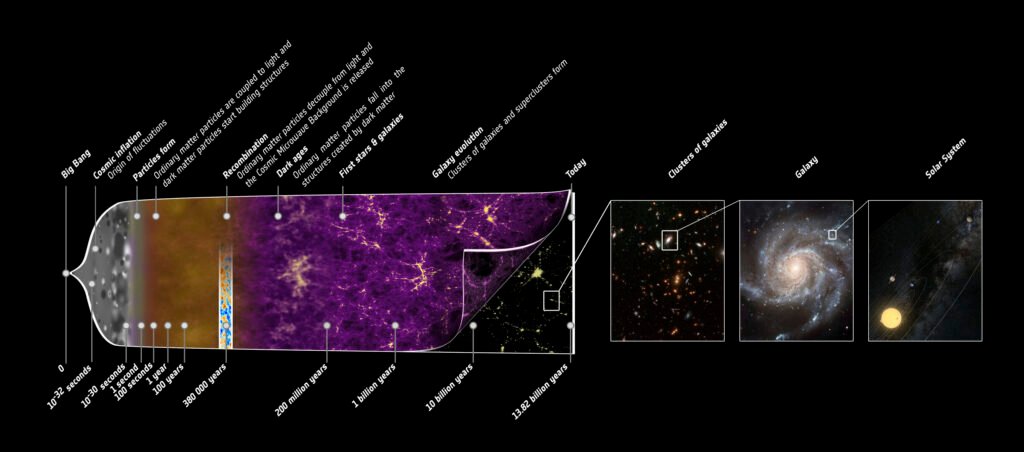
This isn’t a side note in astrophysics. It’s load bearing. Simulations of how galaxies formed and clustered over 13.8 billion years only match what telescopes actually observe when this extra, unseen mass is included as scaffolding, giving gravity enough of a head start to pull matter together into galaxies before radiation pressure could smooth everything out. Remove it from the models, and the universe’s large scale structure, the cosmic web of galaxy filaments and voids that surveys have mapped in detail, does not form the way it demonstrably has.
It also bears on a deeper question raised in our article on what lies beyond the observable universe: understanding the cosmos’s shape and ultimate fate depends on knowing what it’s actually made of, and right now, most of it isn’t the atoms that make up everything we can study directly.
There’s a useful parallel in a particle already covered on this site. Our piece on neutrinos and why they’re so hard to detect describes a real, confirmed particle that passes through ordinary matter almost undisturbed, caught only because of its rare interactions inside a detector. WIMPs and axions are, in a sense, what physicists are hoping to find next: a particle even more reluctant to interact than the neutrino, but one that would finally explain where most of the universe’s mass has been hiding.
Key Takeaways
- Roughly 27% of the universe is made of dark matter, compared to about 5% for the ordinary matter that forms stars, planets, and people.
- It interacts with normal matter and light only through gravity, so it cannot be seen, absorbed, reflected, or emitted the way ordinary matter is.
- Fritz Zwicky first identified the problem in 1933, after finding the Coma Cluster’s galaxies moving too fast to stay bound by their visible mass alone.
- Vera Rubin and Kent Ford’s flat galaxy rotation curves in the 1970s turned the idea from a curiosity into mainstream astrophysics.
- The Bullet Cluster, imaged by Chandra and later refined by the James Webb Space Telescope, shows this missing mass physically separated from ordinary gas after a cluster collision, among the strongest direct evidence available.
- Leading candidates for what it’s made of include WIMPs, axions, and primordial black holes, but none has been confirmed.
- The debate isn’t entirely settled. A 2026 study proposed modified gravity as an alternative explanation, though it remains a minority position against a much larger body of evidence.
FAQs
What is dark matter in simple terms?
It’s an invisible form of matter with mass and gravity that does not interact with light. Scientists infer its existence from its gravitational effects on galaxies and galaxy clusters, even though no telescope has directly detected it.
How do we know it’s real if we can’t see it?
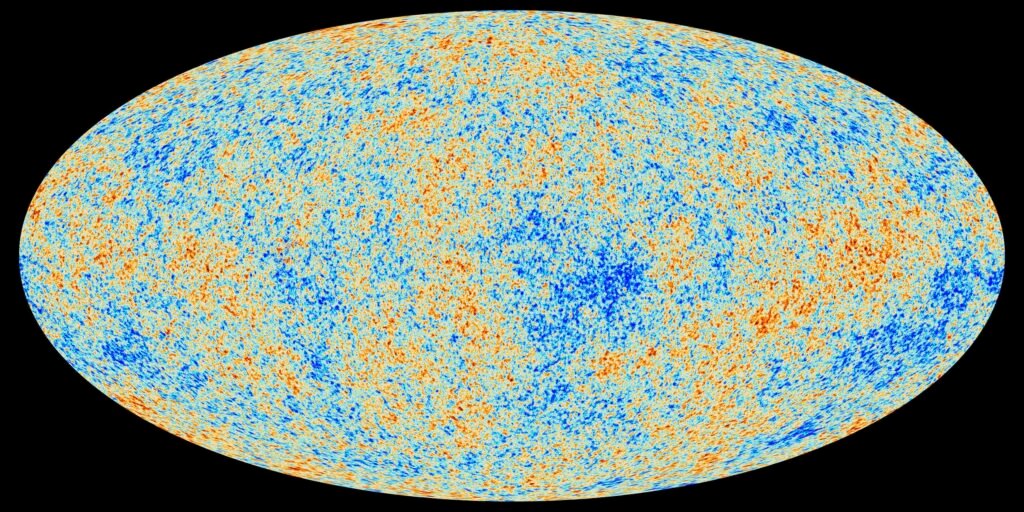
Several independent lines of evidence point the same direction: galaxies rotate faster than visible matter alone can explain, galaxy clusters like the Bullet Cluster show mass separated from visible gas through gravitational lensing, and the pattern of the cosmic microwave background matches predictions that require it.
Is dark matter the same as dark energy?
No. Dark matter adds gravitational pull that helps hold galaxies together. Dark energy is a separate phenomenon thought to be accelerating the expansion of the universe. Together they account for roughly 95% of everything that exists.
What is it actually made of?
No one knows for certain. The leading candidates are WIMPs, axions, and primordial black holes, but decades of experiments have not confirmed any of them.
Could this just mean our theory of gravity is wrong instead?
A minority of researchers explore modified gravity as an alternative, including a 2026 reanalysis of the Bullet Cluster. But the bulk of the evidence, from rotation curves to the cosmic microwave background, still fits the standard explanation better than any gravity only alternative proposed so far.
Why does any of this matter for understanding the universe?
It provided the gravitational scaffolding needed for galaxies and large scale cosmic structure to form in the early universe. Without it, simulations of cosmic history don’t match what telescopes actually observe.
References
- NASA Science, Dark Matter: science.nasa.gov/dark-matter
- European Space Agency, The Dark Universe: esa.int
- European Space Agency, Planck Reveals an Almost Perfect Universe: esa.int
- Brookhaven National Laboratory, Next-Gen Dark Matter Detector in a Race to Finish Line: bnl.gov
- NASA, Interesting Fact of the Month, galaxy rotation curves: nasa.gov
- NASA Imagine the Universe, Cosmic Times, Galaxies Still Misbehaving: imagine.gsfc.nasa.gov
- Chandra X-ray Observatory, Bullet Cluster, Direct Proof of Dark Matter: chandra.harvard.edu
- NASA Science, Webb Pierces Bullet Cluster, Refines Its Mass: science.nasa.gov
- Phys.org, Bullet Cluster Observations Reopen Dark Matter Debate With MOND Scenario: phys.org
- LZ Dark Matter Experiment, Lawrence Berkeley National Laboratory: lz.lbl.gov
- CERN Courier, Introducing the Axion: cerncourier.com
- NASA Science, Astronomers Find Ring of Dark Matter With Hubble Space Telescope: science.nasa.gov
- Wikimedia Commons, GalacticRotation2.svg, PhilHibbs, CC BY SA 3.0: commons.wikimedia.org
Join the discussion
Comments are moderated and may take a little while to appear.