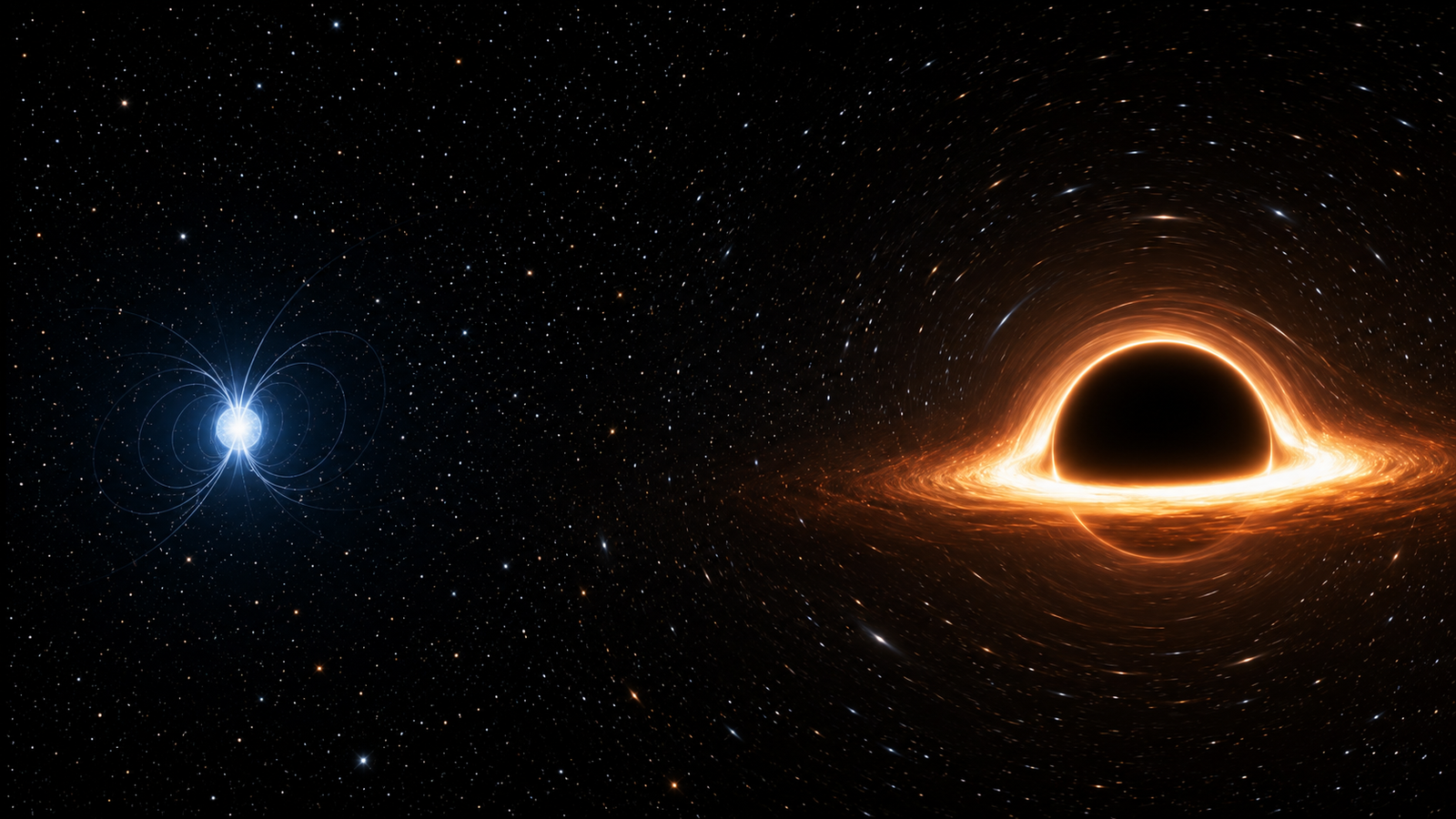
Both are what’s left when a massive star dies. Both come from the same basic event, a supernova, and each is dense enough to break your intuition about matter. But a neutron star and a black hole are not two versions of the same thing. One is an object made of matter, however strange that matter behaves. The other is a region of spacetime where matter, as we understand it, no longer exists in any conventional sense.
The black hole vs neutron star question comes down to one number: mass. And what happens to gravity once you cross a specific threshold.
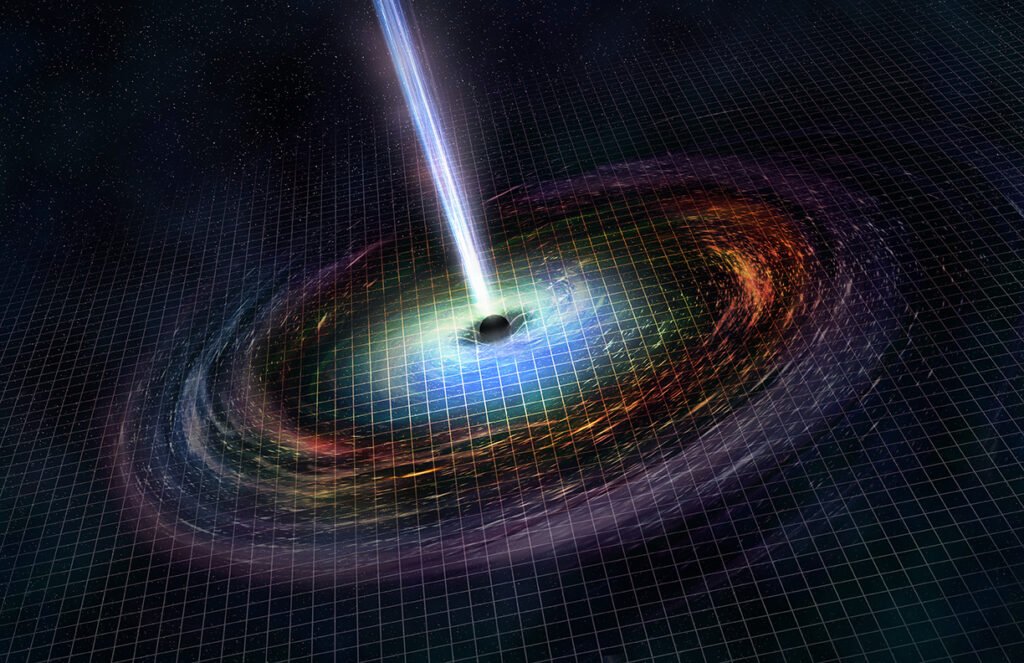
Artist’s illustration of the black hole formed when two neutron stars merged in the event GW170817, shown with its disk of infalling matter and jet of high energy particles. Credit: NASA/CXC/M. Weiss
Where They Both Come From
When a star roughly eight times the mass of the sun or heavier runs out of nuclear fuel, its core collapses under its own gravity in less than a second. The outer layers explode outward as a supernova, and what remains at the center depends almost entirely on how much mass is packed into that collapsing core.
If the leftover core is between about 1.4 and roughly 2 to 3 solar masses, the collapse stops. What’s left is a neutron star.
If the leftover core is heavier than that, nothing stops the collapse. What’s left is a black hole.
The difference between a neutron star and a black hole comes down to a single number: how much mass was left after the star died.
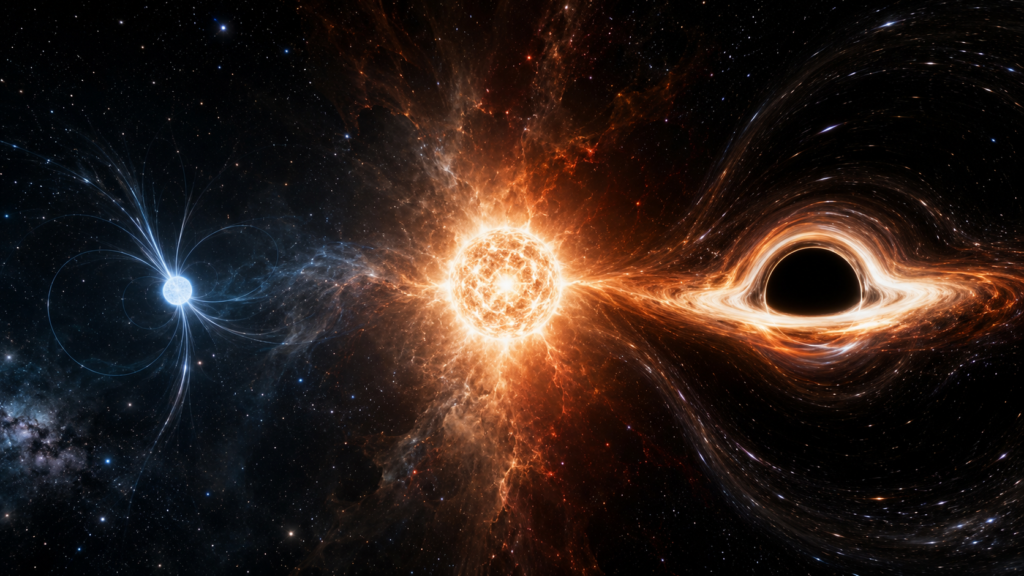
Artist’s illustration of a dying star’s core at the moment of collapse, flanked by its two possible fates: a magnetized neutron star with dipolar field lines on the left, and a black hole bending light around its event horizon through gravitational lensing on the right. Illustration not to scale.
Why Neutron Stars Stop Collapsing
A neutron star is held up by neutron degeneracy pressure. It comes from a rule in quantum mechanics called the Pauli exclusion principle, which says that no two identical fermions, in this case neutrons, can occupy the same quantum state at the same time.
As the core collapses, protons and electrons get crushed together and combine into neutrons. Once the core is made almost entirely of neutrons packed as tightly as physics allows, this quantum pressure pushes back against gravity with enormous force. It’s not heat or normal outward pressure the way a star burning fuel resists gravity. It’s a fundamentally quantum mechanical resistance, and it’s strong enough to halt a collapse that would otherwise flatten anything else in the universe.
The result is an object about the size of a city, typically 20 to 24 kilometers across, containing more mass than the sun. A single teaspoon of neutron star material would weigh around a billion tons on Earth.
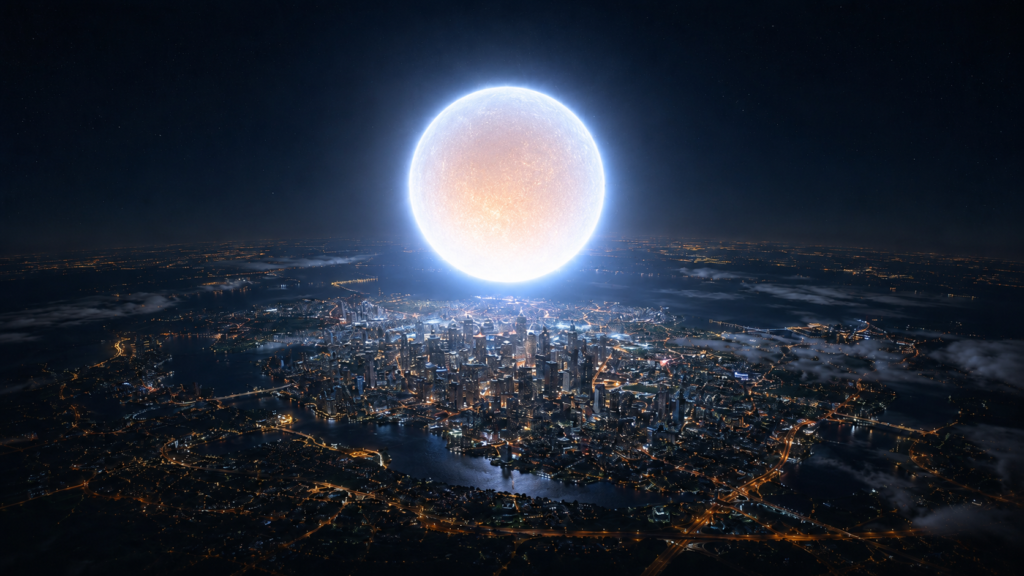
Scale illustration comparing a neutron star to a major city. Despite packing more mass than the Sun, a neutron star is only about 20 kilometers across. Illustration not to scale to the surrounding landscape; surface texture is stylized.
Why Black Holes Don’t Stop
Above roughly 2 to 3 solar masses, even neutron degeneracy pressure can’t win. There is no known force, quantum or otherwise, strong enough to halt the collapse. The core keeps shrinking, and according to general relativity, it keeps shrinking without limit.
This is the theoretical singularity, a point where the equations of general relativity break down and stop making reliable predictions. Physicists generally agree the singularity signals that our current understanding of gravity is incomplete at those scales, not that infinite density is a literal, final answer.
What we can describe with confidence is the event horizon, the boundary around that collapsing core where the escape velocity equals the speed of light. Cross it, and nothing, not light, not information, not you, comes back out.
Gravity does not stop pulling. It simply runs out of anything left to resist it.
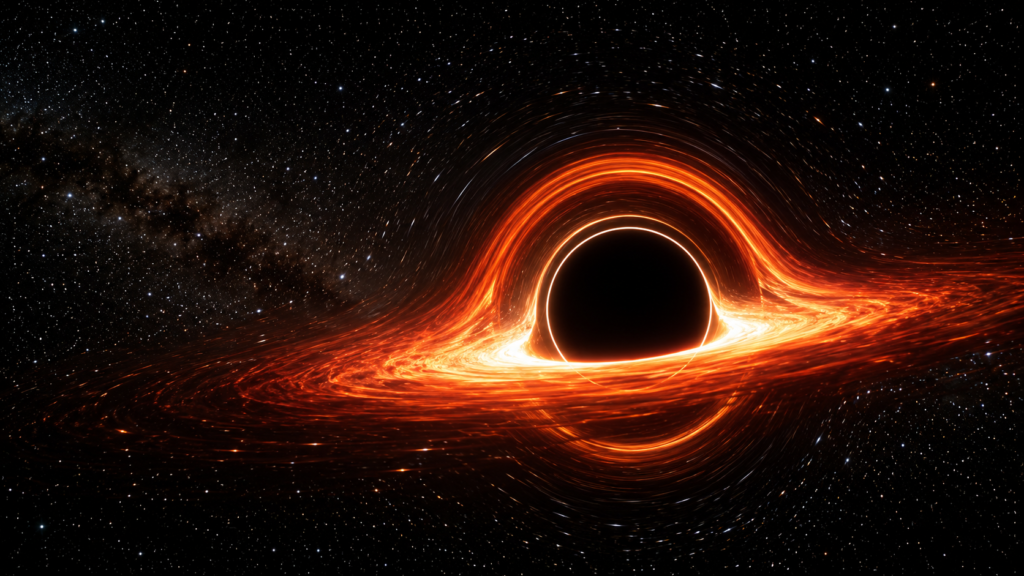
Simulated view of a black hole, showing its dark event horizon ringed by a thin, intensely bright photon sphere. The surrounding accretion disk is warped by gravitational lensing so its far side appears to arc up and over the black hole itself, a real signature of how gravity bends light near an event horizon.
Matter That Behaves Like Nothing Else
A neutron star still has a surface, in the sense that it has an outer layer of matter you could, in principle, describe with physics. Beneath a thin crust of ordinary atomic nuclei, the interior is thought to be a superfluid of neutrons, meaning it flows with zero resistance, alongside a smaller fraction of protons forming a superconductor. Deeper still, in the core, some models predict the neutrons may break down into a soup of quarks, though this remains an active area of research rather than settled fact.
A black hole has no surface and no matter in that sense at all, at least not beyond the event horizon as far as any outside observer can ever confirm. Everything that falls in disappears from the observable universe. What’s left behind is described entirely by three numbers, mass, spin, and electric charge, an idea sometimes called the no hair theorem.
How We Actually Detect Them
Neither object is easy to see directly, but both leave clear fingerprints.
Neutron stars are often detected as pulsars, spinning neutron stars that sweep a beam of radio waves across space like a lighthouse. Some spin hundreds of times per second. Their regularity is precise enough that pulsars have been used as natural clocks for testing general relativity itself.
Black holes are detected through their gravitational influence on nearby matter, through X ray emissions from superheated gas spiraling into them, through the motion of stars orbiting an invisible companion, and through gravitational waves. The 2015 detection by LIGO of two merging black holes confirmed a prediction Einstein made a century earlier, and the 2019 Event Horizon Telescope image of the black hole in the galaxy M87 gave humanity its first direct visual of an event horizon’s shadow.
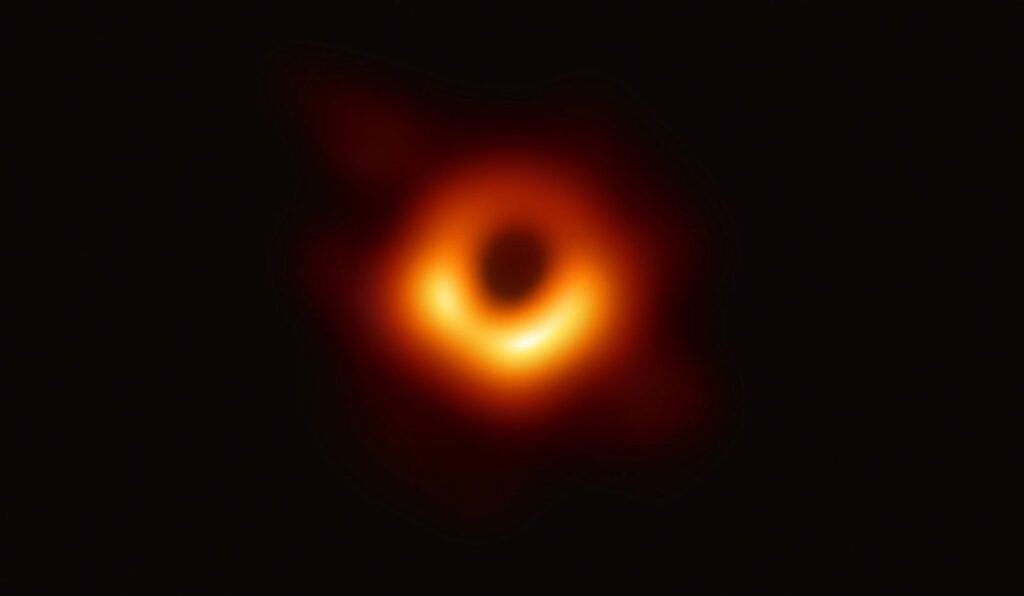
The first-ever direct image of a black hole, the supermassive black hole at the center of the galaxy M87, captured in 2019 by the Event Horizon Telescope. The bright ring is light bent around the black hole’s shadow by intense gravity. Credit: Event Horizon Telescope Collaboration
When the Two Collide
Astronomers have also detected neutron stars merging with each other, and neutron stars merging with black holes. The 2017 detection of a neutron star merger, observed in both gravitational waves and light across the electromagnetic spectrum, confirmed that these collisions produce heavy elements like gold and platinum through a process called rapid neutron capture, the r process. It was one of the first times a single cosmic event was observed through multiple, entirely different channels of evidence at once.
Why the Black Hole vs Neutron Star Divide Matters
Neutron stars and black holes are laboratories for physics that cannot be replicated on Earth. Inside a neutron star, matter sits at densities no nuclear reactor or particle collider will ever reach. A black hole pushes general relativity into its most extreme regime, where gravity grows strong enough to trap light itself, and where crossing the event horizon means leaving the observable universe for good.
Understanding the line between them also tells us something fundamental about the behavior of matter under extreme pressure, a question that connects nuclear physics, quantum mechanics, and the structure of spacetime. At its root, the black hole vs neutron star divide is a story about how much a dying star has left to fight gravity with.
Key Takeaways
- Both form from the collapse of a massive star’s core after a supernova.
- Neutron stars form when the collapsing core is roughly 1.4 to 2 or 3 solar masses. Neutron degeneracy pressure, a quantum mechanical effect, stops the collapse.
- Black holes form when the core exceeds that mass. No known force stops the collapse, and an event horizon forms instead of a surface.
- Neutron stars are matter behaving in extreme but describable ways. Black holes are regions of spacetime where physics runs out of answers at the singularity.
- Both are detected indirectly, through pulsar timing, X ray emission, gravitational waves, and in 2019, a direct image of a black hole’s shadow.
References
- Abbott, B. P., et al. (2016). Observation of Gravitational Waves from a Binary Black Hole Merger. Physical Review Letters, 116, 061102. https://doi.org/10.1103/PhysRevLett.116.061102
- Event Horizon Telescope Collaboration. (2019). First M87 Event Horizon Telescope Results. I. The Shadow of the Supermassive Black Hole. The Astrophysical Journal Letters, 875, L1. https://doi.org/10.3847/2041-8213/ab0ec7
- Abbott, B. P., et al. (2017). GW170817: Observation of Gravitational Waves from a Binary Neutron Star Inspiral. Physical Review Letters, 119, 161101. https://doi.org/10.1103/PhysRevLett.119.161101

Join the discussion
Comments are moderated and may take a little while to appear.