

Why is space black? Stand on the Moon at lunar noon and the Sun blazes overhead while the sky around it stays black. That observation explains why nearby space appears black: a diffuse sky glows only when matter redirects light toward an observer, and space contains very little matter to do the scattering. A second, older puzzle sits behind the first one. The universe holds an enormous number of galaxies, each with billions of stars. Why doesn’t their combined light fill every direction with brightness? The two questions have related but distinct answers, and untangling them took astronomers roughly two centuries.
Why Is Space Black?
Seeing light requires photons entering your eyes from a particular direction. A laser beam crossing a clean, dust-free room is nearly invisible from the side, even though the light is right there; you see it only once smoke or dust scatters some of its photons toward you. The same logic applies to a vacuum on a much larger scale.
Interplanetary space holds almost nothing to scatter with. At sea level, a cubic centimeter of air contains roughly 30 quintillion molecules, while the solar wind near Earth’s orbit typically carries only about 3 to 10 particles in the same volume. Sunlight produces a diffuse glowing sky only when matter scatters some of it toward the observer, and in most directions in space there simply isn’t enough matter to do that. Far too few visible photons arrive from an empty line of sight for the unaided eye to detect anything, so it reads as black.
Why Is Space Black If the Sun Is There?
The Sun radiates roughly 3.8 × 10²⁶ watts continuously, and that light crosses the entire solar system. Shouldn’t it light everything up?
It does illuminate everything it strikes. What matters is the difference between light passing through a region and light coming from that region. Sunlight streams past the International Space Station constantly, and an astronaut on a spacewalk sees the station gleaming, sees Earth glowing blue below, and sees their own suit lit up brilliantly. Turn toward a patch of open space with nothing in it, though, and the sunlight rushing through that patch keeps going without ever turning toward the astronaut’s eyes. That direction looks black even while sunlight fills it.
Sunlight also behaves in unexpected ways during a total solar eclipse, when the Moon briefly blocks the direct beam and lets the faint solar corona become visible, an event worth watching in person during the 2026 and 2027 total solar eclipses.
That direction looks black even while sunlight fills it.
Why Is Earth’s Sky Blue but Space Is Black?
Earth is wrapped in an atmosphere with a total mass of roughly five quadrillion metric tons. Sunlight entering that air collides constantly with nitrogen and oxygen molecules, which scatter it in every direction through a process called Rayleigh scattering. This scattering is much stronger at shorter wavelengths, so blue light gets redirected across the sky far more than red light does. Look in any direction away from the Sun and scattered blue photons reach your eyes from that patch of sky, which is why the daytime sky glows blue rather than staying dark.
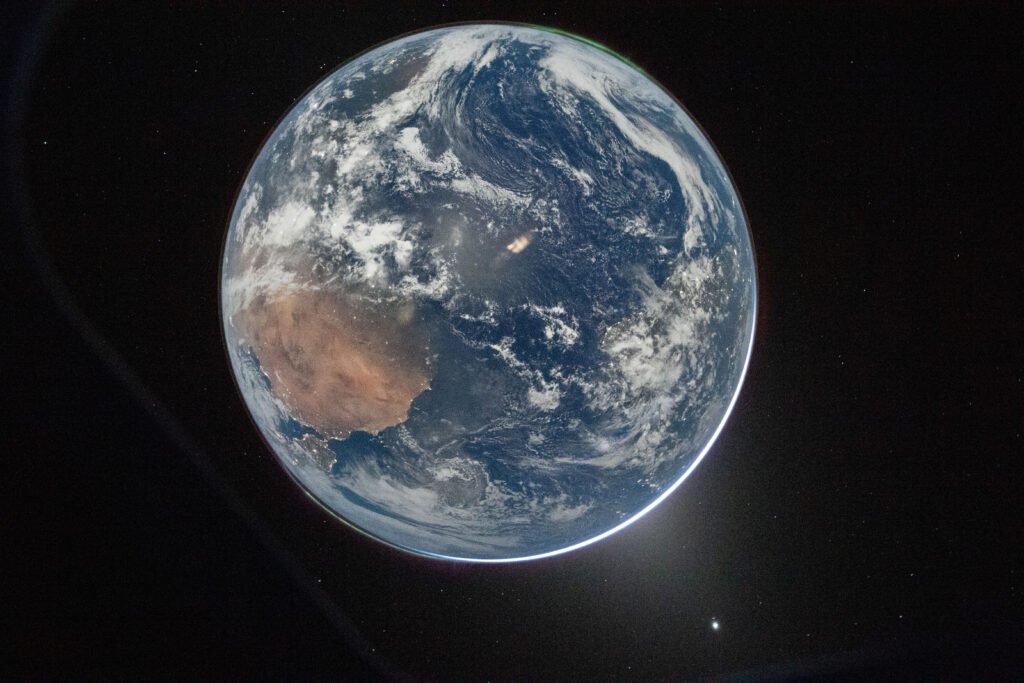
Take away the atmosphere and the effect disappears. The Moon has essentially no air, so even at the height of a two-week lunar day, an astronaut standing in full sunlight sees a black sky with the Sun as a sharp, blinding disk in it. The Apollo photographs show exactly this: brightly lit gray terrain under a completely black sky. This is also why the sky looks black from orbit. Astronauts above the bulk of Earth’s atmosphere are past nearly all the scattering air, so for them daytime means a brilliant Sun, a glowing Earth below, and black everywhere else.
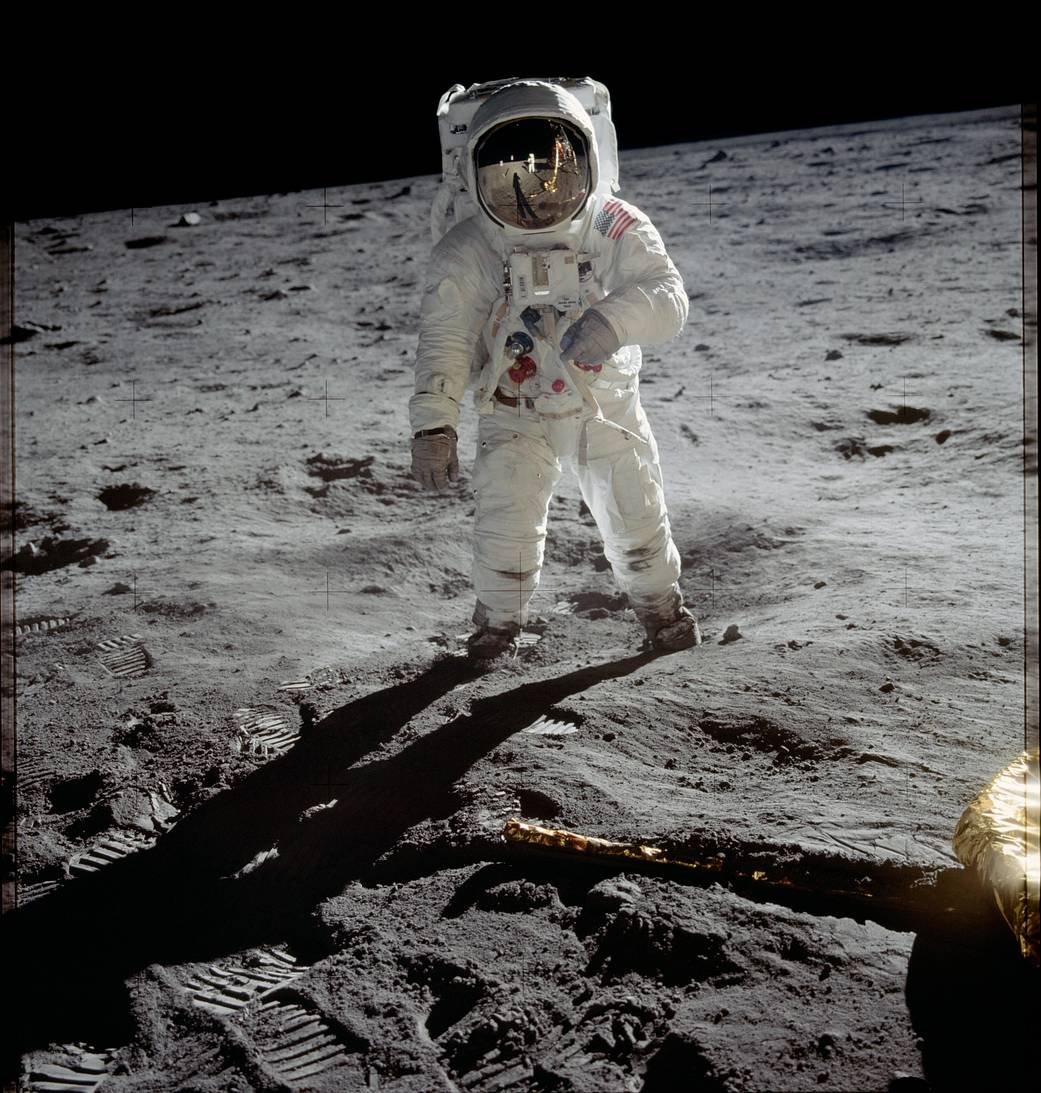
Astronaut Buzz Aldrin walks on the lunar surface near the Apollo 11 lunar module, under a black sky despite full sunlight. Image Credit: NASA.
If There Are So Many Stars, Why Isn’t the Sky Bright?
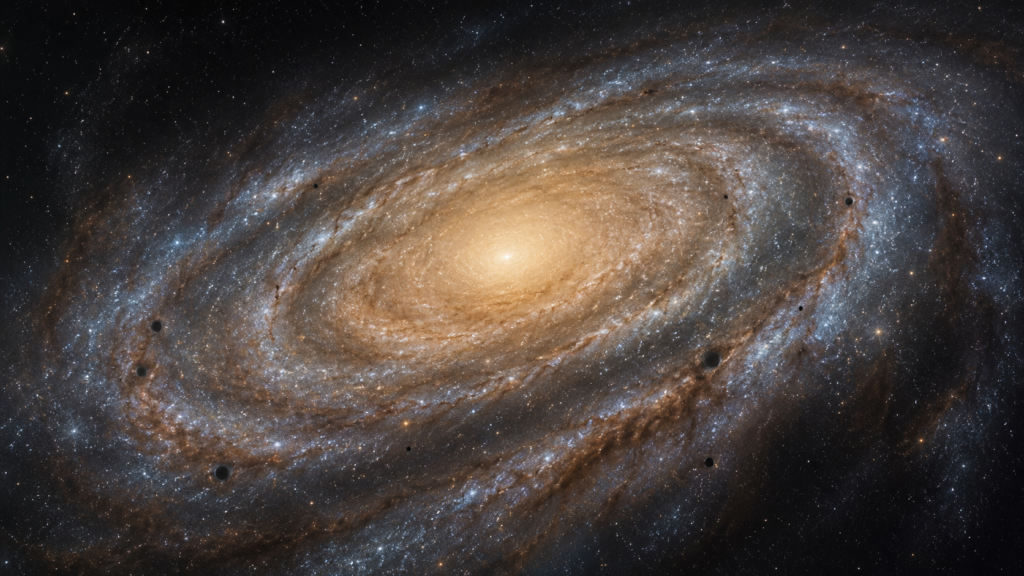
Set the Sun aside. The observable universe contains a very large number of galaxies. One influential extrapolation, based on deep Hubble Space Telescope surveys, suggested the figure could be roughly two trillion, most too faint to detect individually. Whatever the precise count, why doesn’t their combined starlight make the whole night sky glow?
Astronomers have puzzled over this since at least 1610, when Johannes Kepler raised a version of the problem. The German astronomer Heinrich Wilhelm Olbers gave it lasting form in 1823, and it now carries his name: Olbers’ paradox. If the universe were infinite, unchanging, and evenly filled with stars, every line of sight, extended far enough, would eventually hit the surface of some star. What that implies for the observable universe connects to a deeper question about what lies beyond it.
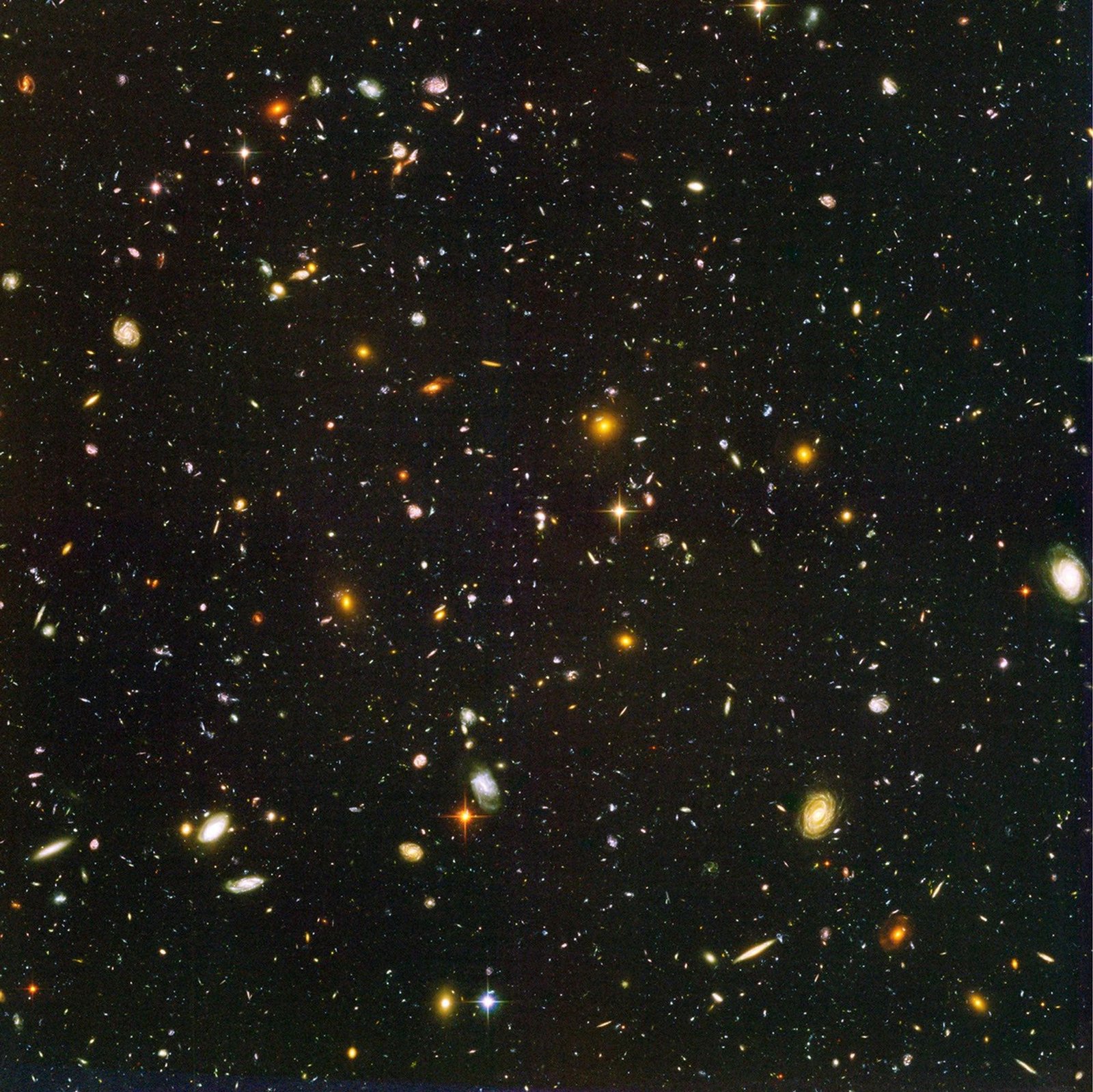
The Hubble Ultra Deep Field, showing nearly 10,000 galaxies of varying ages, sizes, and shapes. Image Credit: NASA, ESA, S. Beckwith (STScI), and the HUDF Team.
What the Classical Paradox Actually Predicts
A tempting shortcut is to say distant stars are simply too faint to matter. Brightness falls off with the square of distance, so a star twice as far away delivers only a quarter of the light. Doesn’t that make far-away starlight negligible?
Not in the idealized setup Olbers described. Picture the stars arranged in concentric spherical shells around Earth. Each star in a farther shell is dimmer by that inverse-square factor, but the number of stars in a shell grows with its surface area, which also scales with distance squared. The two effects cancel. Every shell, whether near or impossibly distant, delivers the same total light to Earth.
Add up enough such shells and, once nearer stars start blocking the view of stars behind them, the calculation approaches something specific: the entire sky would reach the surface brightness of an average star’s visible disk, comparable to looking at the face of the Sun in every direction. Olbers himself suggested that intervening dust absorbs light from very distant stars, but that idea fails too. Dust bathed in that much starlight would heat up until it glowed as brightly as the stars it was supposedly hiding.
Why the Real Universe Doesn’t Match That Prediction
That prediction assumes an eternal, unchanging population of stars, an assumption observational cosmology gives clear reasons to reject.
Stars have finite lifetimes. They form, burn through their fuel over millions to billions of years, and go dark. Light also takes time to travel, and the observable universe has a finite luminous history: we can only receive starlight from regions close enough for their photons to have already reached us. Edgar Allan Poe sketched a version of this idea in an 1848 lecture, arguing that a finite universe or a finite light-travel time would keep the sky dark, decades before physics could confirm it.
Cosmic expansion adds a further effect. Light from distant galaxies gets stretched on its journey toward longer, lower-energy wavelengths, a phenomenon called redshift. The American astronomer Vesto Slipher measured redshifts in dozens of spiral nebulae starting in the 1910s. The Belgian physicist Georges Lemaître connected an expanding-universe model to that observational data in 1927. Edwin Hubble published the now-famous distance-velocity relation in 1929, using his own distance measurements alongside Slipher’s redshift data, and the relationship is formally known today as the Hubble-Lemaître law. Light from the earliest galaxies, and especially the light released around 380,000 years after the hot Big Bang phase began, has been stretched so far into the microwave range that it forms the cosmic microwave background rather than anything visible.
Together, these factors mean the observable universe does not have an infinitely old, static population of eternally shining stars. That is a more careful statement than saying the darkness proves the universe had a beginning; it shows that the cosmos has evolved, with stars appearing and disappearing across a finite luminous history, rather than blazing forever in a static sky.
Cosmic expansion is distinct from time dilation, but relativity also predicts that motion and gravity change how much time passes.
Space Is Dark, but Not Perfectly Black
No direction in space is entirely free of light. Within the solar system, sunlight scattered by fine interplanetary dust produces zodiacal light, visible from a dark site on Earth as a faint glow along the horizon after sunset. From the inner solar system, zodiacal light can be more than 100 times brighter than the cosmic optical background, depending on wavelength and viewing direction, which is exactly why it has made that fainter signal so hard to measure from Earth.
The cosmic optical background is the faint extragalactic light reaching us at visible wavelengths, including the combined unresolved emission of galaxies across cosmic history. It records only the light that reaches us in the optical band, not every photon ever produced by every star. It is the visible counterpart to the cosmic microwave background. Beyond visible wavelengths, space also carries measured backgrounds of infrared, X-ray, and gamma ray radiation. Space looks black to human eyes, but instruments find faint light nearly everywhere.
The universe’s unseen mass is a separate mystery: astronomers infer dark matter from its gravitational effects, not from the visual darkness of space.
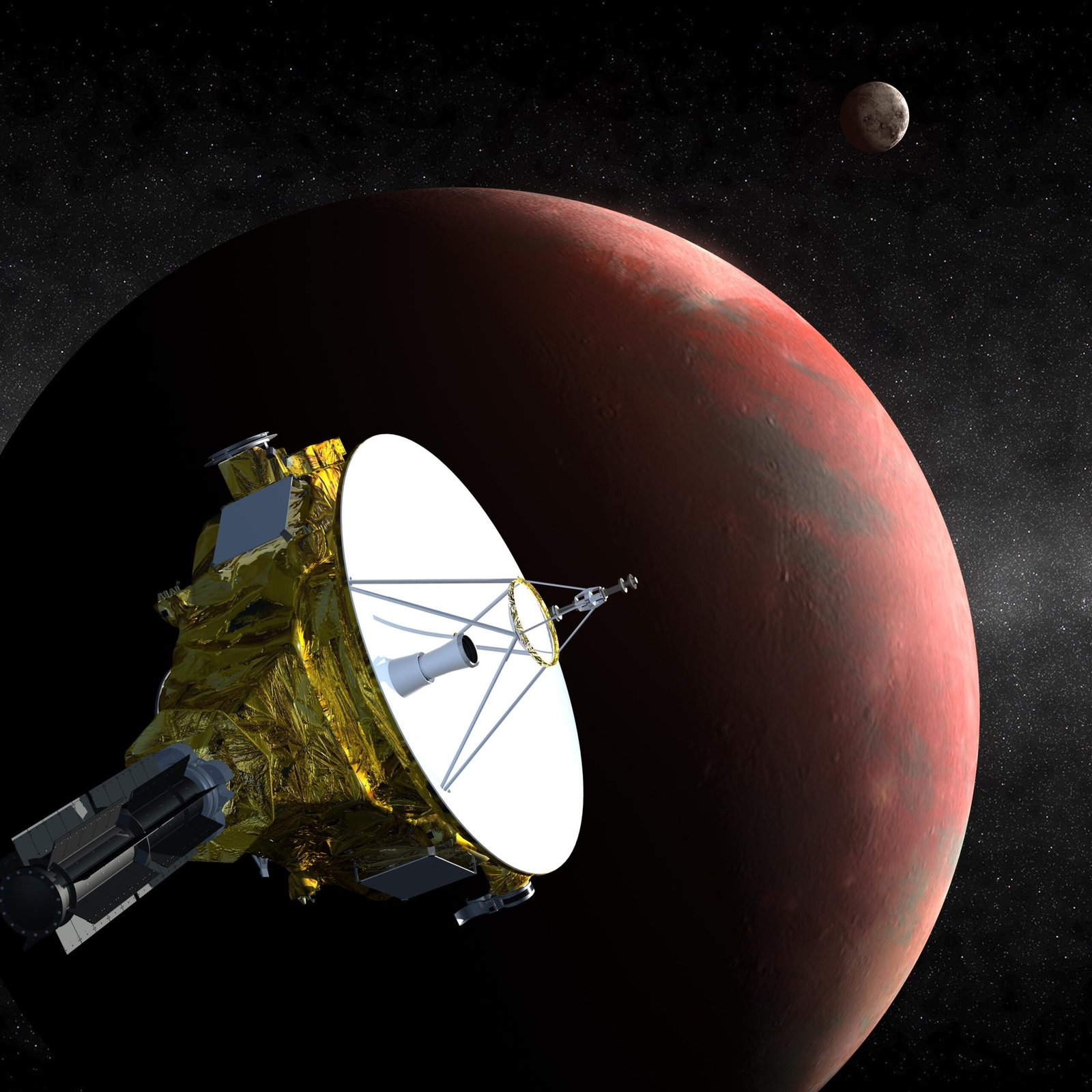
Artist’s concept of NASA’s New Horizons spacecraft in deep space. Image Credit: NASA, Johns Hopkins University Applied Physics Laboratory, Southwest Research Institute.
How New Horizons Measured the Darkness of Space
Measuring that faint background from Earth or nearby space is nearly hopeless, given how thoroughly zodiacal light drowns it out. NASA’s New Horizons spacecraft, launched in 2006 and famous for its 2015 Pluto flyby, offered a way around the problem. By the 2020s it was operating far out in the Kuiper Belt, tens of times farther from the Sun than Earth is, well beyond most of the interplanetary dust. Its Long Range Reconnaissance Imager became the most remote functioning telescope ever operated, looking out at some of the darkest sky any instrument has observed.
An earlier analysis of New Horizons images, published in 2021, found the cosmic optical background running roughly twice as bright as expected from the galaxies telescopes like Hubble can count, hinting at either unseen faint galaxies or some unrecognized source of light.
A 2024 study led by Marc Postman used new, dedicated New Horizons observations taken from about 57 times the Earth-Sun distance, combined with far-infrared data from the European Space Agency’s Planck mission to calibrate how much Milky Way dust was scattering starlight into the images. Once that galactic contamination was more carefully removed, the earlier excess essentially vanished. The measured background matched the light expected from galaxies accumulated over roughly the past 12.6 billion years, with no statistically significant unexplained optical component. As New Horizons co-investigator Tod Lauer put it, the cosmic optical background appears to come entirely from galaxies. The result constrains the total optical light produced by galaxies across cosmic history; it does not itself pin down the exact number of galaxies in the universe.
“The simplest interpretation is that the COB is completely due to galaxies. Looking outside the galaxies, we find darkness there and nothing more.”
Tod Lauer, New Horizons co-investigator
Common Misconceptions
Saying space is black “because light has nothing to bounce off” only addresses the local, vacuum side of the question. It says nothing about why the combined light of countless galaxies fails to light up the entire sky, which is a separate cosmological problem with its own answer. Expansion alone isn’t the whole story either: even without redshift, the finite lifetimes of stars and the finite luminous history of the observable universe would already keep the sky dark on their own. Modern cosmology needs both stellar evolution and cosmic expansion to match what’s actually observed.
Key Takeaways
- Space looks black in a given direction because a near vacuum contains too little matter to scatter sunlight toward an observer’s eyes, so far too few visible photons arrive from that direction for the unaided eye to detect.
- Earth’s sky is blue because atmospheric molecules scatter sunlight, favoring short blue wavelengths through Rayleigh scattering; remove the atmosphere, as on the Moon, and the sky stays black even in full sunlight.
- Olbers’ paradox shows that in an infinite, unchanging universe of stars, inverse-square dimming would be exactly offset by the growing number of stars in larger shells, pushing the whole sky toward the surface brightness of an average star.
- That prediction fails to match reality because stars have finite lifetimes and the observable universe has a finite luminous history, and cosmic expansion further redshifts the most distant light beyond what the human eye can see.
- Space carries measurable but faint light nearly everywhere, including zodiacal light and the cosmic optical background; 2024 measurements from NASA’s New Horizons spacecraft found that background fully consistent with accumulated galaxy light, with no significant unexplained excess.
Frequently Asked Questions
Why is space black if the Sun is there?
Sunlight fills the space around you in orbit or on an airless world, but your eyes only register light traveling directly into them. A vacuum has almost no particles to scatter that passing sunlight toward your line of sight, so any direction without a lit object delivers too few photons to see. The Sun itself, and anything it strikes, still looks brilliant.
Why is space black but the sky is blue on Earth?
Earth’s atmosphere scatters sunlight in every direction, and it scatters short blue wavelengths far more strongly than red ones. That scattered blue light reaches your eyes from across the whole daytime sky. Space and airless worlds like the Moon have no atmosphere to perform that scattering, so their skies stay black even in full sunlight.
Is space completely black?
No. Sensitive instruments detect zodiacal light from solar system dust and the cosmic optical background, the faint extragalactic glow at visible wavelengths built from the unresolved light of galaxies across cosmic history. Space also carries measured microwave, infrared, X-ray, and gamma ray backgrounds. It is extraordinarily dark by everyday standards, but never perfectly black.
Why don’t all the stars light up space?
Stars have finite lifetimes, and the observable universe has a finite luminous history, so most lines of sight don’t currently end on an actively shining star within reach of us. Expansion also stretches the most distant galaxies’ light beyond the visible range. Together these effects leave the night sky dark rather than uniformly bright.
Would space still look black to an astronaut in full sunlight?
Yes. The sky itself remains black during a sunlit spacewalk. However, glare from the Sun, Earth, the Moon, or the spacecraft usually prevents an astronaut’s eyes from becoming dark-adapted enough to see stars. Apollo astronauts on the brightly lit lunar surface generally could not see stars for this reason. When shielded from bright surfaces and given time to adapt, astronauts can see stars as steady points because no atmosphere makes them twinkle.
References
- NASA Space Place. “Why Is the Sky Blue?” NASA. https://spaceplace.nasa.gov/blue-sky/en/
- Royal Museums Greenwich. “Why Is the Sky Blue?” Royal Observatory Greenwich. https://www.rmg.co.uk/stories/space-astronomy/why-sky-blue
- European Space Agency. “Cosmology.” ESA Science and Technology. https://sci.esa.int/web/education/-/35775-cosmology
- Encyclopaedia Britannica. “Olbers’ Paradox.” britannica.com
- NASA. “Hubble Completes Eight-Year Effort to Measure Expanding Universe.” NASA Science. https://science.nasa.gov/missions/hubble/hubble-completes-eight-year-effort-to-measure-expanding-universe/
- NASA Science. “Overview.” NASA Universe. https://science.nasa.gov/universe/overview/
- NASA Science. “Universe Glossary.” https://science.nasa.gov/universe/glossary/
- Britannica. “How Much Does Earth’s Atmosphere Weigh?” https://www.britannica.com/story/how-much-does-earths-atmosphere-weigh
- NASA. “SPARTAN 201-3: The Solar Wind.” https://umbra.nascom.nasa.gov/spartan/the_solar_wind.html
- Zemcov, M., et al. “Measurement of the Cosmic Optical Background Using the Long Range Reconnaissance Imager on New Horizons.” Nature Communications, 2017. https://www.nature.com/articles/ncomms15003
- NASA. “New Horizons Spacecraft Answers Question: How Dark Is Space?” NASA, 2021. https://www.nasa.gov/missions/hubble/new-horizons-spacecraft-answers-question-how-dark-is-space/
- NASA. “Wide Awake on the Sea of Tranquillity.” NASA, Apollo 11. https://www.nasa.gov/missions/apollo/apollo-11/wide-awake-on-the-sea-of-tranquillity/
- Space Telescope Science Institute. “New Horizons Measurements Shed New Light on the Darkness of the Universe.” STScI News Release 2024-029, 2024. https://www.stsci.edu/contents/news-releases/2024/news-2024-029
- Postman, M., et al. “New Synoptic Observations of the Cosmic Optical Background with New Horizons.” The Astrophysical Journal, 2024. https://doi.org/10.3847/1538-4357/ad5ffc
Join the discussion
Comments are moderated and may take a little while to appear.