
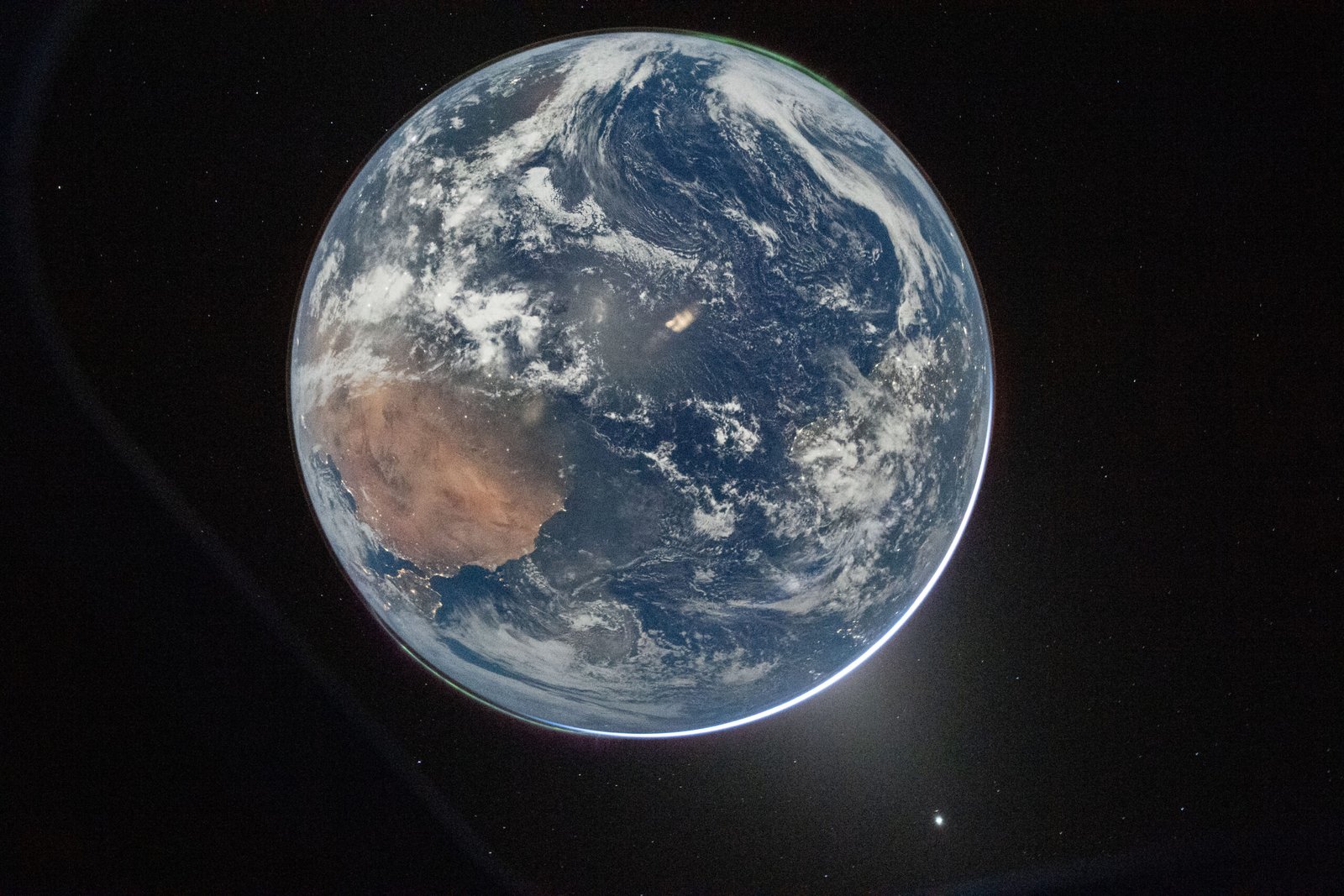
Sending a spacecraft to the Moon does not work the way most people picture it. Nobody points a rocket at the Moon and fires until it arrives. Instead, a spacecraft already circling Earth at close to eight kilometers a second receives one carefully timed burn that stretches its orbit until the far side of that orbit reaches lunar distance. That maneuver is called translunar injection, or TLI, and the entire idea, including a remarkably good estimate of the velocity change it requires, can be worked out with a handful of equations any physics student can follow.
What makes TLI worth understanding is not just the arithmetic. It is that gravity, the force that keeps every one of us stuck to the ground, is the same force that carries a spacecraft to the Moon once the engine shuts off.
An Orbit Is Not Hovering. It Is Falling.
A spacecraft in orbit is not resisting gravity. It is constantly falling toward Earth and constantly missing.
Isaac Newton described this with a thought experiment that NASA still uses in its own astronautics education material: fire a cannonball horizontally from a tall mountain, and gravity curves its path downward until it hits the ground. Fire it faster, and it travels farther before landing. Fire it fast enough, and the ball falls toward Earth at exactly the rate Earth’s surface curves away beneath it. The cannonball never lands. It falls forever, which is another way of saying it orbits.
So before a spacecraft heads for the Moon, it is already moving sideways around Earth at enormous speed. Centripetal force explains why gravity bends that sideways motion into an orbit instead of pulling the spacecraft straight down. That speed is the starting point for everything else.
How Fast a Spacecraft Is Already Moving
For a circular orbit, Newtonian mechanics gives a simple relationship between orbital speed, the strength of Earth’s gravity, and distance from Earth’s center. NASA’s own aeronautics education material sets out this relationship in its classical form.
v = √(μ ÷ r)
Here, v is orbital speed, μ is Earth’s standard gravitational parameter, and r is distance from Earth’s center, not from the surface. JPL’s current planetary constants put Earth’s μ at 398,600.44 cubic kilometers per second squared, which rounds cleanly to 398,600 for this calculation. Earth’s equatorial diameter is 12,756 kilometers, meaning a radius of 6,378 kilometers.
Take a spacecraft parked 185 kilometers above Earth, a fairly typical low parking orbit. Its distance from Earth’s center is:
r = 6,378 + 185 = 6,563 kilometers
Plugging that in:
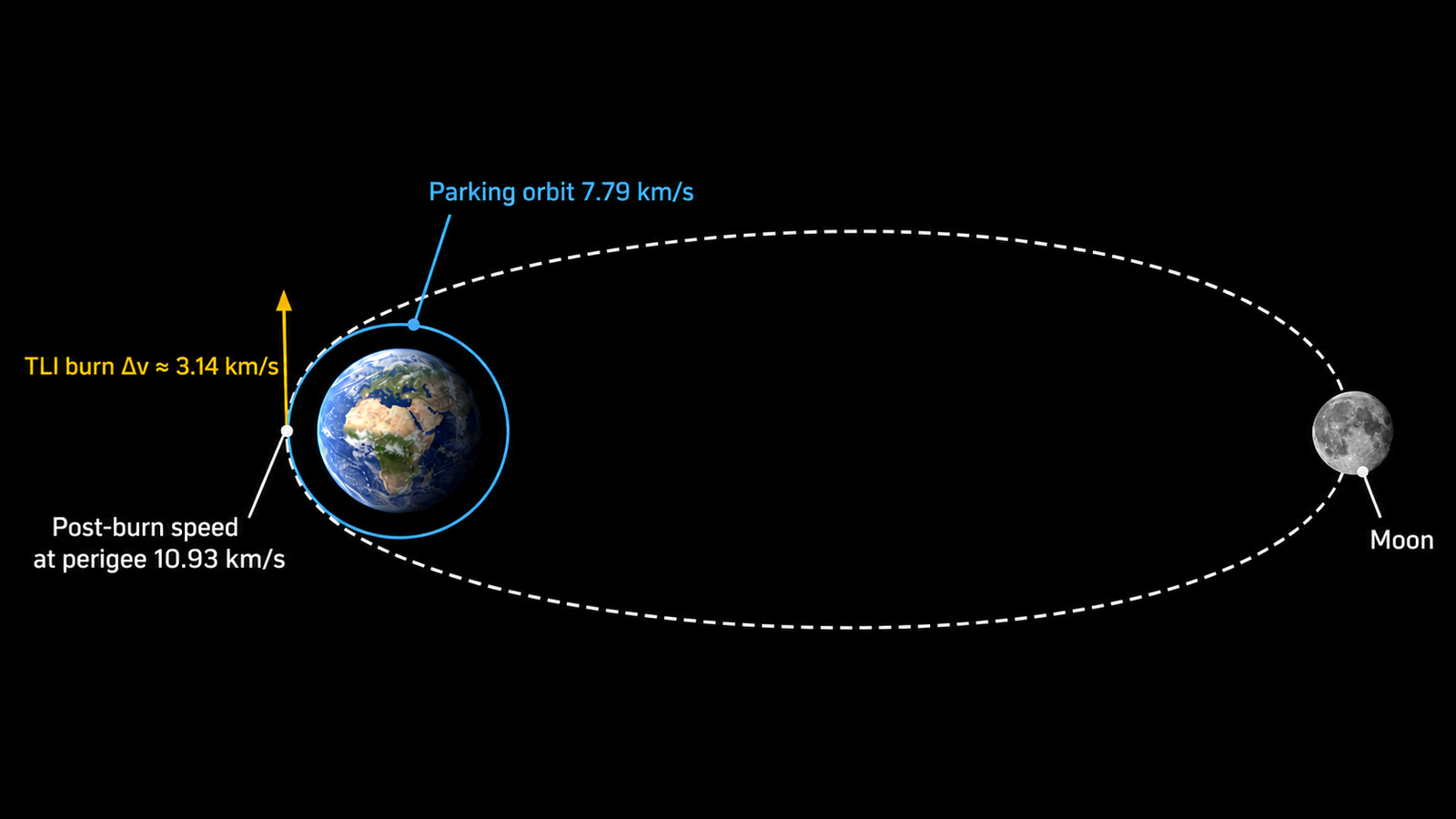
v = √(398,600 ÷ 6,563) = √60.73 ≈ 7.79 kilometers per second
That’s roughly 28,000 kilometers an hour, and the spacecraft is already moving at that speed before any burn aimed at the Moon has even started.
The rocket does not accelerate a stationary spacecraft to lunar speed. It takes a spacecraft already moving at 7.8 kilometers a second and pushes it a little harder.
What Delta-v Actually Means
Every discussion of spaceflight eventually uses the term delta-v, written Δv. The Greek letter delta simply means “change in,” so Δv is nothing more than a change in velocity. If a spacecraft speeds up from 8 kilometers a second to 10, its Δv for that maneuver was 2 kilometers a second. That’s the whole concept. For TLI, the relevant question becomes: how much Δv does it take to stretch a circular parking orbit into one that reaches the Moon.
Building a Simplified Transfer Orbit
To answer that, picture an elongated ellipse with its near point at the parking orbit, 6,563 kilometers from Earth’s center, and its far point at roughly 384,400 kilometers, the Moon’s average distance from Earth confirmed in NASA’s current lunar reference material.
This is a simplified model, not a real mission trajectory. Real planners account for the Moon’s own gravity, its motion, and the Sun’s pull, none of which appear here. But the simplification still captures the core physics correctly, which is the point of building it this way.
An ellipse’s size is described by its semi-major axis, found by averaging the near and far distances:
a = (6,563 + 384,400) ÷ 2 = 390,963 ÷ 2 ≈ 195,482 kilometers
Solving for the Required Speed
The vis-viva equation, derived from conservation of energy in orbital motion, connects speed at any point in an orbit to that orbit’s overall size:
v = √[μ × (2 ÷ r − 1 ÷ a)]
Working through it with μ = 398,600, r = 6,563, and a = 195,482, one step at a time:
2 ÷ 6,563 ≈ 0.0003047
1 ÷ 195,482 ≈ 0.0000051
0.0003047 − 0.0000051 ≈ 0.0002996
398,600 × 0.0002996 ≈ 119.4
√119.4 ≈ 10.93 kilometers per second
That’s the speed the spacecraft needs near Earth to reach lunar distance on this simplified ellipse.
The Delta-v Result
Before the burn: 7.79 kilometers per second. After the burn: 10.93 kilometers per second.
Δv = 10.93 − 7.79 ≈ 3.14 kilometers per second
That single number, a bit over three kilometers a second, is the heart of translunar injection. It’s a strikingly small addition given the size of the journey it produces. The spacecraft doesn’t start from rest and doesn’t need to be accelerated across the entire distance to the Moon. It needs one push, and gravity does the rest.
It needs one push, and gravity does the rest.
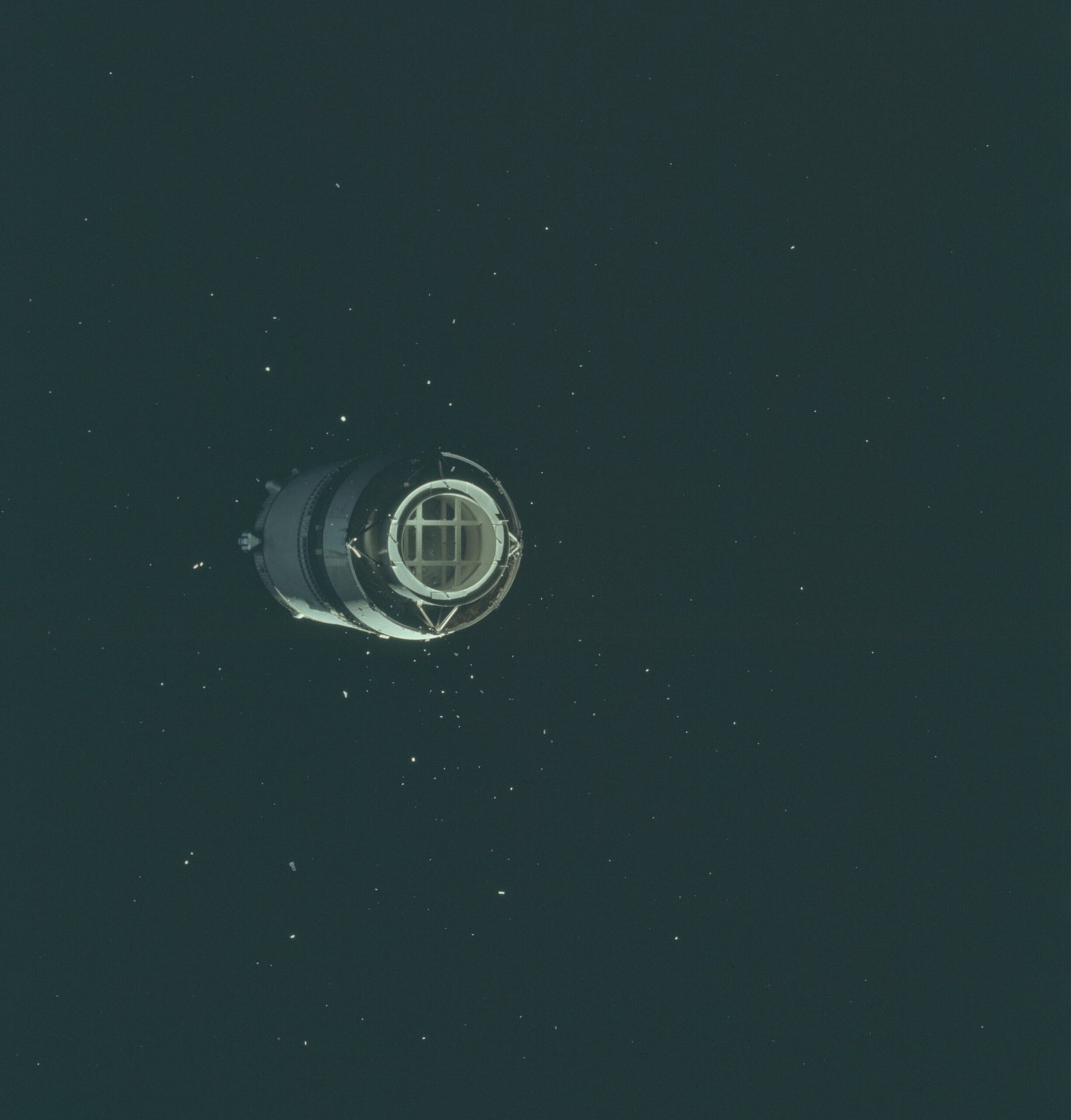
This is where the real numbers from history line up with the simplified math. During Apollo 8, the first crewed mission to leave Earth orbit, the Saturn V’s third stage fired for more than five minutes and raised the spacecraft’s speed from about 17,400 miles per hour to 24,226 miles per hour, roughly 7.8 to 10.8 kilometers a second in metric terms. That’s a Δv of about 3.05 kilometers a second, close enough to the simplified model’s 3.14 to confirm the physics holds up outside the classroom.
Apollo 8’s numbers match the same thrust, staging, and rocket-equation physics explained in Astrinova’s guide to how rocket flight works.
Aiming at a Moon That Isn’t There Yet
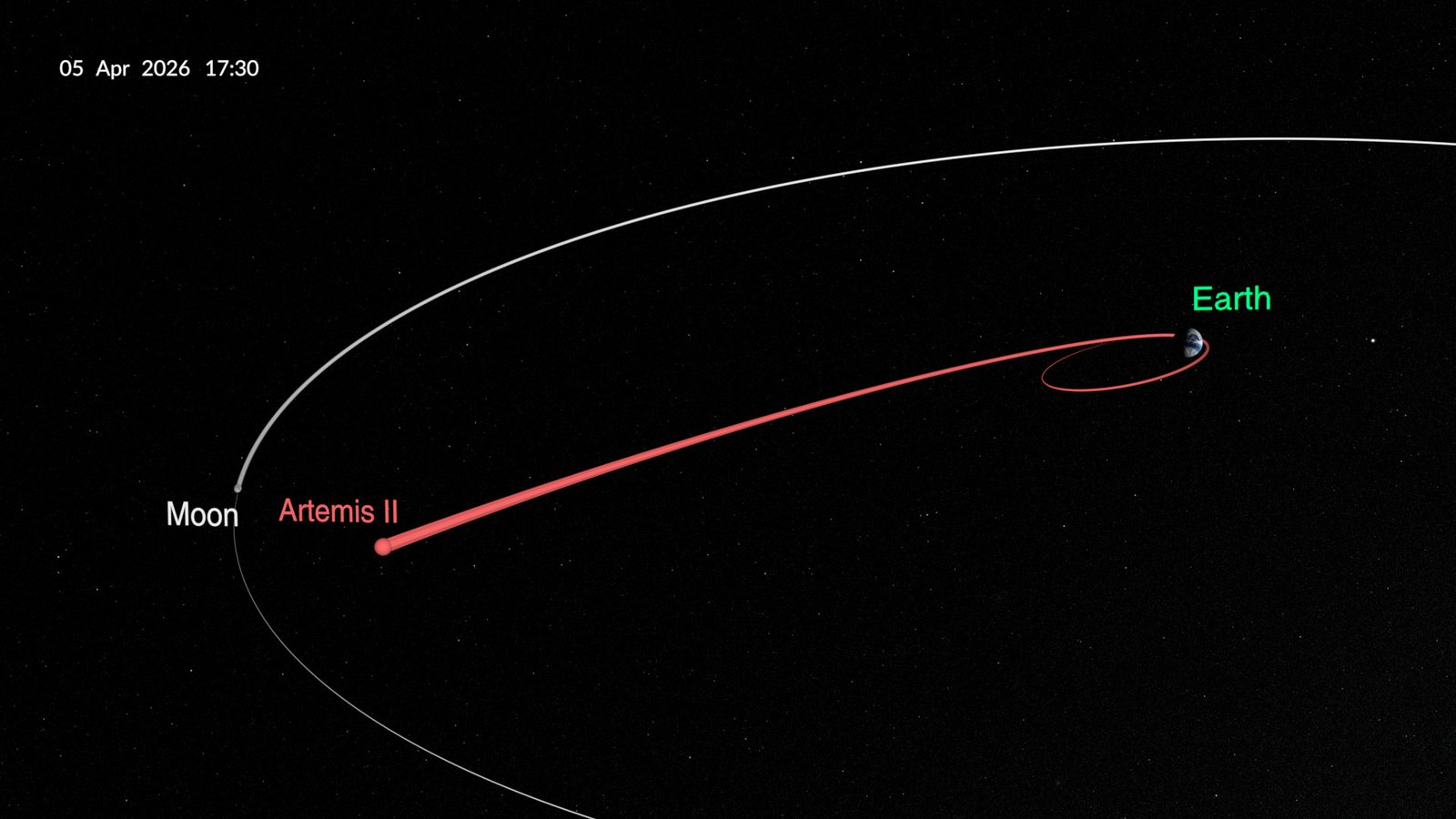
The Moon is not sitting still at the far end of the transfer ellipse. It moves around Earth at about 1 kilometer a second, completing one orbit relative to the stars in roughly 27.322 days, the current figure NASA lists alongside the Moon’s average distance.
A full circle is 360 degrees, so the Moon travels roughly:
360 ÷ 27.322 ≈ 13.2 degrees per day
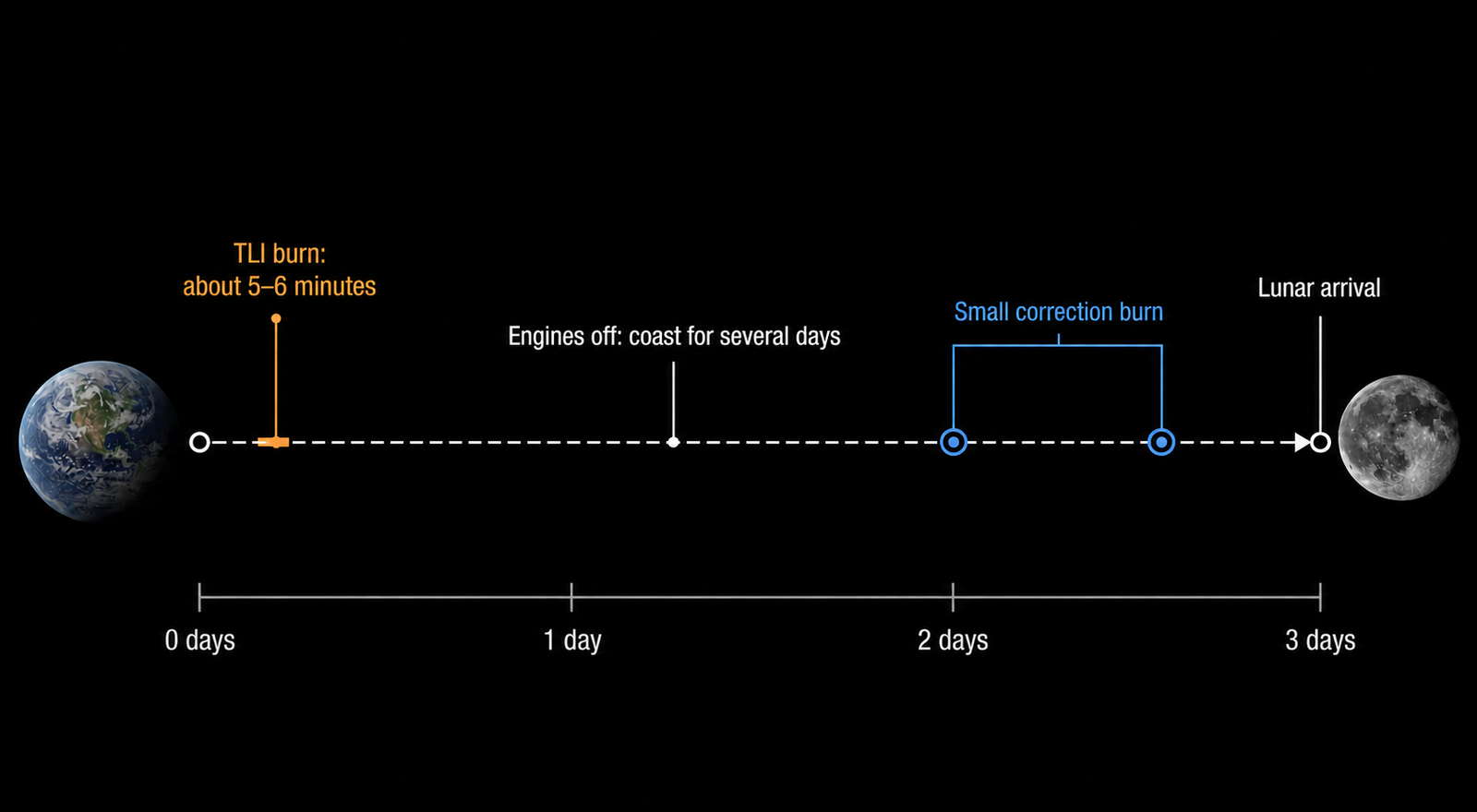
Real Apollo-class translunar trajectories typically reached the Moon in about three days. During a three-day coast, the Moon moves roughly:
13.2 × 3 ≈ 39.6 degrees
Nearly forty degrees is a huge angular displacement. It is almost half of a right angle. Mission planners never aim at the Moon’s current position. They calculate where the Moon will be when the spacecraft arrives, the same logic as leading a moving target with a thrown ball. The spacecraft is launched toward a point in empty space that will only contain the Moon several days later.
Our simplified two-body ellipse, however, would actually take closer to five days to reach its farthest point. That difference is another reminder that the ellipse we calculated is a teaching model, not the exact trajectory flown by a real lunar mission.
TLI Is Not the Same as Escaping Earth
It’s tempting to describe a Moon-bound spacecraft as “escaping Earth’s gravity,” but that phrase overstates what happens. Earth’s gravity continues acting on the spacecraft for nearly the entire trip, constantly slowing it down as it climbs.
Escape velocity at the same 185-kilometer altitude is:
vₑ = √(2μ ÷ r) = √(797,200 ÷ 6,563) = √121.47 ≈ 11.02 kilometers per second
Compare that to the transfer speed calculated earlier, 10.93 kilometers a second. It sits just under the local escape velocity. In this simplified two-body model, the spacecraft can therefore reach lunar distance while still following a bound Earth-centered ellipse rather than an unbound escape trajectory.
Why the Engines Shut Down Within Minutes
A common misconception treats the trip to the Moon as one long, continuous burn. It isn’t. The TLI burn typically lasts only a few minutes, matching what NASA recorded for Apollo 8’s more than five minute burn. After that, the engine shuts down completely, and the spacecraft coasts for the remaining days, with gravity alone shaping its path. Small trajectory-correction burns may follow. Apollo 8 made two during its outbound coast: a 2.4-second Service Propulsion System burn about 11 hours into the mission and an approximately 12-second Reaction Control System burn at about 61 hours. But the enormous sustained thrust people often imagine simply isn’t part of the profile.
Why a One Meter-Per-Second Error Matters
Precision in TLI is not a nicety, it’s the whole game. Consider a velocity error of just one meter per second, something that sounds negligible.
Precision in TLI is not a nicety, it’s the whole game.
Three days works out to:
3 × 24 × 60 × 60 = 259,200 seconds
If that small sideways velocity error simply accumulated over the coast in a straight line:
distance error = speed error × time = 1 × 259,200 = 259,200 meters, or about 259 kilometers
A real lunar trajectory does not accumulate error this way, because gravity continuously changes both the spacecraft’s direction and speed rather than letting a sideways drift build up in a straight line. The calculation above is only meant to show the scale involved, not to predict the actual miss distance. That scale is why TLI guidance and navigation have to control the spacecraft’s velocity and burn timing to extremely tight tolerances.
What the Simplified Model Leaves Out
This entire calculation treats Earth as the only meaningful source of gravity, which is a useful teaching simplification, not a real trajectory. In practice, mission planners also have to account for the Moon’s own gravitational pull, the Moon’s continuous motion, the Sun’s gravity, the finite time it takes an engine to complete its burn, the spacecraft’s changing mass as propellant burns off, and unavoidable uncertainty in navigation measurements.
Many crewed missions also targeted what’s known as a free-return trajectory, a path shaped so that the Moon’s gravity alone bends the spacecraft’s path back toward Earth without any additional propulsion, an important safety margin if the engine meant to enter lunar orbit failed to fire. Apollo 8’s TLI burn placed it onto a free-return trajectory. Apollo 13’s flight was more complicated: it launched into Earth parking orbit, its TLI burn placed it onto a free-return trajectory, the crew then deliberately left that trajectory partway through the mission for a different path suited to its planned landing site, and after the oxygen tank explosion, mission control computed a 35-second burn, fired about five hours after the accident, to steer the spacecraft back onto a free-return path and let the Moon’s gravity carry the crew home, exactly as NASA’s own mission record describes.
Real lunar trajectories today are computed with numerical models running on far more complete physics than a hand calculation allows. But the underlying principle hasn’t changed since Newton described falling cannonballs: change a spacecraft’s velocity by the right amount at the right moment, and gravity takes care of the rest of the journey.
The Numbers, Together
Starting orbital speed: about 7.79 kilometers per second. Required transfer speed: about 10.93 kilometers per second. Required delta-v: about 3.14 kilometers per second. Escape velocity at the same altitude: about 11.02 kilometers per second, just above what the transfer actually needs.
A burn lasting a few minutes, adding a little over three kilometers a second to a spacecraft already moving fast, is enough to send it on a path hundreds of thousands of kilometers long, timed to meet a moving target several days in the future.
Key Takeaways
- Translunar injection does not launch a spacecraft from rest. It adds roughly 3.1 kilometers per second of velocity to a spacecraft already orbiting Earth at close to 7.8 kilometers per second.
- The required speed for a simplified Earth-Moon transfer orbit can be estimated directly from the vis-viva equation, using Earth’s gravitational parameter, the spacecraft’s altitude, and the semi-major axis of the target ellipse. This is a two-body approximation, not the exact figure real mission planners fly.
- Because the Moon moves roughly 13.2 degrees each day, a spacecraft on a three-day coast is aimed at where the Moon will be, not where it currently sits.
- The transfer speed in this model, about 10.93 kilometers a second, stays just under local escape velocity, about 11.02 kilometers a second, meaning the spacecraft follows a bound ellipse rather than an unbound escape trajectory.
- Real TLI burns last only a few minutes. Apollo 8’s burn, recorded by NASA, took the spacecraft from about 7.8 to 10.8 kilometers per second in just over five minutes, closely matching the simplified calculation.
- A velocity error as small as one meter per second illustrates, at the scale of a simple estimate, how a few hundred kilometers of miss distance can build up over a multi-day coast, even though real gravity does not let errors accumulate in a straight line.
- Apollo 8 was placed onto a free-return trajectory during TLI. Apollo 13’s crew had to fire a 35-second burn to get back onto one after leaving it for a planned hybrid trajectory, and that maneuver became critical to their survival.
Frequently Asked Questions
What does TLI stand for? TLI stands for translunar injection, the propulsive maneuver that changes a spacecraft’s Earth orbit into a trajectory that reaches the Moon’s vicinity. It’s typically performed by a rocket’s upper stage shortly after the spacecraft has completed one or more orbits of Earth in a parking orbit.
How much delta-v does a Moon mission actually need for TLI? For a spacecraft starting from a low Earth parking orbit, roughly 3.1 kilometers per second is a solid working estimate, consistent with both a simplified vis-viva calculation and NASA’s recorded Apollo 8 numbers. The exact figure shifts depending on starting altitude and the specific transfer being targeted, and real mission planning uses far more complete models than a two-body estimate.
Does the spacecraft point straight at the Moon during the burn? No. Because the Moon is moving, the burn is calculated to send the spacecraft toward the point in space the Moon will occupy several days later, not its current position. This is the same principle as leading a moving target.
Do the engines run for the entire trip to the Moon? No. The main TLI burn lasts only a few minutes. After that, the spacecraft coasts under gravity alone for the following days, with occasional small correction burns rather than continuous thrust.
Is translunar injection the same thing as reaching Earth’s escape velocity? Not exactly. In a simplified two-body model, the speed needed for a lunar transfer orbit can sit just below local escape velocity. The spacecraft follows a bound, dramatically stretched Earth-centered ellipse rather than an unbound escape trajectory.
Why does such a small velocity error matter so much? Because the spacecraft coasts for days without further correction, even a one meter per second error illustrates, in scale terms, how quickly small mistakes near Earth can turn into a significant miss at the Moon, which is why TLI guidance and burn timing are controlled to extremely tight tolerances.
What is a free-return trajectory, and why does it matter? It’s a trajectory shaped so that the Moon’s gravity alone can swing a spacecraft back toward Earth without further engine burns. Apollo 8’s TLI burn placed it onto one directly. Apollo 13 had left its free-return path for a hybrid trajectory before the accident, and the crew fired a 35-second burn afterward to get back onto a free-return path and return home safely.
How long does it take to reach the Moon after TLI? Apollo-era missions typically coasted for about three days after TLI before arriving near the Moon. The exact duration depends on the specific transfer orbit chosen by mission planners.
References
- NASA Science. “Chapter 3: Gravity & Mechanics.” Basics of Space Flight, NASA. https://science.nasa.gov/learn/basics-of-space-flight/chapter3-4/
- NASA Glenn Research Center. “Flight To Orbit.” https://www1.grc.nasa.gov/beginners-guide-to-aeronautics/flight-to-orbit/
- NASA Jet Propulsion Laboratory. “Astrodynamic Parameters.” https://ssd.jpl.nasa.gov/astro_par.html
- NASA Science. “Facts About Earth.” https://science.nasa.gov/earth/facts/
- NASA Science. “Moon Phases.” https://science.nasa.gov/moon/moon-phases/
- NASA. “50 Years Ago: Apollo 8, You Are Go for TLI!” https://www.nasa.gov/history/50-years-ago-apollo-8-you-are-go-for-tli/
- NASA. “Apollo 13: Mission Details.” https://www.nasa.gov/missions/apollo/apollo-13-mission-details/

Join the discussion
Comments are moderated and may take a little while to appear.