
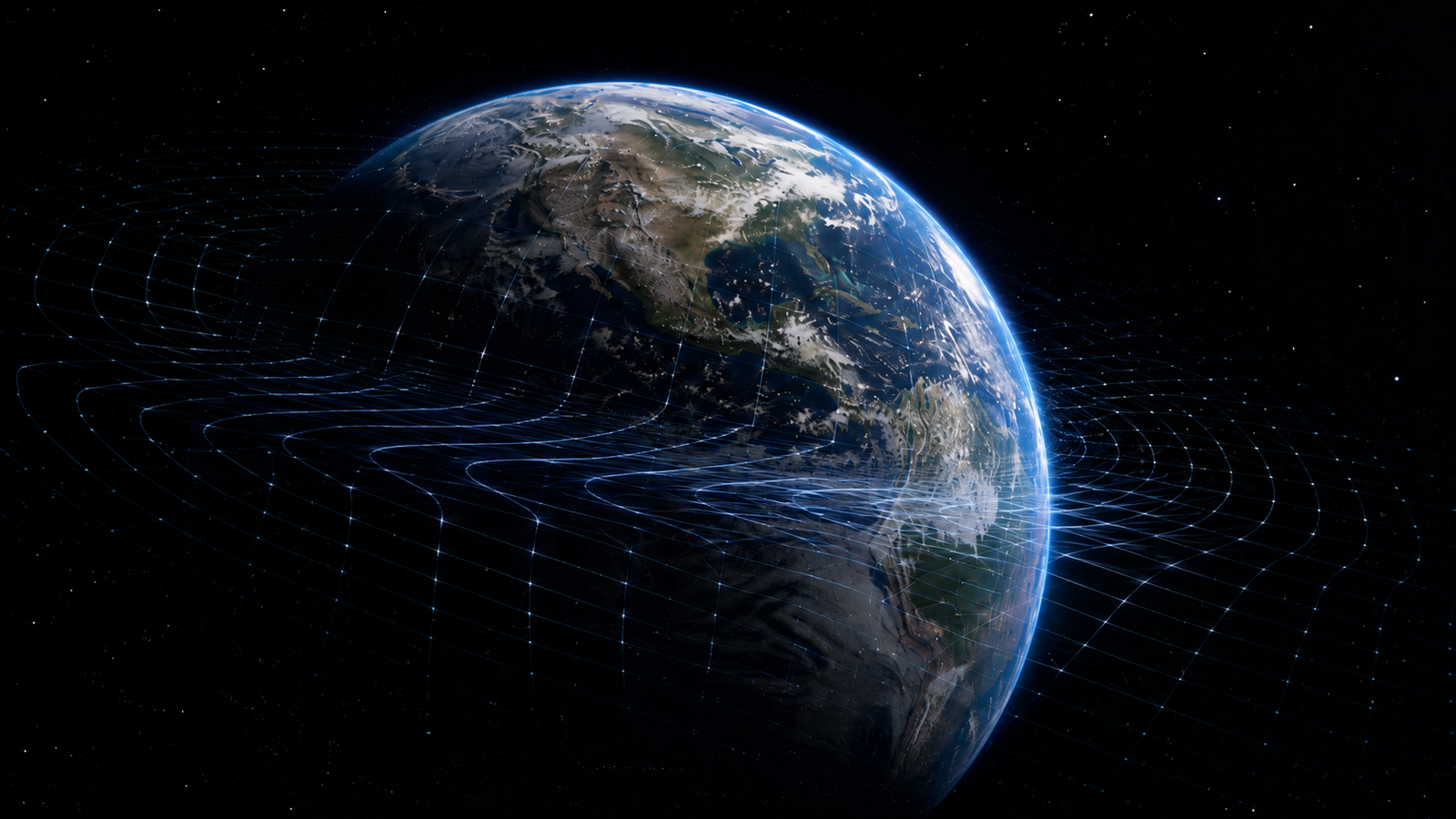
Earth does more to spacetime than dent it. As the planet turns, it twists the geometry around itself in the direction of its spin, and that twist slightly alters the paths and orientations of objects in free fall nearby. A satellite is not dragged bodily along with the planet. Its orbit slowly precesses, meaning the plane of the orbit rotates by a very small amount each year, and a gyroscope in orbit slowly changes the direction its spin axis points. Physicists call this frame dragging, or the Lense-Thirring effect after the two Austrians who worked it out in 1918.
Frame dragging is among the most difficult weak-field predictions of general relativity to measure precisely near Earth, because the effect is fantastically weak. It shifts the orbital plane of a satellite by roughly thirty milliarcseconds a year, an angle so small that a laser has to track the satellite to within a millimetre before the signal can be pulled out of the noise.
Frame dragging is not a satellite being swept along by Earth’s spin. It is a slow twist in the geometry itself, small enough that it took a century of increasingly precise satellites to pin down.
This article explains what frame dragging is, why it differs from ordinary gravitational curvature, how three generations of experiments have tried to measure it around Earth, what the July 2026 LARES-2 result in Nature actually established, and where the effect becomes strong enough to reshape entire astrophysical systems.
Curvature Is Not the Whole of Gravity
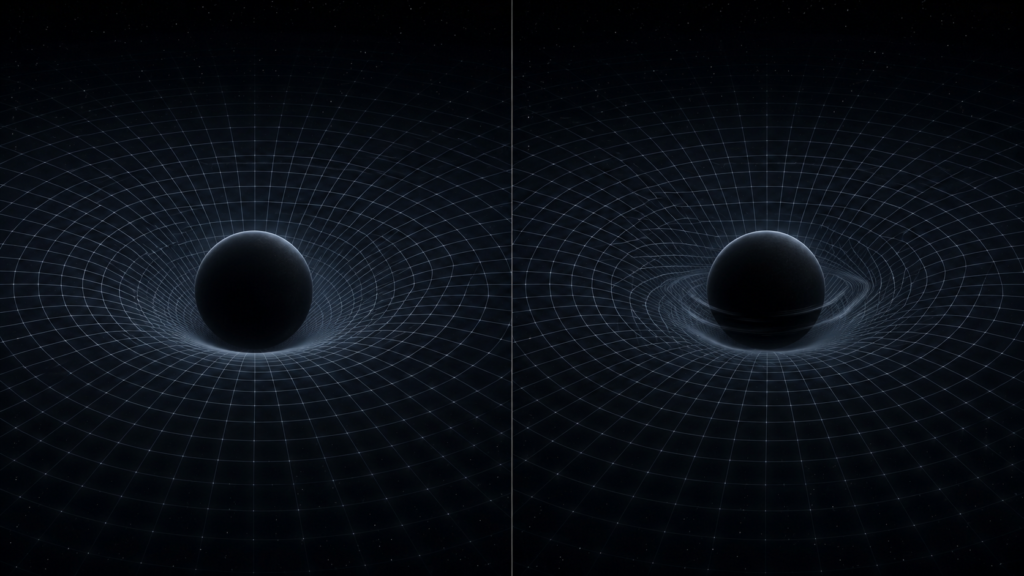
The picture most people carry of general relativity is a mass sitting on a rubber sheet. That picture captures one thing well, which is that mass and energy curve spacetime and that objects follow the curvature. It leaves out something that only shows up when the mass is rotating.
In Einstein’s equations, gravity is sourced not only by mass but by the full stress-energy tensor, which includes energy density, pressure, momentum density, and stresses. A rotating body contains a circulating mass-energy current, and that motion contributes to the gravitational field, producing an effect with no counterpart in Newton’s theory at all.
The result is a component of the gravitational field that acts on moving objects in a way loosely parallel to how a magnetic field acts on moving charges. Physicists call this component gravitomagnetism, borrowing the name because the equations take a similar shape, not because magnetism is involved in any way.
The parallel should not be pushed too far. Gravitomagnetism is a weak-field approximation, a way of rewriting Einstein’s equations when gravity is gentle and speeds are low compared with light. It is not a separate force, and there is no gravitational analogue of a magnetic monopole. Within its range of validity, though, it gives the right answer, and the answer is that a rotating mass twists the local inertial frames around it. What counts as “not rotating” near Earth is itself turning very slowly relative to the distant stars.
How Small the Effect Is Around Earth
Josef Lense and Hans Thirring published the orbital consequences in 1918, three years after Einstein completed the field equations. Their result was that the orbital plane of a satellite around a rotating body should slowly precess in the direction of the body’s rotation, an effect proportional to the central body’s angular momentum and falling off steeply with distance.
The technical name for this drift is nodal precession. The node is the point where a satellite’s orbit crosses Earth’s equatorial plane, and nodal precession is the slow rotation of that crossing point around the planet, which is equivalent to the orbital plane itself turning.
For a satellite in medium Earth orbit, the frame-dragging contribution to that precession is around thirty milliarcseconds per year. A milliarcsecond is about 4.8 nanoradians. Over a full year, the orbital plane of a satellite orbiting at a radius of about 12,000 kilometres measured from Earth’s centre, which corresponds to an altitude of roughly 5,900 kilometres above the surface, is twisted sideways by a few metres.
Everything else acting on that satellite is larger. The dominant problem is that Earth is not a sphere. Its equatorial bulge, described by the gravitational coefficient known as J2, produces a nodal precession many orders of magnitude bigger than the relativistic one. Solar radiation pressure, thermal re-emission from the satellite’s own surface, tidal deformation of Earth’s gravity field, and the wobble of Earth’s rotation axis all contribute as well. Measuring frame dragging around Earth is therefore not an exercise in detecting a faint signal. It is an exercise in modelling a very large set of competing effects well enough that a small residual remains trustworthy.
Gravity Probe B and the Gyroscope Approach
The most direct conceptual test is also the hardest to build. Put a gyroscope in orbit, point its spin axis at a reference star, and watch the axis drift. General relativity predicts two drifts at right angles to each other: the geodetic effect, from motion through curved spacetime, and the much smaller frame-dragging drift from Earth’s rotation.
NASA’s Gravity Probe B, launched on 20 April 2004, carried four fused-quartz spheres coated in niobium, cooled to superconducting temperatures and spun to roughly seventy hertz. Data collection ran from August 2004 to August 2005. The onboard telescope tracked the guide star IM Pegasi.
The experiment nearly failed. Electrostatic patches on the rotor and housing surfaces produced classical torques that dwarfed the relativistic signal, and early estimates of the unmodelled systematic error exceeded the frame-dragging effect several times over. After years of reanalysis, the team published a geodetic drift of 6,601.8 ± 18.3 milliarcseconds per year against a prediction of 6,606.1, and a frame-dragging drift of 37.2 ± 7.2 milliarcseconds per year against a prediction of 39.2 (Everitt et al., Physical Review Letters, 2011).
Both numbers agree with general relativity. The frame-dragging figure carries an uncertainty of about nineteen percent, which is a confirmation rather than a precision measurement. Its real value is that it tested the effect on a spinning gyroscope directly, a different physical configuration from the orbital tests running alongside it (commentary, Physics, American Physical Society).
The Laser-Ranging Approach
The alternative is to give up on gyroscopes and use the orbit itself as the instrument. A dense metal sphere covered in corner-cube retroreflectors has no moving parts, no electronics, and almost nothing for the environment to push on. Ground stations fire laser pulses at it and time the return. The International Laser Ranging Service coordinates a global network doing exactly this.
NASA launched the first LAGEOS satellite in 1976, and LAGEOS 2 followed in 1992 with the Italian Space Agency. Analyses combining their orbits with improving models of Earth’s gravity field, particularly after the GRACE mission began mapping that field from 2002, produced frame-dragging measurements at the ten percent level and later at a few percent. The earliest claims, published in 1998 and 2004, quoted accuracies that many specialists judged optimistic given the gravity models available at the time (Ciufolini and Pavlis, Nature, 2004).
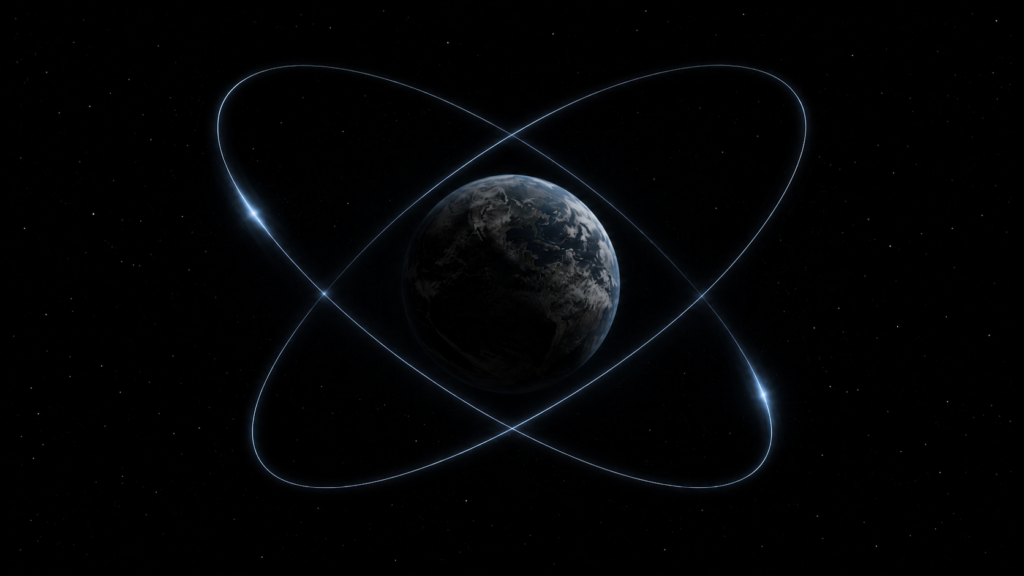
The limiting factor was always the same: uncertainty in Earth’s oblateness leaking into the relativistic signal. There is a clean way around it, proposed in the 1980s. Fly a second satellite in an orbit whose inclination is the supplement of the first, so that the two inclinations add to 180 degrees. The Newtonian nodal precessions caused by Earth’s oblateness then have opposite signs for the two satellites and largely cancel when the orbits are combined, while the frame-dragging precessions have the same sign and add together.
LARES-2 and the 2026 Measurement
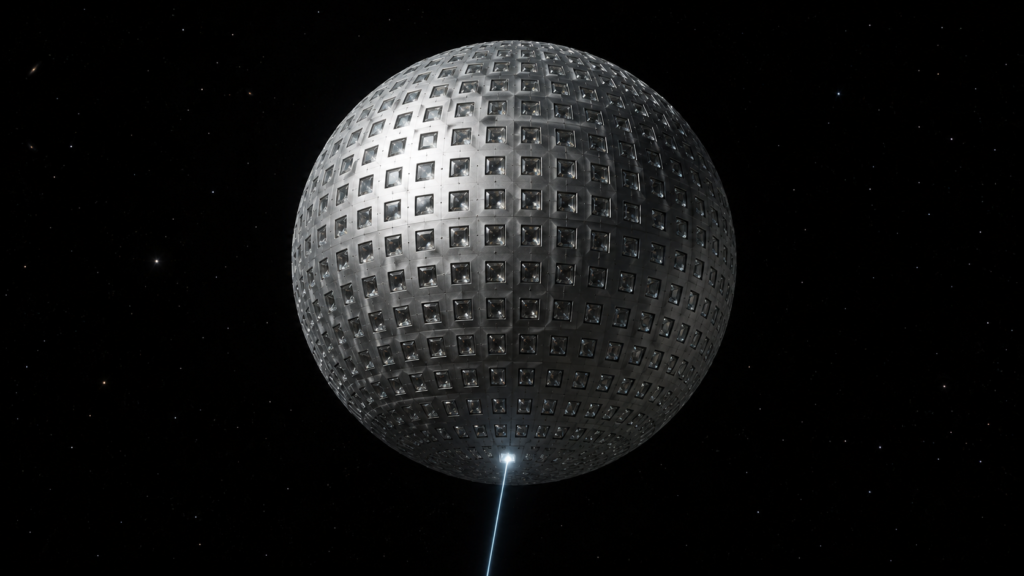
That proposal waited more than thirty years for a launch. LARES-2 went up on 13 July 2022 aboard the inaugural flight of ESA’s Vega C rocket, reaching an orbit at an altitude of about 5,900 kilometres, corresponding to a semi-major axis of roughly 12,266 kilometres measured from Earth’s centre, with an inclination of 70.16 degrees. That is close to supplementary with LAGEOS at 109.8 degrees.
The satellite is a nickel-alloy sphere 42.4 centimetres across, massing 294.8 kilograms, studded with 303 retroreflectors positioned according to a solution of Thomson’s problem rather than in the simple rings used on earlier satellites. Its ratio of cross-sectional area to mass is the lowest of any object in medium Earth orbit, which is the whole point: non-gravitational forces such as radiation pressure scale with that ratio (Ciufolini et al., European Physical Journal C, 2023; eoPortal mission description).
The study, published in Nature on 8 July 2026, lists Roger Penrose and Vahe Gurzadyan among its 14 co-authors. The work was led by Ignazio Ciufolini. Using roughly three years of laser ranging to LARES-2 and LAGEOS, combined with GRACE gravity field models, the collaboration reports a relative uncertainty at approximately the one-part-in-a-thousand level. General relativity predicts a nodal drag of about 30.7 milliarcseconds per year for each of the two satellites, so the combined signal runs to roughly 61 milliarcseconds per year. The measurement agrees with that prediction (Ciufolini et al., Nature 655, 2026).
The paper describes this as roughly an order of magnitude better than previous determinations of frame dragging in the Solar System, and it is about a hundred times tighter than Gravity Probe B on the same effect (Scientific American).
What the Precision Actually Buys
Confirming a century-old prediction is the smaller part of this. The value of a tenfold improvement is that it narrows the range of parameter values that competing theories of gravity are still allowed to occupy.
Several extensions of general relativity predict deviations that appear specifically in the gravitomagnetic sector, the rotation-driven part of gravity, while leaving the better-tested static predictions untouched. Chern-Simons gravity is one example of a modified theory that can change the predicted frame-dragging signal. It adds an extra scalar field that couples to the geometry of spacetime, motivated partly by string theory and partly by attempts to reconcile gravity with quantum mechanics.
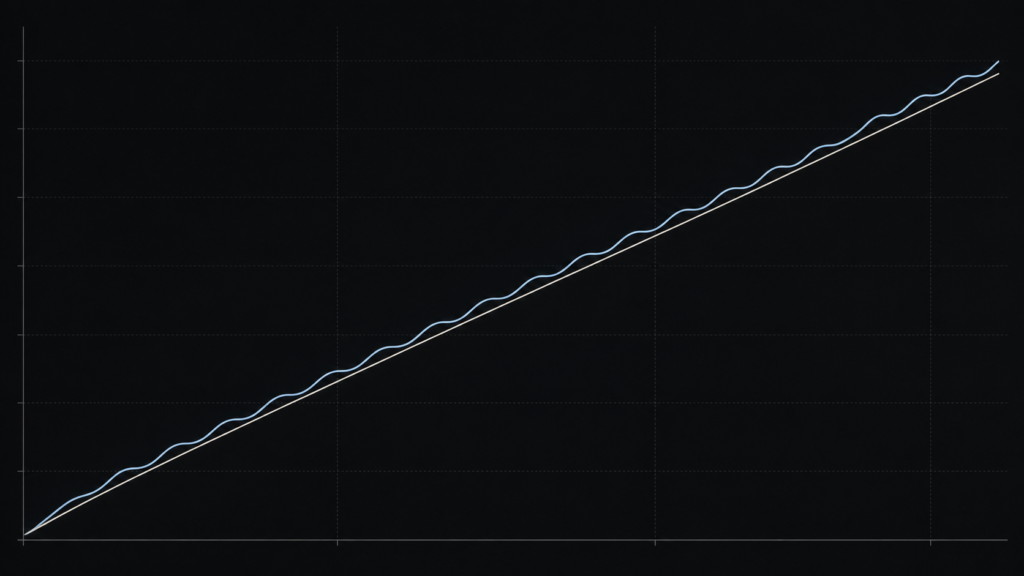
The same dataset also improves the determination of Earth’s lunisolar tidal perturbations, the periodic flexing of the planet and its oceans under the pull of the Moon and Sun, which shows up as a slow oscillation in the satellites’ orbital residuals. That is a geophysical result rather than a relativistic one, and it illustrates how tightly the two problems are coupled. You cannot measure the relativity without modelling the geophysics, and modelling the geophysics well enough produces new geophysics.
The Disagreement Worth Knowing About
The error budget is where this experiment lives or dies, and not everyone accepts the published figure.
Lorenzo Iorio, who has worked on satellite tests of relativity for two decades, has argued in several papers that the supplementary-orbit cancellation is less complete in practice than in principle, and that the residual uncertainty is larger than the LARES-2 team claims. The objections centre on how precisely the two inclinations actually stay supplementary, and on how well the even zonal harmonics of Earth’s gravity field cancel. Those harmonics are the terms in the mathematical description of Earth’s gravity that describe how mass is distributed symmetrically about the rotation axis, with the equatorial bulge being the largest of them. Uncertainty in those terms propagates directly into the frame-dragging result. The LARES-2 team has published detailed replies rejecting the criticisms (Ciufolini et al., European Physical Journal C, 2024; preprint reviewing the accuracy debate).
This is a normal state of affairs for a measurement dominated by systematic rather than statistical error, and it is not a dispute about whether frame dragging exists. It is a dispute about the size of the error bar. The Nature paper went through peer review with the reviewer reports published alongside it, which gives some indication of how carefully the point was examined. Independent reanalysis by groups outside the collaboration would help clarify the remaining disagreement over the error budget.
Where Frame Dragging Stops Being Subtle
Around Earth the effect is a nuisance-level correction. Around compact objects it becomes structural.
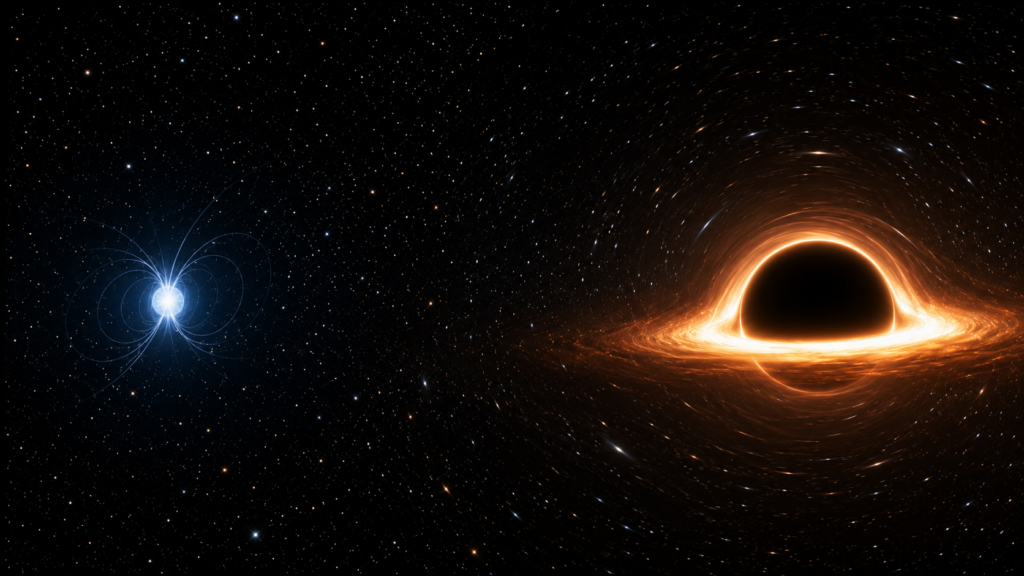
Astrophysical evidence consistent with frame dragging was reported in the binary system PSR J1141-6545, which contains a radio pulsar and a massive, rapidly spinning white dwarf. Timing the pulsar’s radio pulses with the Parkes and UTMOST telescopes over almost twenty years, to within about 100 microseconds per measurement, revealed a slow drift in the orbital inclination. The team attributed the drift to a combination of the white dwarf’s Newtonian quadrupole moment and Lense-Thirring precession. A quadrupole moment is simply a measure of how much an object departs from being a perfect sphere, and a flattened spinning star produces its own orbital drift that has nothing to do with relativity. After accounting for that contribution, the researchers inferred that the remainder came from frame dragging, and that the white dwarf spins in under two hundred seconds (Venkatraman Krishnan et al., Science, 2020; Max Planck Institute for Radio Astronomy).
That inference depends on modelling the white dwarf’s internal structure and rotational history, and the assumptions involved have been questioned in the literature. It is good supporting evidence rather than a clean measurement.
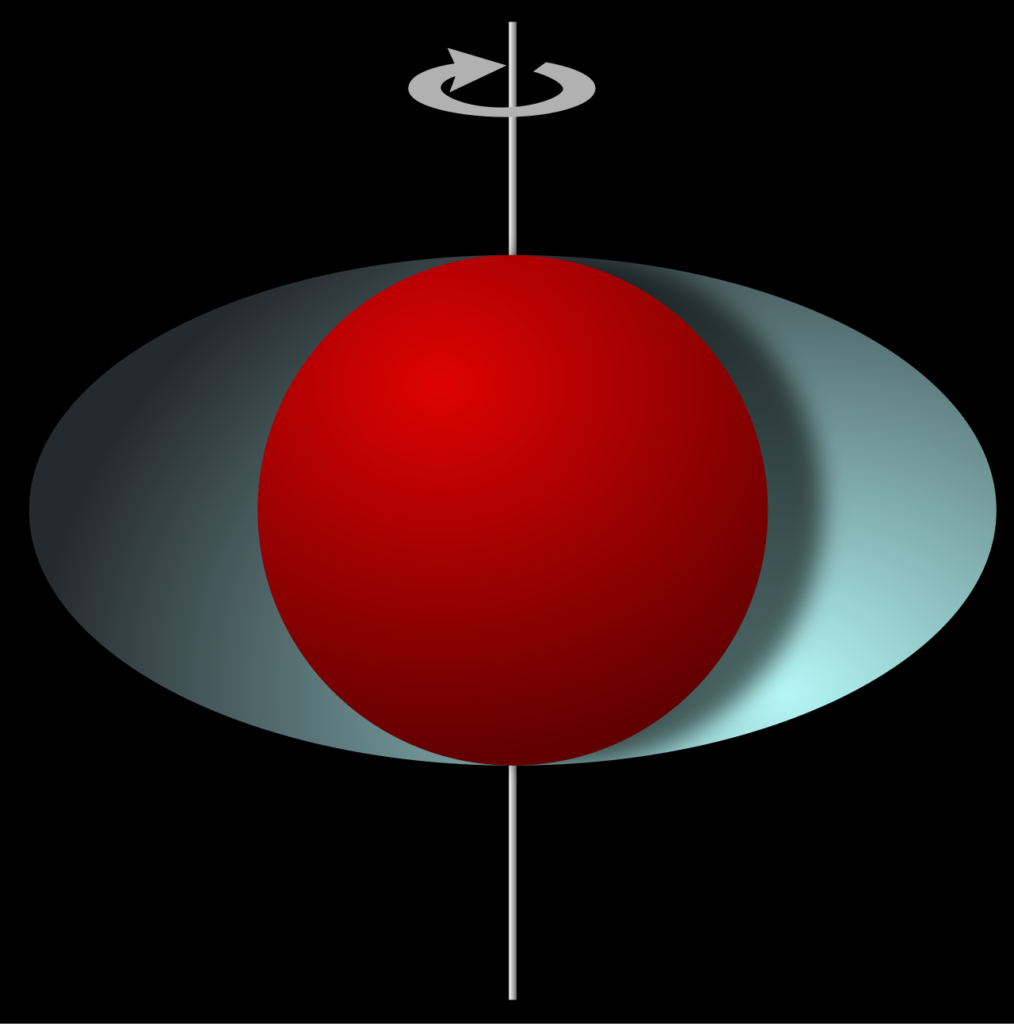
Around a rotating black hole, described by the Kerr solution found in 1963, frame dragging stops being a correction at all. The ergosphere is the region outside the event horizon where the twisting of spacetime is severe enough that no observer can remain stationary relative to the distant stars. Every physically possible trajectory inside it must co-rotate with the black hole to some degree. Nothing is travelling faster than light there. The geometry itself simply no longer contains any path that stays put.
That geometry matters for how rotating black holes interact with their surroundings. Black-hole spin and the magnetic fields threaded through the surrounding plasma are thought to power relativistic jets, most commonly through the mechanism proposed by Blandford and Znajek, in which rotational energy is extracted electromagnetically. How much of the jet power comes from the hole’s spin as opposed to the accretion flow remains an open question in the literature, and the detailed role of frame dragging should not be overstated. The effect is on firmer ground in gravitational-wave astronomy, where models of precessing black-hole spins are built directly into the waveform templates used to analyse merging binary black holes (Ramos-Buades et al., Physical Review D, 2023).
What Is Still Open
Earth’s frame-dragging field is now measured to roughly a part in a thousand, according to the collaboration, and agrees with general relativity. Nothing about that closes the subject.
The weak-field regime and the strong-field regime are tested by entirely different observations, and agreement in one does not guarantee agreement in the other. Gravitational-wave observations probe frame dragging where it is strong, but with far coarser precision than satellite laser ranging achieves in the weak field. There is no experiment yet that measures the effect around a black hole to anything like a percent.
There is also the older question underneath all of this. If local inertial frames are partly determined by the rotation of nearby matter, how much of what we call “not rotating” is set by the matter distribution of the universe as a whole? That was Mach’s idea, and it influenced Einstein while he was constructing general relativity. Frame dragging is often described as a partial vindication of it. Whether it is a vindication or merely a suggestive parallel is a question of interpretation that measurement has not resolved and may not be able to.
Key Takeaways
- Frame dragging is a prediction of general relativity in which a rotating mass twists spacetime around itself, slightly altering the paths and orientations of freely falling objects. It has no Newtonian equivalent and was derived by Lense and Thirring in 1918.
- Around Earth the effect shifts a satellite’s orbital plane by roughly 30 milliarcseconds per year, far smaller than the perturbation caused by Earth’s equatorial bulge.
- Gravity Probe B measured frame dragging on orbiting gyroscopes at 37.2 ± 7.2 milliarcseconds per year, about nineteen percent uncertainty, against a prediction of 39.2.
- The LARES-2 and LAGEOS combination reported in Nature on 8 July 2026 gives a relative uncertainty at approximately the one-part-in-a-thousand level, described by the authors as an order-of-magnitude improvement on previous Solar System determinations.
- The precision works by flying two satellites in supplementary orbits so that the dominant error from Earth’s oblateness cancels when their orbital data is combined.
- The result places stronger bounds on Chern-Simons-type modifications of gravity, though the size of the quoted error bar remains contested by some researchers.
- Around rotating black holes, frame dragging becomes strong enough that inside the ergosphere no observer can remain stationary relative to distant stars, and all possible trajectories must co-rotate to some degree.
Frequently Asked Questions
Is Frame Dragging the Same Thing as Gravity Bending Light?
No. Light bending comes from the curvature produced by mass and energy, and it happens around a non-rotating body just as it does around a spinning one. Frame dragging requires rotation. It is produced by the circulating flow of mass-energy in a spinning body, and it disappears entirely if the body stops rotating. The two effects come from different parts of Einstein’s field equations, which is why experiments have to be designed differently to isolate each of them.
Does Frame Dragging Affect GPS Satellites?
At GPS altitude, the accumulated displacement associated with frame dragging is on the sub-metre scale per year and is absorbed into precise orbit determination rather than applied as a separate timing correction. The relativistic corrections that actually matter for GPS timing are gravitational time dilation and the velocity-related time dilation of special relativity, which together amount to tens of microseconds per day.
Why Did It Take a Hundred Years to Measure This Properly?
Two reasons. The effect around Earth is small enough that measuring it requires tracking satellite positions to roughly a millimetre, which needed decades of development in laser ranging and atomic timing. It also requires knowing Earth’s gravity field to high precision, which only became practical after dedicated missions such as GRACE began mapping it from space in 2002.
Can Frame Dragging Be Used for Anything Practical?
Not for propulsion or energy, despite occasional claims. The effect around Earth amounts to an accumulated sideways displacement of about two metres per year at LAGEOS-class orbital radii, and less at higher orbits such as GPS, far too weak to exploit. Its practical value is scientific: it is a sensitive test of gravity, and the modelling work required to measure it has improved knowledge of Earth’s tidal response and gravity field.
How Is Frame Dragging Different From the Geodetic Effect?
The geodetic effect is the precession a gyroscope experiences from moving through curved spacetime, and it occurs even if the central body is not rotating. Frame dragging is the additional precession caused by the central body’s rotation. Around Earth the geodetic effect is far larger, roughly a factor of 170 by the predicted values, which is why Gravity Probe B measured it to a fraction of a percent while managing only nineteen percent on frame dragging.
Is the LARES-2 Result Universally Accepted?
The existence of frame dragging is not in question. The specific error bar is. Lorenzo Iorio and others have argued that the cancellation of Earth’s oblateness in the supplementary-orbit method is less complete than the team claims, and that the true uncertainty is larger. The LARES-2 collaboration has published detailed rebuttals. Independent reanalysis of the laser-ranging data by outside groups is the normal way such disputes get resolved.
What Does Frame Dragging Tell Us About Mach’s Principle?
It shows that rotating matter does influence local inertial frames, which is qualitatively in the spirit of Mach’s idea that inertia is determined by the rest of the matter in the universe. General relativity does not implement Mach’s principle fully or unambiguously, though, and physicists disagree about how much of it the theory actually contains. Frame dragging is consistent with Machian intuitions rather than a proof of them.
References
- Ciufolini, I., Paolozzi, A., Pavlis, E. C., et al. LARES-2 satellite measures frame-dragging effect around the Earth. Nature 655, 332 to 335, 2026. Peer reviewed paper. DOI: 10.1038/s41586-026-10715-0 (accessed July 2026).
- Everitt, C. W. F., et al. Gravity Probe B: Final Results of a Space Experiment to Test General Relativity. Physical Review Letters 106, 221101, 2011. Peer reviewed paper. DOI: 10.1103/PhysRevLett.106.221101.
- Will, C. M. Viewpoint: Finally, results from Gravity Probe B. Physics 4, 43, American Physical Society, 2011. Editorial commentary. physics.aps.org.
- Ciufolini, I., and Pavlis, E. C. A confirmation of the general relativistic prediction of the Lense-Thirring effect. Nature 431, 958 to 960, 2004. Peer reviewed paper. DOI: 10.1038/nature03007.
- Ciufolini, I., et al. The LARES 2 satellite, general relativity and fundamental physics. European Physical Journal C 83, 87, 2023. Peer reviewed paper. DOI: 10.1140/epjc/s10052-023-11230-6.
- Ciufolini, I., et al. On the high accuracy to test dragging of inertial frames with the LARES 2 space experiment. European Physical Journal C 84, 998, 2024. Peer reviewed paper. DOI: 10.1140/epjc/s10052-024-13301-8.
- Venkatraman Krishnan, V., et al. Lense-Thirring frame dragging induced by a fast-rotating white dwarf in a binary pulsar system. Science 367, 577 to 580, 2020. Peer reviewed paper. DOI: 10.1126/science.aax7007.
- Max Planck Institute for Radio Astronomy. Fast rotating white dwarf drags its space-time in a cosmic dance. Press release, 2020. Research institute press release. mpifr-bonn.mpg.de.
- European Space Agency eoPortal. LARES-2 (Laser Relativity Satellite-2). Mission description, 2022. Space agency reference. eoportal.org.
- Ramos-Buades, A., Buonanno, A., Estellés, H., Khalil, M., Mihaylov, D. P., Ossokine, S., Pompili, L., and Shiferaw, M. Next generation of accurate and efficient multipolar precessing-spin effective-one-body waveforms for binary black holes. Physical Review D 108, 124037, 2023. Peer reviewed paper. DOI: 10.1103/PhysRevD.108.124037.
- Ciufolini, I., et al. First results of the LARES 2 space experiment to test the general relativistic frame-dragging. Preprint, arXiv:2311.13268, 2023. Preprint, not yet peer reviewed. arxiv.org.
- Will LAGEOS and LARES 2 succeed in accurately measuring frame-dragging? Preprint, arXiv:2503.07264, 2025. Preprint, not yet peer reviewed. arxiv.org.
Join the discussion
Comments are moderated and may take a little while to appear.