

In this article (10 sections)
- An Old Picture That Still Feels Right
- A Charge in Motion Should Burn Itself Out
- An Electron Is Not a Tiny Orbiting Marble
- The Lowest Note an Atom Can Play
- A Balance Between Getting Closer and Getting Squeezed
- Why You Cannot Pin an Electron Down
- A State With Nowhere Lower to Fall
- Why This Matters
- Key Takeaways
- References
A hydrogen atom is about as simple as matter gets. One proton, carrying positive charge, sits at the center. One electron, carrying negative charge, sits somewhere around it. Opposite charges attract each other, and at the short range inside an atom that attraction is strong enough to pull steadily on the electron. By every rule of ordinary physics, a negative charge sitting near a positive one should fall toward it, the way a dropped stone falls toward the earth.
Atoms do not do this. Hydrogen has existed since the early universe cooled enough for protons and electrons to combine, and it has not collapsed since. Every atom in every rock, every cell, and every breath of air holds its electrons in stable quantum states with a characteristic spatial probability distribution, not gradually drawn any closer to the nucleus over time. The attraction is real. The collapse never happens. Explaining why takes us out of the comfortable world of orbits and into quantum mechanics, where the rules governing very small things turn out to be nothing like the rules governing planets, stones, or anything else we can hold in our hands.
An Old Picture That Still Feels Right
The image most people carry around in their heads is a miniature solar system. A heavy nucleus sits in the middle like a sun, and a light electron circles it like a planet, held in orbit by an attractive force that weakens with distance, just as gravity does. It is a tidy comparison, and it is not an accident that it caught on. Early twentieth century physicists used a very similar picture themselves. Niels Bohr proposed a model in which electrons travel in fixed circular paths around the nucleus, and that model successfully predicted the pattern of light that hydrogen atoms emit. For a few years it looked like the planetary picture might simply be correct, just shrunk down to the scale of atoms.
It is also the picture that survives in textbook diagrams and classroom posters, which is part of why it feels so natural. A small dot circling a larger one is easy to draw and easy to remember. The trouble is that easy to draw and physically accurate are not the same thing, and this particular image runs into a serious problem the moment you take classical physics seriously.
A Charge in Motion Should Burn Itself Out
Picture an electron actually moving along a circular path around a nucleus, the way the planetary model describes it. Even if that electron travels at constant speed, it is constantly changing direction, curving around the nucleus rather than moving in a straight line. In physics, any change in velocity counts as acceleration, and a change in direction is a change in velocity even when speed stays the same. A literal orbiting electron is therefore accelerating at every point along its path.
This matters because of a well established result from classical electromagnetism. Maxwell’s equations show that an accelerating electric charge radiates electromagnetic energy outward, the same basic principle that lets a radio antenna broadcast a signal by driving electrons back and forth. An orbiting electron, accelerating continuously, should radiate energy continuously too. Radiating energy means losing energy, and an electron that keeps losing energy cannot keep its distance from the nucleus. Its orbit should shrink, turn after turn, spiraling inward until the electron crashes into the nucleus.
Classical physics does not predict a stable atom. It predicts a fast and total collapse.
This was a genuine crisis for physics in the early twentieth century. The planetary model explained some things about atoms reasonably well, but taken at face value it also predicted that no atom could last. Since atoms obviously do last, something in the picture had to give.

The classical picture. An orbiting, accelerating charge should radiate energy and spiral inward within a fraction of a second.
An Electron Is Not a Tiny Orbiting Marble
What gives is the assumption that an electron is a small solid object tracing a definite path through space at all. Quantum mechanics replaces that assumption with something stranger and, once you get used to it, more useful. An electron bound in an atom is described by a mathematical object called a wavefunction, which does not specify a single location and a single path the way a marble’s position does. Instead, it specifies a probability density, a kind of map showing how likely the electron is to be found in any given region if you actually went looking for it.
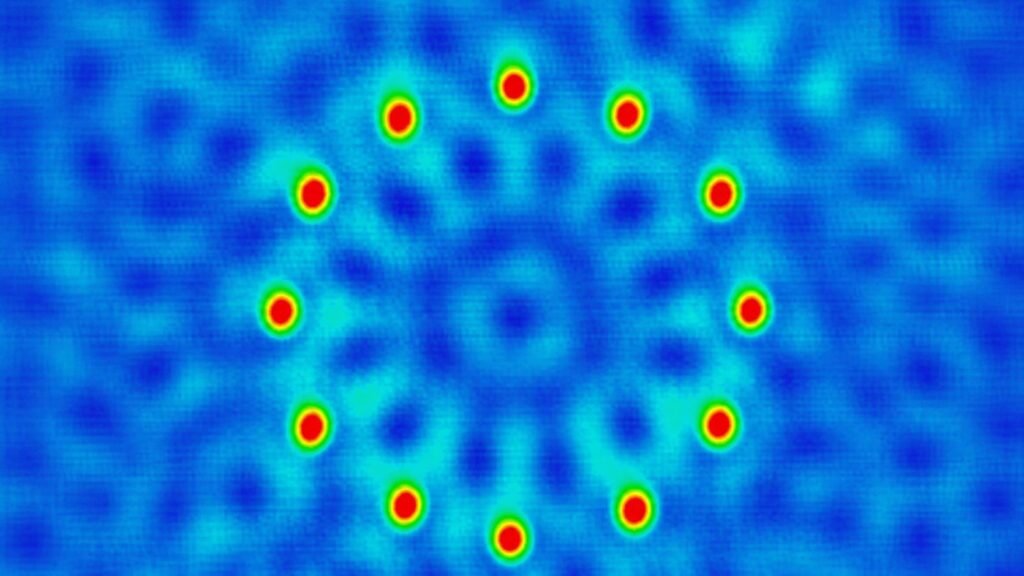
This is the origin of the fuzzy cloud images that often stand in for atoms in textbooks and documentaries. Those clouds are not portraits of a smeared out, half there electron occupying many places simultaneously like a mist. They are visual summaries of probability. Where the cloud is dense, an experiment is more likely to detect the electron. Where the cloud thins out, detection becomes less likely. The shapes that these probability clouds take around a nucleus are called orbitals, and they replace the clean circular path of the planetary model with something closer to a standing pattern, fixed in shape and extent rather than traced out turn after turn by a moving particle.
None of this is a way of admitting ignorance about where the electron really is on some hidden orbit we simply cannot see. Standard quantum mechanics does not describe the bound electron as a tiny object traveling along a definite classical orbit underneath the probability picture. The wavefunction itself is the physical description physicists work with.

The one s orbital as a probability cloud. Density is highest near the center and fades smoothly outward with no sharp edge.
The Lowest Note an Atom Can Play
To find out what these wavefunctions actually look like for a hydrogen atom, physicists solve an equation developed by Erwin Schrödinger in the 1920s. Rather than tracking a moving particle, the Schrödinger equation finds the allowed standing states of the electron bound to the proton, each with its own fixed energy. These energies turn out to be discrete, meaning only certain specific values are allowed, somewhat like the fixed set of notes available on a piano rather than the continuous slide of a trombone.
The lowest of these allowed states is called the ground state, or the 1s state in the notation chemists and physicists use. It is the calmest, lowest energy configuration the electron can occupy, and it has a finite characteristic spatial scale, a stable spatial distribution with no sharp outer edge rather than a hard boundary. This is the key point that the planetary model gets wrong in a more subtle way than the radiation problem alone suggests. The 1s state is not a tiny circular track squeezed in close to the nucleus. It is the lowest rung on a ladder of allowed quantum states, a stable standing pattern with its own characteristic spread, not a path the electron travels around and around.
An electron sitting in the 1s state is not doing anything that resembles orbiting in the everyday sense. It simply occupies that lowest available state, the way a guitar string settles into its fundamental tone rather than continuously sliding through every possible pitch.
A Balance Between Getting Closer and Getting Squeezed
So why does the ground state have the particular scale it has, rather than shrinking down to nothing? The answer comes from a competition between two effects that pull in opposite directions.
Moving an electron closer to the positively charged nucleus lowers its electrical potential energy, exactly as the planetary intuition suggests it should. Closer is, in that one respect, energetically favorable. But quantum mechanics adds a second effect that classical physics has no equivalent for. Confining a quantum particle to a smaller region of space raises its kinetic energy, and the smaller the region, the steeper that rise becomes. Squeeze an electron’s probability distribution down toward the nucleus and you are not just letting it fall toward lower potential energy. You are also forcing a sharp increase in its kinetic energy, working against the very collapse that seemed inevitable in the classical picture.
This balance gives an intuitive way to understand why hydrogen’s lowest-energy state has a finite characteristic scale. The exact 1s distribution comes from solving the Schrödinger equation. Push the distribution in tighter than that, and the kinetic energy cost rises faster than the potential-energy savings. Let it spread out further, and you give up potential-energy gains you could have kept. The hydrogen atom’s lowest-energy state therefore has a real, finite spatial scale rather than collapsing to zero size.

The allowed energy levels of hydrogen, each rung a stable state the electron can occupy, with the widest, calmest rung at the bottom marking the ground state where there is nowhere lower left to go.
Why You Cannot Pin an Electron Down
The kinetic energy cost of confinement is closely tied to a principle named after Werner Heisenberg, and it deserves a careful explanation rather than a quick label. The uncertainty principle states that a quantum particle cannot simultaneously have a perfectly defined position and a perfectly defined momentum. The more tightly you constrain where a particle is, the more its momentum, and therefore its kinetic energy, becomes uncertain and tends to grow.
This is not a statement about clumsy instruments or measurement technique. It is not that we simply lack a precise enough ruler to pin down both position and momentum at once. The uncertainty is a basic feature of how quantum states work, built into the mathematics of wavefunctions themselves, present even for an idealized, perfectly measured system. An electron confined to a region the size of a nucleus would carry an enormous momentum uncertainty and an enormous associated kinetic energy, far more than the electrical attraction could compensate for.
It is worth being precise about what role this principle plays in the larger story. The uncertainty principle is one part of the explanation for why atoms do not collapse, supplying the reason that extreme confinement is so energetically costly. It is not, by itself, the entire reason atoms are stable. The fuller picture is the energy balance described above, with the uncertainty principle as the piece that explains why squeezing the electron in is expensive in the first place.
A State With Nowhere Lower to Fall
This brings the explanation back to the original worry about radiation. Classical physics predicted collapse because an orbiting, accelerating charge should continuously shed energy and spiral inward. But the ground state of a hydrogen atom is not an electron in motion along a path, accelerating turn after turn. It is a fixed, lowest energy quantum state. With nowhere lower to go, there is no ongoing process of decay, no gradual descent toward the nucleus, and no continuous radiation of the kind classical electromagnetism would predict for an orbiting charge.
There is no lower energy bound state available for the electron to fall into.
It is worth adding one precise detail rather than glossing over it. The probability density of the 1s state is nonzero at the location of the nucleus. The probability of finding the electron at any single exact mathematical point, including that one, is technically zero, since position probabilities are spread across continuous space. What is meaningful is the probability of finding the electron within the finite volume of the nucleus itself, and that probability is extremely small, though not exactly zero. This does not mean the electron crashes into the nucleus and stays there, and it does not contradict atomic stability. The atom is stable because the ground state itself is stable, not because the electron is barred from ever overlapping with the nuclear volume.
Why This Matters
The stability of atoms is not a narrow technical curiosity confined to physics classrooms. It is part of the foundation that chemistry and atomic structure are built on. Because electrons occupy stable quantum states rather than spiraling inward, atoms have a finite characteristic size, and the shapes of their orbitals are what make chemical bonds possible at all. Without stable, finite electronic states, there would be no consistent atomic chemistry and no molecules built from predictable bonds.
The energy balance described here, worked out for a single hydrogen atom, explains why that one atom does not collapse. It does not by itself explain why bulk solid matter resists being crushed. That additional rigidity, the reason ordinary objects do not compress under their own weight, depends on further quantum effects that involve many electrons at once, including the Pauli exclusion principle, which prevents electrons from crowding into the same quantum state. Atomic stability is the starting point. The structure of ordinary solid matter builds on it through these many electron effects.
Key Takeaways
- The planetary picture of electrons circling a nucleus like tiny planets is a useful historical stepping stone, not the modern physical description of an atom.
- Classical physics predicts that an orbiting, accelerating electron should radiate energy continuously and spiral into the nucleus almost immediately, which does not match reality.
- Electrons in atoms are described by wavefunctions and probability densities rather than particles tracing fixed visible paths, and orbital clouds represent likelihood of detection, not a smeared physical substance.
- The hydrogen ground state, the 1s state, is the lowest allowed quantum state from the Schrödinger equation, with a finite characteristic spatial scale rather than a tiny circular track.
- Atomic stability comes from a balance between falling potential energy at closer range and rising kinetic energy from confinement, with the uncertainty principle explaining why that confinement cost is so steep.
- The ground state has no lower energy state available to decay into, so it does not radiate away energy and collapse the way a classical orbiting charge would.
References
- OpenStax, University Physics Volume 3, “8.1 The Hydrogen Atom.”
- OpenStax, University Physics Volume 3, “7.2 The Heisenberg Uncertainty Principle.”
- NIST, “Energy Levels of Neutral Hydrogen, H I.”
- MIT OpenCourseWare, Fundamentals of Photonics and Quantum Electronics, Chapter 4, “4.5 The Hydrogen Atom,” especially Sections 4.5.3 and 4.5.4.


Join the discussion
Comments are moderated and may take a little while to appear.