In this article (11 sections)
- The Problem Many-Worlds Was Built to Remove
- What Everett Actually Proposed
- Where the Branches Come From
- Does Every Quantum Event Really Create Another Universe?
- The Probability Problem
- Can the Many-Worlds Interpretation Be Tested?
- What Physicists Actually Think
- What Many-Worlds Does Not Claim
- Key Takeaways
- Frequently Asked Questions
- References
The many-worlds interpretation is the claim that the wave function never collapses. A quantum measurement that appears to select one result from several actually produces all of them, in branches of one universal wave function that lose the practical ability to interfere with each other. Nothing is destroyed at the moment of measurement, and nothing is chosen. Hugh Everett III set this out in a short paper in Reviews of Modern Physics in 1957, and the idea has been argued over ever since. This article covers what Everett actually proposed, how modern versions rely on decoherence, why the question does every quantum event create another universe has a more careful answer than yes or no, where the interpretation is weakest, and what physicists currently think of it.
The Problem Many-Worlds Was Built to Remove
Standard quantum mechanics runs on two rules that do not fit together comfortably. The first is the Schrodinger equation, which is smooth, deterministic, and reversible. Feed it a quantum state and it tells you exactly what that state becomes at any later time. The second rule applies only during measurement: the state suddenly jumps to a single outcome, with probability given by the square of the amplitude. That jump is not smooth, not deterministic, and not reversible.
The awkward part is that the theory never says what counts as a measurement. A photon detector is made of atoms, and atoms obey the Schrodinger equation. So does the laboratory, the experimenter, and the coffee on the bench. If you apply the first rule consistently to all of it, you get a superposition of detector states, and then a superposition of experimenter states, with no point at which the second rule is supposed to switch on. This is the measurement problem, and it has not been solved by consensus in a hundred years.
Interpretations of quantum mechanics are, in large part, different responses to that gap. Objective collapse models add a physical mechanism that makes the jump real and, in principle, detectable. Pilot-wave theory adds particle positions guided by the wave. Epistemic approaches deny that the wave function describes reality at all. Everett took the opposite route from all of them: keep the Schrodinger equation, delete the second rule entirely, and see whether the resulting theory can still account for what observers report.
What Everett Actually Proposed
Everett wrote his thesis at Princeton under John Wheeler, and his central move was to treat the observer as an ordinary quantum system with no special powers. When a measuring device interacts with a superposed particle, the two become entangled. After that, it is meaningless to ask what state the device is in on its own. You can only ask what state it is in relative to a particular state of the particle. Everett called this the relative state formulation, and he did not use the phrase many worlds at all.
The theory then says something strange but internally consistent. Relative to the branch where the particle went left, there is an experimenter who saw left, who remembers seeing left, and who will write left in the logbook. Relative to the branch where it went right, there is an equally complete experimenter with the opposite record. Neither is a copy in the sense of being less genuine. Both follow from the same equation applied without exception.
The paper attracted very little attention at first, and Everett left academic physics for defence analysis rather than pursue the argument. The idea was revived thirteen years later by Bryce DeWitt in Physics Today, and the 1973 volume DeWitt edited with Neill Graham gave the interpretation the name that stuck.
Everett did not add worlds to quantum mechanics. He removed a rule, and the worlds were what remained.
Where the Branches Come From
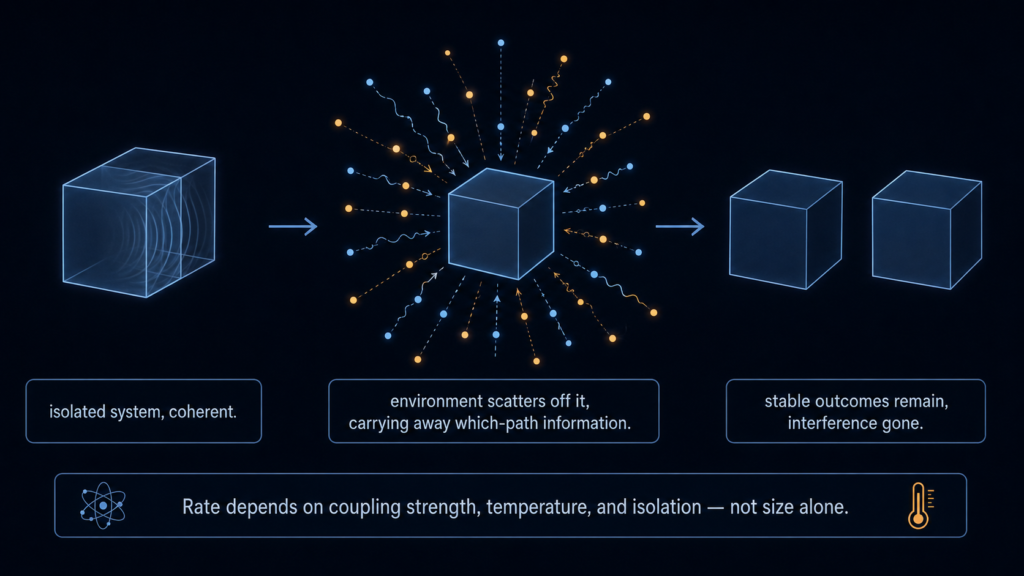
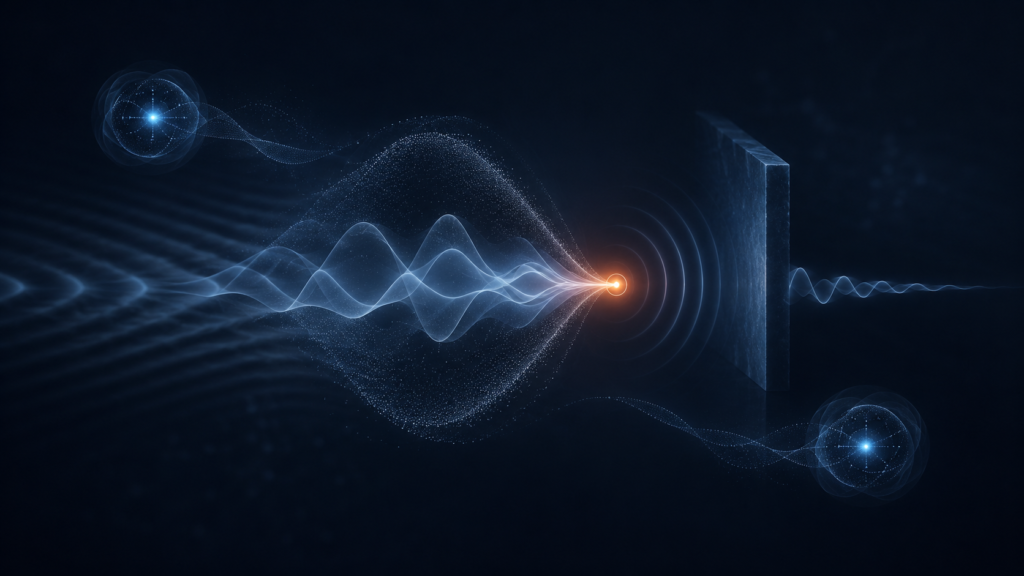
Decoherence as environmental monitoring. An isolated system stays coherent until particles from its surroundings scatter off it and carry away information about which path it took, leaving only stable outcomes with no interference between them. Illustration by Astrinova.io.
Everett’s original account had a serious hole in it, and critics found it quickly. A quantum state can be written as a superposition in an unlimited number of ways, depending on which basis you choose. So why do the branches correspond to detector clicked and detector did not click rather than to some bizarre combination of the two that no one has ever experienced? David Deutsch argued in 1985 that the formalism, in either the conventional or the Everett reading, needed extra structure to fix this preferred basis.
The answer that most Everettians now give comes from decoherence, developed by H. Dieter Zeh, Wojciech Zurek, and others. No laboratory object is perfectly isolated. Air molecules, thermal photons, and stray fields interact with it, and those interactions carry information about certain properties and not others. Position tends to get monitored by the environment heavily and quickly for anything embedded in a warm, dense setting, and exotic superpositions of macroscopically distinct positions do not survive that monitoring under ordinary conditions. The environment effectively selects a stable set of states, which Zurek called einselection, and interference between them becomes practically unmeasurable. How fast this happens is not fixed by size alone. It depends on how strongly a system couples to its surroundings, at what temperature, and how well it is shielded. A sufficiently isolated large molecule can retain coherence for a surprising length of time, which is precisely why matter-wave experiments keep pushing coherence to heavier and heavier objects.
Decoherence is not a matter of opinion. It is a calculable, experimentally confirmed process. What is contested is what it delivers. Decoherence explains why we never see interference between macroscopic alternatives under normal conditions. It does not, on its own, explain why only one alternative is experienced. Everettians treat that as the point: nothing removes the other branches, so the other branches are still there.
Does Every Quantum Event Really Create Another Universe?
This is the question most readers arrive with, and the honest answer is that the popular phrasing gets three things wrong at once.
Nothing is created in the sense of new substance appearing from nowhere. In the Everett picture there is one wave function, evolving under one equation. Branching redistributes structure inside that wave function rather than manufacturing new stuff, and each branch carries a smaller amplitude than the whole it came from. This is also the usual reply to the objection that many-worlds violates conservation of energy, though the reply needs care. Energy conservation is a property of the complete quantum state evolving under its governing dynamics, not a simple accounting rule where a fixed pool gets split evenly between branches. Assigning a well-defined energy to an individual emergent branch, and showing that those branch energies add up the way a classical bookkeeping picture would suggest, is a more subtle question than it first appears, and it is still discussed in the technical literature rather than fully settled.
There is no well-defined count. Branch structure emerges from decoherence, which is a continuous and approximate process, not a switch that flips. Ask how many branches exist after a given experiment and the theory offers no exact integer, because the division depends on how finely you choose to carve the environment. Adrian Kent and others have pressed exactly this point, arguing that a theory in which the fundamental objects are only approximately defined has a serious problem describing what it is a theory of.
And every quantum event is too loose. An electron in a hydrogen atom is in a superposition constantly without anything branching in a meaningful sense. Branching, on the decoherence account, requires amplification: a microscopic difference has to get correlated with enough of the environment that the alternatives can no longer practically interfere. Most quantum behaviour never reaches that threshold. What does reach it does so more or less continuously, everywhere, all the time, which is a far less tidy picture than a universe politely splitting in two whenever a physicist takes a reading.
The Probability Problem
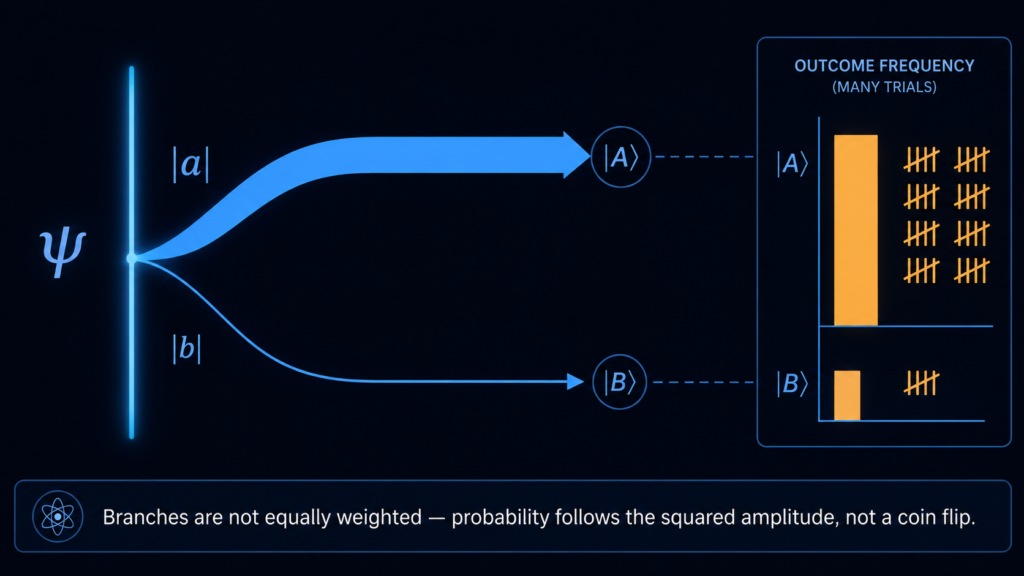
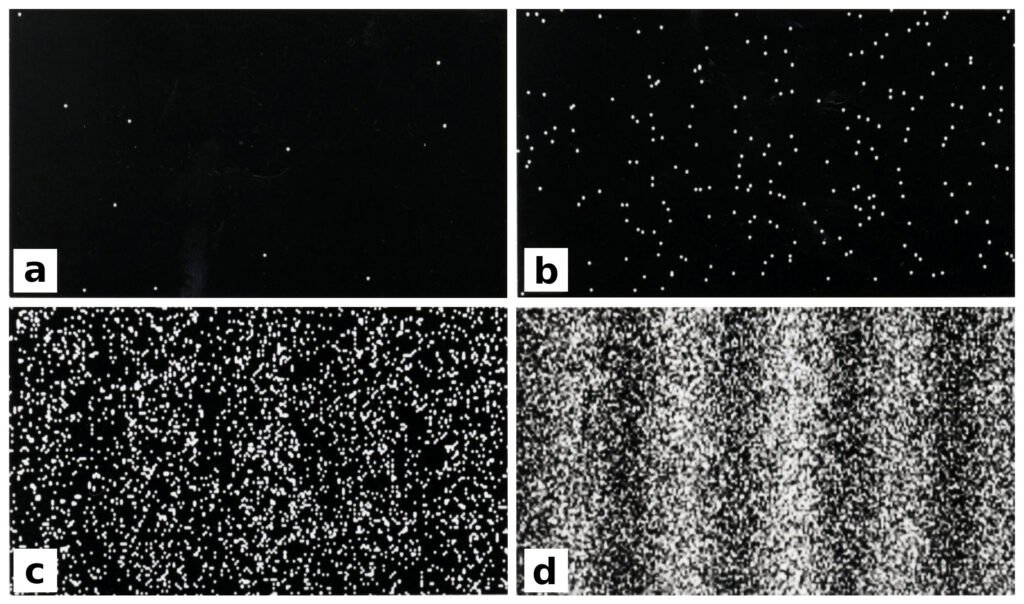
Branches are not equally weighted. The bigger the amplitude feeding a branch, the more often that outcome turns up over many trials, and the count follows the squared amplitude rather than a simple coin flip. Illustration by Astrinova.io.
If both outcomes happen with certainty, what does it mean to say one has a 30 percent chance? This is the sharpest objection to many-worlds, and it remains genuinely open.
Deutsch proposed in 1999 that the Born rule could be recovered from decision theory, by asking what betting behaviour is rational for an agent who knows they are about to branch. David Wallace developed this into a fuller argument. A different route, following Lev Vaidman, uses self-locating uncertainty: in the moment after branching but before you read the result, you know the full state of the universe yet do not know which branch you are in, and Charles Sebens and Sean Carroll argued that the squared amplitude is then the uniquely rational credence to assign.
Critics are not persuaded. Some argue the derivations smuggle in probabilistic assumptions they claim to derive. Others say the deeper issue is confirmation: in a theory where every outcome occurs, it is unclear why our particular experimental record, which happens to look Born-rule typical, counts as evidence for the theory at all. No derivation has won general acceptance, and describing the Born rule as solved within many-worlds would misstate the state of the debate.
Can the Many-Worlds Interpretation Be Tested?
For every experiment currently within reach, many-worlds predicts exactly what textbook quantum mechanics predicts. That is by design, since it uses the same equation with one rule deleted. This is why it is called an interpretation rather than a rival theory, and why no experiment to date has confirmed or ruled it out.
There are indirect pressures worth knowing about. Objective collapse models do make different predictions, because a real collapse mechanism should spoil interference for sufficiently massive objects. Those models are being squeezed by matter-wave interference experiments. A Vienna group reported interference for engineered molecules above 25,000 daltons, built from roughly 2,000 atoms, which places bounds on how strongly any modification to quantum mechanics can act.
Ruling out collapse models would not confirm many-worlds. It would only narrow the field of alternatives, several of which keep a single world without any collapse at all.
Deutsch’s 1985 paper sketched a more direct test using an observer whose memory could be quantum-mechanically reversed, which is not remotely feasible for a human being. What has been achieved is a family of proof-of-principle experiments on the Wigner’s friend scenario, where a photon’s path stands in for an observer. These place theory-independent constraints on assumptions about the absoluteness of observed events, and they are genuinely interesting results, but a photon path is not an observer in the sense the argument requires and no interpretation has been eliminated by them.
What Physicists Actually Think
Support for many-worlds is real but well short of a majority, and it varies enormously with who is asked. A 2011 poll of 33 participants at a quantum foundations conference in Austria found 42 percent favouring Copenhagen and 18 percent favouring Everett, with no votes at all for de Broglie-Bohm.
For the theory’s centenary, Nature ran a far larger survey, emailing more than 15,000 researchers who had recently published on quantum mechanics and collecting over 1,100 responses. Copenhagen led with 36 percent, many-worlds came in at 15 percent, and no option came close to a majority. A separate 2025 poll with a much smaller sample reported Copenhagen at 60 percent and Everett at 7 percent, which mainly demonstrates how strongly these numbers depend on which room you walk into.
One finding from the 2011 poll is worth carrying away: a clear majority of respondents said that personal philosophical preference plays a large role in the choice of interpretation. That is an unusually candid thing for a scientific community to report about itself.
What Many-Worlds Does Not Claim
A good deal of what circulates about this interpretation is not part of it.
It does not say that every decision you make spawns a world where you chose otherwise. Branching tracks quantum outcomes that get amplified into the environment, not human deliberation, and whether ordinary choices depend on such outcomes is an open question about brains, not a claim of the theory.
It does not offer any practical route to another branch. Decoherence makes interference between macroscopic branches effectively inaccessible, which is exactly why each one looks like a self-contained classical world. That inaccessibility is not the same as a fundamental impossibility. Unitary quantum mechanics does not, in principle, destroy information, and a sufficiently controlled reversal of the interaction that caused decoherence could in principle restore coherence. For anything larger than a small, carefully isolated system, the practical barriers to doing this are so extreme that no proposed method comes close, and there is no mechanism in the formalism for signalling, travelling, or peeking between branches in any usable sense.
It does not license the quantum immortality argument, in which a rational person should expect to survive because some branch always contains a surviving version of them. That reasoning depends on treating branch counting as the right guide to expectation, which is exactly what the Born rule debate says you cannot assume. It is a philosophical thought experiment with no experimental support, and treating it as a physical prediction is a misreading.
It also does not follow from quantum computing. Deutsch has argued that the performance of quantum algorithms is best explained by parallel computation across branches, but that reading is his, not a consensus. The algorithms work identically under interpretations with no branches in them, and quantum computer engineers do not need to settle the question to build the machines.
Every interpretation of quantum mechanics asks you to accept something uncomfortable. Many-worlds asks you to accept the other branches. The alternatives ask you to accept a collapse nobody can locate, or particles nobody can see.
Key Takeaways
- The many-worlds interpretation keeps the Schrodinger equation and removes the collapse postulate entirely, so measurement outcomes branch rather than resolve into one result.
- Everett’s 1957 paper described relative states, not worlds. The name and the popular framing came later, largely through Bryce DeWitt’s work around 1970.
- Modern versions depend on decoherence, an experimentally confirmed process whose speed depends on coupling strength, temperature, and isolation rather than size alone.
- The number of worlds is not a well-defined quantity in the theory, because branch structure emerges approximately from a continuous process rather than from a discrete splitting event.
- Energy conservation in many-worlds applies to the complete quantum state; assigning separate, well-defined energies to individual emergent branches is a subtler question than simple division.
- Recovering the Born rule from a deterministic branching picture remains the strongest unresolved objection, despite decision-theoretic and self-locating uncertainty proposals.
- Support among researchers is a substantial minority rather than a consensus, at 15 percent in Nature’s 2025 centenary survey against 36 percent for Copenhagen.
Frequently Asked Questions
Is the many-worlds interpretation proven?
No. It reproduces the predictions of standard quantum mechanics exactly, which means no experiment performed so far distinguishes it from the alternatives. What can be tested are objective collapse models, because a genuine physical collapse should suppress interference for large enough objects, and interference experiments with heavy molecules keep tightening those bounds. Ruling out collapse would still leave several no-collapse interpretations standing. Many-worlds is a serious position held by serious physicists, and it is currently a matter of theoretical argument rather than experimental result.
How many worlds are there?
The theory does not give a number, and this is not a gap that better calculation will fill. Branches emerge from decoherence, which is continuous and approximate, so how finely you divide the wave function into branches depends on choices you make about the description rather than on a fact about nature. Critics treat this as a foundational weakness, arguing that a theory should be able to say what its objects are. Everettians treat approximate emergence as normal, comparing it to the way tables and chairs are real without having exactly defined boundaries.
Do copies of me exist in other branches?
On the Everett picture, yes in a specific sense. When an outcome branches, the observer branches with it, and each resulting observer has a complete memory and an equal claim to being you. None is a copy of an original. There is no fact of the matter about which one is the real continuation. What the theory does not support is the popular version in which those versions made different life choices. Branching follows amplified quantum outcomes, not decisions.
Does many-worlds violate conservation of energy?
Its supporters say no, but the reasoning is more delicate than a simple split. Energy conservation is a property of the full quantum state under its governing dynamics, not a rule that divides a fixed total evenly among branches. Giving each emergent branch its own well-defined energy, and showing those add up in the way classical intuition expects, is a genuinely subtle technical question, and it connects to the broader unresolved issue of how much physical weight each branch is meant to carry.
Can we ever detect or communicate with another branch?
Decoherence makes this effectively impossible for anything macroscopic, because information about the system spreads into an environment too large and too uncontrolled to gather back up. That practical impossibility is not the same as a fundamental law forbidding it. Unitary evolution is reversible in principle, so a sufficiently controlled reversal could restore coherence for a small, carefully isolated system, which is part of why physicists work hard to protect quantum coherence in the lab. Nothing resembling this exists, or is expected to exist, at the scale of a human observer.
Does quantum computing prove many worlds?
No. David Deutsch has argued that parallel computation across branches is the most natural explanation of quantum speedups, and that argument is worth reading, but it is a minority interpretation rather than a demonstration. Quantum algorithms are derived from the standard formalism and give identical results whichever interpretation you hold. Researchers building and running these machines do not need an answer to the branching question, and the field’s progress has not moved the interpretational debate.
Is this the same as the multiverse in cosmology?
No, though the vocabulary overlaps confusingly. Cosmological multiverse proposals, such as the regions produced by eternal inflation, describe other regions of spacetime that are physically separated from ours by distance and expansion. Everettian branches are not somewhere else in space. They are structures within the same quantum state, occupying the same spacetime, distinguished by being practically unable to interfere. Some physicists have argued the two pictures may connect, but they arise from different theories and different motivations.
References
- Everett, H. “Relative State Formulation of Quantum Mechanics.” Reviews of Modern Physics, vol. 29, no. 3, 1957, pp. 454-462. DOI: 10.1103/RevModPhys.29.454. https://link.aps.org/doi/10.1103/RevModPhys.29.454
- DeWitt, B. S. “Quantum Mechanics and Reality.” Physics Today, vol. 23, no. 9, 1970, pp. 30-35. DOI: 10.1063/1.3022331. https://ui.adsabs.harvard.edu/abs/1970PhT….23i..30D/abstract
- Barrett, J. “Everett’s Relative-State Formulation of Quantum Mechanics.” Stanford Encyclopedia of Philosophy. plato.stanford.edu
- Vaidman, L. “Many-Worlds Interpretation of Quantum Mechanics.” Stanford Encyclopedia of Philosophy. plato.stanford.edu
- Deutsch, D. “Quantum Theory as a Universal Physical Theory.” International Journal of Theoretical Physics, vol. 24, no. 1, 1985, pp. 1-41. DOI: 10.1007/BF00670071. link.springer.com
- Zurek, W. H. “Decoherence, Einselection, and the Quantum Origins of the Classical.” Reviews of Modern Physics, vol. 75, no. 3, 2003, pp. 715-775. DOI: 10.1103/RevModPhys.75.715. link.aps.org
- Deutsch, D. “Quantum Theory of Probability and Decisions.” Proceedings of the Royal Society A, vol. 455, no. 1988, 1999, pp. 3129-3137. DOI: 10.1098/rspa.1999.0443. royalsocietypublishing.org
- Sebens, C. T., and Carroll, S. M. “Self-Locating Uncertainty and the Origin of Probability in Everettian Quantum Mechanics.” British Journal for the Philosophy of Science, vol. 69, no. 1, 2018, pp. 25-74. Preprint arXiv:1405.7577. arxiv.org
- Kent, A. “One World Versus Many: The Inadequacy of Everettian Accounts of Evolution, Probability, and Scientific Confirmation.” arXiv preprint 0905.0624, 2009. Published in Many Worlds? Everett, Quantum Theory, and Reality, Oxford University Press, 2010. arxiv.org
- Schlosshauer, M., Kofler, J., and Zeilinger, A. “A Snapshot of Foundational Attitudes Toward Quantum Mechanics.” arXiv preprint 1301.1069, 2013. arxiv.org
- Gibney, E. “What Does Quantum Mechanics Say About Reality?” Nature, 2025. DOI: 10.1038/d41586-025-02342-y. nature.com
- Jedlicka, P. O., et al. “Has Anything Changed? Tracking Long-Term Interpretational Preferences in Quantum Mechanics.” arXiv preprint 2507.09988, 2025. arxiv.org
- Fein, Y. Y., et al. “Quantum Superposition of Molecules Beyond 25 kDa.” Nature Physics, vol. 15, no. 12, 2019, pp. 1242-1245. DOI: 10.1038/s41567-019-0663-9. nature.com
- Bong, K.-W., et al. “A Strong No-Go Theorem on the Wigner’s Friend Paradox.” Nature Physics, vol. 16, 2020, pp. 1199-1205. DOI: 10.1038/s41567-020-0990-x. doi.org
- Proietti, M., et al. “Experimental Test of Local Observer Independence.” Science Advances, vol. 5, no. 9, 2019, eaaw9832. DOI: 10.1126/sciadv.aaw9832. doi.org
Join the discussion
Comments are moderated and may take a little while to appear.