
In this article (12 sections)
- What classical physics actually claims
- The experiments classical physics could not explain
- What quantum mechanics replaced it with
- Quantum physics vs classical physics: the core differences
- Where the boundary sits, and why it is fuzzy
- What the experiments have settled, and what they have not
- Why engineers still use classical physics every day
- The technologies each theory made possible
- The gap that remains: gravity
- Key Takeaways
- FAQ
- References
Quantum physics vs classical physics is not a contest between two competing accounts of the same world. They are two working theories with different domains, different mathematics, and different ideas about what a measurement even is. Classical physics describes a world of definite positions, continuous quantities, and objects that carry their properties around with them whether or not anyone looks. Quantum physics describes a world where those assumptions fail in specific, measurable ways, and where the theory generally predicts probabilities for measurement outcomes rather than one guaranteed result.
The difference matters beyond the seminar room. Every bridge, aircraft, and interplanetary trajectory is calculated with classical mechanics. Every transistor, laser, and MRI scanner depends on quantum behaviour that classical physics cannot produce. This article sets out what each theory actually claims, which experiments forced the split, where the boundary between them sits, and which questions remain genuinely open.
What classical physics actually claims
Classical physics is a family of theories rather than one equation set. Newtonian mechanics handles forces and motion. Maxwell’s electromagnetism handles fields, charges, and light as a wave. Thermodynamics and statistical mechanics handle heat and bulk matter. Einstein’s special and general relativity, despite their reputation for strangeness, also sit inside the classical camp, because they are non-quantum theories. That is a distinction worth holding onto, since “classical” in physics means “not quantum,” not “old.”
What ties these theories together is a set of shared assumptions about how nature behaves.
Objects have definite properties at all times. A cricket ball has a position and a momentum whether or not a camera is recording it. Quantities vary continuously, so a spinning wheel can in principle carry any amount of rotational energy. Measurement is a passive act of reading off a value that was already there. And the equations are deterministic: give them exact initial conditions and they return exactly one future.
Determinism is often confused with predictability, and the two are not the same. Classical systems can be deterministic and still be practically unpredictable, because tiny differences in starting conditions grow exponentially. Weather is the standard example. Chaos is a classical phenomenon, not a quantum one, and it explains a great deal of the messiness people mistakenly attribute to quantum uncertainty.
The experiments classical physics could not explain
By the late nineteenth century, classical physics was not merely successful. It looked close to complete. Then a set of specific measurements refused to fit.
Heated objects glow, and classical electromagnetism combined with classical statistics predicted that a perfect absorber should radiate without limit at short wavelengths. Measured spectra did nothing of the kind. In 1900, Max Planck found that the observed curve came out correctly if energy was exchanged between matter and radiation only in discrete packets proportional to frequency, with the proportionality set by a new constant, h.
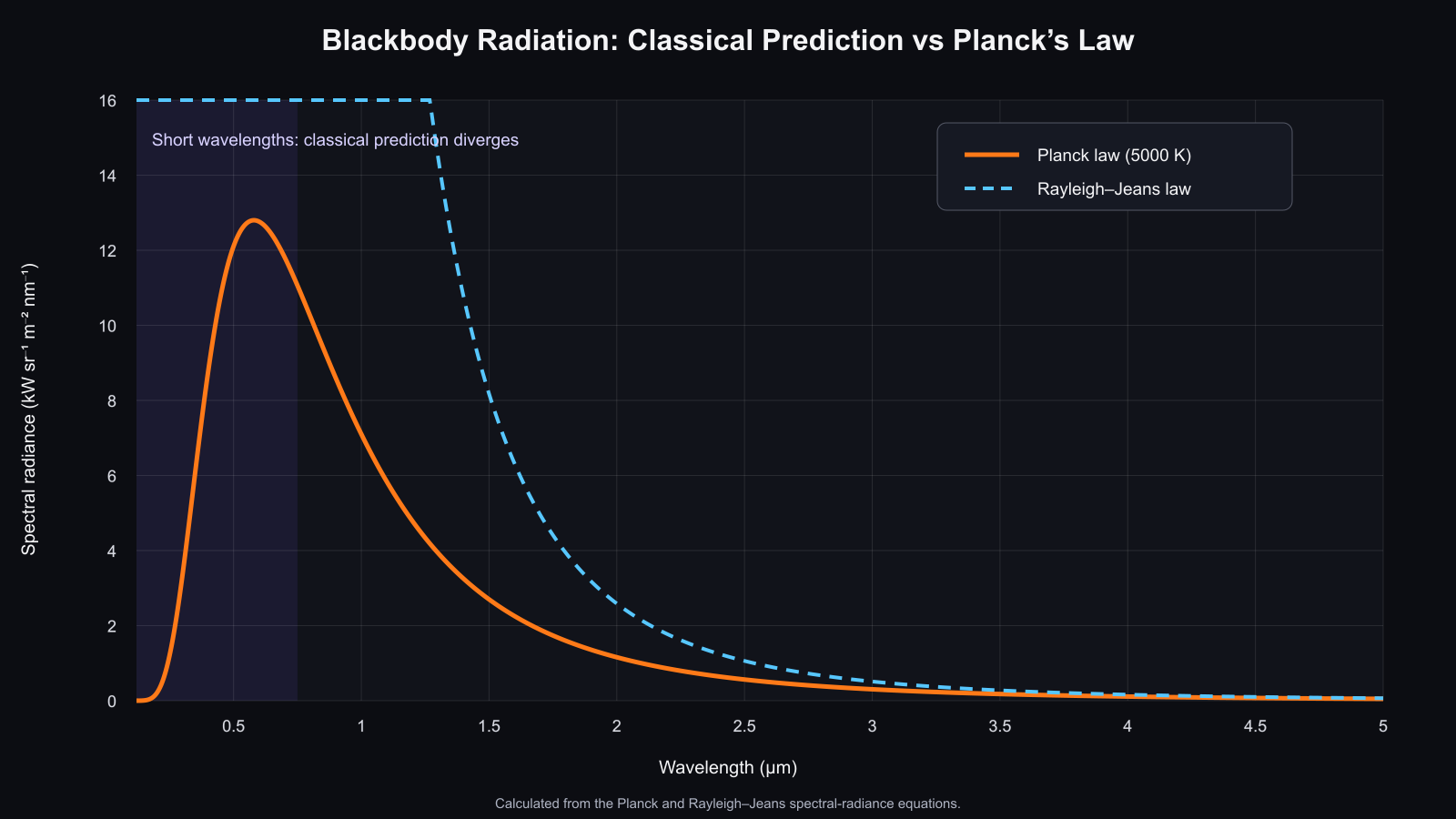
Visualization by Astrinova, based on the public-domain graph and equations by Darth Kule via Wikimedia Commons.
Planck treated the step as a mathematical device. Einstein did not. In 1905 he argued that light itself is granular, which explained why shining brighter light on a metal does not knock out electrons if the frequency is too low, and why increasing the frequency raises the energy of the ejected electrons rather than their number. His Nobel Prize came for that work on the photoelectric effect, not for relativity (The Nobel Prize in Physics 1921).
A third failure was structural. Once Rutherford’s experiments placed a tiny positive nucleus at the centre of the atom, classical electrodynamics predicted disaster. An orbiting electron accelerates, an accelerating charge radiates energy, and the electron should therefore spiral into the nucleus almost immediately. Matter is stable, so something in the classical account was wrong at the root.
What quantum mechanics replaced it with
The theory that emerged in the 1920s keeps some classical ideas, such as conservation of energy and momentum, and discards others outright.
A quantum system is described by a wavefunction, and the wavefunction evolves smoothly and deterministically under the Schrödinger equation. What is not deterministic is what you see when you measure. The wavefunction gives probabilities for outcomes, and repeated identical preparations give a spread of results rather than one repeatable value.
Bound systems have discrete allowed energies. An electron in a hydrogen atom cannot sit at an arbitrary energy, which is why atoms emit and absorb light at sharp characteristic frequencies rather than a smear. Quantisation is not a detail bolted onto classical physics; it is what makes chemistry possible.
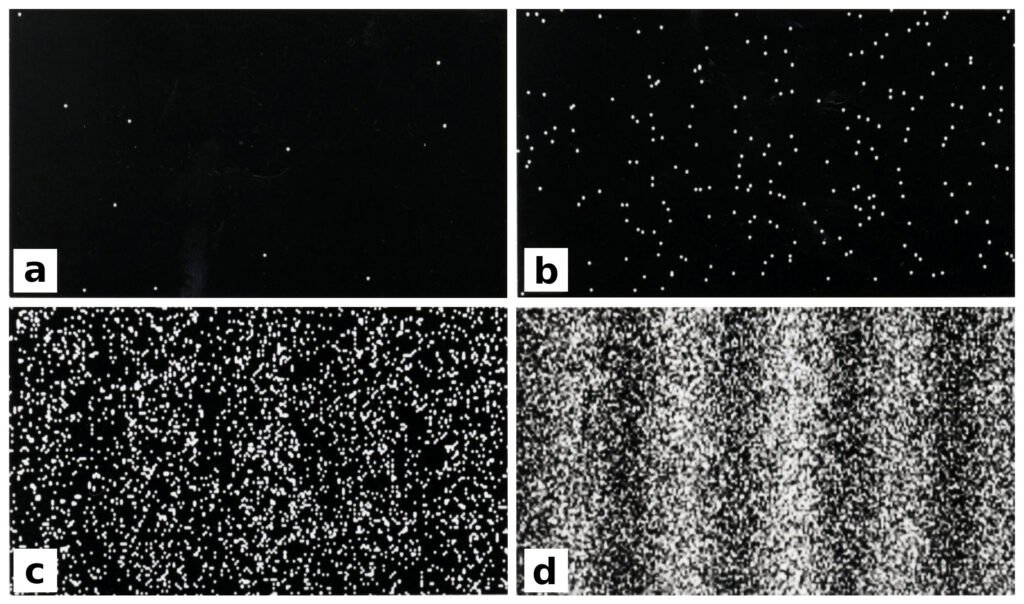
The sharpest demonstration is the double-slit experiment. Fire electrons one at a time at a barrier with two openings, and each one lands as a single localised dot on the detector, which looks entirely particle-like. Let the dots accumulate over hours and they assemble into an interference pattern, which is wave behaviour. Block one opening, or install a detector that records which opening each electron passed through, and the pattern vanishes. Same particles, same apparatus, and an outcome that depends on what path information the setup makes available. No classical model of a small solid object reproduces that.
Then there are the features with no classical counterpart at all.
Superposition means a system can be prepared in a combination of states that are mutually exclusive classically, and that combination produces interference effects a mixture of definite states cannot. Uncertainty means certain pairs of quantities, position and momentum among them, have no simultaneously sharp values, and the limit is built into the structure of the theory rather than caused by clumsy instruments. Entanglement means two systems can share a joint state in which neither has a definite individual property, while their measurement results stay correlated across any distance.
Quantum mechanics did not make the world blurry. It made the sharpness conditional on what you choose to measure.
Quantum physics vs classical physics: the core differences
Stated side by side, the split comes down to a handful of specific disagreements.
Outcomes. Classical theory predicts a single result. Quantum theory predicts a probability distribution, and only statistics over many runs are reproducible.
Values. Classical quantities vary continuously. Many quantum quantities, including bound-state energies and angular momentum, come in discrete steps, though not all of them: position and free-particle momentum still have continuous spectra.
Properties before measurement. Classical objects have their properties whether observed or not. Bell tests show that no local hidden-variable model can reproduce the full pattern of quantum correlations observed experimentally, so a system in superposition cannot be treated as a local object that quietly held one definite value the whole time.
Correlations. Classical correlations between separated objects can always be explained by shared information established in the past. Quantum correlations between entangled systems exceed that limit.
The role of measurement. Classical measurement reveals. Quantum measurement changes the state of the system in a way the theory’s smooth evolution does not by itself describe, which is the unresolved measurement problem.
| Feature | Classical physics | Quantum physics |
|---|---|---|
| Prediction | One definite outcome from exact initial conditions | A probability distribution over outcomes, though some outcomes carry probability 1 |
| State and properties | Definite values held at all times | A wavefunction; properties can be indefinite until measured |
| Measurement | Reads a value that was already there | Changes the state; the outcome rule is not part of smooth evolution |
| Energy values | Continuous | Discrete for bound systems, continuous for free ones |
| Interference | Waves interfere, solid objects do not | Single particles interfere with themselves |
| Correlations | Explained by shared information from the past | Entangled correlations exceed any local hidden-variable limit |
| Typical regime | Action far larger than Planck’s constant | Action comparable to Planck’s constant, system well isolated |
| Engineering examples | Bridges, engines, spacecraft trajectories | Transistors, lasers, MRI, atomic clocks |
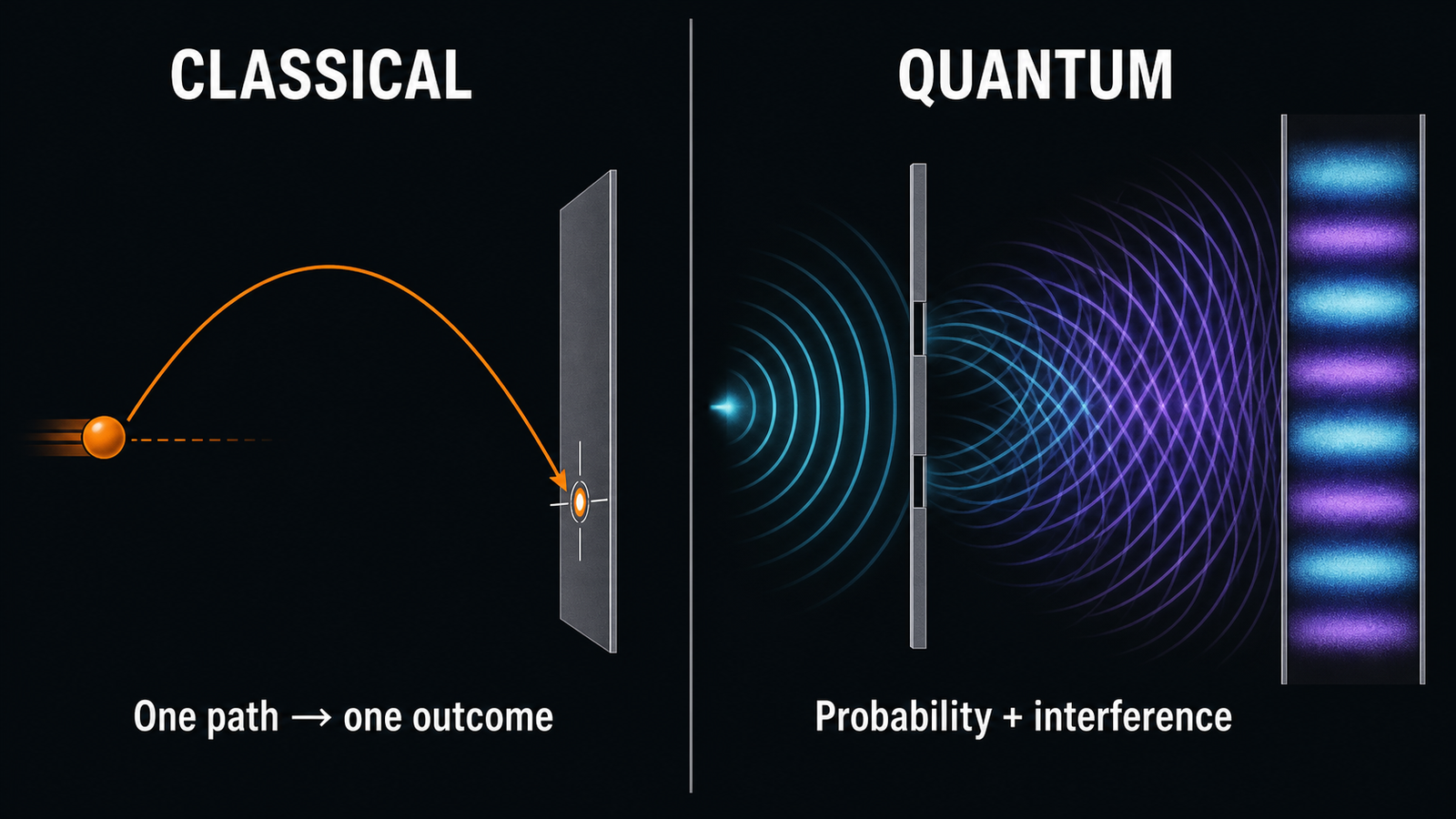
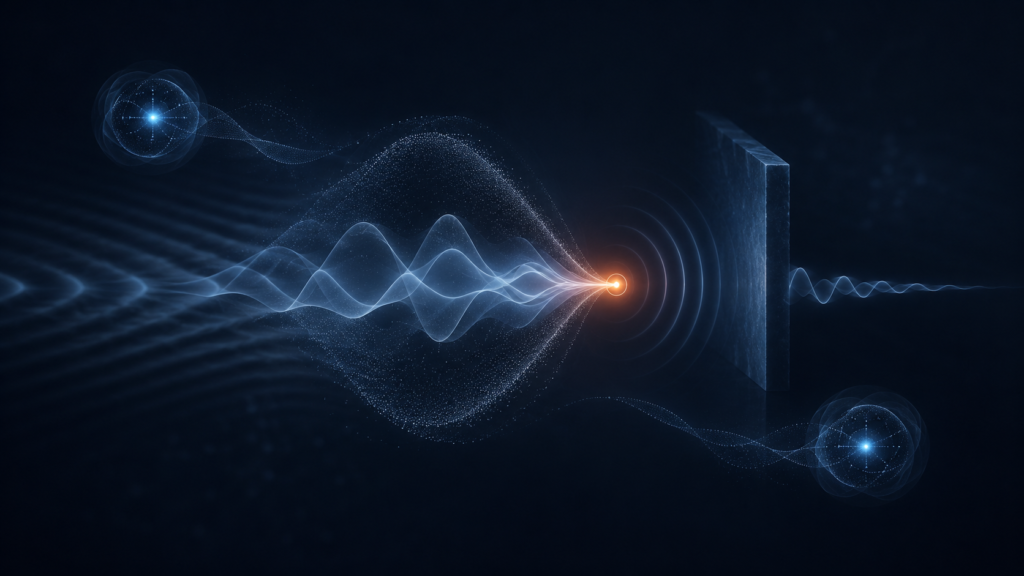
Conceptual illustration by Astrinova.
Two cautions belong here. Quantum theory does not say that observers create reality by looking, and a detector counts as a measuring device whether or not a human reads its output. Quantum theory also does not permit faster-than-light signalling. Entangled measurement results are correlated, but neither side can control their own outcome, so nothing usable travels between them.
Where the boundary sits, and why it is fuzzy
There is no size at which quantum physics switches off. The useful yardstick is Planck’s constant. When the characteristic action of a system, roughly an energy multiplied by a time, is enormous compared with h, quantum corrections are too small to detect and classical equations are the right tool. When it is comparable to h, quantum behaviour dominates.
Niels Bohr framed the expectation as the correspondence principle: quantum predictions must reproduce classical ones in the regime where classical physics is already known to work. For heavy systems and large quantum numbers, they do, which is why nobody needs quantum corrections to aim an artillery shell.
That constant is now woven into the measurement system itself. Since 20 May 2019 the kilogram has been defined by fixing the numerical value of the Planck constant at exactly 6.62607015 x 10^-34 joule seconds, so the SI unit of mass is anchored to a quantum quantity rather than to a metal cylinder in a vault (NIST SI Redefinition).
The deeper question is why large objects look classical at all, and the best-supported answer is decoherence. A system that interacts with its surroundings, and everything large does, rapidly becomes entangled with air molecules, photons, and thermal vibrations. Interference between the components of a superposition is not destroyed so much as dispersed into correlations with the environment, where no practical measurement can recover it. Wojciech Zurek’s work set out how this environmental monitoring picks out the stable, effectively classical states we actually observe (Zurek, 2003).
Decoherence explains why interference between macroscopically distinct alternatives becomes extraordinarily hard to observe once a system is coupled to its surroundings. It does not, on its own, settle why a single definite outcome occurs, and that limitation is acknowledged rather than hidden in the literature.
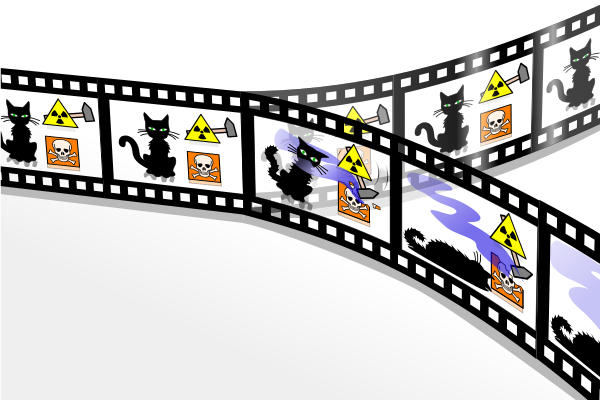
The experimental frontier keeps pushing the boundary outward, and it moved again recently. In 2019, a Vienna and Basel collaboration interfered tailored molecules above 25,000 atomic mass units, built from close to 2,000 atoms, which held the mass record for years (Fein et al., 2019).
On 21 January 2026, Nature published a result from the same Vienna group that went considerably further. Working with sodium nanoparticles rather than designer molecules, the team observed matter-wave interference in clusters of more than 7,000 atoms with masses above 170,000 Da, heavier than most proteins. The particles travelled through the interferometer in a Schrödinger cat state with a macroscopicity of 15.5, which the authors report as an order of magnitude beyond previous experiments and the tightest constraint so far on generic macrorealistic modifications of the Schrödinger equation.
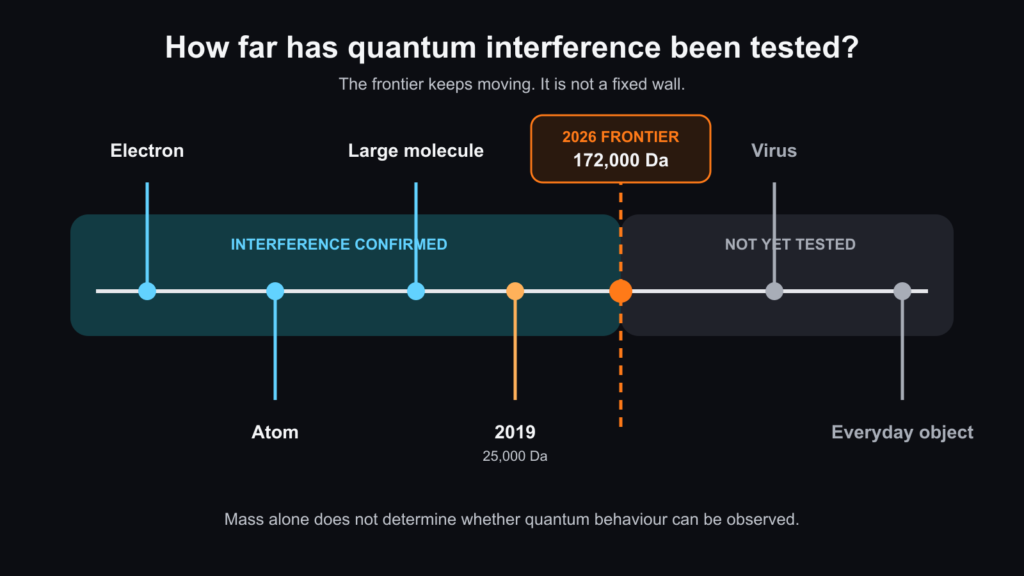
Sources: Fein et al. (2019) and Pedalino et al. (2026). Chart: Astrinova.
That matters for the quantum to classical question in a specific way. Collapse models predict that superpositions break down spontaneously above some mass, independently of environmental decoherence. Each experiment of this kind narrows the parameter space such models can occupy without ruling the class out entirely, and a metal cluster interfering at roughly 0.2 MDa is a hard result for any account expecting quantum behaviour to simply stop at large sizes (Pedalino et al., 2026).
What the experiments have settled, and what they have not
One line of doubt has been closed off. For decades it was reasonable to ask whether quantum randomness merely hides ordinary variables the theory fails to track, with particles carrying definite properties all along. John Bell showed in 1964 that any local theory of that kind obeys inequalities quantum mechanics violates, which turned a philosophical argument into a laboratory test.
Those tests have now been run with steadily fewer escape routes. In 2015 a Delft-led group reported a Bell violation using electron spins in diamond separated by 1.3 kilometres, closing the detection and locality loopholes in the same experiment, with independent photon-based tests published the same year.
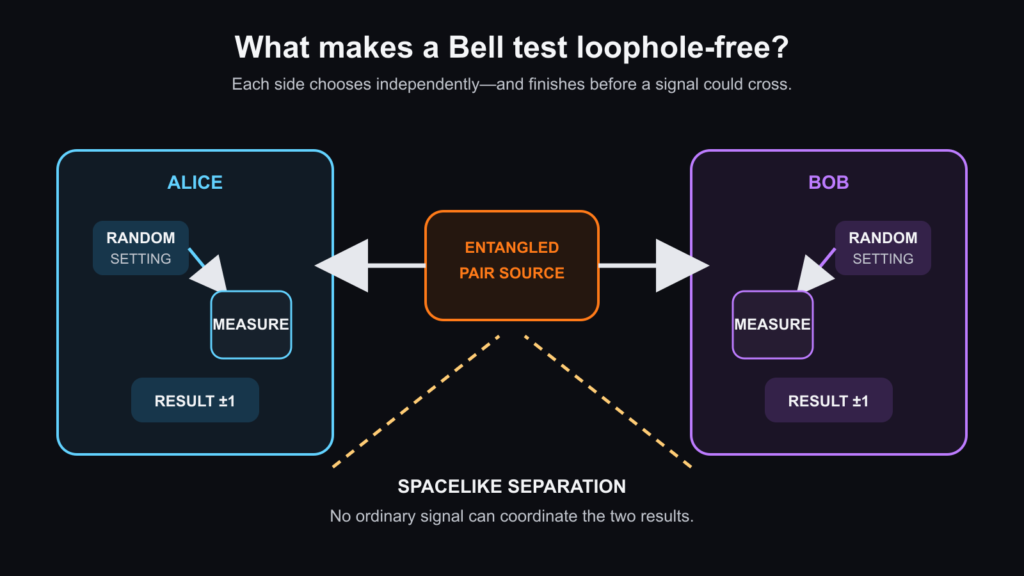
Source: Hensen et al., Nature (2015). Chart: Astrinova.
What these results establish is specific and worth stating precisely. Local hidden-variable models cannot reproduce the observed correlations, under the assumptions the tests rely on. They do not rule out every conceivable hidden-variable theory, and explicitly nonlocal formulations such as de Broglie-Bohm mechanics remain live options in the literature (Hensen et al., 2015; Shalm et al., 2015).
The 2022 Nobel Prize in Physics went to Alain Aspect, John Clauser, and Anton Zeilinger for the experimental programme behind these results (The Nobel Prize in Physics 2022; CERN, 2022).
What has not been settled is what the formalism means. Physicists agree on how to calculate and disagree on what the wavefunction represents, whether collapse is a physical process, and whether measurement outcomes are unique. A poll of specialists at a quantum foundations conference, published in 2013, found no consensus on these questions (Schlosshauer, Kofler and Zeilinger, 2013).
Twelve years on, the picture is unchanged and the evidence is much better. For the centenary of quantum mechanics in 2025, Nature surveyed more than a thousand physicists and found a field divided rather than converging. The Copenhagen interpretation was the most popular single choice while falling well short of a majority, respondents split over whether the wavefunction is physically real or a calculational tool, and on the question most relevant here, whether a boundary exists between classical and quantum objects, opinion was almost evenly divided (Nature, 2025). Treat any article that presents one interpretation as the settled answer with suspicion.
Why engineers still use classical physics every day
Superseded is the wrong word for classical physics. Newtonian mechanics is an approximation with a known domain of validity, and inside that domain it is accurate and cheap.
Spacecraft navigation is the cleanest illustration. Trajectories across the solar system are computed from Newtonian gravitation and Kepler’s laws, with relativistic corrections added where the required precision demands them. Nobody solves the Schrödinger equation for a spacecraft (NASA, Basics of Space Flight).
The same holds across engineering. Structural analysis, fluid dynamics, acoustics, and orbital mechanics are all classical, and treating them quantum mechanically would be computationally hopeless as well as pointless. Quantum mechanics does not forbid using classical physics. It explains why classical physics works where it does.
Classical physics was not overthrown. It was given a boundary and told exactly where it holds.
The technologies each theory made possible
The practical divide is easy to see in hardware.
Classical physics underpins engines, aircraft, power grids, and radio, all of which can be designed without reference to h. Quantum mechanics is required for the semiconductor band structure behind transistors, for stimulated emission in lasers, for nuclear magnetic resonance in MRI, and for the atomic transitions that define the second and drive satellite navigation timing.

Conceptual illustration by Astrinova.
Quantum computing is where careless claims collect, so it deserves plain treatment. Machines exist, they are improving, and no quantum computer has yet demonstrated a commercially decisive advantage on a practically useful problem. A major obstacle is fault-tolerant error correction and the large physical-qubit overhead required to protect a single logical qubit. It is not the only one. A perspective published in June 2026 by the Google Quantum AI team argued that two of the least-resourced stages in the entire pipeline are identifying concrete problem instances where a quantum advantage should appear, and connecting those instances to real-world use cases (Babbush et al., 2026).
Cryptographic migration is already under way as a precaution rather than a response to a working attack. In August 2024 NIST published its first finalised post-quantum cryptography standards, one for key encapsulation and two for digital signatures, so systems can be hardened long before a capable machine exists (NIST, 2024).
The gap that remains: gravity
Quantum field theory extended quantum mechanics to relativistic particles and produced the Standard Model, which accounts for the electromagnetic, weak, and strong interactions and has survived decades of precision testing at accelerators.
It leaves gravity out. General relativity describes gravity as the curvature of spacetime and is itself a classical theory, and no experimentally confirmed quantum theory of gravity exists. Candidate frameworks are under active development, and none has produced a tested prediction that distinguishes it from the alternatives (CERN, The Standard Model).
So the honest summary of quantum physics vs classical physics is not that one replaced the other. Quantum mechanics governs the small and, through decoherence, explains the emergence of the classical world we inhabit. Classical physics remains the correct working description at ordinary scales, and general relativity remains our experimentally established theory of gravity within its tested regime, with no experimentally confirmed quantum theory of gravity yet available. The seam between them is where the next real physics is likely to be found.
Gravity is the one force that has never been made to speak the language of quanta.
Key Takeaways
- Classical physics assumes definite properties, continuous quantities, and one predicted outcome. Quantum physics replaces the last of these with probabilities for measurement outcomes and denies the first for systems in superposition.
- “Classical” means non-quantum, not outdated. Special and general relativity are classical theories in the physicist’s sense.
- The scale that separates the two regimes is set by Planck’s constant and by how well a system is isolated, not by any fixed size. Since May 2019 that constant has also defined the SI kilogram.
- Loophole-free Bell tests reported in 2015, recognised by the 2022 Nobel Prize in Physics, rule out local hidden-variable explanations of quantum correlations without ruling out nonlocal ones, and in January 2026 a Vienna group pushed the mass frontier further, observing matter-wave interference in sodium nanoparticles above 170,000 Da with a macroscopicity of 15.5.
- Decoherence accounts for why interference is unobservable at everyday scales, but it does not resolve why measurements yield single definite outcomes, and a 2025 Nature survey of over a thousand physicists found interpretations still in open conflict.
- Both theories are in active engineering use. Classical mechanics governs spacecraft trajectories and structural design; quantum mechanics underpins transistors, lasers, MRI, and atomic clocks.
- Gravity has not been brought into the quantum framework. The Standard Model covers three of the four fundamental interactions and omits it.
FAQ
What is the main difference between classical physics and quantum physics? Classical physics predicts one definite outcome and assumes objects hold definite properties whether or not anyone measures them. Quantum physics describes systems with a wavefunction, predicts probabilities for measurement outcomes, allows superposition and entanglement, and restricts energies of bound systems to discrete values. Classical physics is accurate when a system’s characteristic action is far larger than Planck’s constant, which covers everyday and engineering scales.
Is classical physics wrong? No. It is an approximation with a well-understood domain of validity. Newtonian mechanics gives accurate answers whenever speeds are far below light speed, gravitational fields are weak, and the system’s characteristic action is enormous compared with Planck’s constant. Those conditions cover nearly all engineering. What quantum mechanics and relativity did was mark the edges of that domain and explain why classical results hold inside it. Calling classical physics wrong is like calling a map wrong because it does not show individual bricks.
At what size does quantum physics take over from classical physics? There is no fixed cut-off in either mass or length. The relevant comparison is between a system’s characteristic action and Planck’s constant, and how strongly the system interacts with its environment. Isolation matters more than size: superconducting circuits visible under a microscope show quantum behaviour, and in 2026 sodium clusters of over 7,000 atoms were made to interfere. A dust grain in open air decoheres almost instantly. The boundary is set by isolation and coupling, not by a number on a ruler.
Is relativity classical or quantum physics? Both special and general relativity are classical theories. In physics, “classical” means non-quantum rather than pre-twentieth-century. Special relativity has been successfully merged with quantum mechanics in quantum field theory, which is the mathematical basis of the Standard Model of particle physics. General relativity has not. Combining gravity with quantum theory remains an open research problem with no experimentally confirmed solution, which is why gravity is usually described as the missing piece rather than a solved one.
Do quantum effects matter in everyday life? Constantly, though indirectly. The stability of atoms, the chemistry of every material, the colour of objects, and the behaviour of semiconductors all depend on quantisation. Transistors, LEDs, lasers, flash memory, MRI scanners, and the atomic clocks behind satellite navigation are quantum devices in the sense that no classical model reproduces their operation. What you do not encounter in daily life is observable superposition of large objects, because decoherence removes any detectable interference long before anything human-scale is involved.
Why can’t we see superposition in large objects? Because large objects cannot be isolated from their surroundings. Air molecules, thermal photons, and internal vibrations continuously carry away information about position, entangling the object with its environment and dispersing the interference into correlations nobody can practically measure. This is decoherence, and it acts extremely fast at everyday scales. Experiments defeat it by working in high vacuum with small, cold, well-controlled systems, which is how nanoparticles of thousands of atoms have now been made to interfere.
Does quantum entanglement allow faster-than-light communication? No. Entangled particles show correlations stronger than any local shared-information model allows, but neither party can choose their own measurement outcome. Each side sees what looks like random results, and the correlation only becomes visible when the two record sets are compared, which requires an ordinary channel limited by light speed. This is the no-signalling property, and it is built into the structure of quantum mechanics. Entanglement is a resource for cryptography and computing, not for messaging.
Do physicists agree on what quantum mechanics means? They agree completely on the mathematics and its predictions, which are among the most precisely tested in science. They do not agree on interpretation. A Nature survey of more than a thousand physicists published in 2025 found sustained disagreement over whether the wavefunction is physically real, whether collapse is an actual process, and whether a boundary exists between classical and quantum objects. Several interpretations reproduce identical experimental predictions, so no measurement currently distinguishes them.
References
- The Nobel Prize in Physics 1921. “Albert Einstein, for his discovery of the law of the photoelectric effect.” The Nobel Foundation, 1921. https://www.nobelprize.org/prizes/physics/1921/summary/
- National Institute of Standards and Technology. “Meet the Constants.” NIST SI Redefinition. https://www.nist.gov/si-redefinition/meet-constants
- National Institute of Standards and Technology. “Kilogram: The Future.” NIST SI Redefinition. https://www.nist.gov/si-redefinition/kilogram/kilogram-future
- Zurek, W. H. “Decoherence, einselection, and the quantum origins of the classical.” Reviews of Modern Physics, vol. 75, no. 3, 2003, pp. 715 to 775. arXiv:quant-ph/0105127. https://arxiv.org/abs/quant-ph/0105127
- Fein, Y. Y., Geyer, P., Zwick, P., Kiałka, F., Pedalino, S., Mayor, M., Gerlich, S., and Arndt, M. “Quantum superposition of molecules beyond 25 kDa.” Nature Physics, vol. 15, no. 12, 2019, pp. 1242 to 1245. https://www.nature.com/articles/s41567-019-0663-9
- Pedalino, S., Ramírez-Galindo, B. E., Ferstl, R., Hornberger, K., Arndt, M., and Gerlich, S. “Probing quantum mechanics with nanoparticle matter-wave interferometry.” Nature, vol. 649, 2026, pp. 866 to 870. https://www.nature.com/articles/s41586-025-09917-9
- Hensen, B., Bernien, H., Dréau, A., et al. “Loophole-free Bell inequality violation using electron spins separated by 1.3 kilometres.” Nature, vol. 526, 2015, pp. 682 to 686. https://www.nature.com/articles/nature15759
- Shalm, L. K., et al. “Strong loophole-free test of local realism.” Physical Review Letters, vol. 115, 250402, 2015. https://doi.org/10.1103/PhysRevLett.115.250402
- The Nobel Prize in Physics 2022, press release. The Royal Swedish Academy of Sciences, 2022. https://www.nobelprize.org/prizes/physics/2022/press-release/
- CERN. “CERN congratulates winners of 2022 Nobel Prize in Physics.” CERN, 2022. https://home.cern/cern-congratulates-winners-2022-nobel-prize-physics/
- Schlosshauer, M., Kofler, J., and Zeilinger, A. “A snapshot of foundational attitudes toward quantum mechanics.” Studies in History and Philosophy of Modern Physics, vol. 44, no. 3, 2013, pp. 222 to 230. arXiv:1301.1069. https://arxiv.org/abs/1301.1069
- Gibney, E. “Physicists disagree wildly on what quantum mechanics says about reality, Nature survey shows.” Nature, 2025. https://www.nature.com/articles/d41586-025-02342-y
- NASA Science. “Basics of Space Flight, Chapter 3: Gravity and Mechanics.” NASA Jet Propulsion Laboratory. https://science.nasa.gov/learn/basics-of-space-flight/chapter3-3/
- Babbush, R., et al. “The Grand Challenge of Quantum Applications.” PRX Quantum, vol. 7, 020101, 2026. https://journals.aps.org/prxquantum/abstract/10.1103/6r9l-lynr
- National Institute of Standards and Technology. “NIST Releases First 3 Finalized Post-Quantum Encryption Standards.” NIST, August 2024. https://www.nist.gov/news-events/news/2024/08/nist-releases-first-3-finalized-post-quantum-encryption-standards
- CERN. “The Standard Model.” CERN. https://home.cern/science/physics/standard-model
Join the discussion
Comments are moderated and may take a little while to appear.