
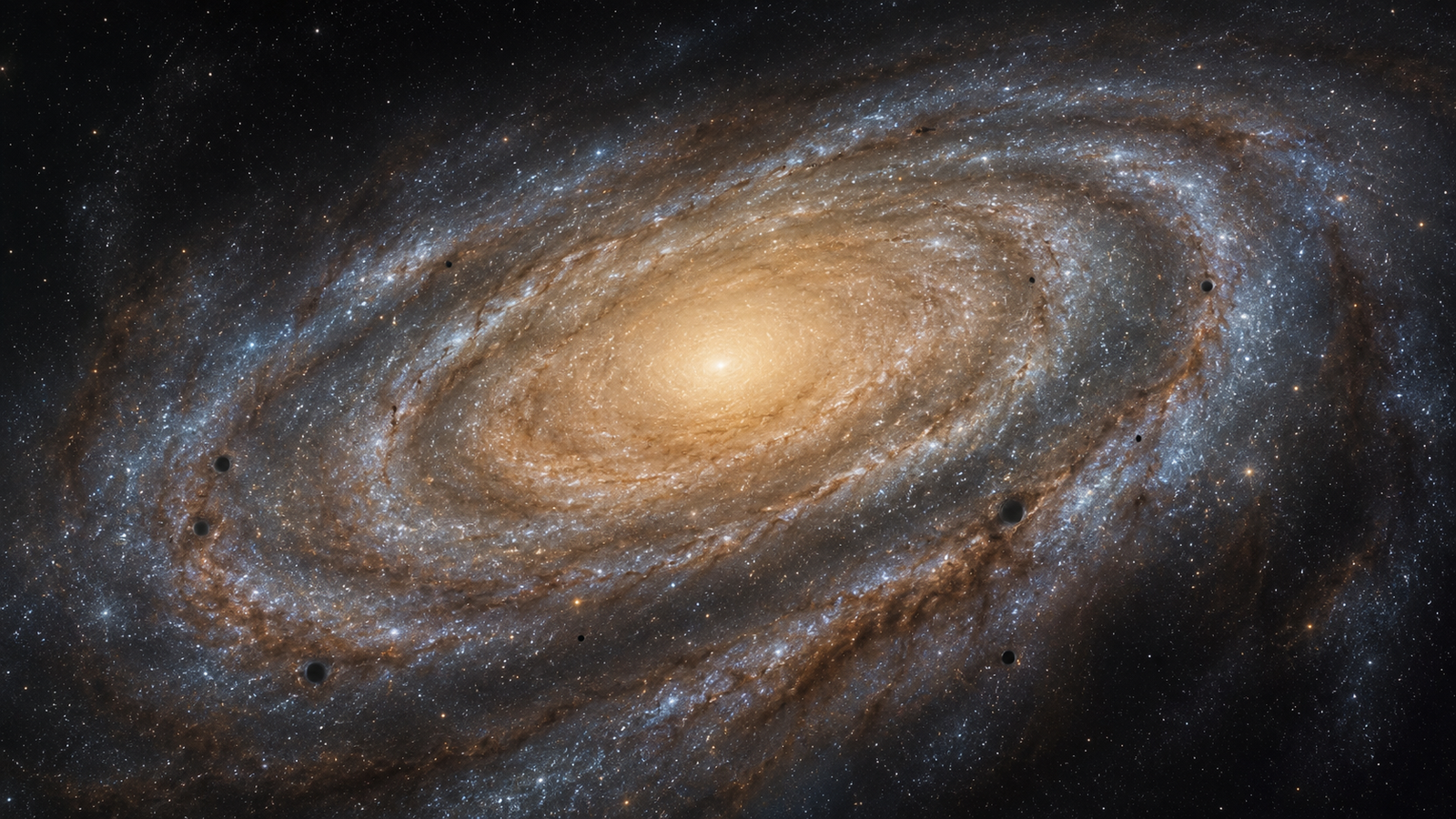
How many black holes are in the Milky Way? Probably at least 100 million, and some estimates push the total closer to one billion. Nobody has counted them. Most black holes drift alone, swallow almost nothing, and give off almost no light, so astronomers arrive at the number indirectly, by modeling how many massive stars have lived and died over the Galaxy’s long history.
One Galactic black hole is beyond dispute. Sagittarius A* sits at the center of the Milky Way and holds roughly 4 million times the mass of the Sun, and it remains the Galaxy’s only confirmed supermassive black hole. Between that giant and the ordinary stellar remnants scattered through the disk lies a third category, the intermediate-mass black holes. Astronomers are actively hunting for them, but no Milky Way example has yet reached the same level of observational certainty.
How Astronomers Estimate the Total
A direct census is out of the question. Most stellar-mass black holes do not continuously consume matter, do not produce bright X-rays, and do not visibly tug on a nearby star. They simply sit there, dark.
So researchers work backward. Population synthesis models begin with the Milky Way’s star formation history and estimate how many massive stars should have ended their lives as black holes.
These calculations lean on the initial mass function, which describes how frequently stars of different masses are born. They also fold in the star formation histories of the Galactic disk, bulge, and halo, along with stellar metallicity, wind driven mass loss, supernova physics, binary evolution, and the natal kicks delivered during compact object formation.
Metallicity matters more than most people expect. In general, stars with fewer elements heavier than helium lose less mass through stellar winds. They can therefore hold on to more material before collapse, and they may produce heavier black holes as a result. Binary interactions and the uncertain physics of stellar collapse can shift the outcome substantially in either direction.
Elbert, Bullock, and Kaplinghat approached the problem using empirical relationships between galaxy mass and metallicity. Their calculations indicated that a galaxy similar to the Milky Way should contain about 100 million stellar-mass black holes, including millions with masses around or above 30 solar masses.
Olejak and collaborators took a different route, building a synthetic Milky Way catalog with the StarTrack population synthesis code. Their model contained approximately 1.2 × 10⁸ single black holes with an average mass near 14 solar masses, plus about 9.3 × 10⁶ black holes still bound in binary systems with an average mass near 19 solar masses.
Other calculations land closer to 109. The spread is not sloppiness. The exact number depends on assumptions about the maximum neutron star mass, stellar winds, supernova mechanisms, binary interactions, and how many black holes were kicked clean out of the Galaxy.
Honest science stops short of a single figure here. The Milky Way probably contains tens of millions to hundreds of millions of stellar-mass black holes, and possibly close to one billion.
What Astronomers Have Actually Found
Set that estimate beside the observational record and the gap is startling.
Fewer than 100 Galactic stellar-mass black holes are currently known or strongly supported by observations. Only a few dozen have especially secure dynamical mass measurements. Most turned up in X-ray binaries, where a black hole strips gas from a companion star and heats it enough to glow in X-rays.
Gaia has opened a second route. Its precise astrometry can reveal the motion of a visible star orbiting an unseen massive object, even when the black hole is not actively accreting anything at all.
Astronomers can name fewer than a hundred black holes in a galaxy that almost certainly holds a hundred million.
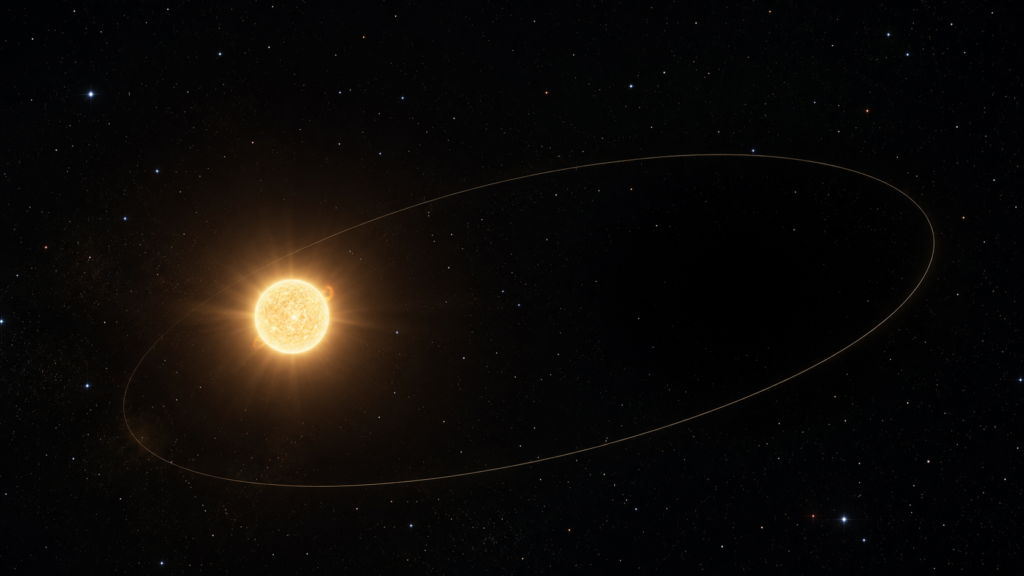
Gaia BH1
Gaia BH1 is the nearest known black hole system. It lies approximately 1,560 light-years away and contains a black hole with a measured mass of 9.27 ± 0.10 solar masses. A Sun-like companion completes one orbit every 185 days.
Nearest known is not the same as nearest. Undiscovered isolated black holes may sit far closer to us.
Gaia BH3
Gaia BH3 holds the most massive known stellar-origin black hole in the Milky Way, with a measured mass of 32.70 ± 0.82 solar masses.
The system lies about 590 parsecs from Earth, roughly 1,925 light-years, and includes an old, metal-poor giant star. That companion matters as much as the mass. Its discovery strongly supports the idea that metal-poor stellar populations can produce unusually massive black holes.
OGLE-2011-BLG-0462
One isolated stellar-mass black hole has also been caught, this time through gravitational microlensing.
OGLE-2011-BLG-0462 passed in front of a distant background star from Earth’s perspective. Its gravity magnified the star and shifted its apparent position by a tiny amount. Updated Hubble Space Telescope observations produced a mass of 7.15 ± 0.83 solar masses and a distance of 1.52 ± 0.15 kiloparsecs.
It remains the first and only isolated stellar-mass black hole that its discoverers describe as unambiguously identified.
The enormous distance between the estimated Galactic population and the tiny observed sample is mostly a selection effect rather than a failure of theory. Black holes become findable when they accrete matter, orbit a visible companion, merge with another compact object, or briefly lens a background star. Everything else stays invisible, which is part of why black holes reveal so little about themselves.
Sagittarius A*
Sagittarius A* is the supermassive black hole at the center of the Milky Way, and it is the best studied black hole in the sky.
Decades of tracking stars that whip around the Galactic center, particularly the star S2, point to a mass of about 4.3 million solar masses packed into an extremely small region. Those same orbits doubled as one of the strongest tests of general relativity ever performed.
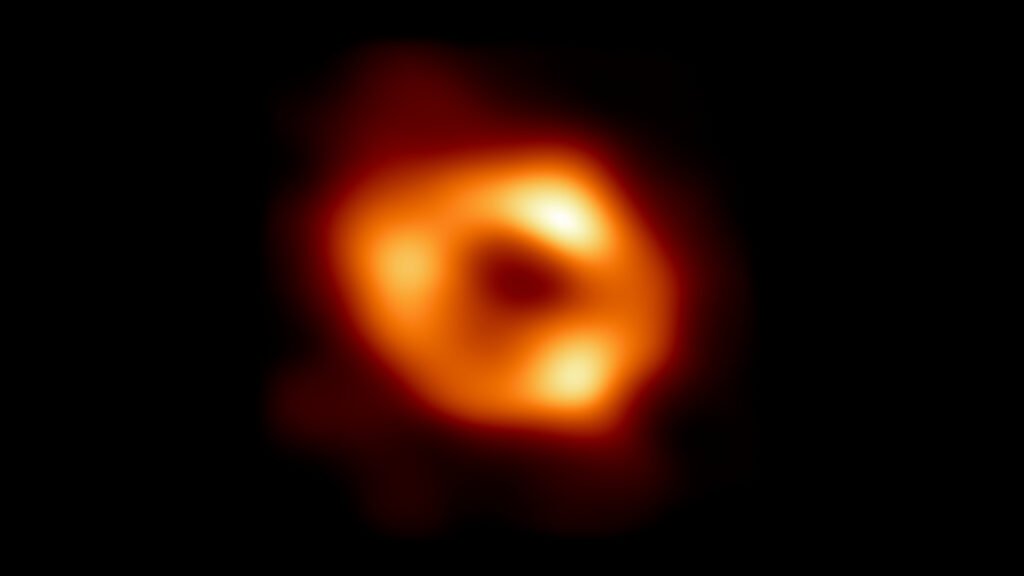
The Event Horizon Telescope then supplied an independent view at scales comparable to the event horizon itself. It reconstructed ring-like millimeter wavelength emission surrounding a central brightness depression.
That image deserves careful wording. It should not be described as a direct photograph of the event horizon, nor as a cleanly resolved photon ring. The observed structure is produced by hot plasma whose appearance is strongly shaped by gravity near the black hole.
By comparing the reconstructed angular scale with relativistic plasma simulations and an independently measured distance to the Galactic center, the Event Horizon Telescope collaboration obtained a mass estimate of about 4.0 million solar masses, with an uncertainty of roughly plus 1.1 million and minus 0.6 million solar masses.
Two completely different methods, one from stellar orbits and one from millimeter interferometry, agree.
Sagittarius A* is currently accreting matter at a very low rate compared with bright active galactic nuclei such as quasars. Its event horizon scale emission can flicker over timescales of minutes to hours, because the region producing that radiation is extremely compact. If you want a sense of what that environment would do to anything falling through it, we walked through the physics separately.
Intermediate-Mass Black Hole Candidates
Between stellar remnants and giants like Sagittarius A* lies a stubbornly empty stretch of the mass scale.
Intermediate-mass black holes would occupy that broad range. Dense star clusters may form or retain such objects through repeated mergers, runaway stellar collisions, or other dynamical processes, though nothing guarantees that they do.
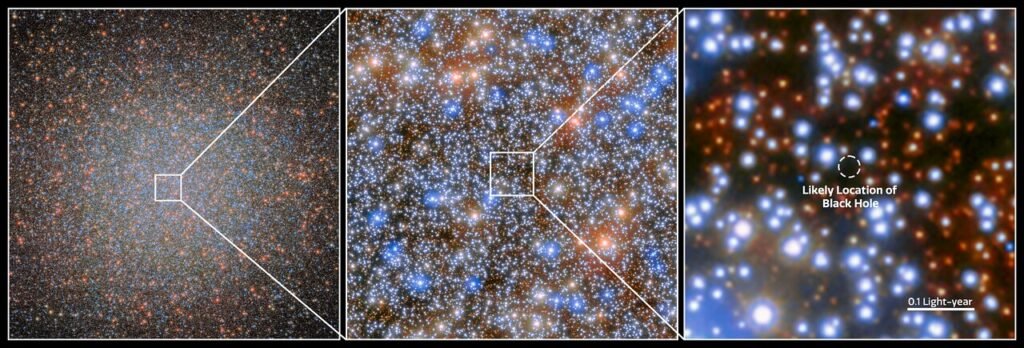
The strongest current Milky Way candidate sits near the center of Omega Centauri. Researchers identified seven unusually fast-moving stars within the cluster’s central region, and their velocities imply that they are orbiting a compact central mass.
The observations place a firm lower limit of about 8,200 solar masses on that object, which makes an intermediate-mass black hole the leading explanation.
The evidence is compelling. It is still more accurate to call the object a candidate than an unquestionably confirmed intermediate-mass black hole. Further measurements of stellar accelerations and three-dimensional orbits would strengthen the case considerably.
Omega Centauri has since produced a second, separate result. Whitaker and collaborators reported oMEGACat BH-2, a black hole of roughly 4.5 solar masses in a long period binary inside the same cluster, detected astrometrically with more than two decades of Hubble data plus JWST observations.
This is a stellar-mass black hole, not the proposed central intermediate-mass object. The two findings describe different objects in the same cluster and should never be combined into a single claim.
Where Are the Milky Way’s Black Holes?
Most stellar-mass black holes should broadly follow the Galaxy’s stellar population. Because most Milky Way stars live in the disk, the disk is expected to hold most of its black holes. Additional populations should exist in the bulge, the stellar halo, and star clusters.
The most massive remnants may be disproportionately tied to old, metal-poor populations, since reduced stellar wind mass loss leaves more material available for collapse.
Gaia BH3, which belongs to a metal-poor halo population or stellar stream, is the obvious example. Metallicity is not the only controlling factor, however, and it would be too simplistic to assign every massive black hole to the halo or the outer disk.
Simple order of magnitude estimates suggest that the nearest undiscovered black hole might lie only about 18 to 40 light-years from the Solar System.
Treat that number carefully. It is not a measured distance and not a prediction about any particular object’s position. It depends heavily on the assumed total number of black holes and on how closely their local distribution follows the local stellar mass density.
No black hole has been confirmed within 40 light-years of the Sun, but current observations do not exclude one.
Finding one that close would probably require a lucky microlensing alignment, the telltale motion of a visible companion, or faint radiation from interstellar gas trickling in.
Connections With Gravitational Wave Astronomy
LIGO, Virgo, and KAGRA have detected mergers involving black holes with masses well above those found in most traditional Galactic X-ray binaries. Nearly all of those gravitational wave events happened in distant galaxies rather than in the Milky Way.
The Galactic population still matters, because it offers a nearby laboratory for studying the same formation processes that also produce neutron stars and magnetars.
Gaia BH3 is especially useful here. Its mass overlaps with many black holes detected through gravitational waves, and its metal-poor environment supports models in which reduced stellar wind mass loss produces heavier remnants.
One caution applies. Only a tiny fraction of the Milky Way’s black holes are expected to sit in binaries tight enough to merge within the age of the Universe, so the total Galactic population cannot be inferred by counting gravitational wave events.
What Future Surveys May Reveal
The Nancy Grace Roman Space Telescope is expected to run a high precision microlensing survey toward the Galactic bulge.
By measuring both the brightening and the astrometric shift of background stars, Roman should help identify dark lenses and pin down the masses of additional isolated black holes.
Future Gaia data releases should reveal more dormant black holes in wide binaries. X-ray surveys will keep catching transient accreting systems, and long baseline optical monitoring, including the ten year sky survey now beginning at the Vera Rubin Observatory, may turn up more microlensing events.
None of this will identify every black hole individually. The real payoff is statistical.
A larger and less biased sample will let astronomers test population models, constrain natal kicks, measure the black hole mass distribution, and work out how often different stellar systems produce black holes at all.
So, How Many Black Holes Are in the Milky Way?
The best current answer is that the Milky Way probably contains around 100 million stellar-mass black holes, with plausible estimates running from roughly 108 to 109.
Only a minute fraction has been identified.
The Galaxy also holds Sagittarius A*, a confirmed supermassive black hole of about 4 million solar masses.
At least one strong intermediate-mass candidate may exist in Omega Centauri, but that interpretation has not reached the certainty attached to Sagittarius A*.
The Milky Way does not contain merely a handful of black holes. It may contain hundreds of millions of dark remnants left by generations of massive stars.
Key Takeaways
- The Milky Way probably contains at least 100 million stellar-mass black holes, and possibly close to one billion.
- Olejak and collaborators estimated approximately 1.2 × 10⁸ single black holes and 9.3 × 10⁶ black holes in binary systems.
- Fewer than 100 Galactic stellar-mass black holes are known or strongly supported observationally.
- Gaia BH1 is the nearest known black hole system, at about 1,560 light-years.
- Gaia BH3 contains the most massive known stellar-origin black hole in the Milky Way, at 32.70 ± 0.82 solar masses.
- OGLE-2011-BLG-0462 is the first and only isolated stellar-mass black hole currently described as unambiguously identified.
- Sagittarius A* contains about 4 million solar masses and is the Milky Way’s confirmed central supermassive black hole.
Frequently Asked Questions
How can astronomers estimate black holes they cannot see?
They combine the Milky Way’s star formation history with models of stellar evolution. Those models estimate how many massive stars should have formed black holes, and how many of those remnants should still remain in the Galaxy today.
Is Sagittarius A* the only supermassive black hole in the Milky Way?
It is the only confirmed one. No second Galactic object in the same mass category is known.
Could an isolated black hole be closer than Gaia BH1?
Yes. Gaia BH1 is the nearest known black hole, not necessarily the nearest one that exists.
Rough estimates suggest an undiscovered isolated black hole might lie within a few tens of light-years, though none has been confirmed at that distance.
Why are isolated black holes so difficult to find?
A black hole without a companion emits almost no light. It can only be detected if it lenses a background star, accretes detectable material, or produces some other measurable gravitational effect.
Do all population models treat ejected black holes in the same way?
No. Different models make different assumptions about natal kicks, escape from the Galaxy, and dynamical interactions. That is one reason their estimates vary so widely.
How does metallicity affect black hole mass?
Lower metallicity stars generally lose less material through stellar winds. They can therefore retain more mass before collapse and may form heavier black holes.
Binary evolution and supernova physics also shape the final mass.
Will future telescopes find most Milky Way black holes?
No. Roman, Gaia, and other surveys should greatly increase the detected sample, but most Galactic black holes will probably remain individually unseen.
References
Elbert, O. D., Bullock, J. S., and Kaplinghat, M. “Counting Black Holes: The Cosmic Stellar Remnant Population and Implications for LIGO.” Monthly Notices of the Royal Astronomical Society, 2018.
https://arxiv.org/abs/1703.02551
Olejak, A., Belczynski, K., Bulik, T., and Sobolewska, M. “Synthetic Catalog of Black Holes in the Milky Way.” Astronomy & Astrophysics, 2020.
https://arxiv.org/abs/1908.08775
Bambi, C. “Stellar-Mass Black Holes.” Symmetry, 2025.
https://arxiv.org/abs/2507.15270
Event Horizon Telescope Collaboration. “First Sagittarius A* Event Horizon Telescope Results. IV. Variability, Morphology, and Black Hole Mass.” The Astrophysical Journal Letters, 2022.
https://arxiv.org/abs/2311.08697
Sahu, K. C. et al. “OGLE-2011-BLG-0462: An Isolated Stellar-Mass Black Hole Confirmed Using New HST Astrometry and Updated Photometry.” 2025.
https://arxiv.org/abs/2503.07820
Nagarajan, P. et al. “ESPRESSO Observations of Gaia BH1: High-precision Orbital Constraints and No Evidence for an Inner Binary.” Publications of the Astronomical Society of the Pacific, 2024.
https://arxiv.org/abs/2312.05313
Gaia Collaboration et al. “Discovery of a Dormant 33 Solar-Mass Black Hole in Pre-release Gaia Astrometry.” Astronomy & Astrophysics, 2024.
https://arxiv.org/abs/2404.10486
Häberle, M. et al. “Fast-moving Stars Around an Intermediate-Mass Black Hole in Omega Centauri.” Nature, 2024.
https://arxiv.org/abs/2405.06015
Whitaker, M. et al. “A Long Period Stellar-Mass Black Hole Binary in Omega Centauri.” The Astrophysical Journal Letters, 2026.
https://arxiv.org/abs/2606.18350


Join the discussion
Comments are moderated and may take a little while to appear.