
In this article (14 sections)
- What is centripetal force?
- Centripetal acceleration and the formula
- Why does the force point inward?
- Is centripetal force a real force?
- Centripetal versus centrifugal force
- Does centripetal force do work?
- Everyday examples of centripetal force
- Gravity and circular orbits
- Particle accelerators: the relativistic case
- Pilots and high-g turns
- Rotating spacecraft and artificial gravity
- Key takeaways
- Frequently asked questions
- References
A stone on a string, a car rounding a bend and a satellite circling Earth look like very different systems. Yet each follows the same basic rule: an object moving along a curved path needs a net force directed towards the inside of the curve. For a circle, that inward role is called centripetal force.
The name can be misleading. Centripetal force is not a separate force that appears whenever something turns. It is a description of the net inward component of the real forces already present. Tension may provide it for a ball on a string, friction for a car, gravity for an orbiting satellite and a magnetic force for a charged particle in an accelerator.
What is centripetal force?
Centripetal means centre-seeking. In uniform circular motion, the velocity of an object is tangent to the circle at every instant. Although the speed is constant, the direction of that velocity keeps changing. A change in velocity is acceleration, so an inward acceleration must be present. Newton’s second law then requires an inward net force in the same direction.
This is why an object does not need an outward force to keep it moving around a circle. Left to itself, it would travel in a straight line tangent to the path. The inward force continually turns that straight-ahead motion into a curved trajectory.
Centripetal acceleration and the formula
For uniform circular motion, the magnitude of the inward acceleration is:
ac = v²/r
Here, ac is centripetal acceleration, v is speed and r is the radius of the circular path. Combining this with Newton's second law gives:
Fnet = mv²/r
The equation reveals two useful relationships. Doubling the speed makes the required inward force four times greater because speed is squared. Doubling the radius at the same speed halves the required force. A tight, fast turn is therefore far more demanding than a broad, slow one.
The formula describes the radial part of the motion. If the speed changes as well as the direction, there is also tangential acceleration. In that case, the total acceleration is the vector combination of radial and tangential components.
Why does the force point inward?
Imagine replacing a circular path with many very short straight segments. At the end of each segment, the velocity must turn slightly towards the next one. The change in velocity points inward, towards the centre of curvature. As the segments become shorter, the polygon becomes a circle and those small changes form a continuous inward acceleration.
If the inward force suddenly disappears, the object does not shoot radially outwards. It continues along the tangent it had at the instant of release. A stone released from a whirling sling and water leaving a spinning tyre both illustrate this result.
Is centripetal force a real force?
The physical forces are real, but the label centripetal describes their net inward role. It answers the question, “Which part of the net force bends the path?” It does not add another force to a free-body diagram.
- For a ball on a string, tension can supply the inward force.
- For a car on a level road, static friction between the tyres and road usually supplies it.
- For a roller-coaster car, gravity and the track's normal force may both contribute, with their roles changing around the loop.
- For a satellite in an ideal circular orbit, gravity supplies the entire inward force.
Centripetal versus centrifugal force
The apparent conflict between centripetal and centrifugal force comes from using different frames of reference. In an inertial frame, such as an observer standing beside a turning car, the car door or seat pushes the passenger inward so that the passenger follows the curve. There is no additional outward interaction acting on the passenger.
In the rotating frame of the car, the passenger is treated as being at rest. An apparent outward centrifugal force is introduced so that Newtonian equations can be used in that accelerating frame. Centrifugal force is therefore an inertial, or fictitious, force. It is useful in a rotating frame, but it is not a new physical interaction.
Coriolis force is another apparent force in a rotating frame, but it appears only when an object moves relative to that frame. A person standing still inside a rotating habitat does not experience a Coriolis deflection. A person walking radially or lifting an object can.
Does centripetal force do work?
In uniform circular motion, the inward force is perpendicular to the object's instantaneous velocity. Work depends on the component of force along the displacement, so the purely radial force does no work. It changes the direction of velocity, not its magnitude, and the kinetic energy remains constant.
That statement has limits. If an object speeds up, slows down or moves to a different radius, another component of force may act along the motion and do work. Real systems can therefore involve centripetal acceleration and an energy change at the same time.
Everyday examples of centripetal force
Cars taking a bend
On a level road, the tyres push sideways on the road and the road exerts an inward static-friction force on the tyres. If the available friction is too small for the required mv²/r, the vehicle cannot follow the intended curve and slides towards the outside relative to the bend. Banking a road lets part of the normal force contribute inward, reducing reliance on friction.
A ball on a string
The string pulls the ball towards the hand. The ball pulls back on the string with an equal and opposite force, but that reaction acts on the hand, not on the ball. If the string breaks, the tension vanishes and the ball travels along the tangent.
Roller-coaster loops
At the top of an idealised loop, the required inward direction is downward. Gravity contributes to the inward net force, and the track may add a normal force. The familiar minimum-speed condition v = √(gr) applies to a simplified car that is just maintaining contact on the inside of a circular track, with the normal force falling to zero at the top. Real coaster loops are not perfect circles, and modern wheel assemblies can retain the train mechanically, so the elementary result is a model rather than a complete design rule.

Gravity and circular orbits
In an ideal circular orbit, gravity supplies the inward force needed to continually redirect a satellite's velocity. Setting gravitational force equal to the circular-motion requirement gives the orbital speed:
GMm/r² = mv²/r so v = √(GM/r)
M is the mass of the central body, r is measured from its centre and G is the gravitational constant. The satellite's own mass cancels. At a larger circular-orbit radius, the required orbital speed is lower.
A satellite in orbit is still falling. Its sideways speed is large enough that the curved surface of Earth falls away beneath it at the same rate. This does not mean that every orbit keeps a constant distance. Most real orbits are elliptical, so radius and speed change around the path in accordance with Kepler's laws. Mission planning also accounts for perturbations, atmospheric drag where relevant, manoeuvres and the gravity of other bodies.
Particle accelerators: the relativistic case
The Large Hadron Collider bends proton beams around a 27-kilometre ring with superconducting dipole magnets. CERN reports that its main dipoles generate fields of about 8.3 tesla using a current of 11,080 amperes. The magnetic force is perpendicular to the proton's motion, so it changes direction rather than speed.
The school-level expression mv²/r cannot be applied directly to LHC protons because they travel extremely close to the speed of light. Their relativistic momentum, p, is the relevant quantity. For motion perpendicular to the magnetic field:
F⊥ = pv/r = qvB and therefore p = qBr
As beam energy rises, the speed changes very little because it is already close to c. The momentum continues to increase, however, and a stronger magnetic field is needed to hold the beam on the same curved path. The centripetal idea survives, but the dynamics must be written in relativistic form.
Pilots and high-g turns
A fast, tight aircraft turn requires a large inward acceleration. Pilots describe the resulting load in multiples of g, Earth's standard gravitational acceleration. The United States Air Force's human-rated centrifuge allows students to experience up to 9 g during training. The aim is to recognise the physiological effects and practise techniques that reduce the risk of g-induced loss of consciousness.
So that’s our number one priority for this device is training.Scott Fleming, Program Manager, 711th Human Performance Wing
The “g-force” a pilot feels is closely related to the force exerted by the seat and restraints. At high positive g, the cardiovascular system must work against a strong head-to-foot acceleration, which can reduce blood flow to the brain. Protective equipment and the anti-g straining manoeuvre improve tolerance, but high-g flight remains physically demanding.
Rotating spacecraft and artificial gravity
A rotating habitat can make its floor push occupants inward. In an inertial frame, that inward normal force keeps each person moving in a circle. In the rotating frame, the same experience is described with an apparent outward centrifugal force that holds the person against the floor.
The acceleration at the floor is a = ω²r, where ω is angular speed in radians per second. A 30-metre radius rotating at 4.5 rpm produces about 6.66 m/s², or 0.68 g, not 0.9 g. Reaching 0.9 g at that radius requires about 5.18 rpm. A 50-metre radius at 4.2 rpm produces about 9.67 m/s², or 0.99 g.
Larger habitats can achieve the same floor acceleration at a lower rotation rate. That matters because small, fast-spinning habitats produce stronger head-to-foot gravity gradients and more noticeable Coriolis effects when people move. Rotation can imitate some effects of gravity, but it is not locally identical to a uniform gravitational field in every respect.
What Gemini XI actually demonstrated
Rotational artificial gravity is not purely theoretical. In 1966, Gemini XI and an Agena target vehicle were connected by a 30-metre tether and set into slow rotation. NASA reports that the experiment produced about 0.00015 g. The acceleration was far too weak to support crew health or ordinary habitation, but it was a genuine crewed demonstration. No crewed spacecraft has yet used rotational artificial gravity at a sustained, operationally significant level.
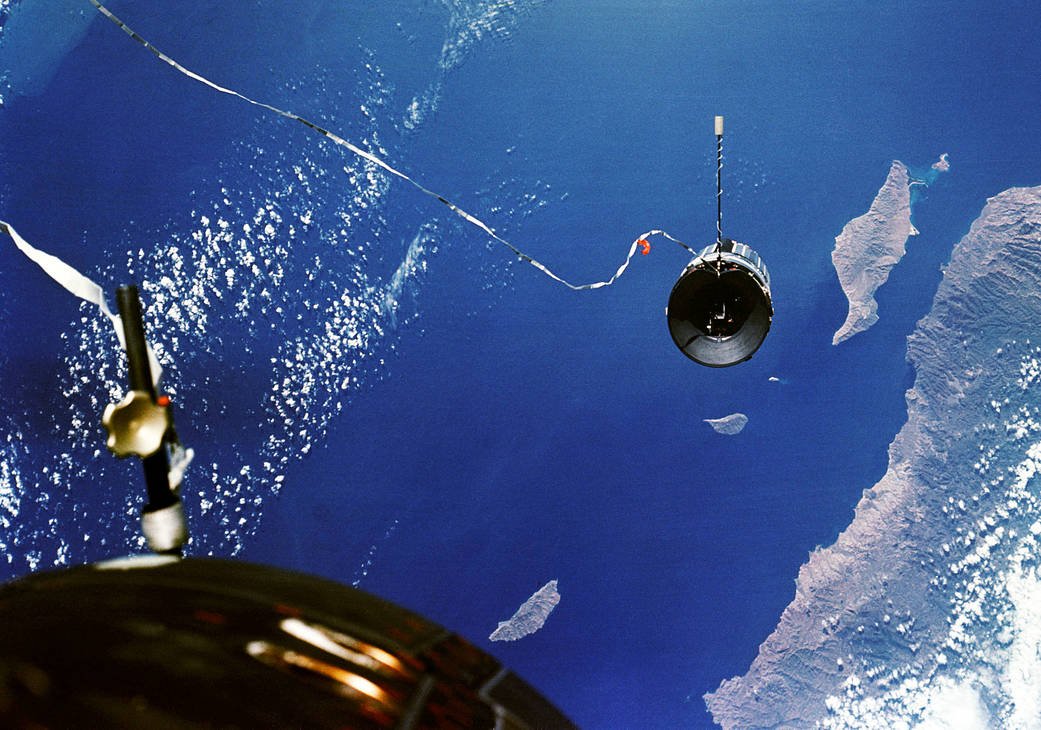
There is an artificial gravity field.Dick Gordon, Gemini XI pilot
Key takeaways
- Centripetal force is the net inward role of real forces, not a separate type of force.
- For uniform circular motion, ac = v²/r and Fnet = mv²/r.
- Without the inward force, an object continues along the tangent rather than flying radially outward.
- Centrifugal and Coriolis forces are useful apparent forces in rotating frames; Coriolis effects require motion within that frame.
- The inward force does no work in uniform circular motion because it is perpendicular to velocity.
- Circular-orbit equations are idealisations; elliptical orbits have changing radius and speed.
- Relativistic accelerators require momentum-based dynamics, not the classical m v²/r expression with ordinary mass.
Frequently asked questions
What causes centripetal force?
Any real force, or combination of forces, can provide the required inward net force. Common sources include tension, friction, gravity, normal force and magnetic force.
Which way does centripetal force point?
For circular motion it points radially inward, towards the centre of the circle. On a more general curved path, the normal component points towards the local centre of curvature.
Why does centripetal force point inward?
The object's velocity is tangent to the path. Turning that velocity towards the next tangent requires an inward change in velocity, so the acceleration and net force point inward.
Is centrifugal force the opposite of centripetal force?
Not as a Newton's third-law pair. Centripetal force describes the inward net force in an inertial frame. Centrifugal force is an apparent force introduced in a rotating frame. A true reaction force acts on a different object.
Does centripetal force change speed?
A purely centripetal force in uniform circular motion changes direction only. If a tangential force component is also present, the speed can change.
References
- NASA Goddard Space Flight Center. “Circular Motion and Gravity.” NASA Imagine the Universe. https://imagine.gsfc.nasa.gov/features/yba/CygX1_mass/gravity/circular_motion.html
- Nave, C. R. “Orbital Motion.” HyperPhysics, Georgia State University. http://hyperphysics.phy-astr.gsu.edu/hbase/orbv.html
- CERN. “Pulling Together: Superconducting Electromagnets.” home.cern. https://home.cern/science/engineering/pulling-together-superconducting-electromagnets/
- CERN. “LHC Magnets: The Great Descent.” home.cern, March 7, 2005. https://home.cern/lhc-magnets-the-great-descent/
- CERN. “Large Hadron Collider.” home.cern. https://home.cern/science/accelerators/large-hadron-collider/
- LHC Closer (CERN outreach project). “Taking a Closer Look at LHC: Lorentz Force.” https://www.lhc-closer.es/taking_a_closer_look_at_lhc/0.lorentz_force
- United States Air Force. Air Force Manual 11-404, Aerospace Physiology. Headquarters AETC. https://static.e-publishing.af.mil/production/1/af_a3/publication/afman11-404/afman11-404.pdf
- Air Force Research Laboratory. “711 HPW: Human-Rated Centrifuge.” afrl.af.mil. https://www.afrl.af.mil/About-Us/Fact-Sheets/Fact-Sheet-Display/Article/2333796/711-hpw-human-rated-centrifuge/
- DVIDS. “711 HPW Centrifuge Hosts Euro-NATO Joint Jet Pilot Training Students.” U.S. Air Force photo by Richard Eldridge, August 12, 2025. https://www.dvidshub.net/image/9283684/711-hpw-centrifuge-hosts-euro-nato-joint-jet-pilot-training-students
- DVIDS. “Cadets Qualify for Olympic Trials in Multiple Sports.” U.S. Air Force photo by Trevor Cokley, May 7, 2024. https://www.dvidshub.net/image/8494453/cadets-qualify-olympic-trials-multiple-sports
- NASA. “A View From Above.” nasa.gov, March 23, 2008. https://www.nasa.gov/image-article/view-from-above-4/
- NASA. “Sept. 14, 1966: Gemini XI Artificial Gravity Experiment.” nasa.gov. https://www.nasa.gov/image-feature/sept-14-1966-gemini-xi-artificial-gravity-experiment/
- NASA Technical Reports Server. “Chapter 2: Physics of Artificial Gravity.” 2007. https://ntrs.nasa.gov/api/citations/20070001008/downloads/20070001008.pdf
- Aerospace America (American Institute of Aeronautics and Astronautics). “Artificial Gravity’s Attraction,” March 20, 2025. https://aerospaceamerica.aiaa.org/features/artificial-gravitys-attraction/
Join the discussion
Comments are moderated and may take a little while to appear.