
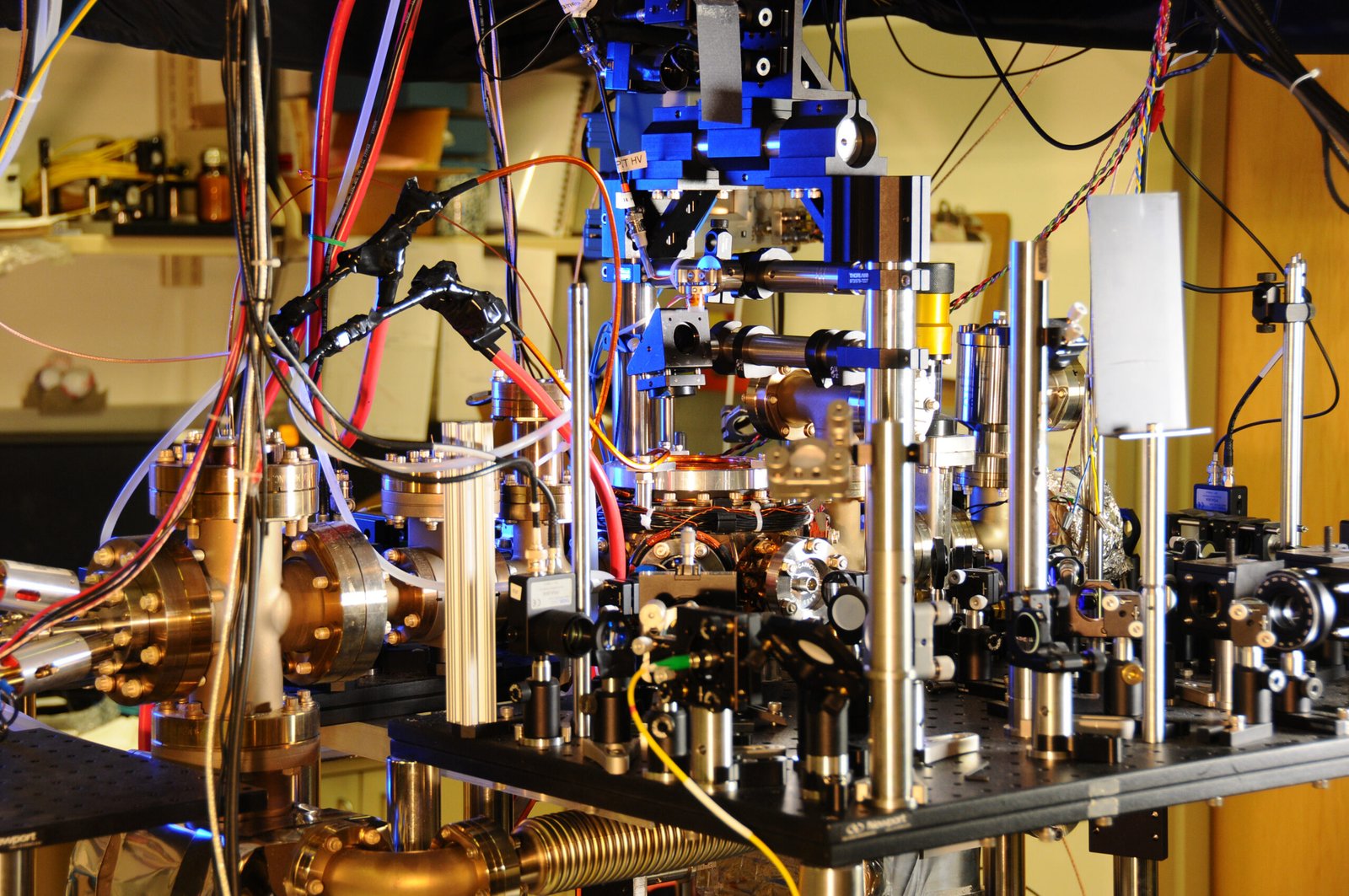
A coffee cup sitting on a desk is either full or empty, not both. A phone is either on the table or under the sofa, not somewhere in between. Yet the equations of quantum mechanics describe particles existing in superpositions, blends of multiple possibilities at once, until something forces them to settle into a single outcome. If the universe runs on quantum rules at its smallest scales, why does the world made of atoms, coffee cups, and phones look so stubbornly ordinary? Once you have quantum decoherence explained, the reason turns out to be almost mechanical.
The answer physicists give is decoherence. It is not a separate law bolted onto quantum theory. It is what the standard quantum formalism itself predicts will happen when a delicate quantum system meets a busy, uncontrolled environment. Understanding decoherence explains why quantum weirdness is real at the scale of atoms and photons, why it becomes nearly invisible at the scale of everyday objects, and why building a working quantum computer is one of the hardest engineering problems humans have taken on.
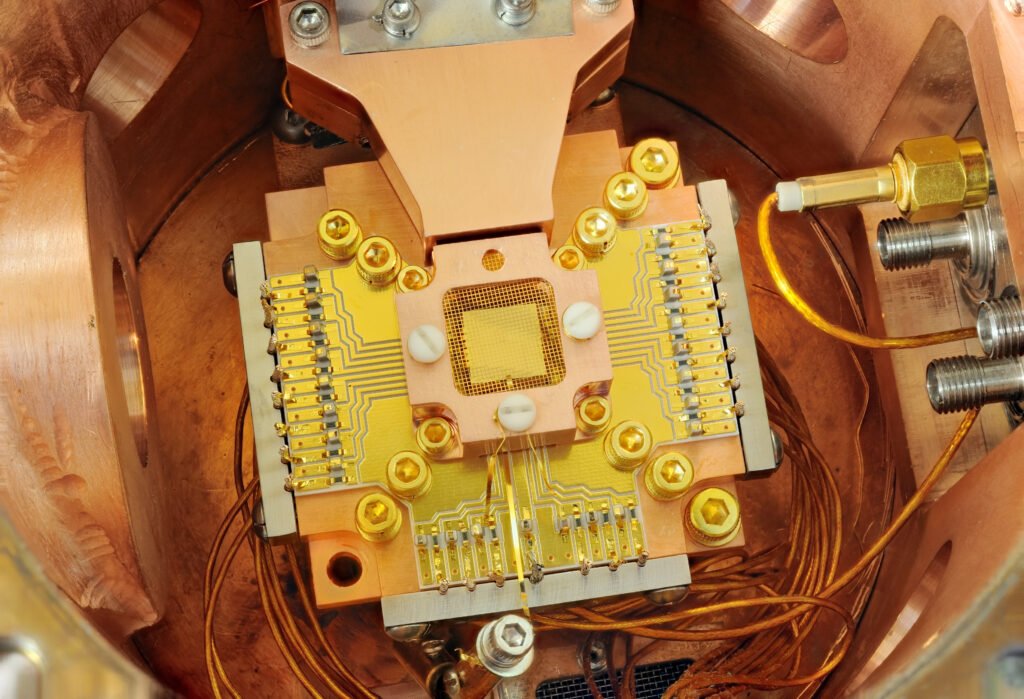
The Puzzle: Why the World Around Us Doesn’t Look Quantum
Quantum mechanics has passed a century of precise experimental tests. Electrons really can behave as if spread across multiple states, and photons really can interfere with themselves in ways that only make sense if they explore multiple paths at once. None of this is in serious scientific dispute.
The puzzle is scale. A single photon or trapped ion can be prepared in a superposition and held there for a controlled period in a laboratory. A cup of coffee, made of roughly a trillion trillion atoms, is never caught in a superposition of full and empty. Something happens between the quantum world of individual particles and the classical world of ordinary objects that erases the strangeness, and it happens fast.
For decades this gap was often described loosely as the observer causing collapse, which made it sound almost mystical, as though consciousness itself were required to fix reality in place. Decoherence theory, developed from the 1970s onward and formalized in detail by physicists including Wojciech Zurek and Maximilian Schlosshauer, replaced that vague picture with a mechanical one grounded entirely in the mathematics of quantum mechanics. It picks up where our piece on why electrons don’t fall into the nucleus left off: if quantum rules genuinely govern atoms, why don’t they visibly govern anything bigger?
What Superposition Actually Means
Superposition means a quantum system’s state is a combination of two or more distinct possibilities, described by a wave function, until an interaction forces one specific outcome to become the one that is actually observed. A useful comparison is a coin spinning in the air. It is not simply hidden in a heads or tails state waiting to be revealed. It is genuinely in a combined state that only becomes one definite outcome once something, like a table, interacts with it and stops the spin.
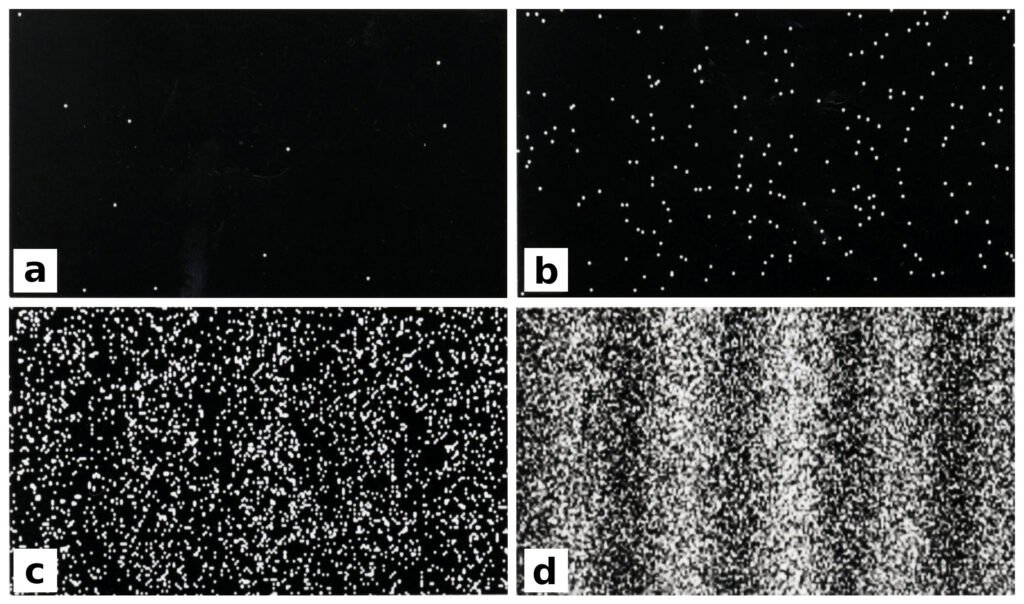
The comparison has limits, and it is worth being honest about them. A spinning coin still obeys ordinary classical physics underneath. A quantum particle in superposition is described by a wave function that produces real interference effects, effects with no classical analogue at all, such as the pattern seen in the classic double slit experiment. The point that matters here is simpler: superposition is fragile, and almost anything that interacts with the system can end it.
Quantum Decoherence Explained: What It Actually Means
Decoherence is the loss of a system’s ability to show quantum interference effects because it has become entangled with its surrounding environment. IBM’s technical glossary puts it plainly: decoherence is the process in which a system in a quantum state collapses into a nonquantum state, triggered either intentionally by measurement or unintentionally by environmental factors.
None of this requires a conscious observer. A stray air molecule bouncing off a dust particle, a photon of ambient light scattering off an atom, or a vibration passing through a crystal lattice can all do the job.
Each interaction leaves a tiny trace of information about the system’s state, smeared out into the environment. Once that information has spread into enough surrounding particles, it can never in practice be gathered back together, and the original superposition becomes impossible to observe. IBM Quantum describes this as a chain reaction in which information about a quantum system spreads into its surroundings, effectively locking the system into what looks, from then on, like a single classical state.
It is also why larger objects lose their quantum behavior almost instantly. A single isolated atom has relatively few ways to interact with its surroundings. A coffee cup has an astronomical number of atoms, each one a potential channel for information to leak into the environment, so any superposition it might theoretically hold collapses far too fast for anyone to notice.
The Environment Is Always Watching
Watching here does not mean anything visual or deliberate. It means physical interaction of any kind. The National Institute of Standards and Technology puts it directly: superpositions are fragile, and stray noise can alter them in ways that are difficult to correct; measuring a particle, or simply disturbing it in almost any way, destroys the superposition and forces it into one definite state, at which point it behaves like an ordinary classical bit.
In practice, the environment pressing in on a fragile quantum system includes:
- Air molecules colliding with the system
- Ambient light and stray electromagnetic fields
- Heat, meaning the random thermal motion of nearby atoms
- Mechanical vibrations carried through supporting materials
- The measuring instrument itself, the moment it interacts with the system
None of these need to be intentional. They are simply what any object embedded in a warm, busy universe experiences constantly. Decoherence, in this sense, is not an exotic failure mode. It is the default fate of any quantum system that is not carefully shielded.
The opposite extreme makes the point clearly. Neutrinos barely interact with anything at all, which is exactly why they are so difficult to catch in a detector, a fact covered in our piece on why neutrinos are nearly impossible to catch. That same near total lack of interaction is also why neutrinos hold onto their quantum properties over enormous distances. With so little to decohere them, there is almost nothing to force a collapse.
Why This Makes Quantum Computers So Fragile
Quantum computers try to do the opposite of what nature does by default: keep information in a fragile superposition long enough to perform a calculation with it. A quantum bit, or qubit, is useful precisely because it can hold a superposition of 0 and 1, and because multiple qubits can become entangled with each other in ways that give quantum computers their theoretical advantage over classical machines.
That advantage disappears the moment decoherence sets in, because the delicate superposition or entanglement the qubit relies on collapses into an ordinary, classical 0 or 1 before the computation finishes. IBM notes that quantum computing generally requires avoiding and minimizing decoherence as a central engineering challenge, not an occasional inconvenience. Every millisecond a qubit spends interacting with heat, stray fields, or vibration is a millisecond closer to losing the information it was meant to hold.
Why Quantum Computers Need Extreme Cold and Isolation
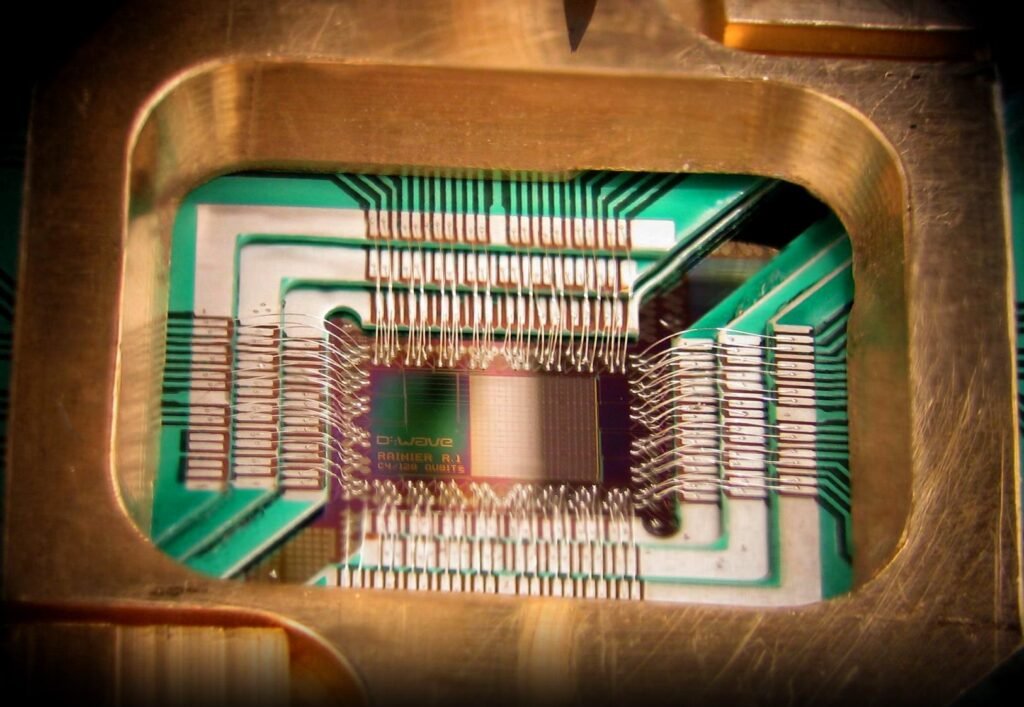
This is why leading qubit technologies, particularly the superconducting qubits used by companies including IBM and Google, are cooled to temperatures only a few thousandths of a degree above absolute zero. At these temperatures, thermal motion, one of the biggest sources of environmental noise, is suppressed as much as physically possible, and the materials involved become superconducting, meaning they carry electrical current with zero resistance, which is itself required for the qubit’s quantum behavior to exist at all. A 2023 National Academies review of quantum computing technologies notes plainly that superconducting qubits require milli Kelvin temperatures to operate.
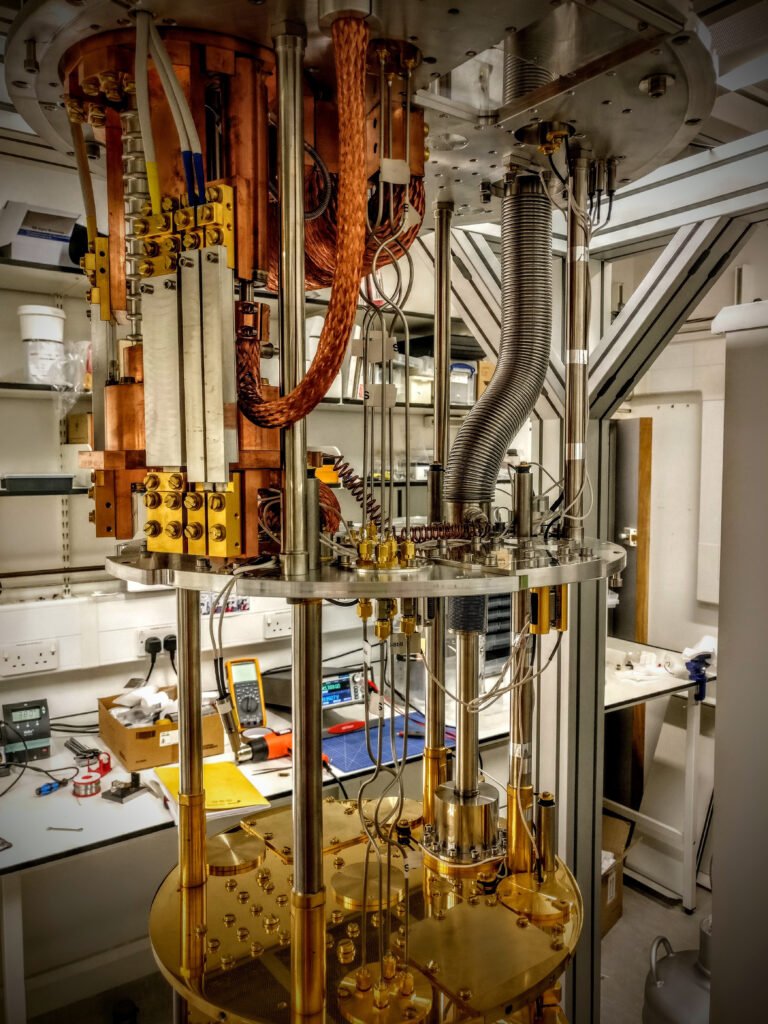
Reaching and holding those temperatures takes specialized hardware called dilution refrigerators, and research into better refrigeration remains an active engineering frontier. A 2024 report in Physics Magazine, published by the American Physical Society, described a new refrigerator design capable of cooling qubits to a record 22 thousandths of a degree above absolute zero, built specifically because even the smallest heat leak or stray radiation can knock a qubit out of the state a calculation depends on. Isolation from vibration, magnetic fields, and stray light matters just as much as temperature. A quantum computer is, in effect, an attempt to build a tiny bubble where decoherence happens as slowly as science currently allows.
Does Decoherence Solve the Measurement Problem?
It is tempting to treat decoherence as the final answer to one of quantum mechanics’ oldest puzzles, the measurement problem: why does a single, definite outcome appear when a quantum system is measured, when the underlying mathematics describes a superposition of many possible outcomes evolving together? Decoherence explains why we never see interference effects from macroscopic superpositions, and why a measured system behaves, for all practical purposes, as if it settled into one classical state.
But most physicists working on the foundations of quantum theory, including Schlosshauer in his widely cited review, are careful to note that decoherence does not fully resolve the deeper interpretive question of why one specific outcome is realized rather than another. Decoherence describes unitary entanglement between the system and its environment. On its own, it does not explain the appearance of a single definite result rather than a persistent combination of possibilities from some larger point of view. Different interpretations of quantum mechanics, from many worlds to various collapse theories, still disagree on what exactly happens at that last step. Decoherence narrows the mystery considerably. It has not, at least so far, closed it entirely.
Why This Matters
With quantum decoherence explained this way, it becomes the bridge between two pictures of nature that can otherwise seem contradictory: a quantum world full of superpositions and interference, and a classical world of definite positions and outcomes. Understanding it removes the need for mysterious observer effects and replaces them with an ordinary, if subtle, physical process: information leaking from a fragile system into an environment too complex to ever fully track again.
It also has direct, practical consequences. Every attempt to build a large scale, reliable quantum computer is, at its heart, a fight against decoherence. Progress on error correction, better materials, and colder, quieter hardware is progress against the same physical process that keeps a coffee cup behaving like an ordinary object instead of a quantum one.
Key Takeaways
- Superposition is a real quantum state in which a system holds multiple possibilities at once, described mathematically by a wave function.
- Decoherence is the loss of a system’s quantum behavior caused by entanglement with its surrounding environment, not by conscious observation.
- Almost any interaction, including air molecules, heat, light, and vibration, can cause decoherence, which is why large objects lose quantum behavior essentially instantly.
- Quantum computers must fight decoherence directly, which is why qubits are cooled to near absolute zero and shielded from vibration and stray fields.
- Decoherence explains why quantum interference disappears at large scales, but physicists still debate whether it fully resolves the deeper measurement problem.
FAQs
What is quantum decoherence in simple words?
Quantum decoherence explained simply: it is the process by which a quantum system loses its ability to show quantum effects, like superposition, because it interacts with its surrounding environment and becomes entangled with it.
Is decoherence the same as measurement?
Measurement is one way to trigger decoherence, but decoherence also happens without a deliberate measurement, through ordinary interactions with air, light, heat, or vibration.
Why do quantum computers need to be cold?
Cold temperatures reduce thermal motion, one of the main sources of environmental noise that causes decoherence, and are required for the superconducting materials many qubits depend on.
What destroys quantum superposition?
Any interaction that transfers information about a system’s state into its environment can destroy superposition, including stray electromagnetic fields, heat, and physical disturbance.
Does decoherence explain Schrödinger’s cat?
Decoherence explains why a cat sized object could never realistically be caught in a superposition of alive and dead, since its enormous number of atoms would interact with the environment and lose coherence almost instantly.
Can decoherence be reversed?
In principle it is extremely difficult, because reversing it would require gathering back information that has spread throughout a complex environment. In practice, once decoherence has occurred, it is treated as effectively irreversible.
References
- National Institute of Standards and Technology, The Strange World of Quantum Physics: nist.gov
- IBM, What Is Quantum Computing? ibm.com
- IBM Quantum, Wigner’s Friend and the Limits of Quantum Mechanics: ibm.com
- Schlosshauer, M., Decoherence, the Measurement Problem, and Interpretations of Quantum Mechanics, Reviews of Modern Physics 76, 1267 (2004): arxiv.org
- National Academies of Sciences, Engineering, and Medicine, Quantum Computing: Progress and Prospects, Appendix C: nationalacademies.org
- American Physical Society, Physics Magazine, Quantum Refrigerator Keeps Qubits Cool: physics.aps.org


Join the discussion
Comments are moderated and may take a little while to appear.