
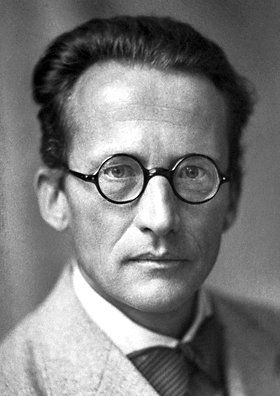
A particle does not sit still and wait to be found. Before anyone looks, it exists as a spread of possibilities, and the rule that governs how those possibilities move through time is the one Erwin Schrödinger wrote down in 1926. Physicists call it the Schrödinger equation, and although it is usually introduced through a page of symbols, its actual job is far simpler than that page suggests. Here is the Schrödinger equation explained the way it actually works: as a description of how a quantum system changes from one moment to the next.
The Schrödinger equation explained: what it actually does
The Schrödinger equation does not predict where a particle is. It predicts how the odds of finding a particle in different places change over time. That distinction is the whole point of quantum mechanics, and it separates this equation from anything in classical physics.
Think of it as a set of instructions rather than a formula to solve. Feed it the current state of a quantum system and the forces acting on it, and it hands back the state of that system at any later moment, with complete precision. That precision belongs to the underlying pattern of possibilities, not to any single measurement. The pattern evolves in a fixed, predictable way. What you actually see when you measure the particle does not.
Why Schrödinger needed a new rule
By the 1920s, several experiments had already broken classical physics beyond repair. Electrons inside atoms did not spiral smoothly into the nucleus the way a tiny orbiting planet would. Instead they sat at fixed energy levels and jumped between them, absorbing or releasing light at very specific frequencies. Light itself behaved as a wave in some experiments and as discrete particles in others.
A few years earlier, Louis de Broglie had proposed that matter might carry a wave nature of its own, not just light. Schrödinger took that idea seriously and asked what kind of wave behavior would produce the fixed energy levels physicists were already seeing in the lab. What he arrived at treated electrons less like tiny orbiting balls and more like standing waves wrapped around the nucleus, in the same way a guitar string only rings at certain fixed pitches once its ends are held in place.
He was not working alone in the field. Around the same time, Werner Heisenberg had developed a completely different approach to the same problem, built from grids of numbers rather than waves, known today as matrix mechanics. The two methods looked nothing alike on paper and were developed independently within months of each other. Schrödinger published a proof in 1926 arguing the two were mathematically equivalent, and most physicists accepted it at the time. Historians of physics have since pointed out that the early proofs, including Schrödinger’s, had technical gaps, and a fully rigorous version of the equivalence was not established until the mathematician John von Neumann worked it out in 1932. Even so, the fact that two very different starting points converged on the same physics helped convince the field that quantum mechanics was describing something real.
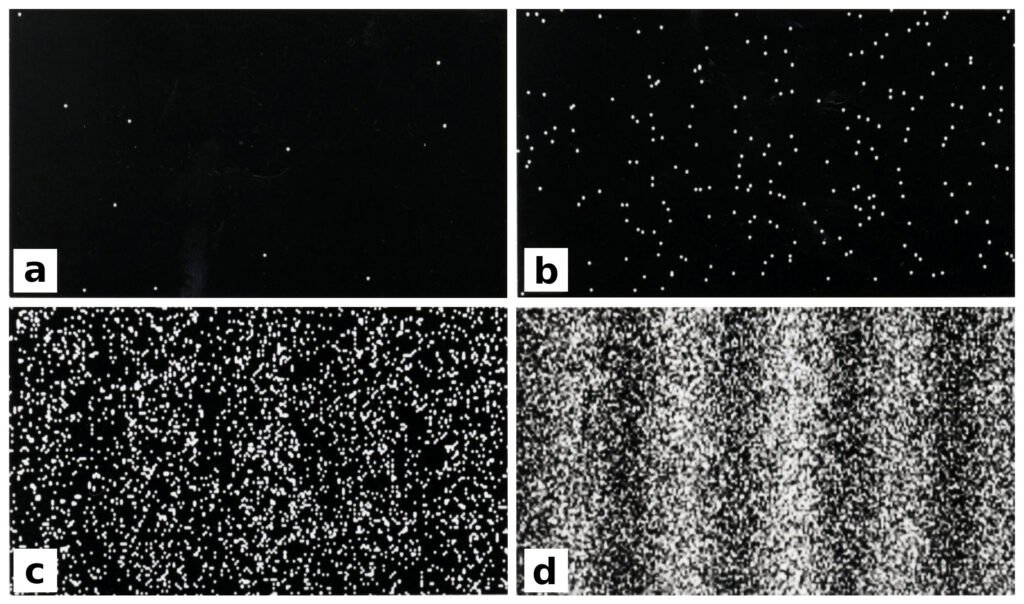
Before a measurement, a particle is not located anywhere in particular. It exists as a spread of possible outcomes, all at once.
What the wave function represents
The central object in this story is called the wave function. It is not a physical ripple you could point a camera at. It is a description, one that assigns a likelihood to every place a particle might be found.
Where that likelihood is high, the particle tends to show up when measured. Where it is low or effectively zero, the particle almost never appears there, sometimes because the dynamics of the system forbid it outright. Physicists often describe the wave function as a landscape of probability, and the Schrödinger equation is the rule that reshapes that landscape as time passes, shifting where the high and low points sit.
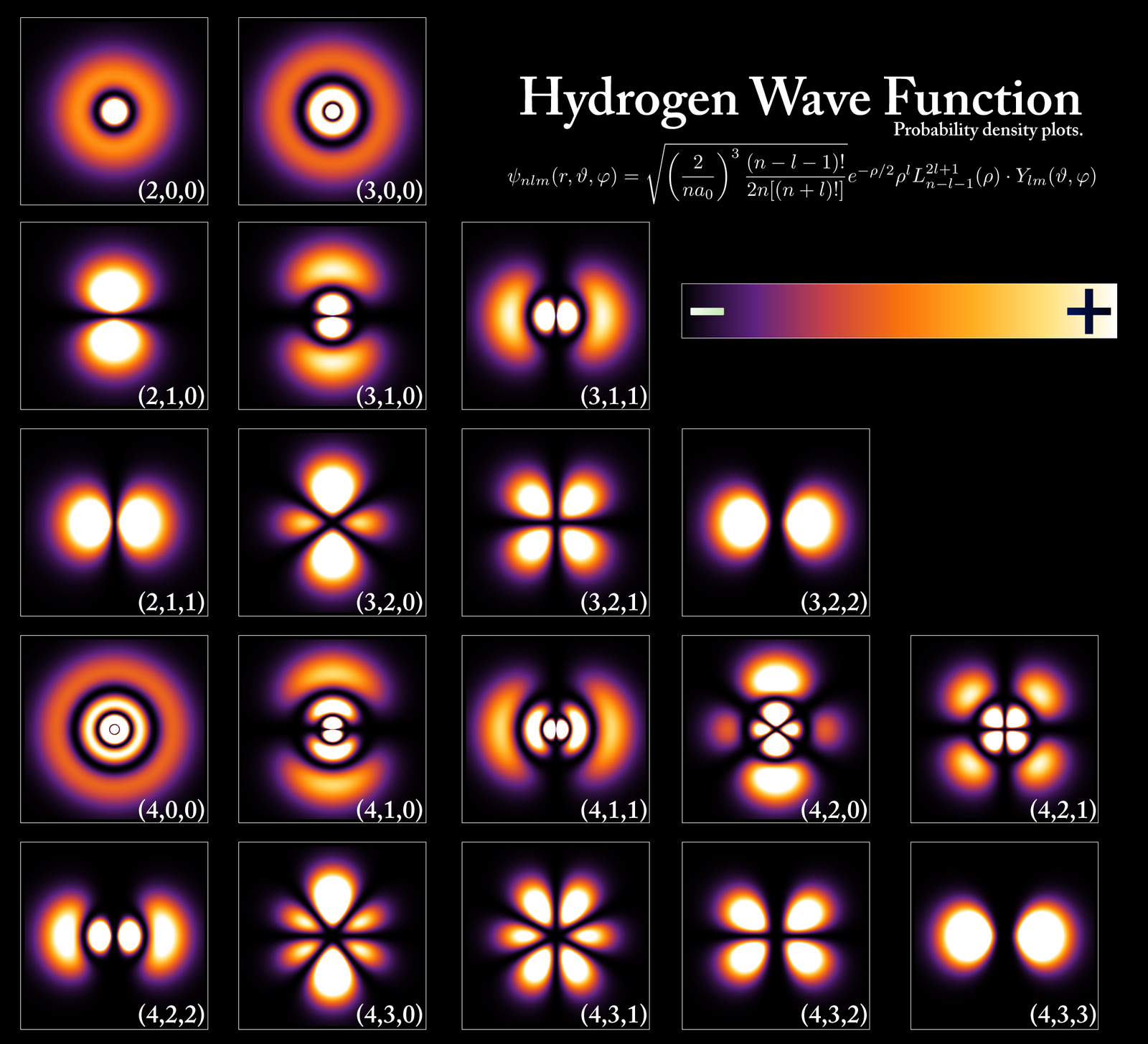
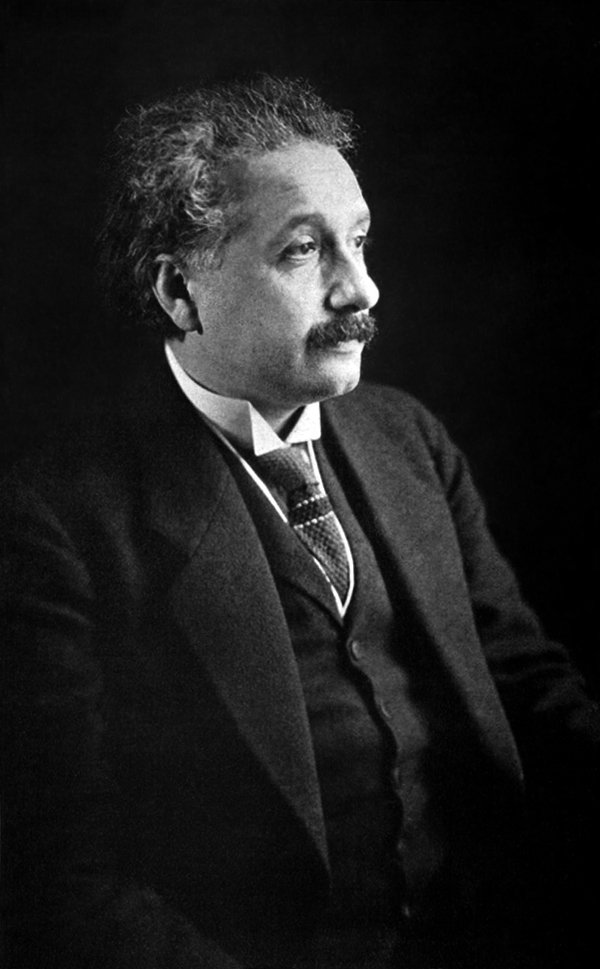
Image via Wikimedia Commons, public domain.
A simple case: the particle in a box
One of the clearest ways to see this in action is a thought experiment called the particle in a box, used in nearly every introductory course on the subject. Picture a particle trapped between two rigid walls, unable to exist outside them, with nothing pushing or pulling on it in between.
Work out what the Schrödinger equation allows inside that box, and the result is a set of standing wave patterns, each fitting neatly between the walls. Two things follow from this. First, only certain energies are allowed, corresponding to patterns with a whole number of humps, the same way a plucked string only rings at certain fixed pitches and nothing in between. Second, the particle is not equally likely to be found everywhere inside the box. Some spots are favored, others are not, depending on which of those allowed patterns the particle occupies.
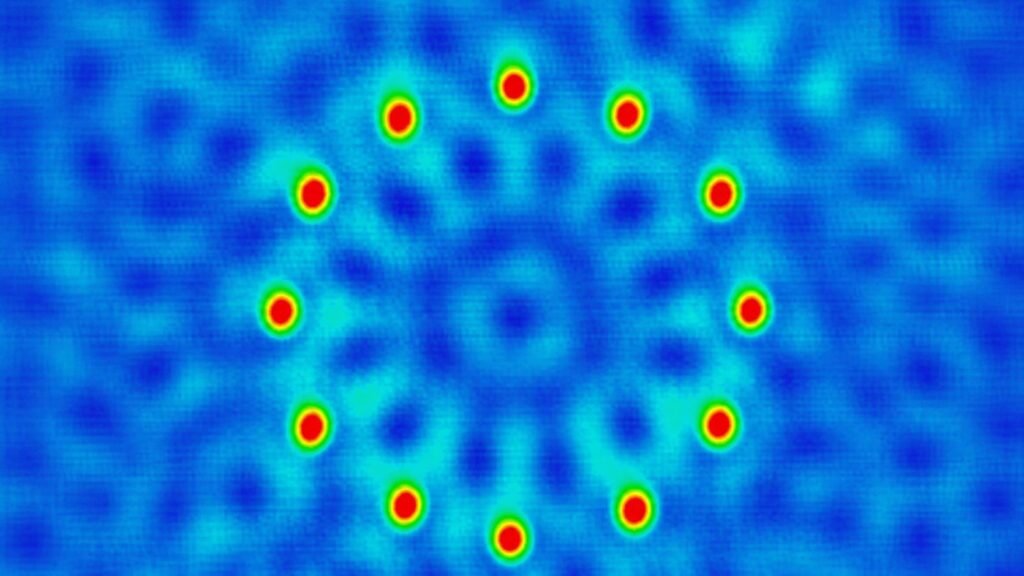
This toy setup captures something real about atoms. Electrons bound to a nucleus behave in a similar way, sitting at fixed energy levels rather than a continuous range, which is why atoms absorb and give off light only at specific, characteristic colors.
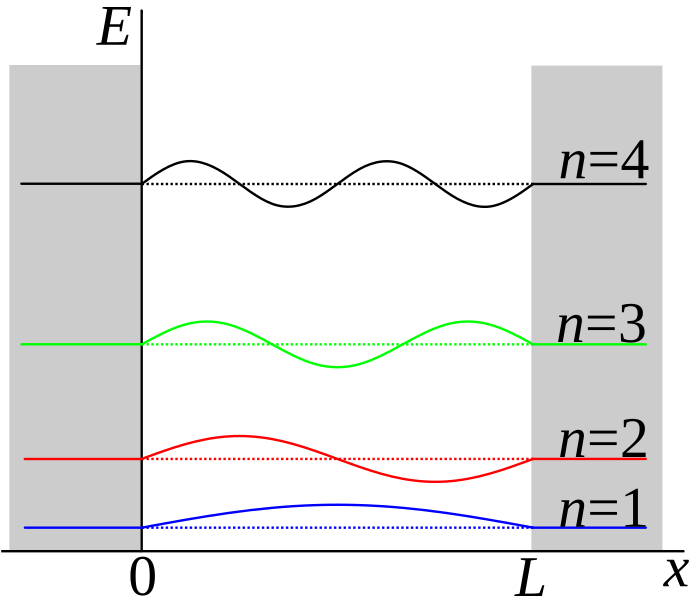
Image via Wikimedia Commons, licensed CC BY-SA 3.0.
Where you can actually see this at work
This is not an abstract point. Sodium streetlights glow a distinct orange because sodium atoms can only release light at a small set of exact wavelengths, fixed by the energy levels the Schrödinger equation predicts for a sodium electron. Neon signs glow red for the same reason, just with a different set of allowed energies belonging to neon. Every element has its own fingerprint of colors it can emit, and astronomers read exactly this fingerprint in starlight to work out what a distant star is made of, without ever needing to travel there.
Every element leaves its own fingerprint of colors in the light it gives off, fixed by the same physics that governs an electron trapped in a box.
The same confinement idea from the particle in a box shows up in modern technology too. In a quantum dot, a semiconductor crystal only a few nanometers across, electrons are boxed in on a tiny enough scale that their allowed energies become widely spaced and tunable simply by changing the size of the crystal. That effect, recognized with the 2023 Nobel Prize in Chemistry, is what lets manufacturers produce the sharp, precise colors used in quantum dot televisions and LED lighting, just by growing crystals of slightly different sizes.
Two situations, two versions of the rule
Physicists generally reach for one of two forms of the Schrödinger equation, depending on the situation.
One version tracks how a quantum system changes continuously over time, and it handles dynamic processes: a cluster of probability spreading out, particles scattering off one another, or a particle tunneling through a barrier it classically shouldn’t be able to cross.
The other applies when the forces acting on a system stay constant over time. In that case, physicists look for states with a fixed, unchanging energy, states that keep the same shape indefinitely. Solving for these hands over the exact energy levels seen in atomic spectra and in the structure of solids like semiconductors, which is why this version does most of the heavy lifting in atomic physics and chemistry.
What happens at the moment of measurement
Between measurements, the Schrödinger equation describes something smooth and reversible. Run it forward, and the pattern of probability evolves in one direction. Run it backward, and it retraces its steps exactly. Nothing about that process is left to chance.
Measurement breaks that pattern. In the standard way of interpreting quantum mechanics, a system can hold several possible outcomes at once before it is measured, each carrying its own share of likelihood. The act of measuring forces a single, definite result, an event physicists call collapse, and the odds of landing on any particular outcome are set by the shape of the probability landscape in the instant before the measurement happens.
The Schrödinger equation itself has nothing to say about this collapse. It governs the smooth evolution between measurements, and the collapse is an additional rule layered on top to connect the theory to what actually shows up in a detector. One leading explanation for why the world looks so solid and classical despite this, a process called quantum decoherence, addresses part of that puzzle without fully resolving it.

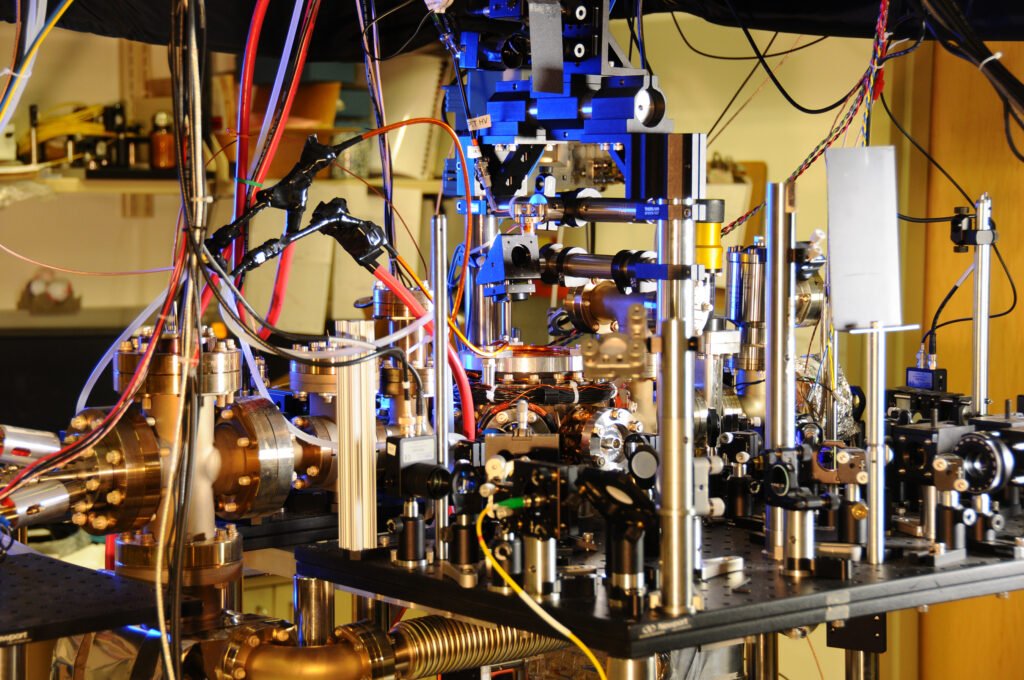
Image via Wikimedia Commons, licensed CC BY-SA 4.0.
What the equation leaves unanswered
For all its success, the Schrödinger equation does not say what the wave function actually is. Whether it represents something physically real, a bookkeeping tool for probabilities, or a description of what an observer can know is a matter of interpretation, not something the equation itself settles. Physicists have spent a century trying to fill that gap, and none of the attempts has become the agreed answer.
The Copenhagen interpretation, the oldest and still the most commonly taught, treats the wave function as a tool for predicting outcomes rather than a real physical wave, and simply accepts collapse as something that happens without trying to explain the mechanism behind it.
The many worlds interpretation takes the opposite approach. It denies that collapse happens at all, and instead proposes that every possible outcome of a measurement actually occurs, each in its own separate, non-interacting branch of reality. What looks like a single random result is, on this view, just the branch you happen to find yourself in.
Pilot wave theories, developed by Louis de Broglie and later by David Bohm, keep the particle as a real object with a definite position at all times, guided along by the wave function acting like a steering signal. Collapse never has to happen because there was never any genuine uncertainty about where the particle was, only about what an observer could know.
No experiment has ever managed to tell Copenhagen, many worlds, and pilot wave theory apart. All three keep the same equation. They only disagree on what it means.
Why This Matters
The Schrödinger equation is not a historical curiosity confined to textbooks. It underlies the calculations used to understand atoms, molecules, and solids, and it sits behind the design of semiconductors, lasers, and much of modern chemistry. Every time physicists work out the allowed energy levels of an electron, model how electrons move through a transistor, or estimate a chemical reaction rate, they are relying on this rule, the same quantum framework that shows up when physicists model something as fundamental as the Higgs field.
That is the Schrödinger equation explained at its most practical: not an abstraction, but a working tool. Beyond its technical uses, it marks a genuine shift in how physics describes nature. Classical mechanics tracks one definite path for an object. Quantum mechanics tracks an evolving landscape of possibilities, and the Schrödinger equation is what tells physicists exactly how that landscape changes from one moment to the next.
Key Takeaways
- The Schrödinger equation describes how a quantum system’s probability landscape evolves over time, not where a particle sits at any given instant.
- The wave function assigns a likelihood to every possible location a particle might be found, and that likelihood shifts as time passes.
- The underlying evolution is exact and predictable. The outcome of any individual measurement is not.
- The particle in a box shows how confinement alone produces fixed energy levels, an effect visible in everything from streetlight colors to quantum dot televisions.
- The equation says nothing about what the wave function fundamentally is, or about the mechanism of measurement collapse, questions that remain open across competing interpretations like Copenhagen, many worlds, and pilot wave theory.
References
Galler, A., Canfield, J., Freericks, J. K. “Schrödinger’s original quantum-mechanical solution for hydrogen.” European Journal of Physics 42, 035405 (2021). https://iopscience.iop.org/article/10.1088/1361-6404/abb9ff
Born, M. “Zur Quantenmechanik der Stoßvorgänge.” Zeitschrift für Physik 37, 863–867 (1926). https://doi.org/10.1007/BF01397477
“The Born Rule, 100 Years Ago and Today.” Entropy 27, 415 (2025). https://doi.org/10.3390/e27040415
Wieśniak, M. “How to Be a Copenhagenistic-QBistic Everettist.” Entropy 27, 248 (2025). https://doi.org/10.3390/e27030248
de Gosson, M. A. “Born–Jordan Quantization and the Equivalence of the Schrödinger and Heisenberg Pictures.” Foundations of Physics 44, 1096–1106 (2014). https://doi.org/10.1007/s10701-014-9831-z
“Spectra and What They Can Tell Us.” NASA Goddard Space Flight Center, Imagine the Universe. https://imagine.gsfc.nasa.gov/science/toolbox/spectra1.html
“The Nobel Prize in Chemistry 2023: Press Release.” The Royal Swedish Academy of Sciences. https://www.nobelprize.org/prizes/chemistry/2023/press-release/

Join the discussion
Comments are moderated and may take a little while to appear.