Introduction
Fire electrons one at a time at a barrier with two narrow openings, and they do not pile up behind the two gaps the way bullets would. They land in stripes. Bright bands, dark bands, bright bands again, built up dot by dot from thousands of separate arrivals. That is the double-slit experiment, and it is the reason quantum mechanics had to become its own subject rather than a correction to classical physics.
The experiment is famous, and it is also one of the most badly explained results in science. Popular accounts tend to claim that particles “know” when they are being watched, that consciousness collapses the wave function, or that later measurements can rewrite the past. None of that is supported by the actual data. This article walks through what the apparatus does, what has been measured in real laboratories, what the result genuinely establishes, and which parts remain open questions that working physicists still argue about.
What the experiment actually does
The setup is almost embarrassingly simple. You need a source of something small, a barrier with two parallel slits cut close together, and a screen that records where each thing lands.
Start with waves, because waves behave in a way everyone has seen. Drop two pebbles into a still pond and the ripples spread out and cross. Where two crests meet, the water rises higher. Where a crest meets a trough, the surface goes flat. Freeze that pattern along a line and you get an alternating sequence of high and calm, high and calm. That is interference, and it is the signature of anything that spreads out and overlaps with itself.
Now try particles. Fire ball bearings at a wall with two gaps and you get two heaps on the floor behind it, one behind each gap, with the heaviest concentration directly in line with each opening. The two gaps simply add: whatever comes through slit one, plus whatever comes through slit two.
Light was the first thing to break that expectation. Thomas Young reported his optical interference work to the Royal Society in 1803, and the published account describes splitting a narrow sunbeam with a slip of card and observing coloured fringes where the two halves recombined. Historians have pointed out that the tidy two-slit version taught in textbooks is not clearly something Young performed himself in exactly that form, though he does describe passing light through two apertures. The physics he demonstrated stands regardless: light behaves like a wave when its paths overlap.[1]
For the wider context, see how quantum physics broke away from classical mechanics.
One particle at a time changes everything
Light behaving like a wave is not the mystery. Waves interfere. That was settled physics by the middle of the nineteenth century.
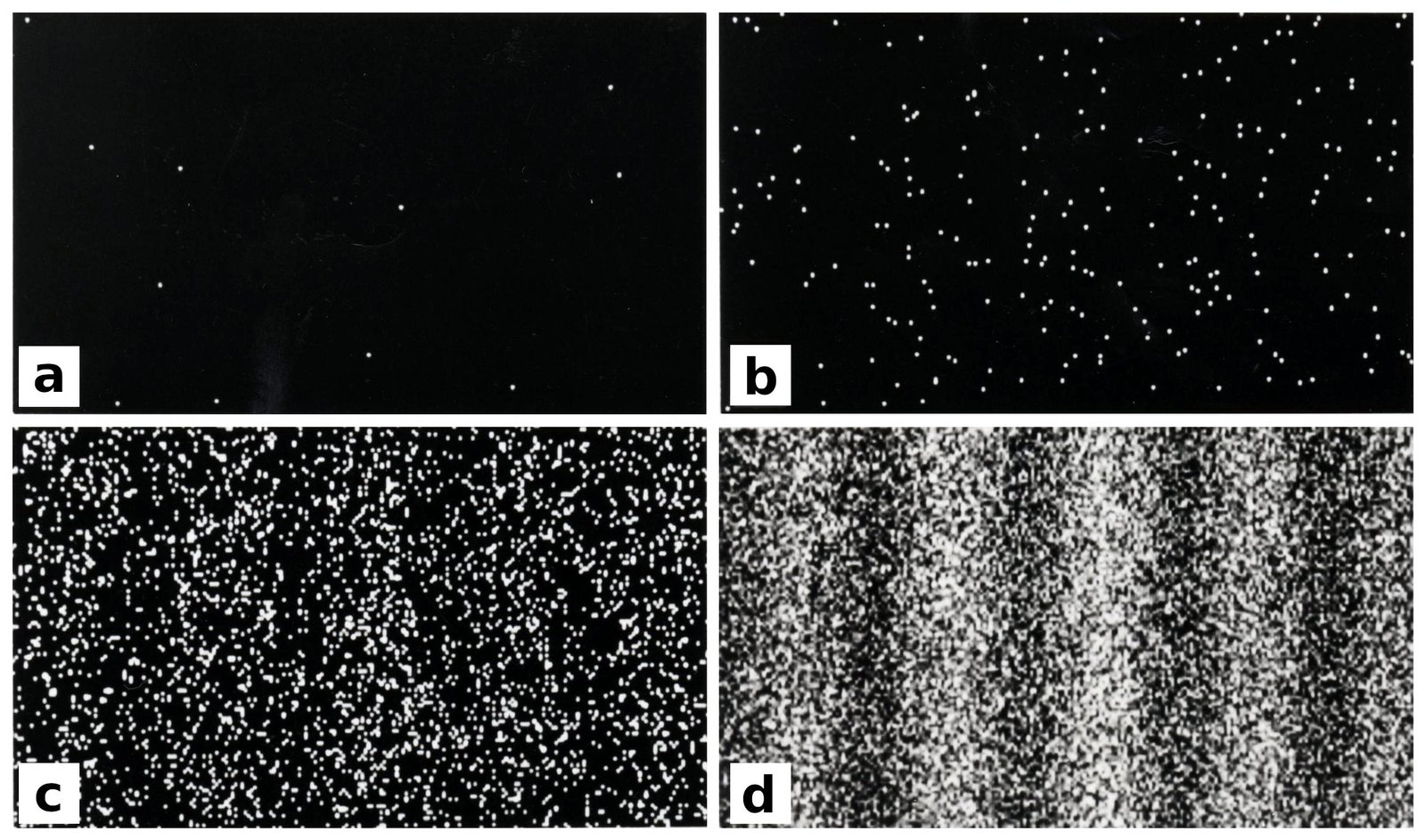
The mystery arrives when you turn the source down so far that only one object is inside the apparatus at any moment. No other particle is present. Each electron leaves the source alone, crosses the barrier alone, and hits the detector as a single localised dot. Run it for long enough and those dots do not scatter into two heaps. They assemble, gradually, into the striped interference pattern.
Richard Feynman built his introduction to quantum mechanics around exactly this comparison, contrasting bullets, water waves and electrons in the same apparatus. He called the result “impossible, absolutely impossible, to explain in any classical way” and said it contains the only mystery.[2]
Feynman thought the single-electron version could never actually be built. He was wrong about that, though it took decades. In 1989 Akira Tonomura and colleagues at Hitachi recorded the buildup of an interference pattern from individually detected electrons, using an electron biprism rather than literal slits.[3]
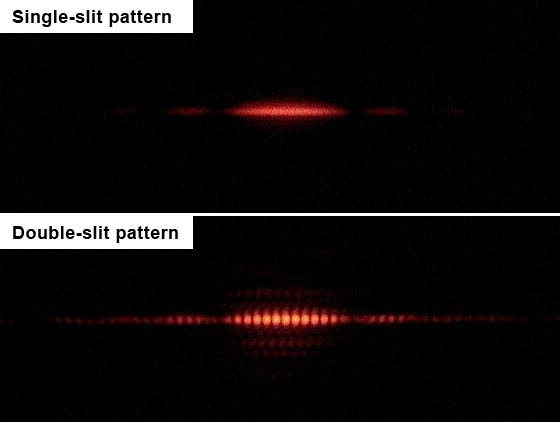
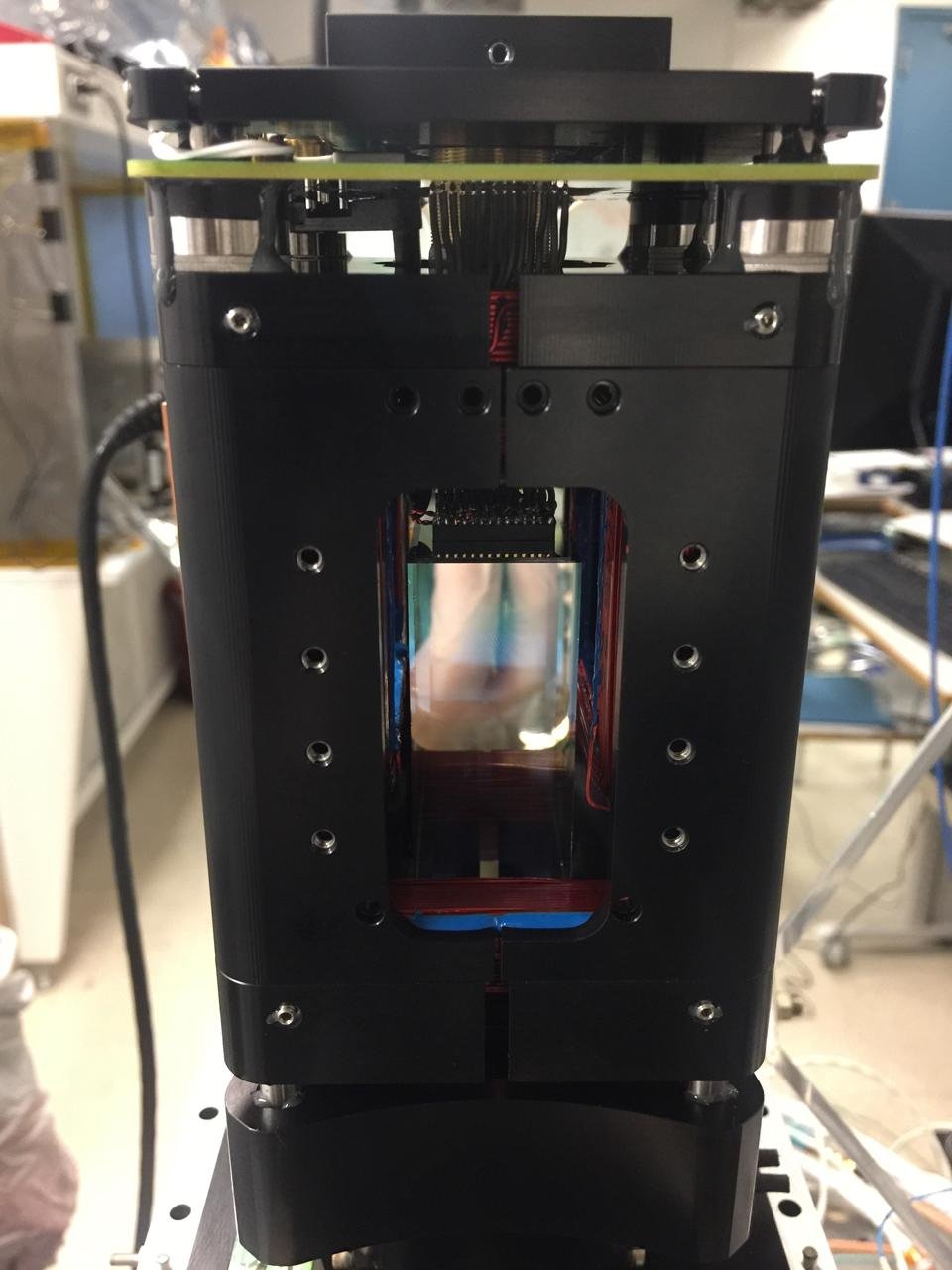
The literal version, with real fabricated slits and a movable mask that could block either one, was completed in 2013 by a group at the University of Nebraska. They recorded the pattern with slit one open, slit two open, and both open, and built up the two-slit pattern from single detection events.[4]
Each electron arrives as a single dot. The stripes only exist in the statistics of many arrivals, which is why no single electron can be said to have made a fringe.
From light to electrons to molecules of 2,000 atoms
If this were only about electrons, you might suspect something peculiar about electrons. It is not.
Interference has been demonstrated with photons, electrons, neutrons, whole atoms, and increasingly large molecules. In 1999 a Vienna group observed matter-wave interference of C60 buckyballs, each one a cage of sixty carbon atoms.[5]
Twenty years later the same line of research pushed past 25,000 atomic mass units, using engineered molecules of up to about 2,000 atoms.[6]
Those large-molecule experiments do not use two slits. They use diffraction gratings and multi-grating interferometer designs, because fabricating and aligning a true double slit for something that heavy and slow is impractical. The physics being tested is the same superposition principle, but the apparatus is not the textbook picture.
Some alternatives to standard quantum mechanics predict that superpositions spontaneously collapse above a certain mass. Every heavier object that still interferes tightens the bounds on those models. So far, nothing has shown a breakdown. Read more about matter, mass and particles.
What “observing” the particle really means
If you install a detector that reveals which slit the particle went through, the interference pattern disappears. You get two heaps, like bullets.
This is routinely described as particles behaving differently “when watched.” That phrasing implies an observer with eyes and awareness, and the evidence does not support it. What matters is whether path information becomes physically available anywhere in the world, recorded in some other system, whether or not any human ever reads it.
The standard textbook explanation used to be that measuring the path necessarily kicks the particle, and that the recoil scrambles the pattern. That explanation was tested directly. In 1998 a group at Konstanz built an atom interferometer where the which-way detector stored path information in the atom’s internal states, and the momentum disturbance was far too small to account for the loss of fringes. The interference vanished anyway. The cause was the correlation, the entanglement between the detector and the atom’s path, not a mechanical kick.[7]
There is also a quantitative trade-off. Path distinguishability and fringe visibility are bound by an inequality, so partial path information gives partial interference. It is a dial, not a switch.
The broader framework is quantum decoherence. As a quantum system becomes entangled with its environment, interference terms stop being observable in practical measurements of the system alone. Decoherence explains why fringes vanish and why the everyday world looks classical. Whether it fully resolves the measurement problem is a separate, contested question.[8]
See also how entanglement links two systems into one shared state.
Delayed choice and the quantum eraser
Two variants of the experiment get quoted constantly as evidence that the future affects the past. Both are real experiments. Neither shows that.
John Wheeler asked what happens if you decide whether to measure the path only after the particle has entered the apparatus. Vincent Jacques and colleagues ran an almost ideal version in 2007 using single photons in a Mach-Zehnder interferometer, with the choice made by a quantum random number generator and separated relativistically from the photon’s entry. The outcome matched standard quantum mechanics exactly: interference when the interferometer was closed, path information when it was open.[9]
The quantum eraser goes further. Entangle each particle with a partner, send the partner to a distant detector, and choose later whether to read out the partner in a way that preserves or destroys path information. Kim and colleagues published the best-known version in 2000.[10]
The raw data makes the key point clear. The pattern at the main detector shows no interference, regardless of what happens to the partner photon. Fringes appear only when already-recorded hits are sorted into subsets according to what the partner detector reported. The past is not changed. Existing data is grouped by a correlation established when the pair was created.[11]
The quantum eraser sorts data that already exists. Nothing travels backward in time, and no message can be sent that way.
What the experiment proves, and what it doesn’t
Quantum mechanics assigns each path a complex probability amplitude. When paths are indistinguishable, you add the amplitudes first and then square the total to get the probability. When paths are distinguishable, you square each amplitude separately and then add. Adding before squaring produces the cross terms that form the fringes. That rule has never failed a test.
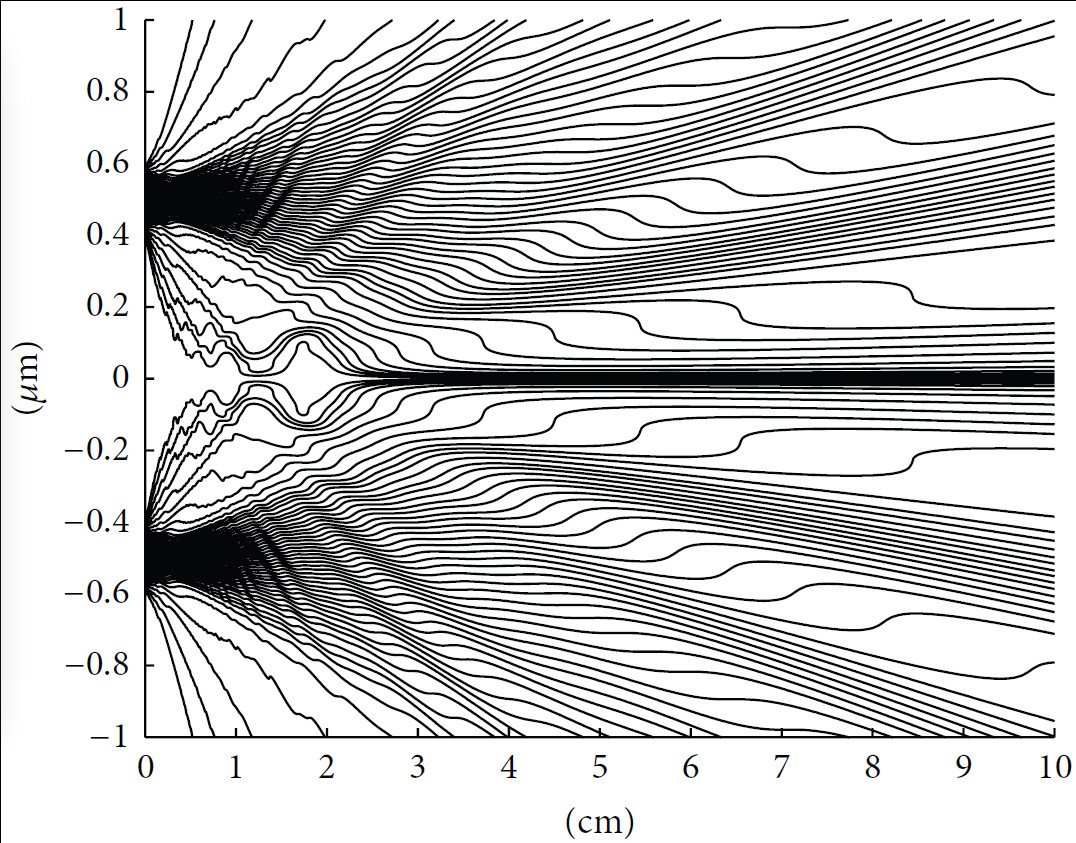
What the experiment does not settle is what physically happens between the source and screen. Copenhagen-style accounts decline to assign the particle a trajectory. Many-worlds accounts keep the wave function evolving smoothly and treat apparent collapse as branching. De Broglie-Bohm pilot-wave theory gives the particle a definite trajectory guided by a wave that passes through both slits. All reproduce the observed pattern. No double-slit experiment performed so far distinguishes between them.
The honest summary is narrower than the headlines. The experiment proves that the classical particle picture fails, that probability amplitudes interfere, and that the availability of path information controls whether interference survives. It does not prove that observers create reality, that a particle chooses a slit, or that any one interpretation is correct. Definitions are available in Astrinova’s quantum glossary.
Where the experiment still earns its keep
Matter-wave interference is now a working tool. Electron interferometry became a method for imaging magnetic fields inside materials. Atom interferometers are used as gravimeters and inertial sensors precise enough for geophysical surveys.
Large-molecule experiments test quantum theory itself, placing bounds on collapse models that no other technique reaches. Interference between amplitudes is also the mechanism quantum algorithms depend on: wrong answers cancel and right answers reinforce. That is the same cancellation that makes dark fringes, running inside a processor rather than across a screen. See what quantum computers can do in 2026.
Key Takeaways
- Single particles sent one at a time, with no other particle present, still build an interference pattern over many detections.
- Interference has been confirmed for photons, electrons, neutrons, atoms and molecules of roughly 2,000 atoms.
- The pattern disappears when which-path information becomes physically available, whether or not a person looks.
- Entanglement between particle and path detector, not human consciousness, destroys the fringes.
- Delayed-choice and quantum-eraser results provide no evidence for backward causation.
- The mathematics is settled, but interpretations disagree about what physically occurs between source and screen.
FAQ
Does the particle really go through both slits?
That depends on the interpretation, and the experiment cannot decide. The measured pattern rules out a simple classical object taking one route. Pilot-wave theory says the particle takes one route while a guiding wave passes through both. Many-worlds says the wave function passes through both. Copenhagen declines to say.
Does the experiment prove consciousness affects reality?
No. Interference disappears when a physical system records path information. Detectors work identically whether their output is read, stored or discarded.
Why don’t we see interference with everyday objects?
Macroscopic wavelengths are unimaginably small, and large warm objects rapidly entangle with their surroundings through collisions and thermal radiation. Decoherence washes out observable interference.
Can the quantum eraser send information back in time?
No. Raw signal data never shows interference. Fringes appear only after two data sets are compared and sorted through ordinary communication moving forward in time.
Has anyone done it with real slits and single electrons?
Yes. A 2013 University of Nebraska experiment used fabricated slits and a movable mask, recording single-slit and double-slit distributions from individual electron detections.
Does quantum computing rely on the same effect?
Yes, on the same underlying principle. Quantum algorithms arrange amplitudes so wrong answers cancel and correct answers reinforce. Preserving interference against decoherence is a central engineering challenge.
References
- Young, T. “Experiments and Calculations Relative to Physical Optics.” Philosophical Transactions, 1804.
- Feynman, R.P., Leighton, R.B., and Sands, “Quantum Behavior,” The Feynman Lectures on Physics, Vol. III.
- Tonomura et al., “Demonstration of single-electron buildup of an interference pattern,” American Journal of Physics, 1989.
- Bach et al., “Controlled double-slit electron diffraction,” New Journal of Physics, 2013.
- Arndt et al., “Wave-particle duality of C60 molecules,” Nature, 1999.
- Fein et al., “Quantum superposition of molecules beyond 25 kDa,” Nature Physics, 2019.
- Dürr, Nonn and Rempe, “Origin of quantum-mechanical complementarity,” Nature, 1998.
- Schlosshauer, “Decoherence, the measurement problem, and interpretations of quantum mechanics,” Reviews of Modern Physics, 2004.
- Jacques et al., “Experimental Realization of Wheeler’s Delayed-Choice Gedanken Experiment,” Science, 2007.
- Kim et al., “A Delayed Choice Quantum Eraser,” Physical Review Letters, 2000.
- Kastner, “The Delayed Choice Quantum Eraser Neither Erases Nor Delays,” Foundations of Physics, 2019.
Join the discussion
Comments are moderated and may take a little while to appear.