
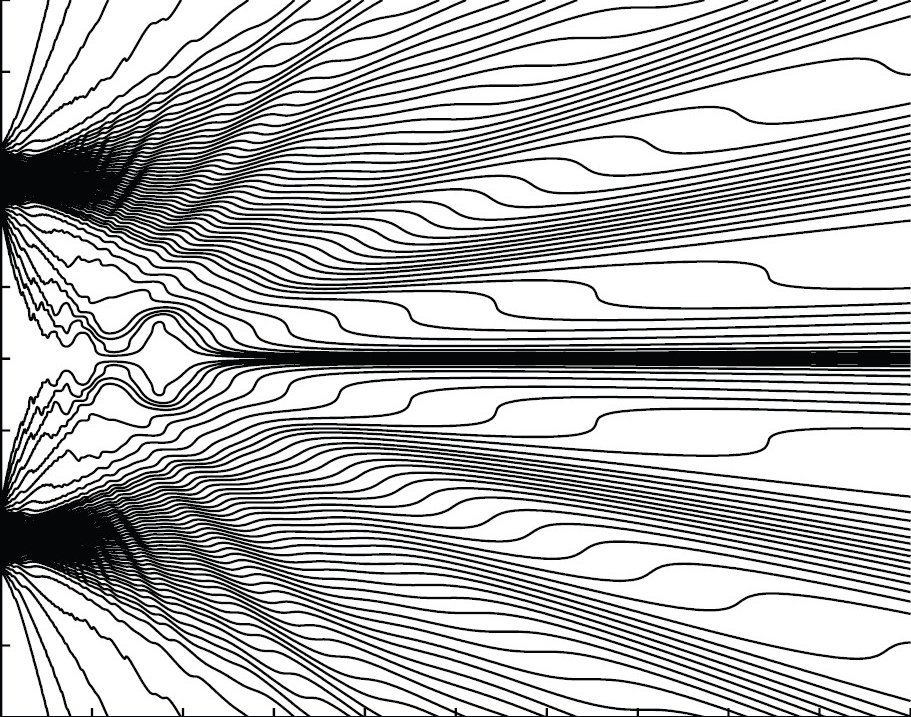
Isaac Newton’s universe ran like a clock. Give it a full description of every particle’s position and speed, and in principle the entire future, down to the last atom, was already written. Quantum mechanics broke that picture. It told us that even with perfect information about a system, the outcome of a measurement is only ever a probability. So does quantum physics disprove determinism? Not quite. The real answer is more careful, and more interesting, than either “yes, everything is chance” or “no, determinism survives untouched.”
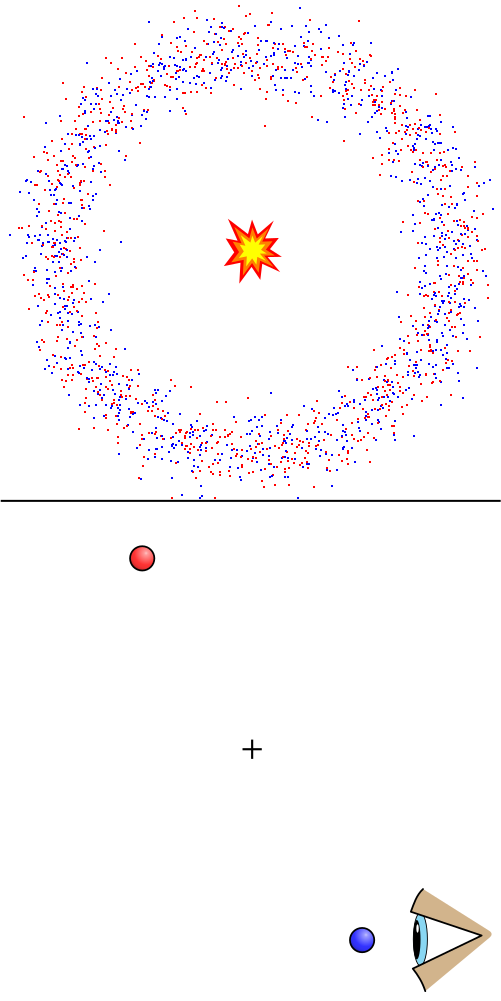
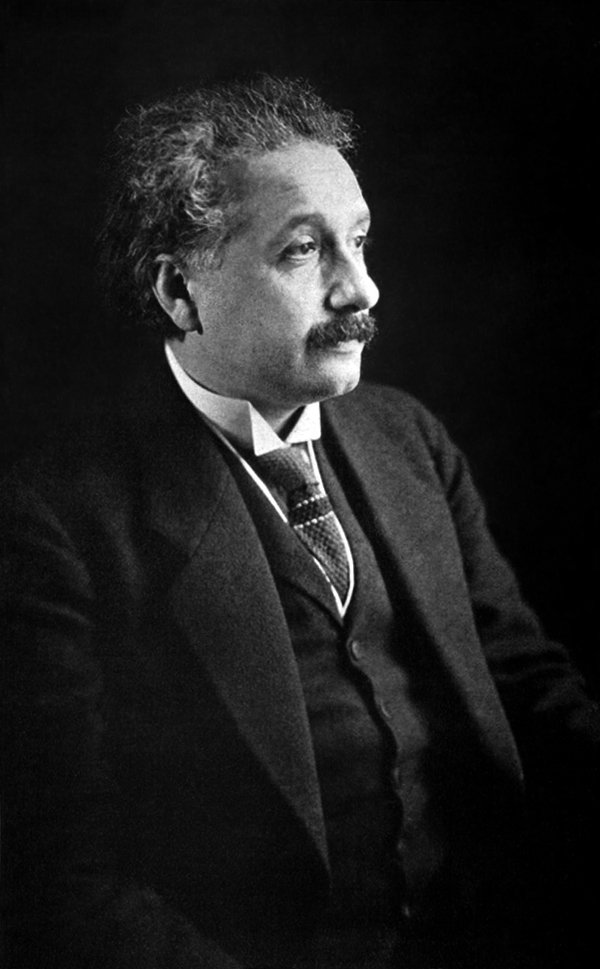
Image via Wikimedia Commons, licensed CC BY-SA 4.0.
What Determinism Means in Classical Physics
In physics, determinism has a precise meaning. Given a complete description of a system at one moment, plus the laws that govern it, the state at every later moment is fixed. There is no branching, no chance, and no second possible outcome once the initial conditions are set.
Newtonian mechanics works this way. Positions and velocities at one instant, run through the equations of motion, produce one and only one future. The French mathematician Pierre Simon Laplace captured the idea with a thought experiment now called Laplace’s demon: an intellect that knew the exact position and momentum of every particle in the universe could calculate the future and the past with total precision.
It is worth separating this from something people often confuse it with: predictability. Chaotic systems, like weather or a swinging double pendulum, are deterministic but not predictable in practice, because tiny differences in starting conditions blow up over time. The equations still produce one exact outcome. We just cannot measure the starting conditions precisely enough to know which outcome that is. A recent review of determinism across classical and quantum physics makes exactly this distinction: chaos limits what we can predict, not what is actually fixed by the underlying dynamics [1].
How Quantum Mechanics Changes the Picture
Quantum mechanics keeps one part of the deterministic story and breaks another.
Between measurements, a quantum system is described by a wave function, and that wave function evolves according to the Schrodinger equation. This evolution is completely deterministic. Feed in an exact quantum state and the exact interactions it undergoes, and the wave function at any later time is fixed, no probabilities involved.
The break comes at measurement. When you actually observe a quantum system, standard quantum mechanics does not predict a single outcome. It predicts a set of possible outcomes, each with a probability attached. Two identical setups can give two different results, even though nothing about the preparation differed. This is the part of quantum theory that has no classical counterpart, and it is the reason the question of determinism resurfaces at all.
Quantum mechanics is deterministic right up until the moment you look. Then the certainty runs out.
The Born Rule: Ignorance or Fundamental Randomness?
The rule connecting the wave function to actual measurement outcomes is called the Born rule, after physicist Max Born, who introduced it in 1926 while working out how to interpret the wave function in scattering experiments [2]. The rule says the probability of getting a particular result is given by the square of the wave function’s amplitude for that result.
This raises an old philosophical distinction. In classical physics, when we use probabilities, they usually reflect our ignorance. A coin flip looks random only because we do not track the exact force, angle, and air currents involved. If we could measure all of that, the outcome would not be a matter of chance at all.
Quantum probabilities, in the standard textbook telling, are different in kind. Even with a complete quantum description of the system, the theory still only offers probabilities. There is nothing more to know, in this picture, that would let you predict the single actual outcome in advance.
But that “in this picture” matters. Whether the randomness is fundamental or whether it is disguised ignorance about some deeper layer of reality depends entirely on which interpretation of quantum mechanics you adopt, a point we will return to. The formalism itself, the equations that make correct predictions, does not settle the question.
Is Radioactive Decay Truly Random?
Radioactive decay is the textbook example of quantum randomness, and it is worth taking seriously as a concrete case rather than an abstraction.
An unstable atomic nucleus has a certain probability of decaying in any given interval of time, described by an exponential decay law. Take a single nucleus, and standard quantum mechanics gives you a half life, a most likely range, but never the precise instant it will decay. Two identical nuclei, prepared identically, can decay seconds apart or years apart.
Experiments match this prediction closely. Nobody has found a hidden clock inside a nucleus that determines its decay moment in advance. That is genuinely striking, and it is one of the cleanest pieces of evidence that quantum probabilities are doing real work, not just papering over some unmeasured classical variable [3]. Even so, this experimental support does not amount to a logical proof that no deeper deterministic account could ever exist. It shows that no simple hidden mechanism has turned up, which is a narrower and more honest claim.
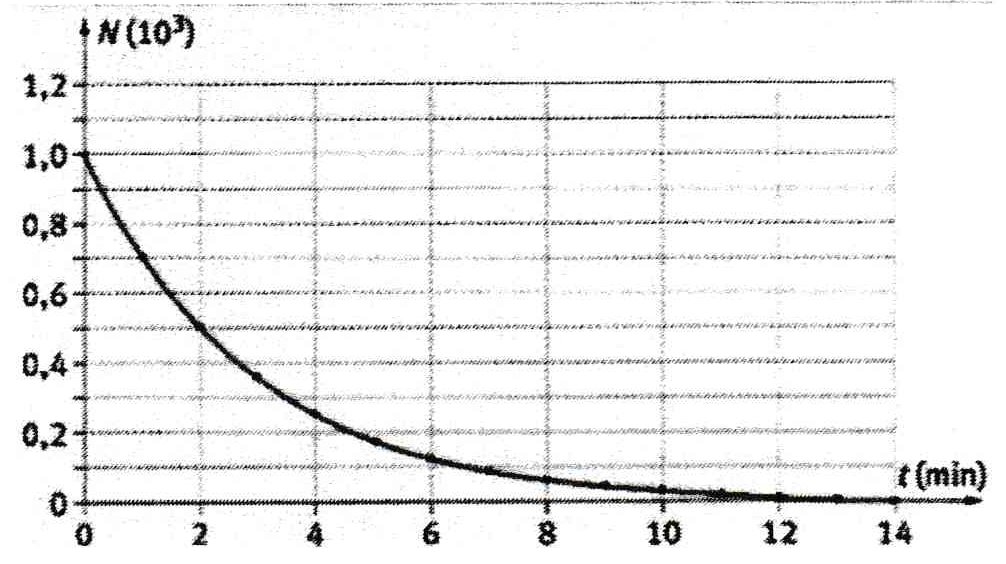
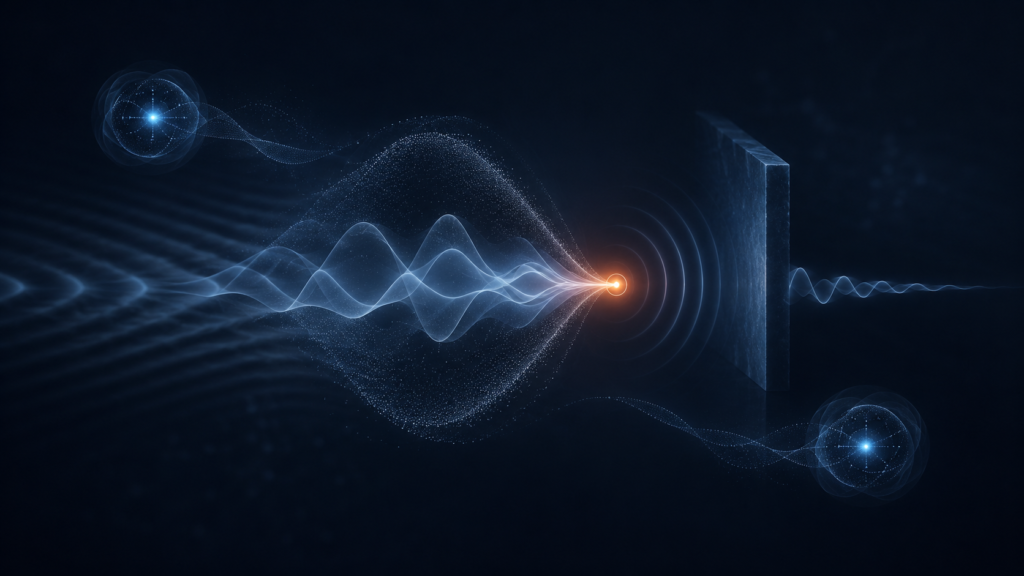
Image via Wikimedia Commons, released under CC0 by Pradana Aumars.
The Measurement Problem
Here is the tension at the center of quantum theory. Between measurements, the wave function evolves smoothly and deterministically under the Schrodinger equation. At measurement, something different happens: the wave function appears to “collapse” abruptly onto one outcome, chosen probabilistically according to the Born rule.
Quantum mechanics, in its standard textbook form, never precisely defines what counts as a measurement or exactly when collapse occurs. It works beautifully for calculating probabilities of experimental outcomes, but it leaves open what is physically happening during that jump, and whether the jump is even a real physical event rather than an artifact of how we choose to describe the system [4].
This gap is called the measurement problem, and it matters enormously for the determinism question. If collapse is a genuine physical process, quantum mechanics has real, built in randomness at its core. If collapse can instead be explained away, through decoherence, branching, or hidden variables, an underlying deterministic story becomes possible again. Which of these is correct is exactly what separates the major interpretations of quantum mechanics from one another.
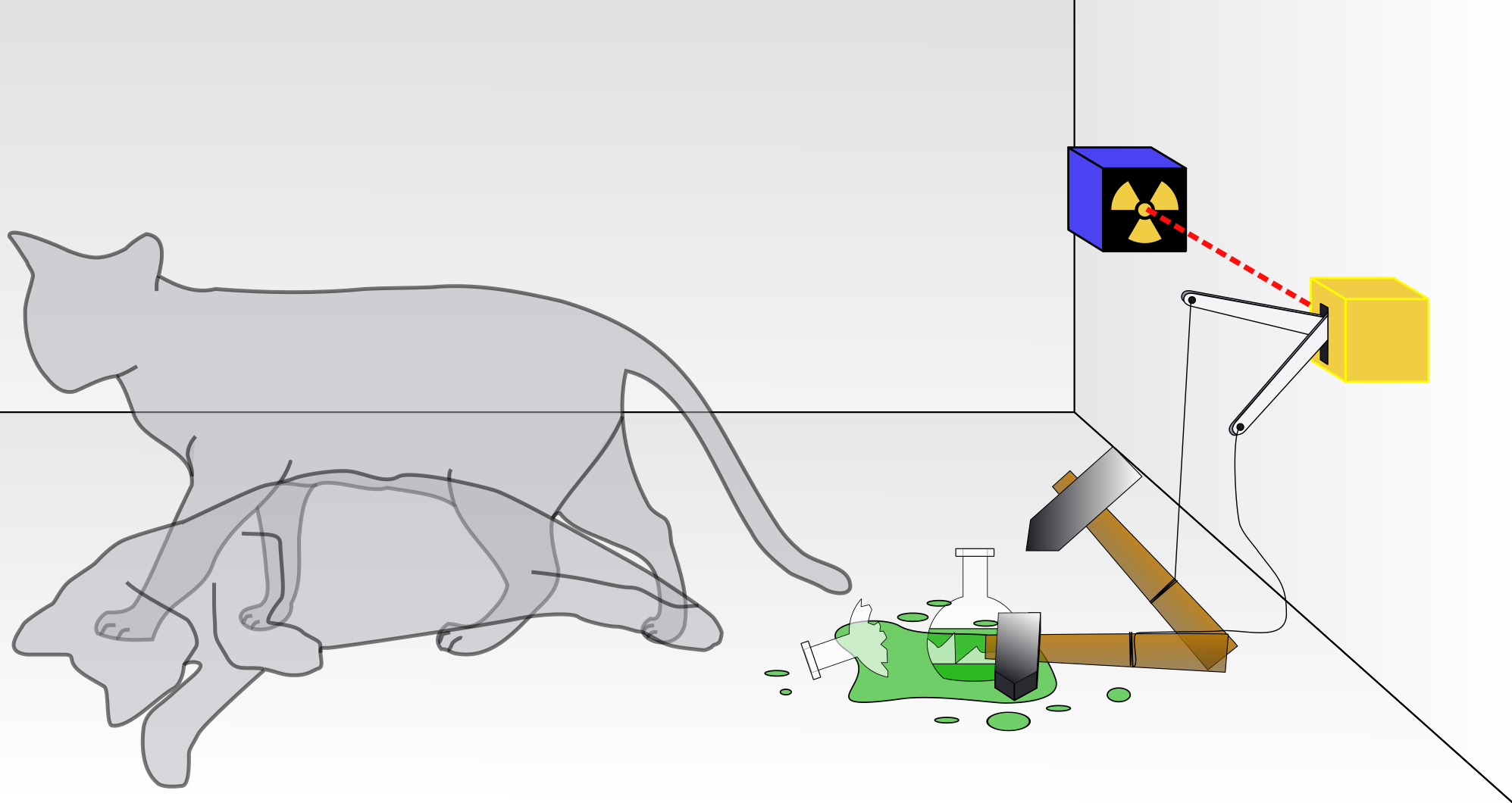
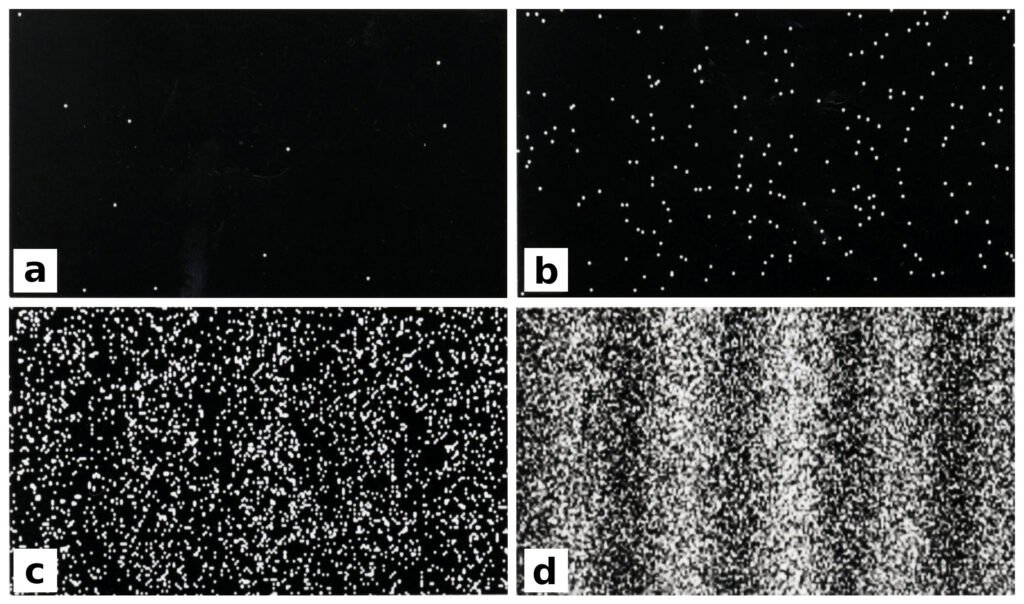
Image via Wikimedia Commons, by Dhatfield, licensed CC BY-SA 3.0.
Five Ways Physicists Picture What Is Really Happening
All interpretations of quantum mechanics agree on the experimental predictions. They disagree, sometimes sharply, on what is actually going on underneath those predictions, and on whether the universe is deterministic.
Copenhagen style views. The oldest and still most commonly taught approach treats the wave function largely as a tool for predicting measurement outcomes, with probabilistic collapse simply built in as a postulate. This approach usually treats measurement outcomes as objectively probabilistic, though it is not a single unified position, and different physicists working within it hold different views about what the wave function represents.
Many Worlds. Proposed by Hugh Everett in 1957, this interpretation removes collapse entirely [5]. The universal wave function always evolves according to the Schrodinger equation, full stop. What looks like a random outcome is actually branching: every possible result occurs, each in its own branch of reality, and an observer experiences only the branch they happen to be part of [6]. At the level of the total wave function, this picture is completely deterministic. The apparent randomness we experience comes from not knowing, ahead of time, which branch we will end up in.

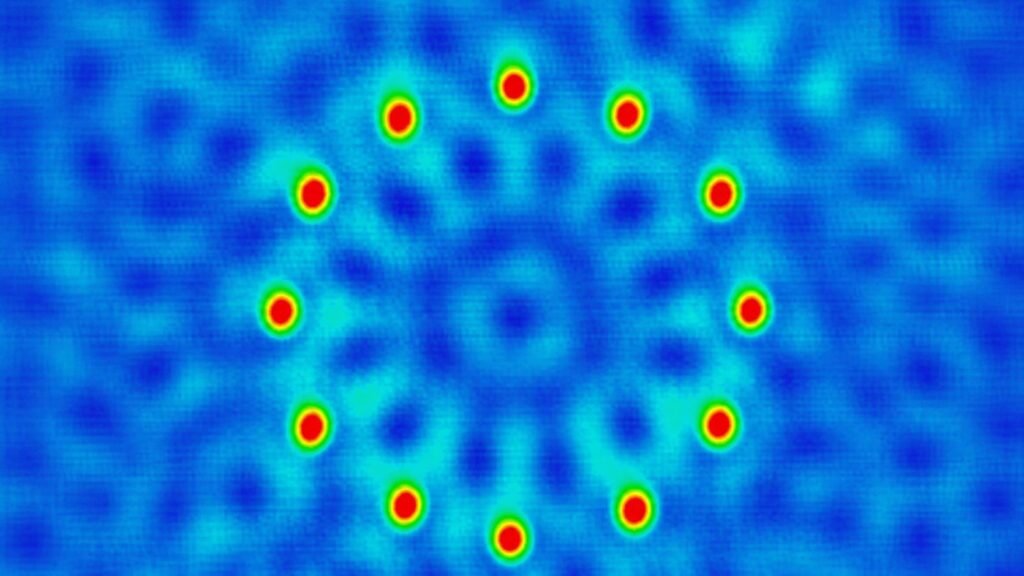
Image via Wikimedia Commons, by Christian Schirm, released under CC0.
Bohmian mechanics. Developed by David Bohm in 1952, this approach gives particles real, definite positions at all times, guided by a wave function through what is called a pilot wave [7]. Given an exact initial wave function and exact initial particle positions, the future trajectory of every particle is completely fixed. Probabilities enter only because we do not know the precise starting positions, an assumption called quantum equilibrium that recovers the Born rule statistically [8]. The price for this determinism is nonlocality: influences in Bohmian mechanics can act instantaneously across distance, something Einstein famously distrusted.
Objective collapse models. Theories such as the GRW model, introduced by Ghirardi, Rimini, and Weber in 1986, modify the Schrodinger equation directly, adding rare, genuinely random localization events that happen spontaneously, without needing an observer or a measuring device at all [9]. These models are explicitly indeterministic. Randomness is not an artifact of description here, it is written into the fundamental dynamics.
Superdeterminism. This is the most radical route back to determinism. It proposes that the measurement settings an experimenter chooses are not truly independent of the hidden variables governing the particles being measured, both were fixed together, far back in the universe’s history. If true, this would let a fully deterministic theory reproduce quantum correlations without needing nonlocal influences. Superdeterminism remains logically consistent, but most physicists consider it deeply unattractive, since it implies a conspiratorial correlation between an experimenter’s free choices and the particles under study. It stays on the table mainly because it has not been ruled out, not because it commands wide support.
Bell’s Theorem: What It Rules Out, and What It Leaves Open
This is where the determinism debate gets its sharpest edge, and where popular science writing most often goes wrong.
In 1964, physicist John Bell proved a mathematical result about a specific class of theories: local hidden variable theories [10]. These are theories that try to restore determinism by assuming particles carry extra, unmeasured properties that fix the outcome of any future measurement, combined with the assumption that no influence can travel faster than light, and the assumption that an experimenter’s choice of what to measure is statistically independent of those hidden properties.
Bell showed that any theory meeting all three conditions must obey certain statistical limits, called Bell inequalities, on the correlations between distant measurements of entangled particles. Quantum mechanics predicts correlations that break those limits. Decades of experiments, including increasingly rigorous loophole free tests such as the 2015 experiment led by Marissa Giustina and colleagues, have confirmed that real entangled particles do break the Bell inequalities, exactly as quantum theory predicts [11]. This body of work was central to the 2022 Nobel Prize in Physics, awarded to Alain Aspect, John Clauser, and Anton Zeilinger for their experimental work on entangled photons and Bell inequality violations [12].
Here is the part that gets flattened in popular accounts: this result rules out local hidden variable theories that meet all three of Bell’s assumptions. It does not rule out every deterministic theory. A deterministic theory can still reproduce quantum correlations if it gives up locality, as Bohmian mechanics does, or if it gives up measurement independence, as superdeterminism does. Bell’s theorem narrows the field of deterministic theories considerably. It does not close it.
Bell’s theorem does not prove the universe is nondeterministic. It proves that determinism, if it is real, cannot be both local and built on measurement independent hidden variables.
Does Quantum Physics Make Free Will Possible?
Quantum indeterminacy is sometimes recruited into arguments for free will. The reasoning goes: if the future is not entirely fixed by the past, there is room for genuinely free choices rather than mere mechanical output.
This argument runs into a problem almost immediately. Even if some quantum event in the brain is genuinely random, randomness is not the same thing as agency. A choice caused by an unpredictable quantum fluctuation is not a choice you made for a reason, it is a coin flip you did not control any more than you control a deterministic process. Philosophers working on this question have generally concluded that quantum indeterminacy does not, by itself, supply anything resembling the kind of control or authorship that free will is usually meant to describe [3].
What quantum mechanics does show is narrower and more modest: fundamental physics does not have to be strictly deterministic in the classical Laplacian sense. That leaves room for various philosophical positions on free will, compatibilist and otherwise, but it does not settle the free will debate, and it is not accurate to describe quantum mechanics as having proven that free will exists.
So, Does Quantum Physics Disprove Determinism? A Nuanced Answer
Pulling this together, the honest answer has two parts.
Classical style determinism, the kind that assumes locality and treats an experimenter’s choices as independent of the system being studied, is ruled out by quantum experiments. Bell’s theorem and its experimental confirmations make that conclusion solid.
But determinism itself, in a broader sense, is not ruled out. Bohmian mechanics offers a fully deterministic account of quantum phenomena at the cost of nonlocality. Many Worlds offers a fully deterministic account of the universal wave function, with apparent randomness explained as branching rather than chance. Superdeterminism, though controversial, offers another deterministic escape route. Meanwhile, Copenhagen style views and objective collapse models keep genuine randomness at the center of physical law.
All of these interpretations make the same experimental predictions, at least in the regimes we have tested so far. Choosing between them is not something current experiments can do. A recent review of determinism across physics puts this plainly: quantum theory undermines the simplest, most naive form of determinism, but it does not force a fully indeterministic universe on us, since deterministic completions remain viable [1].
So, does quantum physics disprove determinism? The most accurate short answer is this: quantum physics rules out a specific, well defined kind of determinism, and leaves the door open, if narrower than before, to several deterministic pictures of reality. Whether nature is ultimately random at its foundation, or deterministic in some deeper way we cannot yet observe, remains an open question in physics, not a settled fact.
Key Takeaways
- Quantum mechanics is deterministic between measurements (via the Schrodinger equation) but probabilistic at measurement (via the Born rule), and this split is the real source of the determinism debate.
- Whether quantum randomness is fundamental or hides a deeper deterministic layer depends on which interpretation you adopt, not on the equations alone.
- Bell’s theorem rules out local hidden variable theories that assume measurement independence. It does not rule out nonlocal deterministic theories like Bohmian mechanics, or superdeterministic ones.
- Many Worlds and Bohmian mechanics both offer fully deterministic pictures of quantum phenomena, at the cost of either accepting branching realities or accepting nonlocal influences.
- Quantum indeterminacy does not establish free will. Randomness alone does not amount to agency.
- The accurate conclusion is narrower than either extreme: classical, local determinism is ruled out, but determinism in general is not.
References
- M. Gomez Esteban et al., “Determinism in Current Physics. Is It Possible?” Axiomathes (2024).
- M. Born, “Zur Quantenmechanik der Stossvorgange,” Zeitschrift fur Physik 37 and 38 (1926).
- H. W. de Regt et al., “Does Quantum Physics Refute Realism, Materialism and Determinism?” Science & Education (2012).
- G. Bacciagaluppi, “Collapse Theories,” Stanford Encyclopedia of Philosophy (2002, updated 2025).
- H. Everett III, “‘Relative State’ Formulation of Quantum Mechanics,” Reviews of Modern Physics 29, 454 (1957).
- J. Barrett and P. Byrne, “Everett’s Relative State Formulation of Quantum Mechanics,” Stanford Encyclopedia of Philosophy (1998, archived 2013).
- D. Bohm, “A Suggested Interpretation of the Quantum Theory in Terms of Hidden Variables, I and II,” Physical Review 85, 166 and 180 (1952).
- Stanford Encyclopedia of Philosophy, “Bohmian Mechanics” (entry on the quantum potential and pilot wave dynamics), 2001, updated.
- G. C. Ghirardi, A. Rimini, and T. Weber, “Unified Dynamics for Microscopic and Macroscopic Systems,” Physical Review D 34, 470 (1986).
- J. S. Bell, “On the Einstein Podolsky Rosen Paradox,” Physics Physique Fizika 1, 195 (1964).
- M. Giustina et al., “Significant Loophole Free Test of Bell’s Theorem with Entangled Photons,” Physical Review Letters 115, 250401 (2015).
- D. Garisto, “Quantum Milestones, 1964: John Stewart Bell Quietly Rings in New Era of Quantum Theory,” Physics (APS), 2022.
Join the discussion
Comments are moderated and may take a little while to appear.