
Anyone who wants a quantum computer explained honestly should start with what it does not do: it does not check every possible answer at once and hand you the right one. That is the single most common misunderstanding about this technology, and it is worth clearing up before anything else, because the real mechanism is stranger and more interesting than the myth.
A quantum computer stores information in qubits instead of bits. A classical bit is either 0 or 1, full stop. A qubit can be prepared in a superposition of both, described mathematically by a pair of probability amplitudes rather than a fixed value. A quantum superposition represents the probability of the qubit’s state, as IBM’s own quantum research team puts it, and that probability only firms up into a definite 0 or 1 the instant the qubit is measured. Everything else, the gates, the entanglement, the interference, exists to shape those probabilities before that final measurement happens.
That distinction, between holding many possibilities open and actually extracting one useful answer, is where the real physics lives. Here is how it works, piece by piece.
What Makes a Qubit Different From a Bit
A qubit’s state is written as a combination of two basis states, conventionally labeled 0 and 1:

The numbers alpha and beta are probability amplitudes. They are complex numbers, meaning each one carries both a size and a phase, and the squared size of each amplitude gives the probability of measuring that outcome. Phase has no everyday counterpart. Two qubits can have identical odds of reading out 0 or 1 while differing completely in phase, and that hidden phase is exactly what later determines how the qubit interferes with others.
It helps to think of a qubit’s state as an arrow pointing somewhere on the surface of a sphere, a picture physicists call the Bloch sphere. IBM’s own teaching materials lean on this image directly, describing how a coin free to rotate in three dimensions is a close analogy to the way a qubit’s state is visualized, with quantum gates rotating that arrow in a fully deterministic and reversible way. Randomness only enters at the very last step, when you measure.
This is also why the common shorthand, that a qubit is simply both 0 and 1 at the same time, falls short. Whether a state even counts as a superposition depends on which direction you choose to measure along. Rotate your measurement axis to match the arrow’s current direction and there is no superposition left to speak of. The arrow itself, however, is perfectly well defined at every moment. The strangeness is not in the qubit refusing to have a definite state. It is in what happens when several such qubits are wired together.
Quantum Gates and Interference
A quantum gate is an operation that rotates a qubit’s state vector or links it to another qubit’s state. The Hadamard gate is the standard tool for turning a plain 0 or 1 into an equal superposition. Two qubit gates, such as CNOT, are what create entanglement, wiring one qubit’s fate to another’s.
Running a quantum algorithm means applying a carefully chosen sequence of these gates so that the amplitudes of wrong answers cancel each other out and the amplitude of the right answer grows. IBM describes this directly: interference is the engine of quantum computing, with superposed qubits structuring information the way waves do, complete with amplitudes tied to each possible outcome. Constructive interference reinforces the correct path. Destructive interference suppresses the rest. Nothing about this involves testing every possible answer individually and reading them all back, since a single measurement only ever returns one outcome. The entire point of the gate sequence is to make sure that one outcome is overwhelmingly likely to be the right one.
Entanglement: Correlation Without Contact
Entanglement links two or more qubits so tightly that their combined state cannot be described by treating each qubit separately, only the whole system has a well defined state. This is not folklore. IBM Quantum researchers have generated and verified entangled states spanning entire 27 qubit and 65 qubit processors, reporting that quantum entanglement allows qubits, which behave randomly, to be perfectly correlated with each other. A separate result, published in Scientific Reports, part of the Nature portfolio, confirmed genuine multipartite entanglement across a 20 qubit superconducting device, with researchers finding that each pair of connected qubits was inseparable and hence the prepared state was entangled.

Two entangled qubits. Neither has a definite state until measured, but the instant one is checked, the other’s outcome comes out opposite, with no signal of any kind crossing the space between them. AI generated illustration, Astrinova.
Here is the point that gets mangled most often in casual explanations. Entanglement does not send a signal faster than light, and it cannot be used to communicate instantly across any distance. Measuring one entangled qubit does fix the outcome of its distant partner, but each individual measurement result still looks completely random to the person holding that qubit. The correlation between the two results only becomes visible once someone compares both outcomes over an ordinary, light speed limited channel. Physicists call this restriction the no signaling theorem, and it holds without exception in every experiment performed to date.
Measurement and the Return to Ordinary Bits
At some point every quantum computation ends the same way, with a measurement that collapses the qubit’s superposition into a plain classical outcome. IBM’s description is direct: when a quantum system is measured, its state collapses from a superposition of possibilities into a binary state. Measurement destroys the superposition that made the computation possible in the first place, and it typically destroys entanglement with other qubits at the same time. Measure the same collapsed qubit again and you will get the identical classical result, because there is no longer any superposition left to interfere.
This is also why a single run of a quantum algorithm is not enough. Because measurement is probabilistic, a quantum program is usually executed many times, called shots, and the results are read out as a distribution. A well designed algorithm concentrates that distribution heavily on the correct answer through interference. A poorly designed one just produces noise.
Why Qubits Forget: Decoherence
Qubits are fragile. Any unwanted interaction with the surrounding environment, stray photons, thermal vibrations, tiny material defects, imperfect control electronics, can leak information out of a qubit and erase the delicate phase relationships that superposition and interference depend on. This process is called decoherence, and it is the central engineering obstacle across every hardware approach in the field.
It is also why quantum processors look the way they do physically. Superconducting and spin qubit chips sit inside dilution refrigerators cooled to within a hundredth of a degree of absolute zero. Trapped ion and neutral atom systems rely on ultra high vacuum chambers and precisely tuned lasers. Every one of these engineering choices exists to slow decoherence down long enough to finish a useful computation before the qubits forget what they were doing.
Physical Qubits, Logical Qubits, and Error Correction
No single physical qubit built today is reliable enough, on its own, to run a long or complex computation without accumulating fatal errors. The answer the field has converged on is quantum error correction, in which many physical qubits are combined into one logical qubit, an error protected unit of quantum information that can have its mistakes detected and fixed without ever directly measuring, and thereby destroying, the information it holds.
Quantum error correction provides a path to reach practical quantum computing by combining multiple physical qubits into a logical qubit.
That line comes from Google’s own Nature paper on its Willow processor, and the result behind it is genuinely significant. The logical error rate is suppressed exponentially as more qubits are added, provided the underlying physical error rate sits below a critical threshold, and Google’s team demonstrated a 101 qubit logical qubit whose lifetime exceeded that of its best individual physical qubit, a milestone the field calls operating below threshold.
This idea is not new, only newly demonstrated at meaningful scale. NIST ran an early proof of concept nearly a decade earlier using trapped ion qubits, reporting that quantum error correction protects quantum information stored in two level quantum systems by rectifying errors with unitary operations conditioned on projective measurement outcomes.
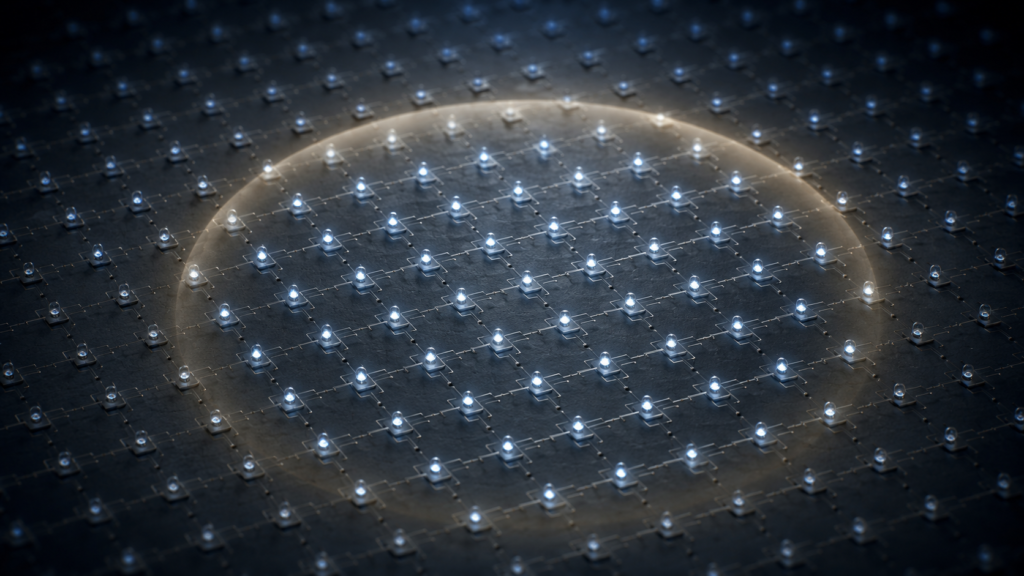
Many physical qubits, bundled inside an error correcting boundary, form one protected logical qubit. AI generated illustration, Astrinova.
One practical consequence follows directly from this. Raw qubit counts are a poor measure of a quantum computer’s real capability. A chip with more physical qubits but worse fidelity or connectivity can be less useful than a smaller, cleaner one, because what actually matters is how many reliable logical qubits, and how many error corrected operations, that hardware can ultimately support. Companies increasingly report logical qubit counts and code performance for exactly this reason, though the physical to logical qubit ratios different hardware platforms will need at full scale are still being worked out and vary between reported results.
\n\n\nFor a closer look at where that leaves the technology right now, including which claimed advantages actually hold up, see What Can Quantum Computers Actually Do in 2026?.
Five Ways to Build a Qubit
There is no single agreed upon way to physically build a qubit, and several serious approaches are being pursued at once by different teams.
Superconducting qubits are the most commercially mature approach, used by IBM and Google. They rely on a superconducting circuit built around a component called a Josephson junction, cooled near absolute zero, with the qubit’s state encoded in the oscillation of electric charge or magnetic flux around that circuit. IBM’s current lineup spans processors from 127 qubits up past 150, while Google’s Willow chip runs 105 qubits and produced the error correction result described above.
Trapped ion qubits use individual charged atoms held in place by electromagnetic fields and manipulated with laser light, an approach pursued commercially by companies including IonQ and Quantinuum. This platform is associated with very high native gate fidelity and long coherence times, though scaling up requires precisely controlling more and more individually addressed laser beams, one for every ion.
Neutral atom qubits trap electrically neutral atoms with tightly focused laser beams called optical tweezers, encoding information in the atom’s internal energy levels, an approach associated with companies including QuEra and Atom Computing. Because neutral atoms carry no charge, they interfere with each other less than ions do, which has allowed rapid scaling to large atom arrays, though gate operations on this platform currently run slower than on superconducting circuits.
Photonic qubits encode information directly in light, an approach pursued by companies including Xanadu and PsiQuantum using different encoding schemes for the same underlying idea. Much of a photonic system can run at ordinary room temperature, a genuine advantage, though the single photon detectors typically still need deep cooling, and photon loss remains a serious open engineering problem.
Spin qubits encode a bit of quantum information in the spin of a single electron trapped inside a silicon quantum dot, an approach led by Intel in partnership with QuTech at Delft University of Technology. The appeal here is direct compatibility with existing silicon chip manufacturing. Intel has reported 99.9 percent gate fidelity, the highest reported for qubits made with all CMOS industry manufacturing, using standard 300 millimeter semiconductor wafer processes.
Which of these platforms, if any single one, eventually dominates at the scale of a full fault tolerant machine remains genuinely open. Google itself now runs both a superconducting program and a newer neutral atom program side by side, treating the two as complementary research paths rather than declaring either one the winner.
What Quantum Algorithms Actually Speed Up
Two algorithms come up in almost every conversation about why quantum computers might matter, and both are frequently described in ways that overstate what they do.
Shor’s algorithm, devised by mathematician Peter Shor in 1994, finds the prime factors of a large integer by using a quantum subroutine called the quantum Fourier transform to find the period of a related mathematical function, a task that is exponentially hard for classical computers as the numbers involved grow large. Because RSA encryption, used to secure much of the internet, depends on factoring being classically hard, a sufficiently large and reliable quantum computer running Shor’s algorithm would undermine it. That sufficiently large qualifier matters enormously. Breaking a real 2048 bit RSA key is estimated to require a fault tolerant machine with a physical qubit count in the millions once error correction overhead is included, a scale that does not exist today. Small, compiled demonstrations of the algorithm have been run, including a photonic chip experiment that factored the number 15, but these are proofs of principle, not evidence that today’s hardware threatens real encryption. This gap is exactly why quantum resistant cryptography standards are already being rolled out well ahead of any working large scale factoring machine.
Grover’s algorithm, introduced by Lov Grover in 1996, searches an unsorted list of N items using roughly the square root of N steps, compared with up to N steps for a classical search in the worst case. The QuEra glossary describes it simply as a quantum algorithm designed to search an unsorted database, and this quadratic speedup has been mathematically proven to be the best any quantum algorithm can achieve against a fully generic search problem. It is real, and it is useful as a building block inside larger algorithms, but it is a modest speedup next to Shor’s exponential one, and it still requires many sequential rounds of amplitude amplification rather than an instant readout of the answer.
Where the Technology Stands Now
Today’s quantum processors fall into a category researchers call noisy intermediate scale quantum, or NISQ, hardware. These machines lack full error correction and are limited by gate errors, imperfect qubit connectivity, and shallow circuit depth. IBM has been candid about this limitation in its own public roadmap, stating plainly that current devices and error mitigating techniques limit us to small circuits, and that the technology will only deliver on its promise once hardware can run hundreds of millions of gates reliably, a capability that does not exist yet.
IBM’s public roadmap targets a fault tolerant system called Starling for 2029, aiming for roughly 200 logical qubits able to run about 100 million gates, with a larger successor called Blue Jay planned for sometime after 2033. These are company stated engineering goals, not independently verified results, and it is worth remembering that quantum computing roadmaps across the industry have shifted before.
None of this means quantum computers are on track to replace classical ones. They were never designed for that. IBM makes this point about its own technology without hedging: quantum computers won’t solve every problem more efficiently than classical supercomputers, which are better at performing sequential logical tasks. The strategy across the field is hybrid, using quantum processors as accelerators alongside classical high performance computing for the narrow class of problems where quantum effects offer a genuine, provable edge.
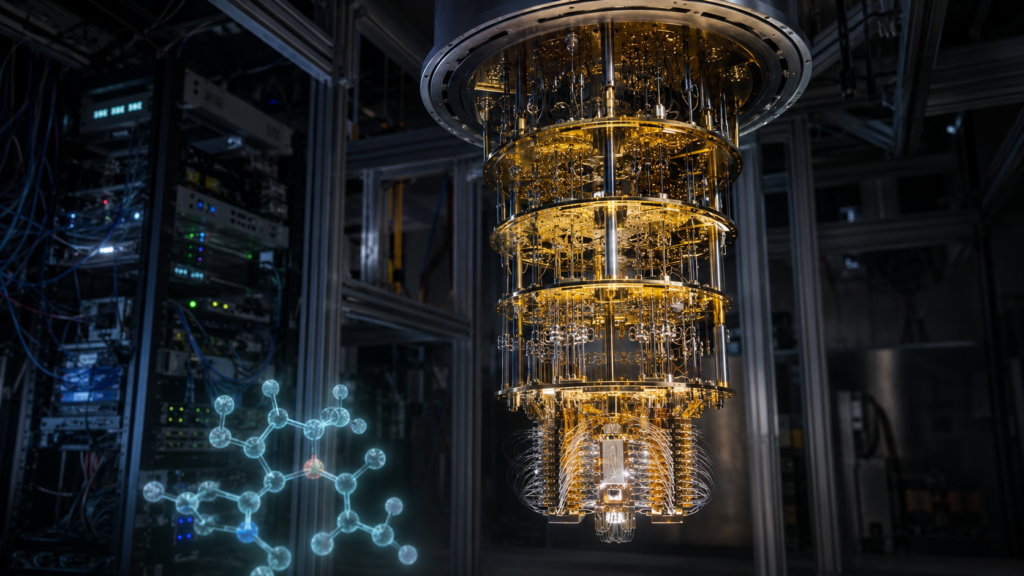
Hybrid quantum classical workflows, not standalone quantum computers, are where near term chemistry results are coming from. AI generated illustration, Astrinova.
Where might that edge show up first. Molecular simulation, for drug discovery, materials science, and catalyst design, is widely seen as the clearest medium term opportunity, because molecules are themselves quantum mechanical systems that map naturally onto quantum hardware. In 2026, IBM, the Cleveland Clinic, and RIKEN used a hybrid quantum classical workflow to simulate a protein ligand complex containing more than 12,000 atoms, described as the largest calculation of its kind attempted at that scale. It is a genuine research milestone. It is not evidence that quantum computers currently outperform classical drug discovery methods, and independent analysis of the same result notes plainly that the quantum approach did not yet beat the best purely classical techniques on the same problem. Pharmaceutical companies including Roche, Boehringer Ingelheim, Amgen, Moderna, and Biogen have run early exploratory pilots with quantum computing partners, and most serious industry estimates place any real displacement of classical computational chemistry five to ten years out, contingent on further hardware progress.
Financial and logistics optimization gets mentioned just as often as a near term use case, and deserves more caution. Whether quantum optimization algorithms will consistently beat very well tuned classical heuristics on real world problems, even once hardware improves substantially, remains a genuinely open scientific question, since classical optimization methods are themselves extremely mature and hard to beat.
Why This Matters
Getting a quantum computer explained accurately, rather than through what headlines imply, matters because the technology is being built into national infrastructure decisions, cybersecurity planning, and pharmaceutical research budgets right now, years before it reaches its most ambitious promised capabilities. Governments are already migrating toward quantum resistant encryption standards, not because today’s quantum computers can break current cryptography, but because the multi decade lifespan of sensitive data means the threat has to be planned for well in advance. Pharmaceutical and materials companies are running small pilot projects for the same reason, positioning themselves for a capability that is still some years away rather than waiting until it arrives. None of that requires believing that quantum computers test every answer at once, or that they will replace the laptop on your desk. It requires understanding, instead, the much stranger and more precise thing they actually do: shaping probability itself, through superposition, entanglement, and interference, until the right answer becomes the loudest one in the room.
Key Takeaways
- A qubit holds a superposition described by probability amplitudes, not a simultaneous both 0 and 1 value, and the true state is only fixed by a chosen measurement basis.
- Quantum gates rotate and link qubit states, and interference between amplitudes, not brute force checking, is what makes a correct answer more likely to be measured.
- Entanglement creates real, verified correlations between qubits but cannot transmit information faster than light.
- Measurement collapses a qubit’s superposition into an ordinary classical bit, which is why algorithms are run many times and read out as a probability distribution.
- Decoherence, the loss of quantum information to environmental noise, is the central engineering obstacle across every hardware platform.
- Quantum error correction combines many physical qubits into one protected logical qubit, and logical qubit count and code performance matter far more than raw physical qubit totals.
- Superconducting, trapped ion, neutral atom, photonic, and spin qubits are five genuinely different, actively competing approaches to building hardware, with no settled winner yet.
- Shor’s algorithm threatens current public key cryptography only at a scale of millions of physical qubits that does not exist today, while Grover’s algorithm offers a real but modest quadratic speedup for search problems.
- Today’s quantum processors are noisy, error prone, and limited to small circuits, and the field’s own roadmaps describe quantum computers as accelerators alongside classical supercomputers, not replacements for them.
References
- IBM. “What is a qubit?” IBM Think. https://www.ibm.com/think/topics/qubit
- IBM. “What Is Quantum Computing?” IBM Think. https://www.ibm.com/think/topics/quantum-computing
- IBM Quantum Learning. “Superposition with Qiskit.” https://quantum.cloud.ibm.com/learning/en/modules/quantum-mechanics/superposition-with-qiskit
- IBM Quantum Computing Blog. “Generating entanglement on 27 and 65 qubit quantum systems.” https://www.ibm.com/quantum/blog/whole-device-entanglement
- Wang, Y., et al. “Entanglement in a 20 Qubit Superconducting Quantum Computer.” Scientific Reports, 2019. https://www.nature.com/articles/s41598-019-49805-7
- Google Quantum AI. “Quantum error correction below the surface code threshold.” Nature, 2024. https://www.nature.com/articles/s41586-024-08449-y
- NIST. “Realization of quantum error correction.” https://www.nist.gov/publications/realization-quantum-error-correction
- QuEra. “Grover’s Algorithm.” QuEra Glossary. https://www.quera.com/glossary/grovers-algorithm
- IBM Quantum. “IBM lays out clear path to fault tolerant quantum computing.” IBM Quantum Computing Blog. https://www.ibm.com/quantum/blog/large-scale-ftqc
- IBM Quantum. “Modeling realistic chemistry with quantum computing.” Case study. https://www.ibm.com/quantum/case-studies/modeling-realistic-chemistry
- IBM. “Quantum 2026.” IBM Technology Atlas roadmap. https://www.ibm.com/roadmaps/quantum/2026/
- Intel / Nature. “Probing single electrons across 300 mm spin qubit wafers,” as reported by QuantumZeitgeist. https://quantumzeitgeist.com/intel-quantum-chip-scalable-quantum-processors/
- Politi, A., Matthews, J. C. F., O’Brien, J. L. “Shor’s quantum factoring algorithm on a photonic chip.” arXiv preprint. https://arxiv.org/pdf/0911.1242
- Chicago Quantum Exchange. “Why quantum computing competition is a Quantum Prairie strength.” University of Chicago consortium. https://chicagoquantum.org/news/why-quantum-computing-competition-quantum-prairie-strength
- McKinsey and Company. “Quantum computing in life sciences and drug discovery.” https://www.mckinsey.com/industries/life-sciences/our-insights/the-quantum-revolution-in-pharma-faster-smarter-and-more-precise
Join the discussion
Comments are moderated and may take a little while to appear.