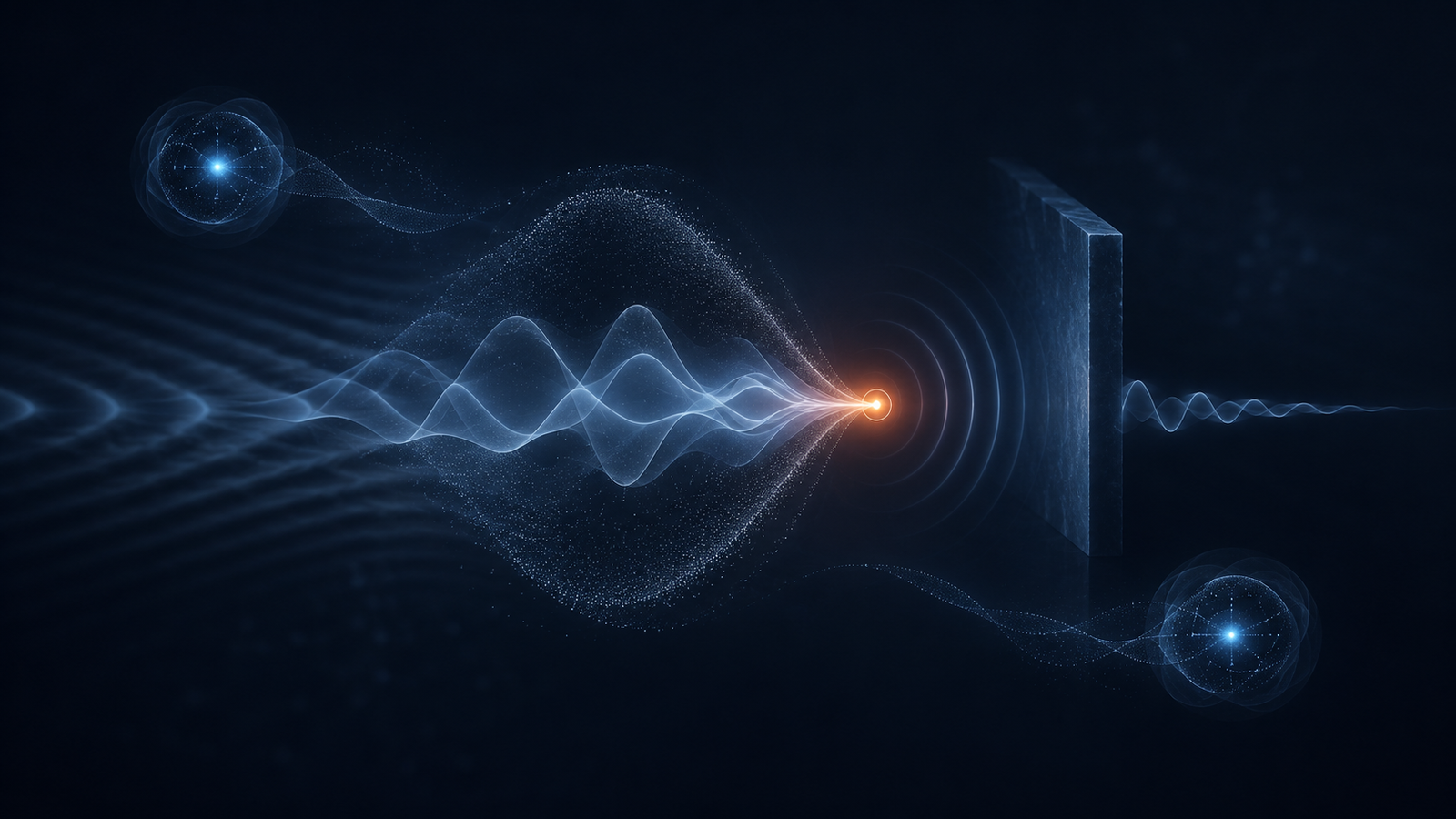
Quantum physics, in one sentence, is the branch of physics that describes the fundamental behaviour of matter, light and energy, with its distinctly quantum effects becoming most apparent at atomic and subatomic scales. This guide gives a clear definition, explains why physicists needed a new theory, and shows how those ideas built modern electronics.
Quantum physics is not an exotic layer added onto ordinary reality. It is the deeper framework underneath it, and the familiar classical world we experience emerges from that framework once a system interacts strongly with its surroundings, not merely because it happens to contain many particles.
Quantum Physics in Simple Terms
Quantum physics is the theory used to describe matter and radiation at atomic and subatomic sizes, where familiar classical ideas about motion, energy and measurement stop giving fully accurate results. It does not replace classical physics in the domains where Newton’s laws and electromagnetism work well; rather, it explains the deeper behaviour from which classical patterns emerge as an approximation for large systems. Quantum effects are most obvious at these small scales, but the theory itself is not limited to them: engineered systems such as superconductors and quantum computers show distinctly quantum behaviour at a far larger, sometimes even visible, scale.
The theory grew out of crisis, not taste for abstraction. Around the turn of the twentieth century, experiments on hot objects, light striking metals and the structure of atoms produced results that classical physics could not account for consistently. Quantum theory began as an effort to fit those observations, and developed into one of the most successful frameworks in science, underpinning modern chemistry, electronics and precision measurement.
Why Classical Physics Breaks Down
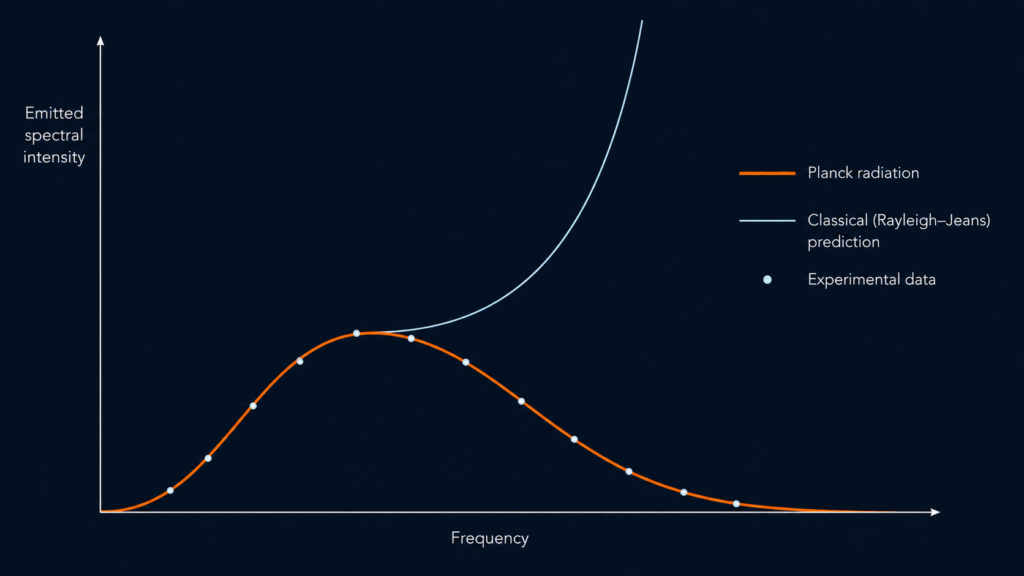
Classical physics works beautifully for projectiles, planets and circuits, but it runs into trouble when applied directly to atoms and radiation. One major problem appeared in blackbody radiation, the spectrum of light emitted by a hot object: calculations based on older ideas predicted far too much high-frequency radiation, in conflict with experiment. Another problem appeared in atoms themselves, whose observed line spectra and stability resisted classical explanation.
That failure mattered because atoms are not special exceptions; they are the building blocks of ordinary matter. If the theory breaks at that level, it cannot be the final description of nature. Quantum mechanics solved this by introducing a new language of discrete energy levels, wave-like matter and probabilities for measurement outcomes rather than exact classical trajectories. For a fuller side-by-side comparison, see Quantum Physics vs Classical Physics: What’s the Difference?

Planck and the Quantum of Energy
The first decisive step came in 1900, when Max Planck proposed that the microscopic oscillators responsible for blackbody radiation could exchange energy only in discrete amounts. The key relation is:
E = hf
where E is the energy of one quantum, f is the radiation’s frequency, and h is Planck’s constant, a fundamental constant of nature. This simple rule reproduced the observed blackbody spectrum and avoided the catastrophic high-frequency divergence of classical theory.
Planck did not yet have full quantum mechanics, but he had introduced the idea that nature may permit only certain discrete amounts of energy in microscopic processes. The Nobel Prize later cited him for his discovery of energy quanta, recognising that this step had changed physics at its foundations.
Einstein, Photons and the Photoelectric Effect
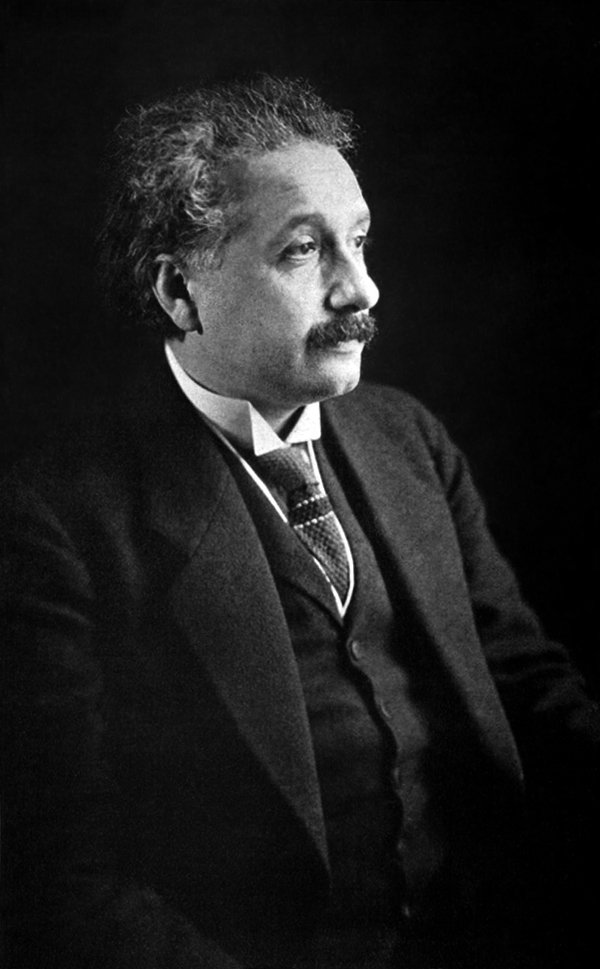
In 1905, Einstein proposed that light energy is absorbed and emitted in discrete quanta, later called photons. He used that idea to explain the photoelectric effect, in which light shining on a metal ejects electrons from its surface. What mattered experimentally was not just brightness but frequency: below a threshold frequency, no electrons were emitted, however intense the light; above it, emission could occur promptly.
Einstein’s explanation followed directly from Planck’s relation. If each photon carries energy E = hf, then a photon must have enough energy to free an electron from the metal, and increasing intensity mainly increases the number of photons, not the energy of each one. That insight was so important that the Nobel Prize in Physics 1921 honoured Einstein especially for his discovery of the law of the photoelectric effect.
Wave–Particle Duality
By the 1920s, physicists faced an uncomfortable fact: light sometimes behaves like a wave and sometimes like a particle. It produces interference patterns like a wave, yet in the photoelectric effect it transfers energy in discrete packets. Louis de Broglie then proposed the converse idea: matter should also have wave-like properties.
His relation,
λ = h/p
states that a particle with momentum p is associated with a wavelength λ, where h is Planck’s constant. This does not mean an electron is alternately a little ball and then a water wave. It means quantum objects are described by a framework that contains both localized detection events and wave-like interference, and neither classical picture alone is sufficient.
What the Double-Slit Experiment Reveals
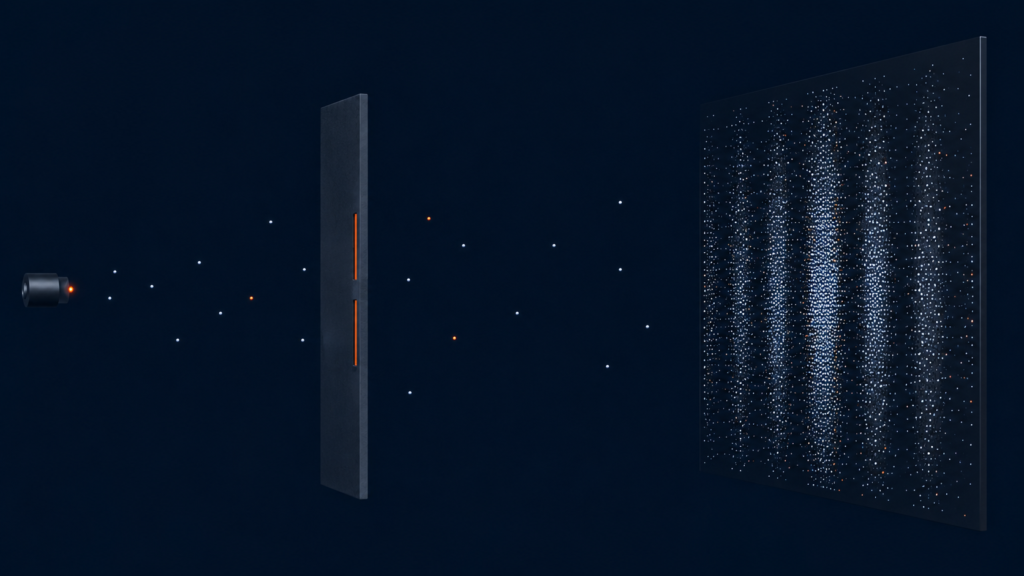
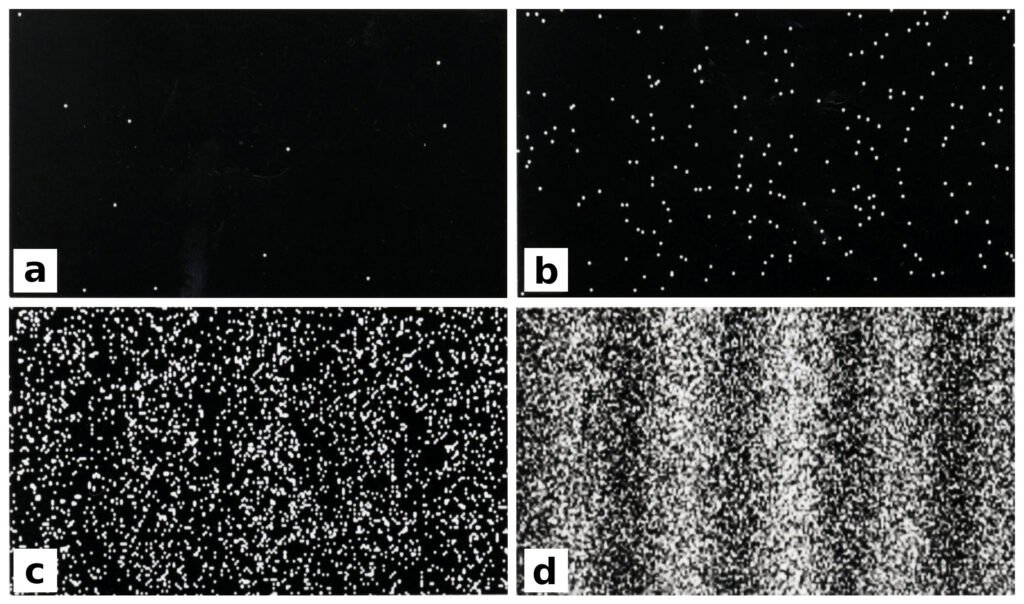
The double-slit experiment remains the cleanest illustration of that point. When particles such as electrons or photons are sent toward two narrow slits and then detected on a screen, the final pattern can show interference fringes, the hallmark of wave behaviour. Remarkably, the same pattern builds up even when particles are sent one at a time, so the theory must account for individual detection events and for the wave-like distribution they accumulate into. For the full experimental history and a walk-through of what each version of the setup shows, see Double-Slit Experiment Explained: What It Really Shows About Quantum Mechanics.
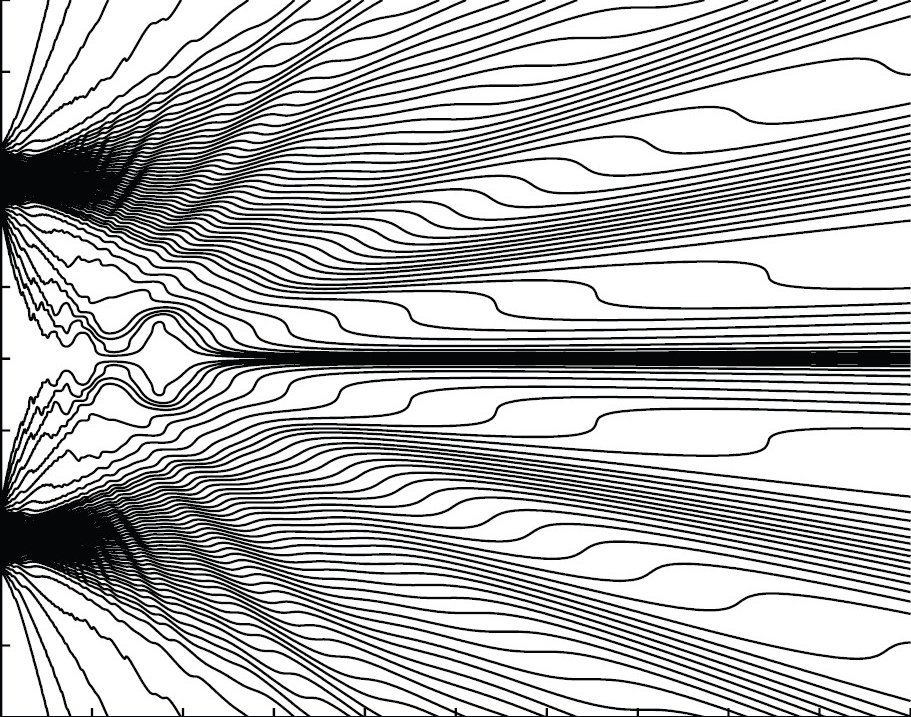
In the standard formulation of quantum mechanics, these probabilities are not simply a stand-in for ignorance about which slit the particle really went through. They describe a state in which the alternative paths remain coherent, so the possibilities can reinforce or cancel one another. Not every interpretation reads this the same way: de Broglie–Bohm theory, for instance, does assign the particle a definite, if nonlocal, trajectory. What every interpretation has to reproduce, regardless, is the interference pattern itself.
The careful way to say this is not that an electron is a tiny object literally following two visible trajectories. Quantum mechanics assigns amplitudes to alternative paths, and interference depends on the coherence between those alternatives. Obtaining which-path information destroys the coherence between the alternatives, so the interference pattern disappears. That is a physical statement about interactions and information, not about human consciousness forcing nature to choose.
The Wavefunction and Quantum Probability
The wavefunction is the mathematical object quantum mechanics uses to represent a system’s state and calculate the probabilities of possible measurement outcomes. In practical terms, it tells physicists what outcomes are possible and how likely they are when a measurement is made. The quantity usually visualised is probability density, which indicates where a particle is more or less likely to be detected, not a little cloud of matter smeared through space in an ordinary sense.
When a measurement produces a definite outcome, the quantum state is updated accordingly. Different interpretations disagree about what this update means physically: some treat it as a change in knowledge, some as part of a branching universal state, and some propose additional dynamics. What experiments establish securely is the predictive framework, not one single philosophical reading of it. The equation that governs how the wavefunction evolves between measurements is the Schrödinger equation; see The Schrödinger Equation Explained Without Advanced Mathematics for how it works without heavy maths.

A related issue is randomness. Quantum mechanics predicts probabilities rather than exact outcomes for many measurements, but Bell’s theorem does not rule out every conceivable deterministic theory. What Bell experiments rule out are local hidden-variable theories under the assumptions used in Bell’s theorem; deterministic but explicitly nonlocal theories, such as de Broglie–Bohm theory, remain logically possible. For a deeper discussion, read Does Quantum Physics Disprove Determinism? What Quantum Mechanics Actually Tells Us.
Uncertainty and Superposition
Werner Heisenberg showed that quantum states impose limits on how sharply certain pairs of quantities can be defined at the same time. For position and momentum, the standard relation is:
Δx Δp ≥ ħ/2
where Δx is the uncertainty in position, Δp is the uncertainty in momentum, and ħ is the reduced Planck constant, equal to Planck’s constant divided by 2π. This is not simply a statement about poor instruments; it reflects the structure of quantum states themselves.
Superposition follows from the same framework. A quantum system can be in a state that combines several possible outcomes before measurement, and those alternatives can interfere with one another. The common analogy of a coin that is “both heads and tails” is only partly useful, because a quantum superposition is not just an unknown classical state; it can produce measurable interference effects that no ordinary mixture can reproduce.
Quantum Entanglement
Entanglement arises when two or more quantum systems are described by a joint state that cannot be separated into independent states for each part. In such a case, measurements on one system are correlated with measurements on the other in ways that can exceed classical expectations. Bell’s theorem showed that no local hidden-variable theory can reproduce all of those correlations, and subsequent experiments have repeatedly supported the quantum prediction.
This does not mean a usable signal flashes instantaneously from one particle to another. Quantum mechanics predicts that each local measurement outcome is random and cannot be steered to encode a message; the correlation only becomes visible once the two sets of results are later compared through ordinary, no-faster-than-light communication. Whether that randomness is truly fundamental or reflects a deeper deterministic layer is a question interpretations disagree on, not one current experiments have settled. Spin often enters here because many entanglement experiments use particle spin as the measured property; spin is intrinsic angular momentum, not literal rotation of a tiny sphere. For a closer look at how entanglement is created and tested in the lab, see Entangled Particles Explained.

Quantum Tunnelling
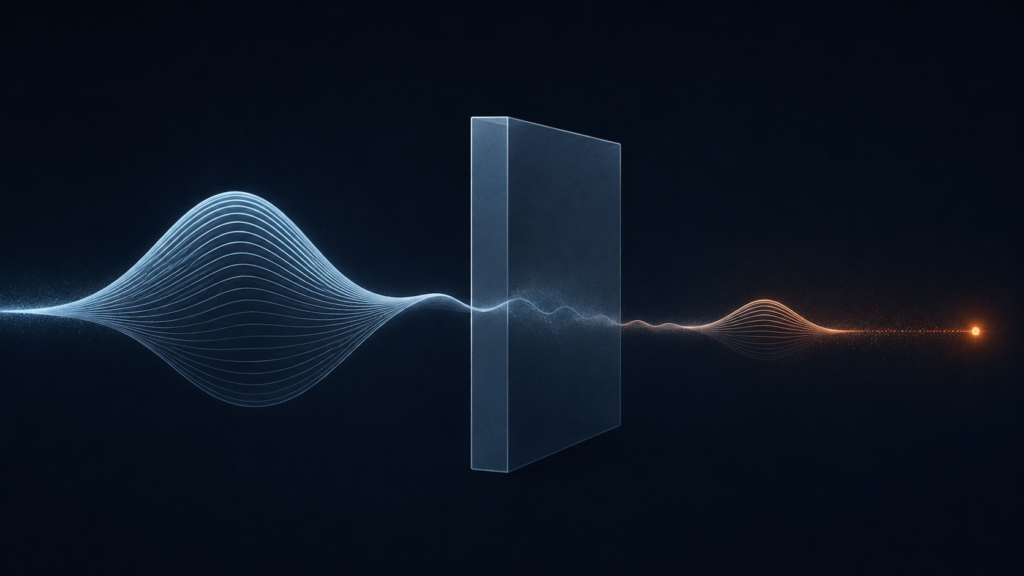
Quantum tunnelling is one of the clearest ways quantum physics departs from classical intuition. In classical mechanics, a particle with less energy than a barrier height cannot cross the barrier. In quantum mechanics, the particle’s wavefunction extends into the classically forbidden region, so there is a nonzero probability that the particle will be detected on the far side.
This is not a matter of borrowing energy or violating energy conservation for a moment. The key point is that the quantum state is not confined in the classical way, and the mathematics yields a finite transmission probability through the barrier. Tunnelling helps explain alpha decay in nuclei and underlies devices such as the scanning tunnelling microscope, which images surfaces by measuring a tunnelling current that changes sharply with tip-to-surface distance.
Atomic Orbitals and Why Atoms Are Stable
Quantum theory also explains why atoms do not collapse. Electrons in atoms do not move in classical planetary orbits around the nucleus. An orbital is a quantum state described by a wavefunction, and the familiar cloud shown in textbooks represents probability density: where an electron is more or less likely to be found if measured. Electrons occupy stationary quantum states, including a lowest-energy ground state, so the classical picture of a charged particle continuously radiating energy and spiralling into the nucleus does not apply.
That picture explains atomic spectra and the architecture of chemistry. The Pauli exclusion principle, which states that no two identical fermions can occupy the same quantum state, determines how electrons fill orbitals and is one reason the periodic table has the structure it does. For a fuller explanation, read Why Don’t Electrons Fall Into the Nucleus?
Decoherence and the Classical World
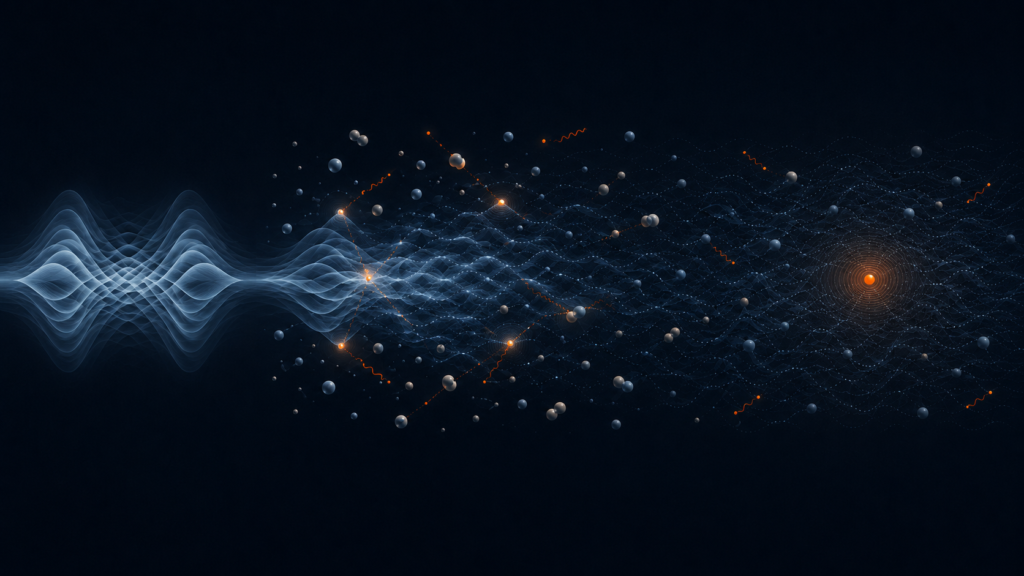
If the microscopic world is governed by superposition and interference, why do tables, raindrops and planets look classical? A large part of the answer is decoherence. When a quantum system interacts with its environment, including air molecules, thermal radiation and nearby matter, the coherence between alternative components of its state is rapidly dispersed into that environment. As a result, interference becomes effectively unobservable for macroscopic objects.
The classical world is not separate from the quantum world. It is what quantum behaviour looks like when coherence is relentlessly diluted by interactions with the environment.
Decoherence is therefore crucial for explaining why classical behaviour emerges so robustly in everyday life. But it does not by itself explain why one unique outcome is experienced in an individual measurement; it suppresses observable interference between alternatives, rather than fully settling the interpretive problem of outcomes. For the full treatment of the process, and the specific interpretive questions it does and does not resolve, see Quantum Decoherence Explained: Why the World Looks Real.
Technologies Built on Quantum Physics
Quantum physics is not confined to laboratories. Semiconductors depend on quantum energy bands in solids and on the behaviour of electrons constrained by the exclusion principle; without that physics, modern electronics would not exist. Lasers rely on quantized atomic transitions and stimulated emission, while MRI depends on the quantum behaviour of nuclear spin in magnetic fields.
Atomic clocks provide another direct example. Their operation depends on precisely measured quantum transitions in atoms, and those clocks are essential to navigation and communications infrastructure. GPS satellites carry atomic clocks whose operation depends on quantum transitions; the navigation system must also correct for both special and general relativistic time dilation. How We Know Einstein Was Right: Five Experiments That Proved General Relativity.
What Quantum Physics Does Not Mean
Popular culture often turns quantum physics into a license for claims about consciousness, mysticism or unlimited mental control over reality. The science does not justify that move. Quantum mechanics says that measurement outcomes are probabilistic and that physical systems can become entangled, but it does not show that human intention can override the theory’s statistical rules or send influence instantly across space.
A careful reading is more interesting than the popular myths. Quantum physics does not imply that “anything can happen,” nor that ordinary causality disappears. It says that nature at small scales is governed by a precise mathematical framework whose predictions are often probabilistic, and whose classical limit appears when quantum coherence becomes negligible. Classical physics remains extraordinarily accurate in the domain for which it was built.
Quantum theory does not invite magical thinking. It asks for stricter thinking: fewer intuitive pictures, clearer definitions, and closer attention to what experiments actually show.
Key Takeaways
- Quantum physics was developed because classical physics could not explain blackbody radiation, the photoelectric effect and atomic stability.
- Planck’s relation E = hf introduced quantized energy and opened the path to modern quantum theory.
- The wavefunction represents a quantum state and is used to calculate measurement probabilities; interpretations differ on what it means physically.
- Entanglement produces correlations stronger than classical local theories allow, but it cannot send usable information faster than light.
- Modern electronics, lasers, MRI and atomic clocks all depend on quantum principles, even while classical physics remains an excellent large-scale approximation.
FAQs
What is quantum physics in simple terms?
Quantum physics is the theory that describes how matter and light behave at very small scales, such as atoms, electrons and photons. Instead of always predicting exact classical paths, it often predicts probabilities, discrete energy levels and wave-like interference patterns that become important when systems are microscopic.
What does the word “quantum” mean?
In physics, a quantum is a discrete packet or unit associated with a quantized physical quantity. For example, a photon is one quantum of electromagnetic radiation, with energy E = hf. The word comes from the Latin for “how much,” and the concept became central to physics after Max Planck showed that energy exchange in microscopic processes occurs in discrete amounts.
Is quantum physics the same as quantum mechanics?
In everyday use, yes, the two terms are treated as interchangeable. More precisely, “quantum physics” is the broader umbrella covering the whole subject, its history, experiments and applications, while “quantum mechanics” refers specifically to the mathematical framework, the equations and rules that generate the theory’s predictions.
How is quantum physics different from classical physics?
Classical physics treats quantities such as energy and position in a continuous, intuitive way and works extremely well for everyday objects. Quantum physics becomes necessary when that picture fails at atomic scales, where energy is quantized, particles can show interference, and measurements are described by probabilities rather than definite trajectories.
Does quantum physics mean everything is random?
Not in the loose everyday sense. Quantum mechanics gives exact rules for how probabilities evolve, so it is highly precise even when individual outcomes are not fixed in advance. Bell experiments also do not prove that every deterministic theory is impossible; they rule out local hidden-variable theories of a certain kind.
Can quantum entanglement send information faster than light?
No. Entanglement creates correlations between distant measurements, but each local result remains random on its own. To compare the results and reveal the correlation, observers must still exchange ordinary information through conventional channels, which cannot outrun light.
Why do we not see quantum effects in everyday life?
Everyday objects constantly interact with their environments. Those interactions cause decoherence, which suppresses the interference effects that make quantum behaviour obvious in microscopic systems. The result is that classical descriptions become extremely accurate for large, warm and complex systems such as ordinary objects.
What technologies use quantum physics?
Many core technologies rely directly on quantum ideas. Transistors and semiconductors depend on quantum states in solids, lasers use quantized atomic transitions, MRI uses nuclear spin, and atomic clocks depend on precise quantum transitions. GPS also relies on those atomic clocks, while requiring additional relativistic corrections to keep time accurately.
References
- Nobel Prize. “Max Planck – Facts.”
- Nobel Prize. “Max Planck – Nobel Lecture.”
- Nobel Prize. “Nobel Prize in Physics 1921.”
- Nobel Prize. “Albert Einstein – Facts.”
- MIT. “Double Slit Experiment.”
- American Physical Society. “1927: Heisenberg’s Uncertainty Principle.”
- Reviews of Modern Physics. “Hidden Variables and the Two Theorems of John Bell.”
- Maximilian Schlosshauer. “Decoherence, the Measurement Problem, and Interpretations of Quantum Mechanics.”
- NIST. “Scanning Tunneling Microscope Introduction.”
- Chemistry LibreTexts. “Atomic Orbitals and Their Energies.”
- Encyclopaedia Britannica. “Pauli Exclusion Principle.”
- NIST. “Putting Einstein to the Test.”

Join the discussion
Comments are moderated and may take a little while to appear.